

Musical Fidelity B1Xi
Specifications and features


Overview
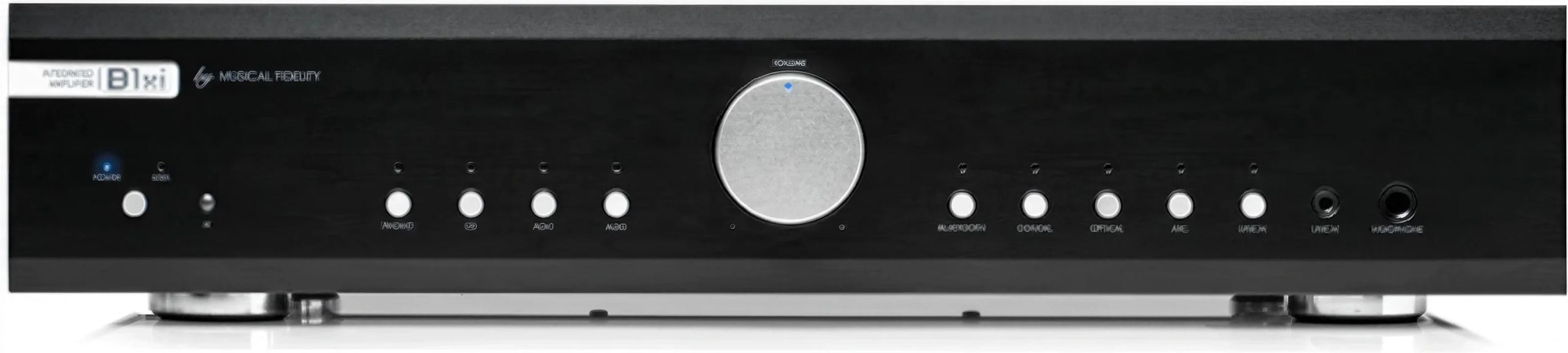
In the early 1990s, the B1 made Musical Fidelity amplification accessible on a reasonable budget. The B1xi adopts its name and its principle: a Class A/B transistor amplifier in an all-metal enclosure. It adds what a modern setup needs, with a phono preamp, a DAC for digital sources, an HDMI ARC port for the TV and Bluetooth. It has neither a display nor Wi-Fi, however.
Class A/B at ease with 4-ohm speakers
The power stage operates in Class A/B, with a fully discrete circuit: each transistor, resistor and capacitor is a separate component, rather than a function integrated into a chip. Class A/B is a long-established, proven compromise between Class A, which is highly linear but power-hungry, and Class B, which is more efficient but prone to distortion when switching from one half-cycle to the other.
Musical Fidelity specifies 2 × 60 W into 8 ohms and 2 × 100 W into 4 ohms at 1% distortion, with peaks of 140 W into 2 ohms. A second, more demanding measurement gives 2 × 50 W into 8 ohms and 2 × 80 W into 4 ohms across the entire audible range with 0.09% distortion. This is the figure to bear in mind for high-volume listening. When the impedance is halved, the power almost doubles, indicating a power supply that can keep up when the speakers demand current. The toroidal transformer is generously sized and the output stage delivers 8 A peak-to-peak. However, a single pair of output transistors per channel limits use into 2 ohms to signal peaks. The damping factor, which measures the amplifier’s ability to control the movement of bass drivers, is 30.
Three separate power supplies and volume control that remains analog
The preamplifier, amplification and digital section each have their own power supply. The DAC and HDMI ARC input are mounted on separate boards, away from the analog stages and powered by their own linear circuits. Shielding against radio interference completes the arrangement, along with a mains filter and a separate standby power supply. Musical Fidelity spent a year on the circuit layout and shielding. The brand also chose components with assured long-term availability, which matters when a repair becomes necessary.
Volume is adjusted using a motorized analog potentiometer. When using the remote control, the knob physically turns on the front panel, and the signal from an analog source is never converted to digital for attenuation. On the line inputs, total harmonic distortion plus noise remains below 0.02%. The signal-to-noise ratio reaches 100 dB and the frequency response extends from 10 Hz to 30 kHz.
Turntable, TV and smartphone on the same amplifier
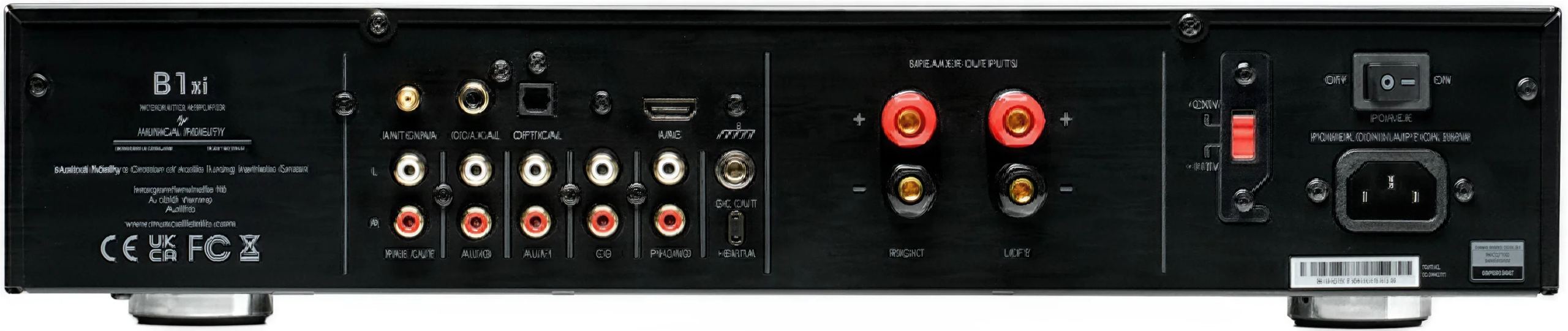
The phono input accepts moving magnet (MM) cartridges. Its gain of 42 dB for a sensitivity of 5 mV, with a load of 47 kΩ and less than 100 pF, matches the standard values for these cartridges. The signal-to-noise ratio is 70 dB and RIAA accuracy is within ± 1 dB. Three RCA line inputs remain available for a CD player, a tuner or a network player.
The optical and coaxial inputs use an ESS9018 DAC that supports up to 24-bit / 192 kHz. They are suitable for a CD player used as a transport, a console or a set-top box. The HDMI ARC port receives sound from the TV through a single cable. Bluetooth 5.1 lets you stream music from a phone or tablet without an additional box.
Outputs for a subwoofer, a second amplifier or headphones
A variable-level RCA preamp output feeds an active subwoofer or a power amplifier for bi-amping. A USB-C port provides an isolated 5 V supply to an external network player. The B1xi has no built-in streaming, but a small player powered by this port and connected to a digital or line input fills this gap without an additional power adapter. On the front panel, a 6.35 mm jack accommodates headphones. Speakers connect to a pair of binding posts that accept 4 mm banana plugs.
An all-metal enclosure standing 9 cm tall
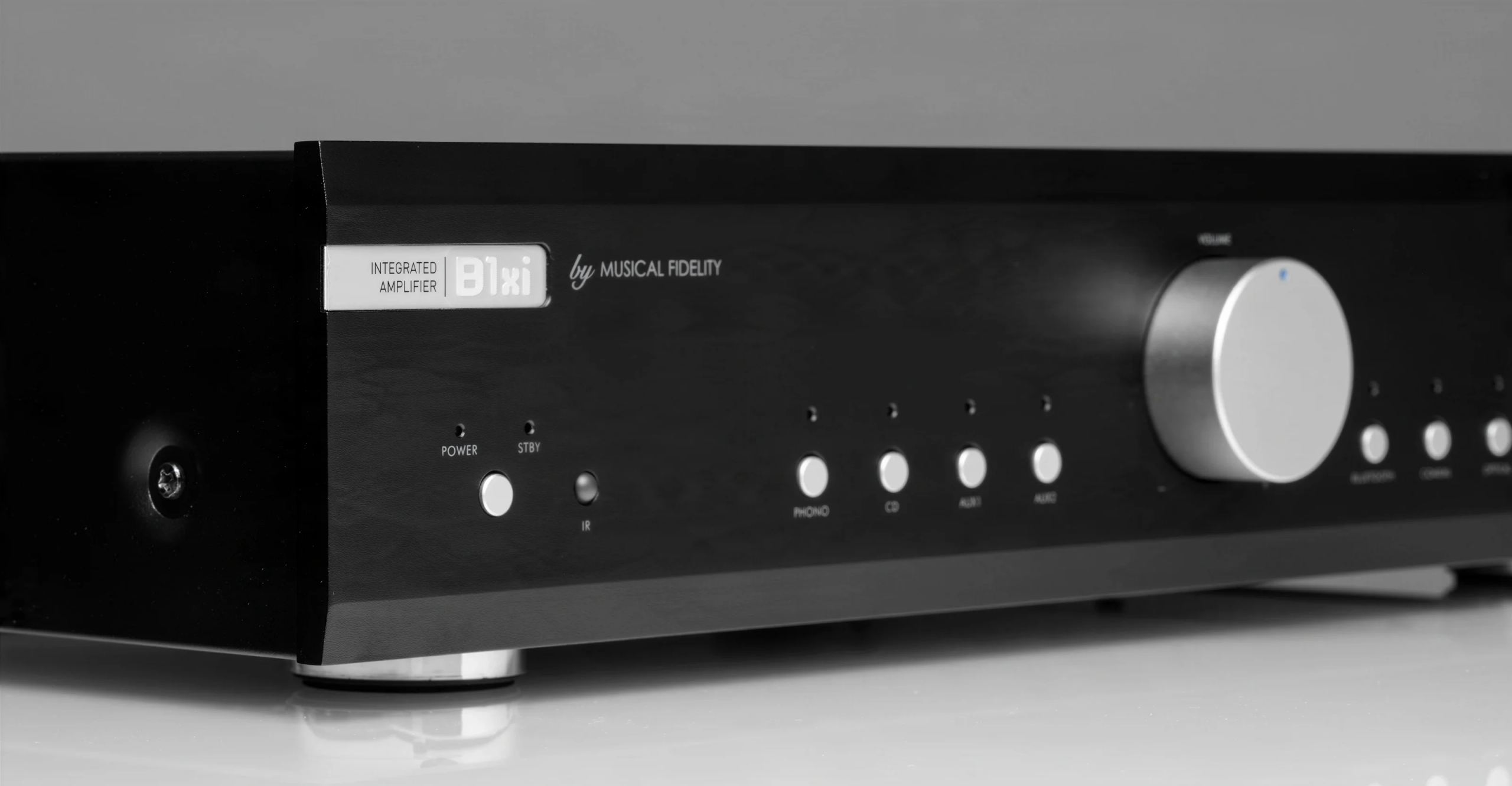
The chassis is entirely metal. The front panel is machined from an extruded aluminum profile and the knobs are solid metal. The unit measures 43 cm wide, 9 cm high including feet and 32.4 cm deep including binding posts. It weighs 7.2 kg, a substantial part of which is accounted for by the transformer. It is available in a black finish.
The absence of a display, app and Wi-Fi is a deliberate choice by the brand. The digital electronics are limited to fixed connections that do not depend on software updates to keep working. If you want to control your music from an app, you need to add a network player, which can be powered by the USB-C port.
Technical specifications
Amplification
- Type: stereo integrated amplifier
- Amplification class: class A/B, fully discrete circuit
- Output power (2 channels driven, at 1% THD)
- 2 × 60 W into 8 Ω
- 2 × 100 W into 4 Ω
- 140 W peak into 2 Ω
- Output power (2 channels driven, at 0.09% THD, from 20 Hz to 20 kHz)
- 2 × 50 W into 8 Ω
- 2 × 80 W into 4 Ω
- Output voltage: 21 V RMS
- Current: 8 A peak-to-peak
- Damping factor: 30
- Output devices: 1 pair per channel
Preamplification and features
- Low-noise preamplifier with dedicated power supply
- Motorized analog volume control
- Separate digital and HDMI ARC boards
Audio inputs
- 3 × stereo RCA (line level)
- 1 × stereo RCA MM phono
- 1 × optical input
- 1 × coaxial input
- 1 × HDMI ARC
Audio outputs
- 1 × stereo RCA preamp output (variable), for an active subwoofer or bi-amping
- 1 × 6.35 mm headphone jack output
- 1 × speaker output (4 mm terminals)
Phono section
- Sensitivity: 5 mV
- Signal-to-noise ratio: 70 dB (A-weighted)
- Input impedance: 47 kΩ
- Input capacitance: less than 100 pF
- Gain: 42 dB
- Frequency response: RIAA / IEC ± 1 dB (20 Hz – 20 kHz)
Line section
- Total harmonic distortion + noise (THD+N): less than 0.02% (typical, 20 Hz – 20 kHz)
- Signal-to-noise ratio: 100 dB (A-weighted)
- Input impedance: 47 kΩ
- Frequency response: 10 Hz – 30 kHz (+0 / -3 dB)
Digital audio
- Digital-to-analog converter (DAC): ESS9018
- Maximum resolution: 24 bits / 192 kHz (stereo PCM)
- USB-C output: 5 V to power an external network player
Wireless connectivity
- Bluetooth: 5.1
- Wi-Fi: no
Power supply
- Mains voltage: 115/230 V AC, 50/60 Hz (factory preset), 100 V AC available as an option
- Maximum power consumption: 280 W
- Transformer: toroidal
- Independent power supplies for the preamplifier, amplifier and digital sections
Construction
- All-metal construction with aluminum front panel
Dimensions and weight
- Width: 43 cm
- Height: 9 cm (including feet)
- Depth: 32.4 cm (including terminals)
- Net weight: 7.2 kg
- Packed weight: 8.9 kg
Frequently asked questions
Can a moving coil (MC) cartridge be connected to the phono input?
Not directly. The phono input is configured for moving magnet cartridges, and its 42 dB gain is insufficient for the much lower voltage of an MC cartridge. You will therefore need a step-up transformer placed before the phono input, or an external MC-compatible phono preamp connected to one of the three line inputs.
How do I set up the TV to output sound via HDMI ARC?
Connect the HDMI cable to the TV’s socket marked ARC, then set the TV’s audio output to stereo PCM. The B1xi’s converter processes a stereo PCM signal, not a Dolby or DTS multichannel stream. If the TV doesn’t have an ARC socket, connecting its optical output to the amplifier’s optical input gives the same result.
What happens to the speakers when you add a subwoofer?
The B1xi has no filter to separate out the bass. The main speakers therefore continue to receive the full frequency range, and the subwoofer’s filter sets the frequency at which it takes over. Since the preamp output tracks the volume, the subwoofer’s level rises and falls with the speakers: a single balance adjustment during setup is all that’s needed.
How do you bi-amp with the B1xi?
It requires speakers with dual binding posts, with the jumpers removed. The B1xi drives one pair of binding posts, for example the midrange and treble, and its preamp output feeds a power amplifier that drives the bass. The gain of the two devices must be similar so that the tonal balance does not change. Choosing a power amplifier with adjustable gain, or the same type of circuitry, simplifies the process.
Can the B1xi receive high-resolution music?
Yes, via the coaxial and optical inputs up to 24-bit / 192 kHz, in PCM. Bluetooth remains a compressed connection, convenient for listening from a phone. For online music at CD quality or higher, a network player connected digitally delivers better results.
Is there a matching CD player?
Yes, the B1xcd is part of the same B range. It has the same width and front panel styling, allowing them to be stacked or placed side by side in a standard 43 cm hi-fi cabinet.
How much power does the amp consume and what voltage does it operate at?
Maximum power consumption is 280 W. The units are factory-set to the voltage of the destination country, 230 V in France. A 100 V version is available as an option for other markets. Like any Class A/B amplifier, it heats up during listening: leave a few centimetres of air space above the cover.
- Eco-contribution of €2.58 included in the sale price.
- GTIN / EAN: 9120129867863