

MartinLogan Expression ESL 13A (pack of 2)

Hybrid electrostatic floorstanding speaker
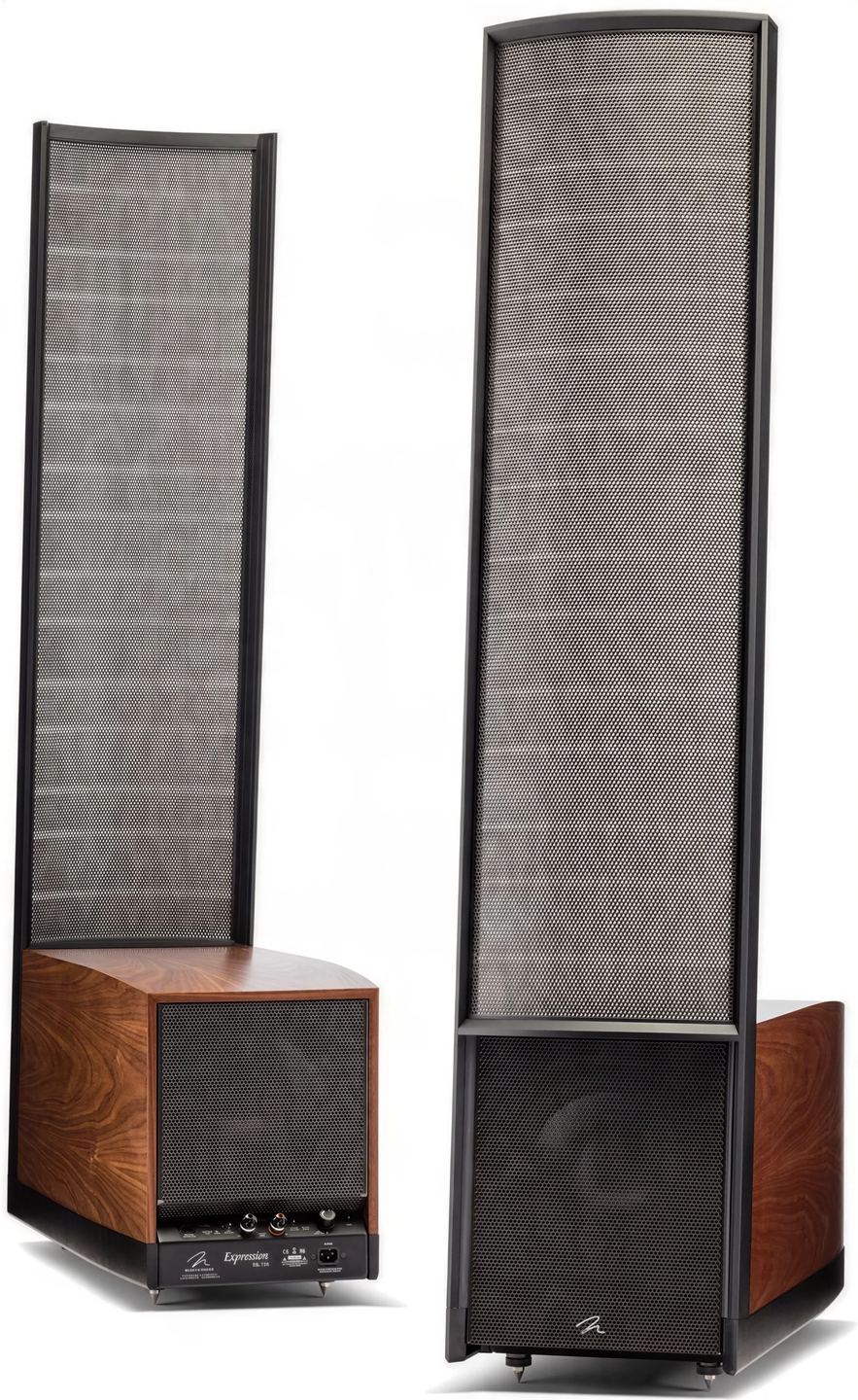
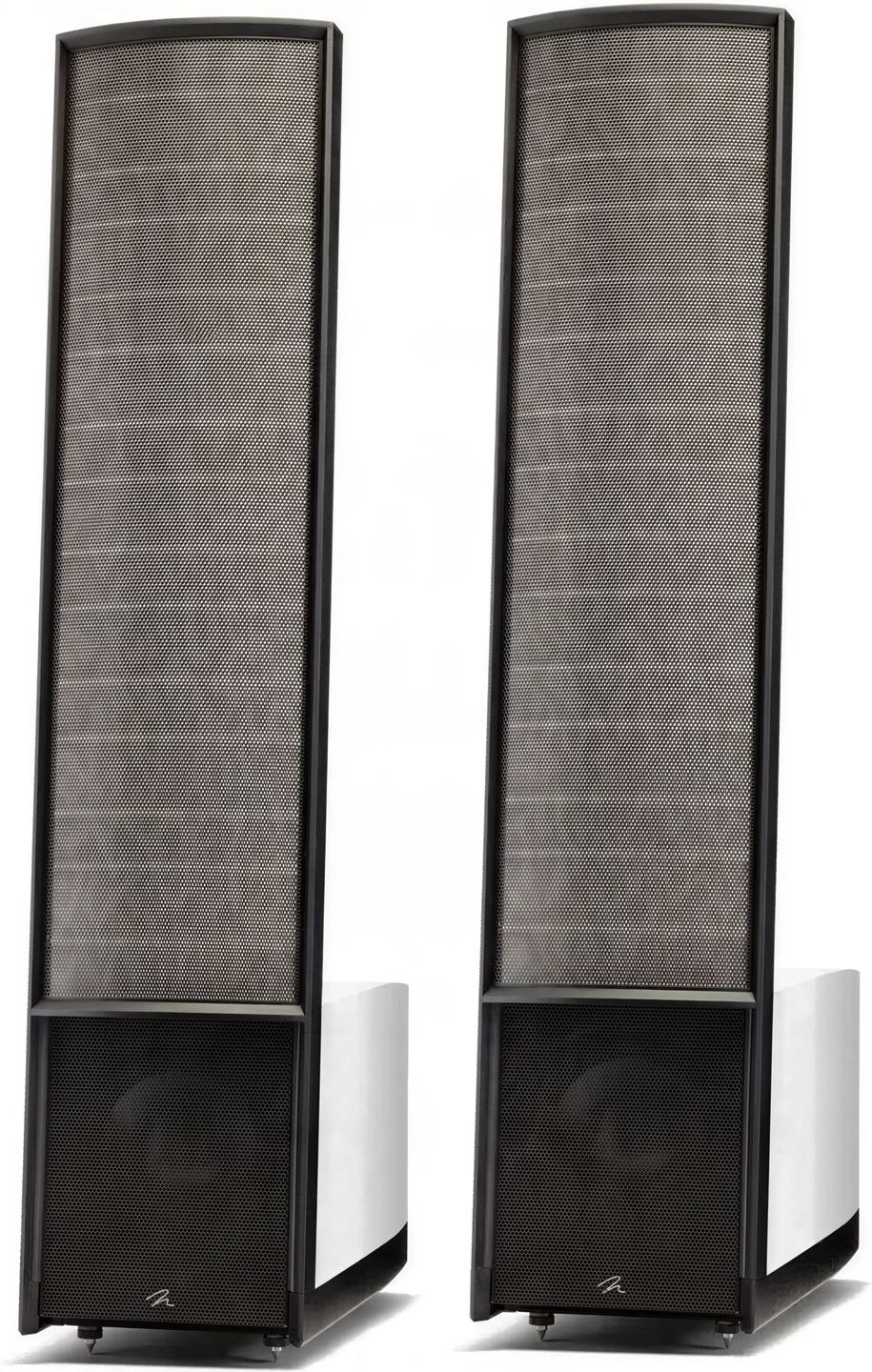
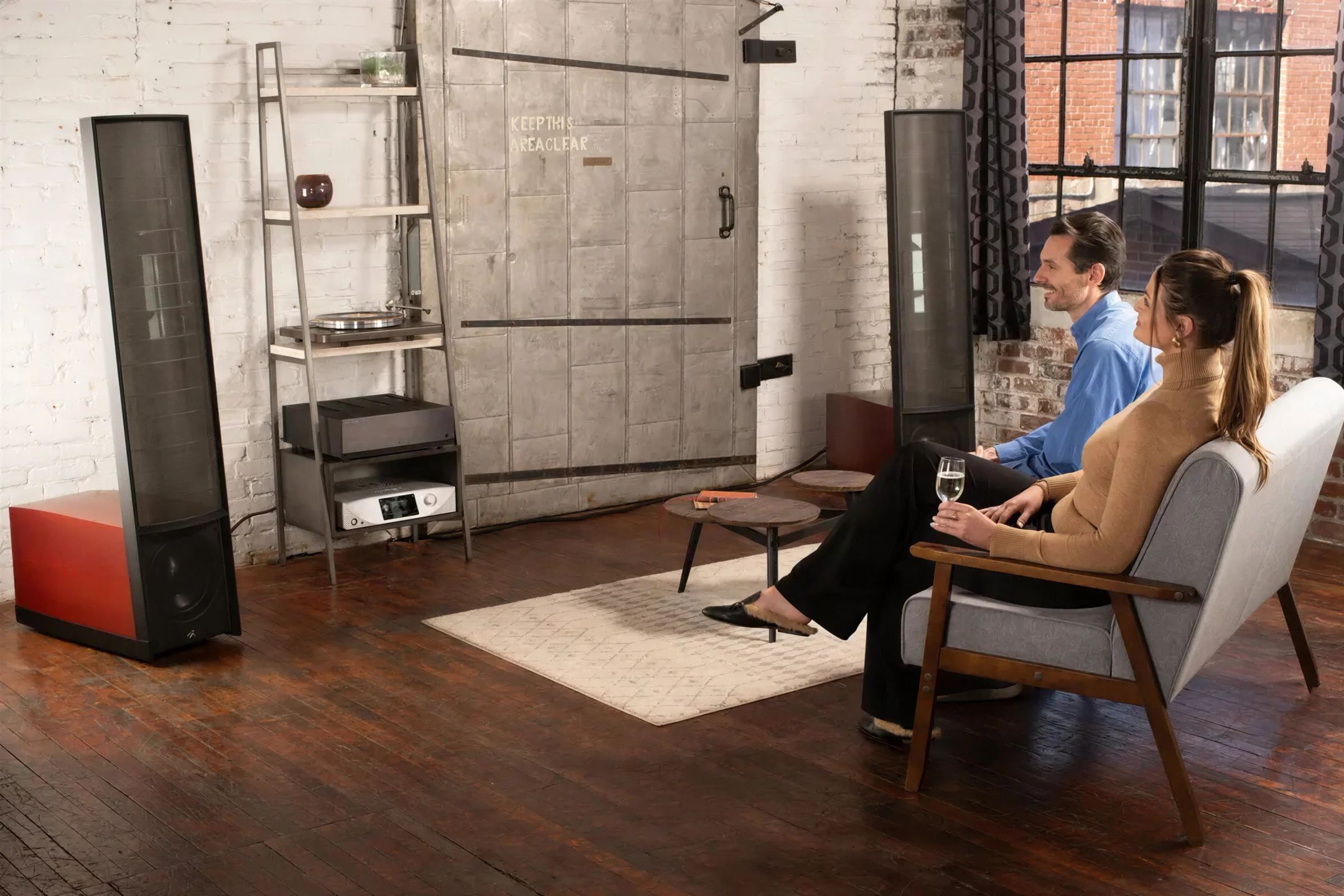
Above 300 Hz, everything goes through a 112 cm-tall electrostatic panel. Below that, two 25 cm drivers take over with their own amplifiers. MartinLogan combines these two technologies in a 156 cm floorstanding speaker. The bass has its own electronics and can benefit from room correction, addressing the perennial challenge of electrostatics: matching an almost massless diaphragm with bass that holds up in a real room.
A 112 × 33 cm electrostatic panel
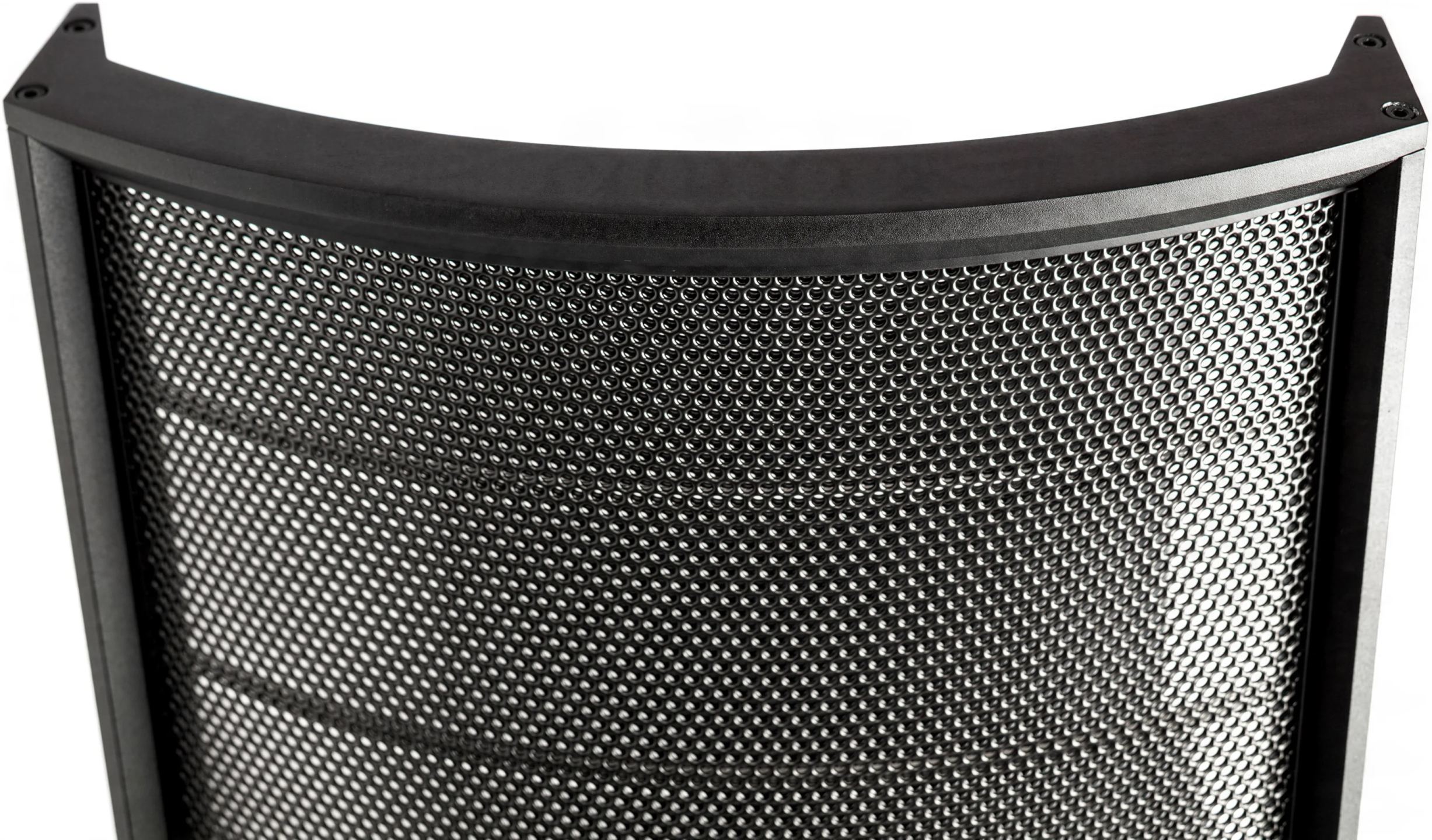
In an electrostatic speaker, a very thin diaphragm is stretched between two metal grilles, the stators, which carry a high voltage. The audio signal varies the electric field, and the diaphragm moves across its entire surface rather than being pushed at a single point like the cone of a conventional driver. On the Expression ESL 13A’s XStat CLS panel, this radiating area reaches 3,696 cm².
The horizontal curve is formed at the factory. A flat panel would send the treble out in a very narrow beam. This slightly curved panel spreads it over 30°, enough to cover two or three seats on a sofa without losing the stereo image. The MicroPerf stators have finer perforations than conventional stators, and MartinLogan claims almost twice as much exposed diaphragm area for a panel of the same size. ClearSpar spacers reinforce the assembly and maintain diaphragm tension. The panel is open, so you can see the wall through it.
Vertically, the panel radiates as a 112 cm line source: the treble does not come from a single point, and less of it reflects off the floor and ceiling than with a dome tweeter. The panel radiates forwards and backwards, but very little to the sides. The side walls therefore receive less sound. However, the rear wave means leaving at least 76 cm between the panel and the wall behind it.
The panel is attached to the bass cabinet by the AirFrame Blade, an extruded aluminium alloy rail. Viewed from the front, the rail is thin and does not obscure the radiating surface. Viewed from the side, it is wide and rigid. It isolates the panel from the cabinet both electrically and mechanically, so vibrations from the bass drivers do not reach the diaphragm.
Two bass drivers with their own amplification
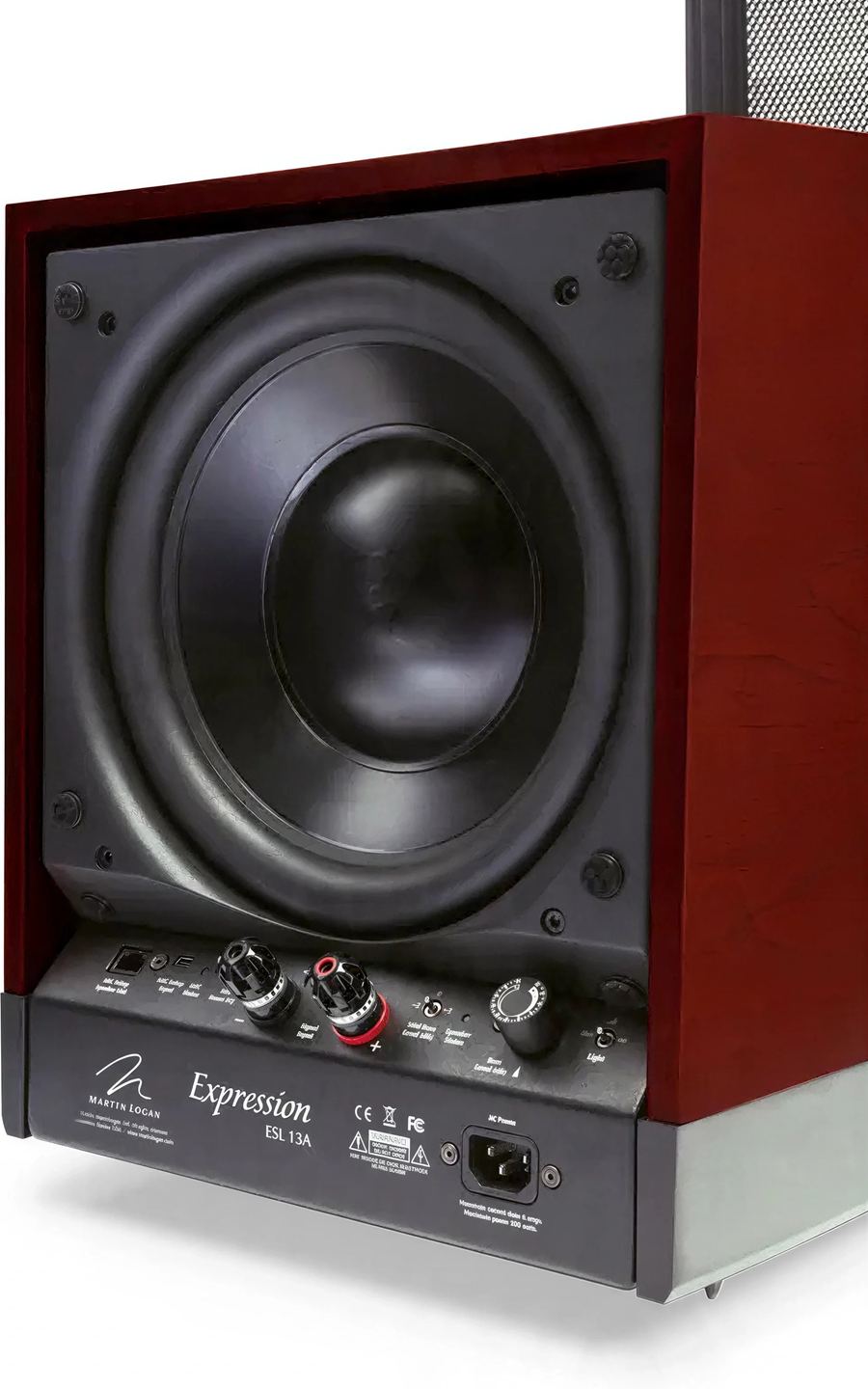
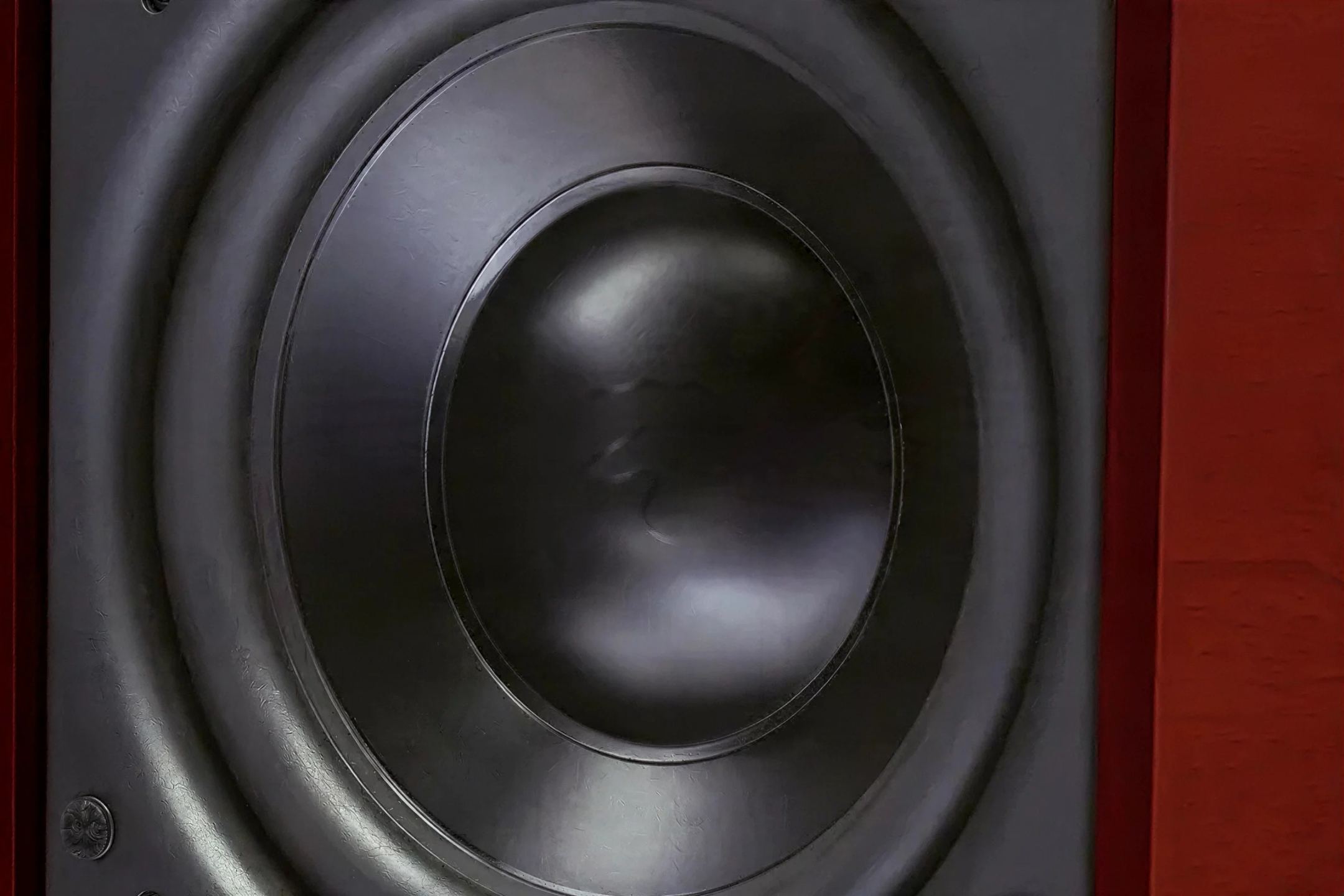
The two 25.4 cm drivers have a rigid aluminium cone, a cast-iron basket and a long-excursion motor. Each has its own sealed chamber, with an asymmetrical shape to prevent internal resonances. One faces forwards, the other backwards. This is the principle MartinLogan calls PoweredForce Forward: the crossover adjusts the time offset between the two drivers to reduce bass reflections from the wall behind the speaker. These reflections are what cause dips in the bass response at the listening position.
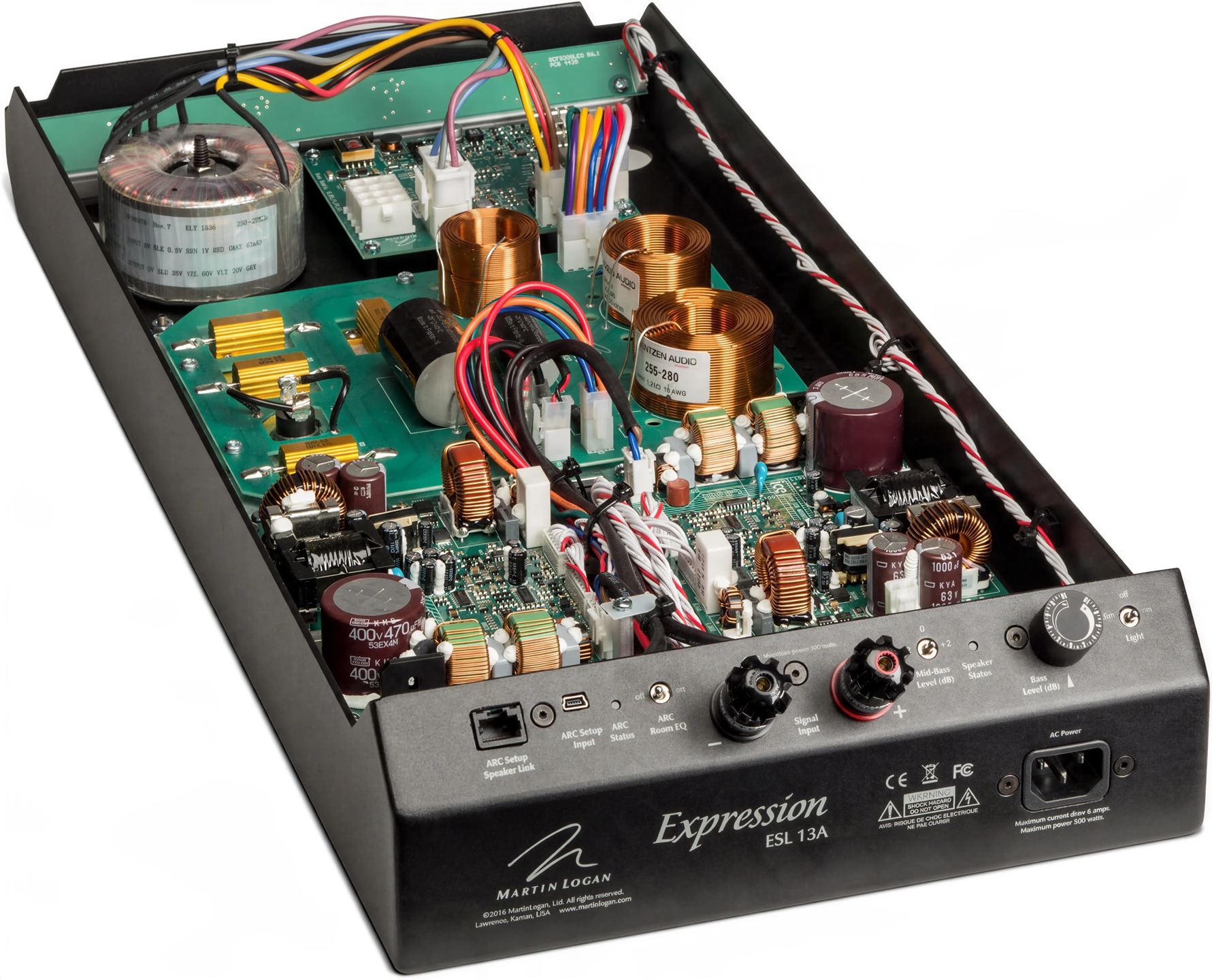
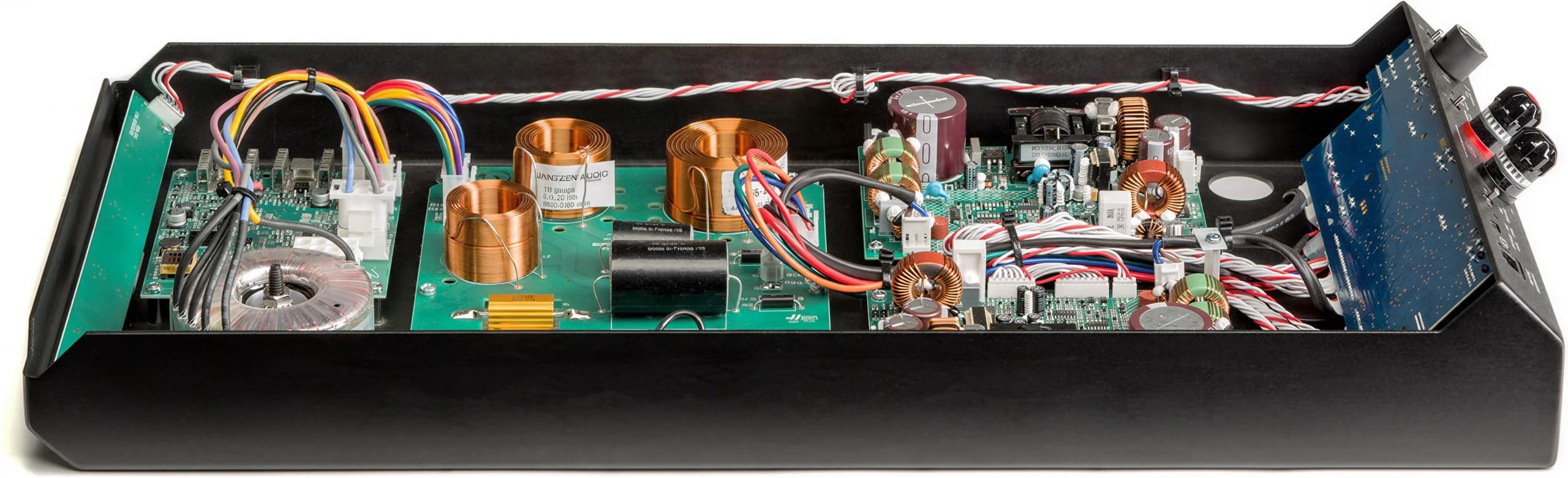
Each driver receives 300 W of Class D power into 4 Ω, with peaks of 600 W. A 24-bit digital signal processor (DSP) handles low-pass filtering, equalisation and limiting for this section. The response extends down to 24 Hz at ±3 dB, and up to 23 kHz at the top of the spectrum. The external amplifier does not supply the bass power: the built-in modules handle that, leaving the amplifier free from having to drive two 25 cm cones.
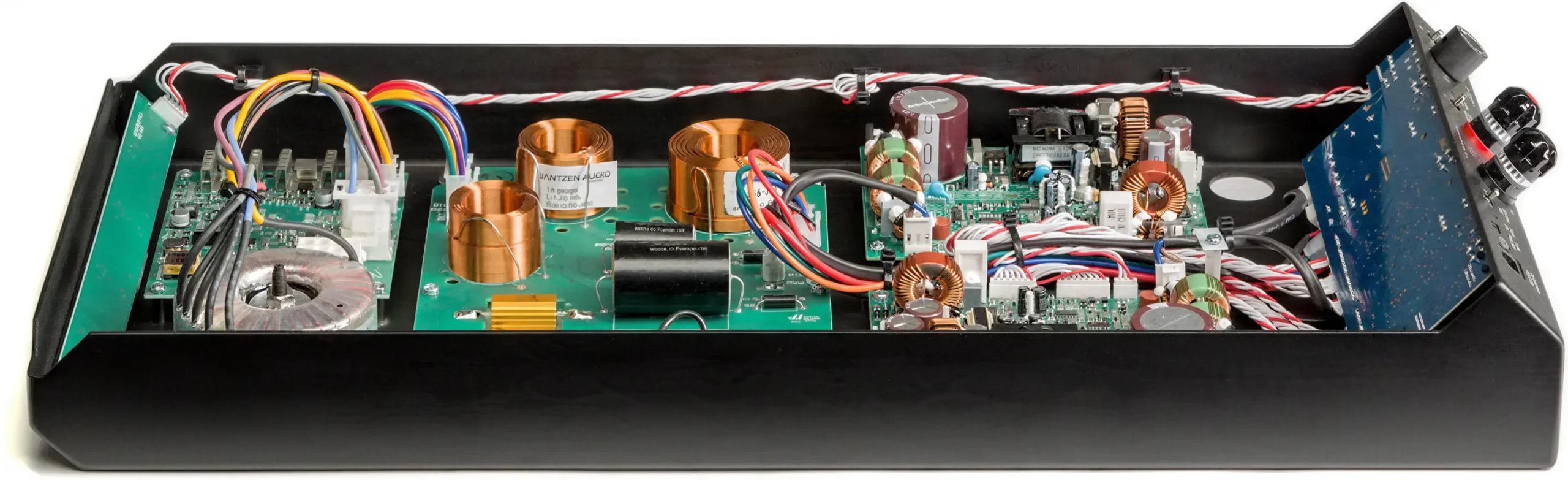
The 300 Hz crossover and amplifier choice
The passive crossover feeding the panel follows MartinLogan’s proprietary Vojtko topology. It is hand-assembled with air-core inductors, polypropylene capacitors and a custom-wound audio transformer. This transformer steps up the signal voltage to the level required by the electrostatic panel.
Sensitivity is 91 dB at 2.83 V at 1 m, and MartinLogan recommends 20 to 600 W per channel. The figure that really matters is impedance: nominally 4 Ω, but 0.7 Ω at 20 kHz. To the amplifier, an electrostatic panel behaves almost like a capacitor, and its impedance falls as frequency rises. The amplifier must therefore supply current in the treble and remain stable into a very low load, regardless of its rated power. The brand states compatibility with 4, 6 and 8 Ω outputs.
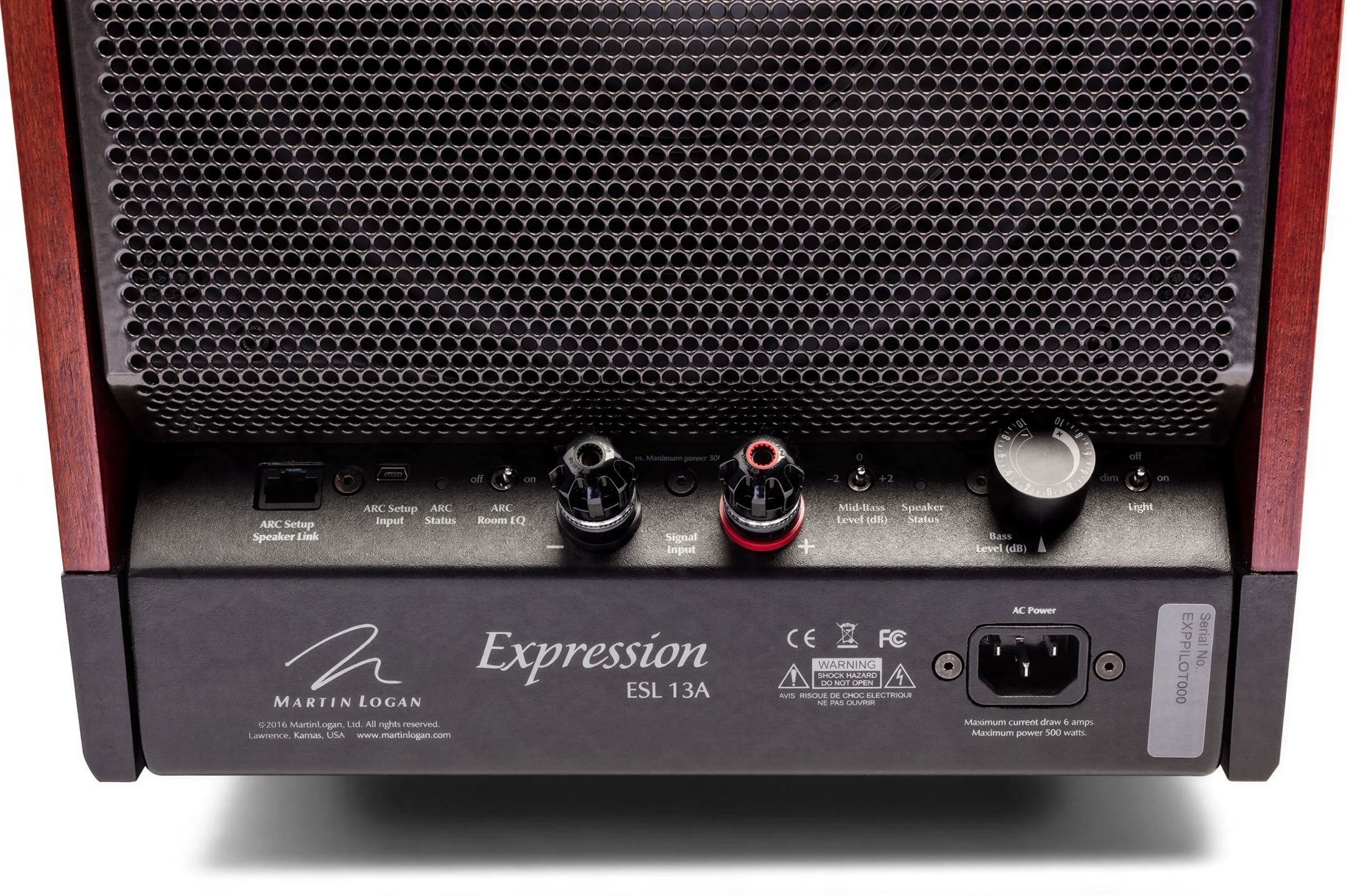
Connection is via a single pair of WBT-0703Cu nextgen binding posts. Their conductor is made of gold-plated pure copper, is nickel-free and non-magnetic, so there are no eddy currents to interfere with the signal. The binding posts are fully insulated.
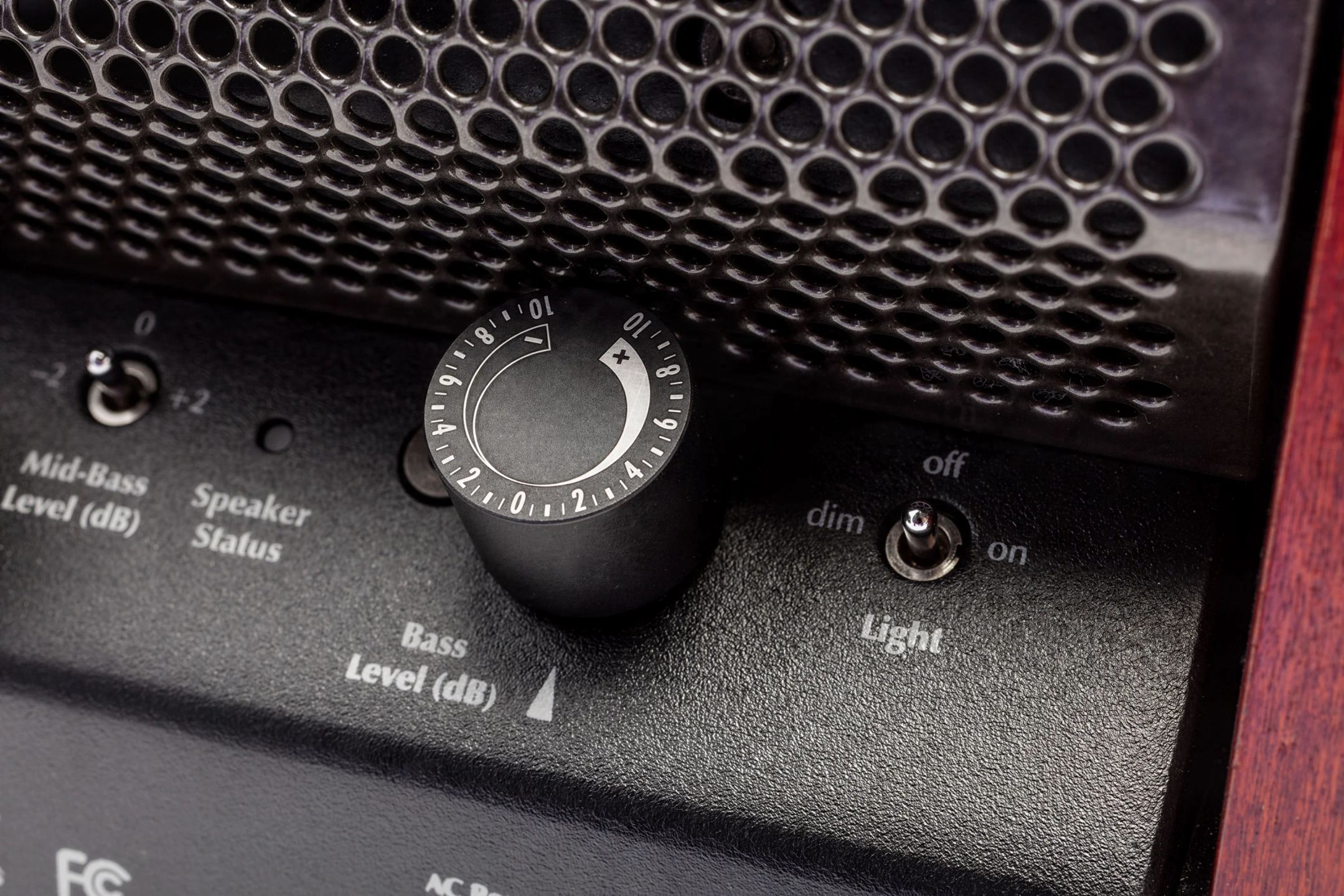
Adjusting the bass to suit the room
There are three controls on the speaker. The first adjusts the bass by ±10 dB below 75 Hz. The second adjusts the lower midrange across three settings (−2, 0 or +2 dB), to tame a living room that booms around 200 Hz or, conversely, add body in a heavily damped room. The third switches ARC correction on or off.
ARC (Anthem Room Correction) comes from Anthem, MartinLogan’s sister brand. The system measures the bass actually produced at the listening position, then corrects the bass section to bring it into line with a target curve matched to the panel’s level. The panel is not altered. The speaker has an RJ45 socket and a mini USB port for this operation, but the measurement microphone is sold separately.
When positioning the floorstanding speaker, MartinLogan recommends leaving at least 25 cm between the rear of the cabinet and the wall, equivalent to the diameter of a bass driver. The panel requires 76 cm. At 69.9 cm deep, the speaker takes up considerably more floor space than a conventional floorstanding speaker.
Dimensions, weight and finishes
The Expression ESL 13A measures 156.1 cm high, 33.9 cm wide and 69.9 cm deep, and weighs 46.8 kg. It needs a mains socket for its amplification. LED lighting has three settings: on, dimmed or off. The cabinet is available in gloss black, gloss white, walnut and dark cherry. The premium finish range adds Arctic Silver, Desert Silver, Meteor Grey, Rosso Fuoco, Cordoba Red, Deep Sea Blue and Basalt Black lacquers.
Technical specifications
Acoustic performance
- Frequency response: 24–23000 Hz ± 3 dB
- Horizontal dispersion: 30°
- Vertical dispersion: 112 cm line source
- Sensitivity: 91 dB / 2.83 V / m
- Impedance: 4 Ω, 0.7 at 20 kHz
- Compatible with 4, 6 or 8 Ω amplifiers
- Crossover frequency: 300 Hz
Transducers
- High-frequency transducer: XStat CLS electrostatic transducer
- Panel dimensions: 112 × 33 cm
- Radiating area: 3696 cm²
- Low-frequency transducer: two 25.4 cm drivers
- Cast-iron basket
- Long excursion
- Rigid aluminum cone
- Extended-excursion motor
- Asymmetrical, resonance-free enclosure loading
Amplification and electronics
- Recommended amplifier power: 20 to 600 W per channel
- Built-in woofer amplifier: 2 × 300 W / channel (4 Ω), 2 × 600 W peak
- Components
- Passive crossover: custom-wound audio transformer, air-core inductors, polypropylene capacitors
- 24-bit DSP preamplifier (paired with the woofer amplifier)
- Power consumption
- Idle: < 1 W / channel
- Maximum: 500 W / channel
Adjustments and acoustic correction
- Audio controls
- Bass: ± 10 dB below 75 Hz
- Lower midrange: −2 dB, 0 dB, +2 dB
- ARC Room EQ acoustic correction: on / off
- Lighting: LED brightness adjustment: on, dimmed, off
- Room acoustic correction (bass section): compatible with Anthem Room Correction (ARC), sold separately
Connectivity
- Signal inputs: WBT-0703Cu nextgen binding posts
- Gold-plated pure copper filigree signal conductor
- Nickel-free, non-ferromagnetic
- High conductivity, fully insulated
- No eddy current effects
- Connectors: AC power, RJ45 (for ARC), mini USB (for ARC)
Dimensions and weight
- Dimensions: 156.1 × 33.9 × 69.9 cm
- Weight: 46.8 kg
Frequently asked questions
How much power does the speaker consume?
At idle, each speaker consumes less than 1 W. At full power, bass amplification can reach 500 W per speaker. A mains socket is therefore required near each floorstanding speaker.
Is the ARC measurement kit included?
No. For correction, you need one of the Anthem kits: ARC Calibration Microphone Kit, Advanced ARC Calibration Kit or PBK (Perfect Bass Kit). ARC Genesis software runs on macOS 10.12 or later and Windows 7 to 11, with an available USB port on the computer.
Can the Expression ESL 13A be bi-wired or bi-amped?
No, the speaker has only one pair of terminals. The separation between the two sections is already handled internally: the panel receives the signal from the external amplifier through the passive crossover, and the bass section has its own amplifiers.
Can a low-power amplifier be sufficient?
The recommended range starts at 20 W, and the sensitivity of 91 dB is high enough for a small amplifier to deliver a normal listening level. The challenge lies in the load: at 0.7 Ω at 20 kHz, the amplifier must supply current in the treble range and remain stable. It is best to choose a model whose manufacturer guarantees operation at very low impedances, whether the amplifier is solid-state or tube-based.
Where does it fit in the Masterpiece series?
The Expression ESL 13A sits between the Impression ESL 11A and the Renaissance ESL 15A. The Impression has a panel of the same height but narrower, and 20 cm woofers. The Renaissance has a 117 cm tall panel and 30 cm woofers. The Classic ESL 9 sits below the Impression.
Should you add a subwoofer?
In stereo, this is not necessary: the response extends down to 24 Hz and the bass can be corrected with ARC. In a home theater setup, the low-frequency effects (LFE) channel is still assigned to a subwoofer by the processor or AV receiver. The floorstanding speakers then handle the front left and right channels across their full bandwidth.hybrid electrostatic floorstanding speaker
Above 300 Hz, everything goes through a 112 cm-tall electrostatic panel. Below that, two 25 cm drivers take over with their own amplifiers. MartinLogan combines these two technologies in a 156 cm floorstanding speaker. The bass has its own electronics and can benefit from room correction, addressing the age-old challenge of electrostatics: matching an almost massless diaphragm with bass that holds up in a real room.
- Eco-contribution included in the sale price.