

Naim Audio HI-Line custom

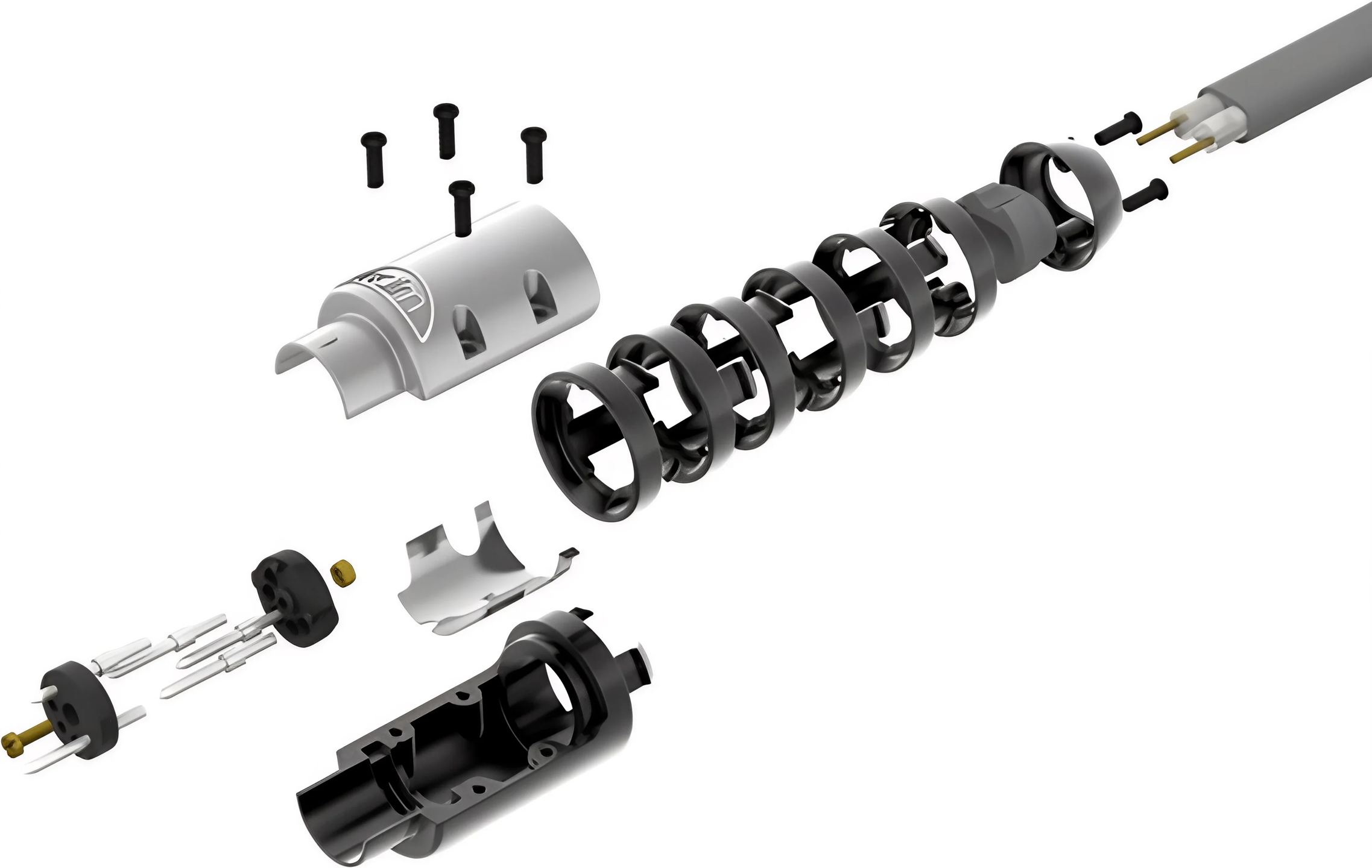

Naim Audio Hi-Line custom DIN interconnect cable
In a Naim system, devices communicate through DIN sockets that carry both stereo channels in a single plug. The Hi-Line was born during the development of the CD555 player, as part of a parallel project: to improve on the supplied cable by reworking the conductor and plug together, rather than the cable alone. This custom version lets you choose the terminations that match your devices.
The Air-PLUG, a DIN plug that filters vibrations
A conventional plug transmits mechanical vibrations through the cable from one device to another: those from an amplifier’s transformer or the mechanism of a CD player. It also transmits vibrations that the cable picks up from the air in the room. The Air-PLUG, patented by Naim, is designed to break this path. Its rear section consists of several segments clipped together, forming a flexible, vibration-damping tail. The cable is secured inside without being fully tightened, which prevents it from being crushed and its impedance from changing. The plug also contains less metal than an ordinary DIN plug, to limit electromagnetic effects and eddy currents, the stray currents that arise in metal parts placed near a conductor.
The Air-PLUG’s pins are mounted “floating”, meaning they have a little play within the plug body. This decouples them from the device, but requires slightly more care when connecting than with a rigid DIN plug.
Teflon-insulated, double-shielded Litz wire
The conductor is exclusive to Naim. Each twisted pair combines 80 very fine strands of Litz wire (40 AWG), individually insulated from one another. This type of wire distributes current evenly throughout the conductor’s cross-section. Each pair is wrapped in PTFE tape (Teflon, a low-loss insulator) and Kapton, a heat-stable polyimide film. The assembly then passes through a semiconductive sheath, which dissipates static electrical charges, followed by two spirally wound copper shields and another layer of PTFE tape.
Two of these assemblies, one per channel, are placed side by side, wrapped in PTFE and then in a black rubber outer sheath. This gives the cable its flattened cross-section, measuring approximately 9.25 × 5.3 mm. According to Naim, this arrangement keeps the signal conductor and ground in a fixed position relative to each other. The electric fields they are exposed to therefore remain identical, regardless of how the cable is bent.
Terminations chosen to suit your devices
The same cable can be fitted with several combinations of plugs. The 5-pin DIN to 5-pin DIN is the most common connection between two Naim components. The 4-pin DIN to 5-pin DIN is used for devices whose socket has only four contacts. The DIN to two RCA, or two RCA to DIN versions connect a Naim device to a source or amplifier equipped with RCA sockets. An RCA to RCA version is also available. The cable is 1.3 m long, a length that covers most stacks on a hi-fi rack or devices placed side by side.
The Hi-Line carries a line-level analog signal. For example, it connects a CD player, streamer or converter to a preamplifier, or a preamplifier to a power amplifier.
Connection direction and placement to observe
The Hi-Line is directional. A light-colored band marks the end to be connected to the source device. On DIN versions, it is located at the junction between the cable and plug. On RCA versions, it is located where the two conductors emerge from the outer sheath.
Naim also stresses the importance of cable routing. It performs best when it forms a free-hanging loop from the source to the destination device, without touching the rack, floor or other cables. You therefore need to allow some space behind the devices, and take this into account with a fixed length of 1.3 m.
Documentation
Technical Specifications
Construction
- Conductors: Litz wire with individual spiral shielding
- Insulation in polytetrafluoroethylene (Teflon)
Physical Specifications
- Length: 1.3 m
- Color: black
Type
- Analog interconnect cable
Frequently asked questions
How do you connect an Air-PLUG that resists insertion?
Never force it. With floating pins, each one must be aligned with its hole before insertion. If the plug does not slide in smoothly, pull it back slightly, adjust its orientation and try again. When handling it, hold it by its metal body and the plastic section opposite, never by the flexible tail, which Naim warns is fragile if gripped incorrectly.
Should the devices be turned off before connecting or disconnecting the cable?
Yes. Naim requires all affected components to be powered off before any connection or disconnection. Inserting a plug while the power is on can cause a pop in the speakers or even damage an input or output stage.
How many cables are needed for a stereo connection?
Just one. Both channels run through the same sheath. In the DIN version, they terminate in a single plug. In the RCA version, the cable splits at the end into two plugs, left and right.
Is the Hi-Line suitable for a coaxial digital connection?
No. A coaxial S/PDIF connection requires a cable with a characteristic impedance of 75 Ω, which the Hi-Line does not claim to have. It is intended exclusively for line-level analog signals.
Can it be used with a device from another brand?
Yes, by choosing an RCA termination at this device’s end. For a DIN-to-DIN connection with a device from another brand, first check its socket pinout: the contact assignments of a DIN socket are not the same across all manufacturers.
How do I know if I need a 4-pin or 5-pin DIN plug?
Count the contacts in the socket on the back of the device, or consult its manual, which specifies the socket type for each input and output. A single connection may require a different plug at each end, hence the DIN 4 to DIN 5 version.
What should I do if the cable needs to run against the furniture?
The Hi-Line still works, but Naim says the clearest improvement comes with a free-hanging loop. Move the units back slightly, or rearrange them so that the cable hangs freely, rather than pressing it against a wall or running it along the floor.
- Eco-contribution included in the sale price.


