Rasmus
Perfect. Good special price and reasonable delivery time.
Comment from 10 February 2026 — Experience from 30 January 2026
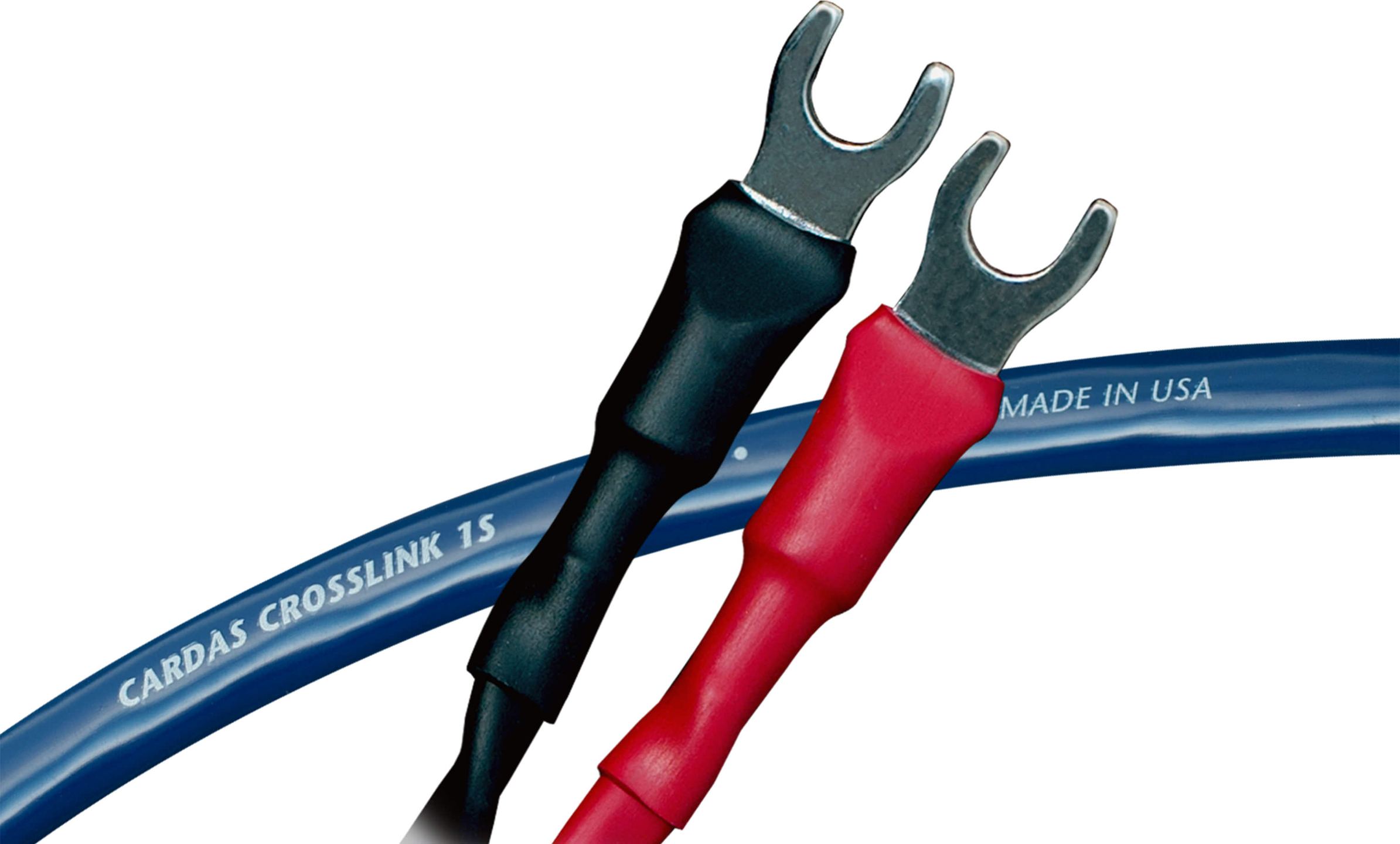
The Crosslink by Cardas Audio is a speaker cable that has been on the market for about 25 years. Designed in the United States, it draws on telecommunications engineering principles and a geometry based on the golden ratio. Intended for entry- to mid-level stereo and home theater systems, it offers straightforward installation and balanced audio reproduction.
The Crosslink Speaker Cable is based on a four-conductor configuration of 14.5 AWG Grade 2 OFHC copper. Each of these conductors comprises 28 strands of pure copper, for a total of 108 strands in the complete cable. This multiplication of fine strands optimizes signal transfer across the entire audio spectrum, from lows to highs.
What sets the Crosslink apart is the application of the golden ratio (1.618…) to the arrangement of its conductors. This mathematical proportion—found in spiral shells and great concert halls—here serves to control the cable’s internal resonances. The finest strands occupy the center, while the cross-sections progressively increase toward the periphery following a precise geometric progression. This layout aims to prevent the different strands from entering common resonance, a phenomenon that can color sound reproduction.
The so-called “Star-Quad” structure organizes the four conductors concentrically. Between them, natural cotton yarns provide mechanical damping with no memory effect. The insulation uses an EEA (ethylene acrylic acid) and cotton dielectric, chosen for its favorable electrical properties. Everything is protected by a supple outer PVC jacket with a 9.27 mm diameter, giving the cable good flexibility despite its generous cross-section.
The Crosslink occupies the second rung of the Cardas hierarchy, just above the 101 Speaker. Above it are the Iridium and Parsec ranges, followed by the Clear cables (Sky, Cygnus, Reflection, Clear, and Clear Beyond). Don’t be misled by its entry-level status: unlike the higher models that employ Cardas ultra-pure Grade 1 copper, the Crosslink uses Grade 2 copper while benefiting from the same golden ratio-based design philosophy.
Cardas entry-level cables are specifically engineered to accommodate the typical shortcomings of the systems they’re intended for. Many multichannel setups or midrange components tend to accentuate high frequencies or exhibit a certain aggressiveness. The Crosslink provides a natural counterbalance to these characteristics. Conversely, Cardas Clear cables reveal, without compromise, the strengths and weaknesses of the high-end systems they’re aimed at.
The presence of four distinct conductors makes the Crosslink particularly adaptable. For a standard connection, the conductor pairs are twisted together, creating a cable equivalent to 10 AWG. For speakers equipped with dual binding posts, the four conductors are split between the bass and treble terminals, enabling bi-wiring without multiplying cable runs.
Bare copper greatly simplifies preparation. No solder bath is required: simply strip the end, twist the strands, and insert them into five-way or spring terminals. This simplicity appeals to both busy professionals and hobbyists who want to finish their own cables. Moreover, Cardas offers the Crosslink in two versions: either factory-terminated with connectors or sold by the meter for custom installations.
CL2 certification authorizes in-wall use without violating building codes. This feature explains why the Crosslink is found in many custom home installations, where cables run discreetly between rooms. It’s also encountered in professional contexts: sound reinforcement systems, concert installations, and even top-tier car audio competitions.
The factory connectors reflect Cardas’s attention to detail. GRS spades and CABE bananas are machined from solid copper, then silver-plated with a final touch of rhodium. This treatment ensures optimal conductivity while preventing oxidation. The hand-executed cold crimping in Bandon preserves the integrity of the copper by avoiding thermal alteration. A supple protective sleeve covers the junction between the cable and the connectors.
Electrical measurements for the Crosslink show a capacitance of 168 pF/m and an inductance of 0.54 µH/m. These moderate values allow the cable to pair well with a wide variety of amplifiers and speakers without risking problematic electrical interactions. The Q factor of 10.6 indicates stable behavior in the face of impedance variations.
The Crosslink’s sonic reproduction is characterized by overall balance with no particular emphasis. The midrange maintains a certain density and natural rendering, especially pleasing on vocals. The highs remain smooth, without the sometimes excessive brightness that certain digital systems or metal-dome tweeters can generate. The bass is full-bodied and well-defined, with the solidity that cables in this category often lack.
This balanced approach makes the Crosslink a savvy choice for calming slightly aggressive or analytical systems. It doesn’t add marked coloration but brings a certain roundness that favors long listening sessions. The soundstage unfolds naturally, with good layering without creating an exaggerated sense of depth. Subtle details emerge without being pushed forward: a double bass pluck reveals both the string’s attack and the resonance of the instrument’s body.
With its total cross-section equivalent to 10 AWG (about 5 mm²), the Crosslink is suitable for most home installations up to around a hundred watts per channel. Beyond that, or for speakers with very low impedance (less than 4 ohms), it’s preferable to consider a cable with a larger cross-section or to double the runs to increase current-carrying capacity.
Cardas’s ultra-pure Grade 1 copper boasts 99.9999% purity versus 99.99% for Grade 2. This difference translates into slightly higher conductivity and an even more homogeneous crystal structure. Cardas produces its own Grade 1 copper using a proprietary process, while Grade 2 comes from specialized high-quality OFHC suppliers.
Like many cables, the Crosslink requires a break-in period during which the dielectrics settle. The first hours of listening may seem slightly dry or lacking cohesion. After a few dozen hours of use, the sound gains in naturalness and fluidity. George Cardas also notes that after moving or reconnecting a cable, you should allow it a few hours to return to its best performance.
Cardas designs its cables to work harmoniously with each other but also with those from other manufacturers. You can absolutely use a Crosslink for the speakers while employing interconnects from another brand or from a higher Cardas range. The key is the system’s overall coherence and the result you hear.
In a bi-amped setup where each speaker section receives its own amplifier, the Crosslink can certainly be used. Its four-conductor structure naturally lends itself to this. To maximize the benefits of bi-amping, you can even consider using two complete Crosslink cables, thereby creating total separation between the bass and treble sections, in the manner of “shotgun” bi-wiring.
Based on reviews from customers who purchased this product, summarised by AI
Rasmus
Perfect. Good special price and reasonable delivery time.
Comment from 10 February 2026 — Experience from 30 January 2026
Sylvain
I am a long-time Cardas devotee for both speaker cables and interconnects. I own several examples in different systems. Although this Crosslink is their entry-level model, it already achieves excellence. The sound is very fleshy and full-bodied with strong presence, perfect linearity, and great dynamics without being forward or aggressive. The expansive soundstage is natural and varies based on upstream components. Perfect results with Klipsch Heresy III and RF 7 MK2 speakers, Rega Saturn and Marantz players, Naim Uniti 2 amplifier and Teac.
Comment from 14 December 2022 — Experience from 3 December 2022
Jean-Pierre
This speaker cable, at a reasonable price, quite significantly improves the listening experience compared to more entry-level cables, providing an interesting level of detail and transparency.
Comment from 7 November 2022 — Experience from 20 October 2022