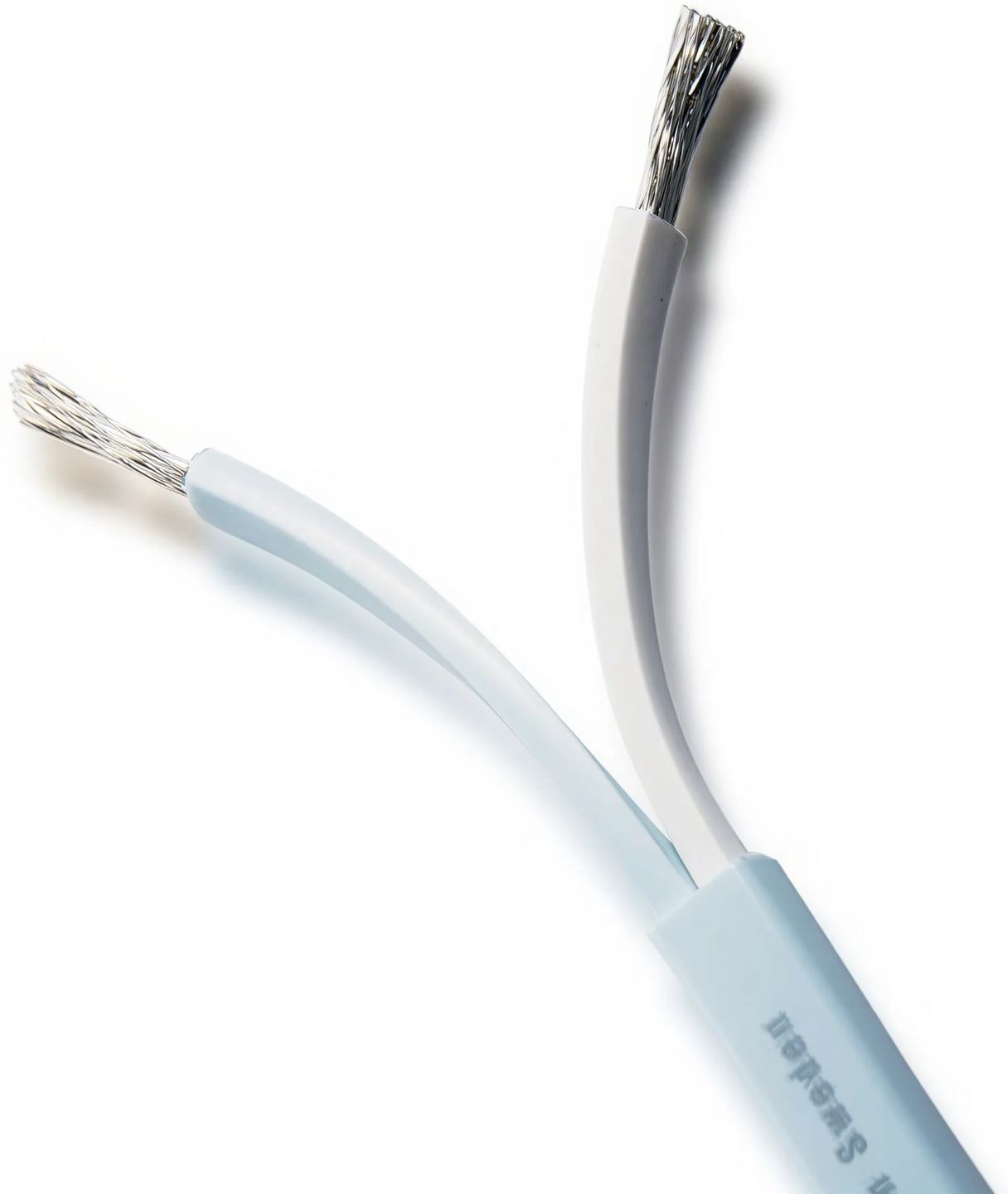
The Supra Ply 3.4 blue represents the culmination of decades of research in audio cable technology by the Swedish company Jenving Technology. This 3.4 mm² speaker cable combines sophisticated multi-strand construction with full tin-plating of the conductors, offering electrical characteristics particularly suited to modern high-fidelity systems. Sold by the meter, it stands out with its distinctive square shape and glacier blue color, the result of a technical approach that favors objective measurement over abstract marketing concepts.
A unique rectangular construction to minimize inductance
The Supra Ply 3.4 adopts a distinctive rectangular geometry that is more than just aesthetic. This shape results from the assembly of multiple conductor bundles tightly packed together, creating a 7.2 × 7.2 mm cross-section. This configuration achieves a remarkably low inductance of just 0.20 µH per meter, a value comparable to flat or ribbon cables but without their practical installation and connection constraints.
Each conductor contains 192 individual strands of oxygen-free copper (OFC) with a purity of 99.999%, each strand measuring 0.15 mm in diameter. This multitude of fine strands allows for optimal current distribution and contributes to the cable’s flexibility despite its substantial cross-section. The outer insulation, made of chloride ion-stabilized PVC, provides durable protection against mechanical and environmental stress while maintaining enough flexibility for home installations.
Full tin-plating: a barrier against oxidation and skin effect
The major innovation of the Ply 3.4 lies in the complete tin-plating of each copper strand. This layer of pure tin serves several crucial functions. First, it acts as a hermetic shield against copper oxidation, allowing the cable to maintain its electrical properties over time, even in humid or salty environments. This feature makes the cable suitable for outdoor or marine installations, where bare copper cable would quickly deteriorate.
Electrically, the tin-plating creates a “semi-Litz” effect by slightly increasing the surface resistance compared to the underlying copper. This difference forces the current to distribute more evenly across the conductor’s cross-section, minimizing the skin effect that tends to concentrate high frequencies at the conductor’s periphery. Unlike silver-plating, often used on high-end cables, tin forms a natural alloy with copper without creating a diode barrier, thus avoiding junction distortions between different metals.
Optimized electrical characteristics for audio transmission
With a resistance of 5.1 ohms per kilometer and an inductance of 0.20 µH per meter, the Ply 3.4 offers electrical parameters particularly favorable for audio signal transmission. The low resistance ensures optimal coupling between the amplifier and speakers, preserving damping factor and speaker control, especially in the bass range.
The low inductance results in excellent transient response and faithful transmission of high-frequency harmonics. Transient measurements show that the cable allows a rapid return to zero volts after impulses, with no parasitic oscillations or excessive overshoot. This feature contributes to rhythmic precision and clarity of reproduction, especially on percussive instrument attacks or fast transients.
Sound performance: neutrality and articulation
Listening tests reveal a remarkably neutral cable across the entire spectrum. The bass range stands out for its articulation and depth, with no emphasis or sluggishness. Low frequencies retain their texture and definition, allowing clear distinction of different bass lines even in complex passages. This quality is explained by the combination of low resistance and excellent transient behavior.
The midrange remains transparent and natural, with no coloration or excessive forwardness. Vocals retain their natural timbre and intelligibility, while acoustic instruments recover their full harmonic texture. The treble, though slightly less projected than on some silver-plated cables, offers satisfying extension with a smoothness that avoids listening fatigue during long sessions.
The soundstage benefits from good spatial definition, with clear instrument separation and convincing depth. Dynamics, especially subtle micro-dynamics, are well preserved, allowing appreciation of interpretive nuances and the finest variations in intensity.
Compatibility and practical implementation
The Ply 3.4 is particularly well-suited to high-efficiency speakers (over 90 dB), where its neutrality and lack of coloration allow full exploitation of these transducers’ transparency. On systems equipped with horns or compression drivers, the cable helps to attenuate any residual harshness without excessively rounding off transients.
The cable’s rectangular shape, initially surprising, proves practical in use. It facilitates insertion into speaker and amplifier terminals, and the cross-section can be slightly “rounded” by pressure to fit standard circular connectors. The cable easily accommodates banana plugs, spades, or 3.4 mm² lugs, with excellent mechanical hold thanks to the strand density.
For installations requiring increased immunity to interference, Supra offers a shielded version (Ply 3.4 S) equipped with a tinned copper screen and separate ground drain. This variant is relevant in electrically noisy environments or when speaker cables must run close to power cables or sources of electromagnetic radiation.