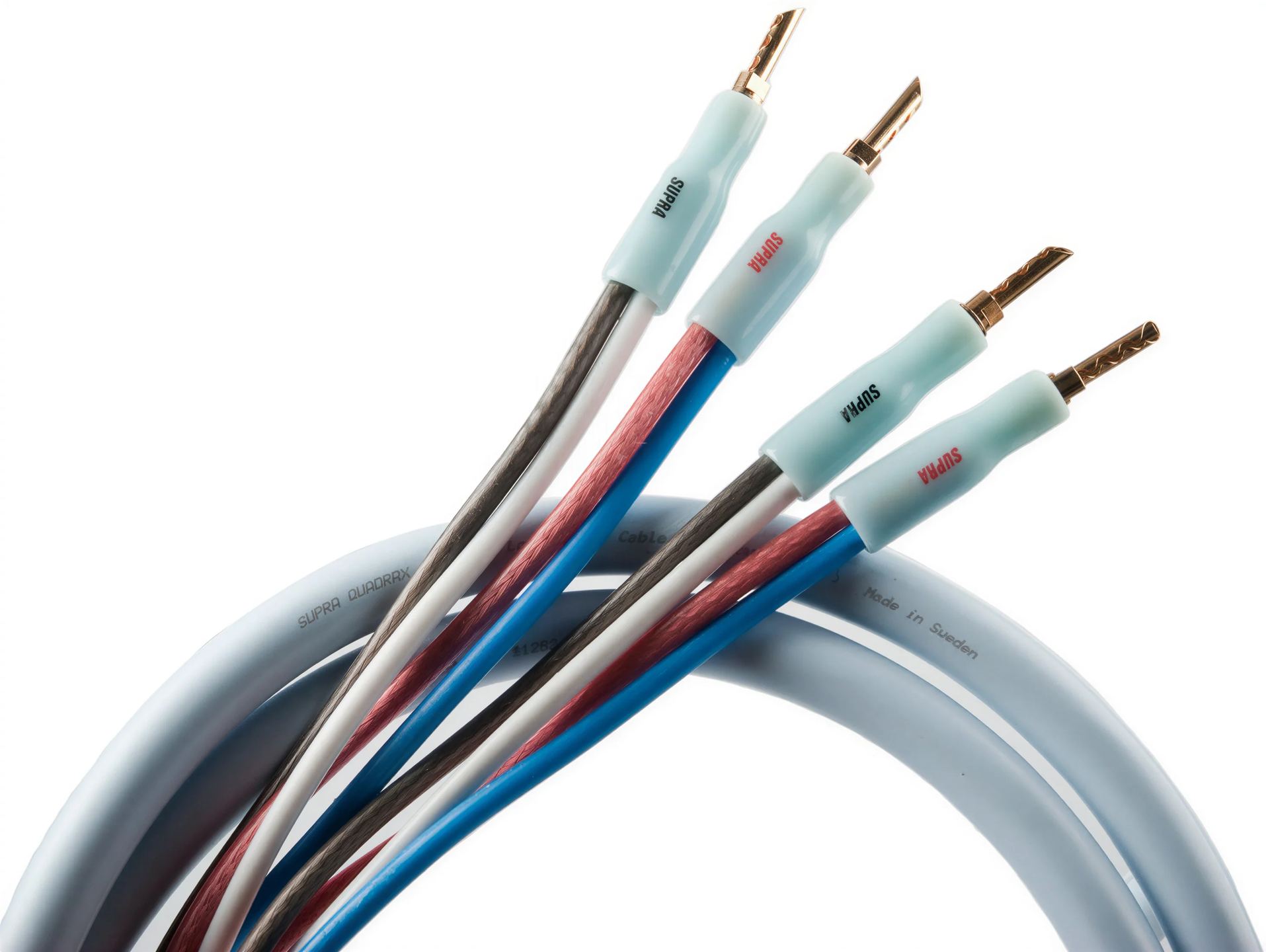
Four conductors instead of two, a plastic core at the center of each one, tinned copper strands wound into a tube: the Swedish brand Supra speaker cable departs from the usual twist. Its Star Quad geometry and four-point termination are ideal for dual-binding-post speakers and powerful amplifiers. It remains to be seen what this design brings to the signal and how to connect it.
A tubular conductor around an insulating core
Each conductor is built around a polypropylene core, a plastic that does not conduct electricity. Around this core, 120 strands of 5N (99.999%) oxygen-free copper, tinned and braided, form a tube with a 2 mm² cross-section. The design addresses a known phenomenon: at high frequencies, current tends to flow near the surface of the conductor rather than at its center, known as the skin effect. By hollowing out the center and distributing the copper in a ring, bass and treble encounter a comparable effective cross-section, helping to maintain an even response and fast transients.
The effect remains limited over a few metres at audio frequencies, and the most tangible benefit of this tubular shape is the lower inductance it provides. Tinning the strands serves another purpose: it prevents oxidation of bare copper and the micro-contacts that, over time, behave like tiny diodes between untreated strands. The polypropylene insulation, chemically and mechanically stable, maintains low capacitance, limiting phase shifts and treble loss.
Star Quad geometry against interference
The principle comes from professional cabling, namely microphone cables. The four conductors are arranged in a square, with opposing pairs carrying currents in opposite directions. Their magnetic fields largely cancel each other out, inductance is reduced, and the cable radiates less outward. Due to its symmetry, it also picks up less surrounding radio interference. Combined with polypropylene’s low capacitance, the assembly remains neutral across the entire frequency range.
This cancellation is most complete when all four wires work together as a single pair, namely the full-range (2>2) version in the range. In bi-amplification (4>4), the conductors are split between bass and treble: each pair retains the benefits of the tubular conductor and low capacitance, but the cancellation specific to a complete Star Quad configuration is less effective. The choice between the two versions therefore depends on your setup.
Four conductors for bi-amping or bi-wiring
The blue version presented here terminates in four points at each end (4>4), with each 2 mm² conductor crimped separately. On the speaker side, the four connectors are distributed across the bass and treble terminals of a dual-binding-post speaker. On the amplifier side, two uses are possible: in bi-amplification, each speaker receives two separate amplifier channels, one for bass and one for treble; in bi-wiring, the four connectors are doubled onto a single pair of outputs. In both cases, the factory jumpers linking the bass and treble terminals on the speaker must be removed, otherwise the separation has no effect.
This arrangement requires a speaker with four terminals. The audible benefit of bi-amplification depends on the rest of the system: its primary advantage is separating bass and treble currents across two cables, or even two amplifiers. On a speaker with a single set of terminals, this four-conductor format loses its purpose, and the full-range (2>2) version of the same range is more suitable.
Interchangeable CombiCon terminations
The cable arrives pre-crimped at the factory. The CombiCon system is based on a 24-carat gold-plated copper crimp barrel, compressed onto the conductor under high pressure to form an airtight, solder-free connection. This tight contact resists oxidation and remains stable over time, whereas solder can age. Interchangeable banana plugs or spades screw onto the barrel’s M6 thread. The 4>4 pair includes both types, twelve banana plugs and twelve spades, allowing you to switch from one format to another depending on the terminals without re-terminating the cable.
Diameter, jacket and cable routing
Round in shape, the cable measures 15 mm in outer diameter and comes in glacier blue, with other shades available to order. Its PVC jacket resists heat and ageing. One point deserves attention for installation inside a wall: this jacket is neither halogen-free nor flame-retardant, whereas fire safety regulations often require these properties for concealed runs. For surface wiring, this is not an issue, but the diameter and four conductors make the cable fairly stiff: allow for the bend radius and space behind the cabinet or rack. It is made in Sweden.