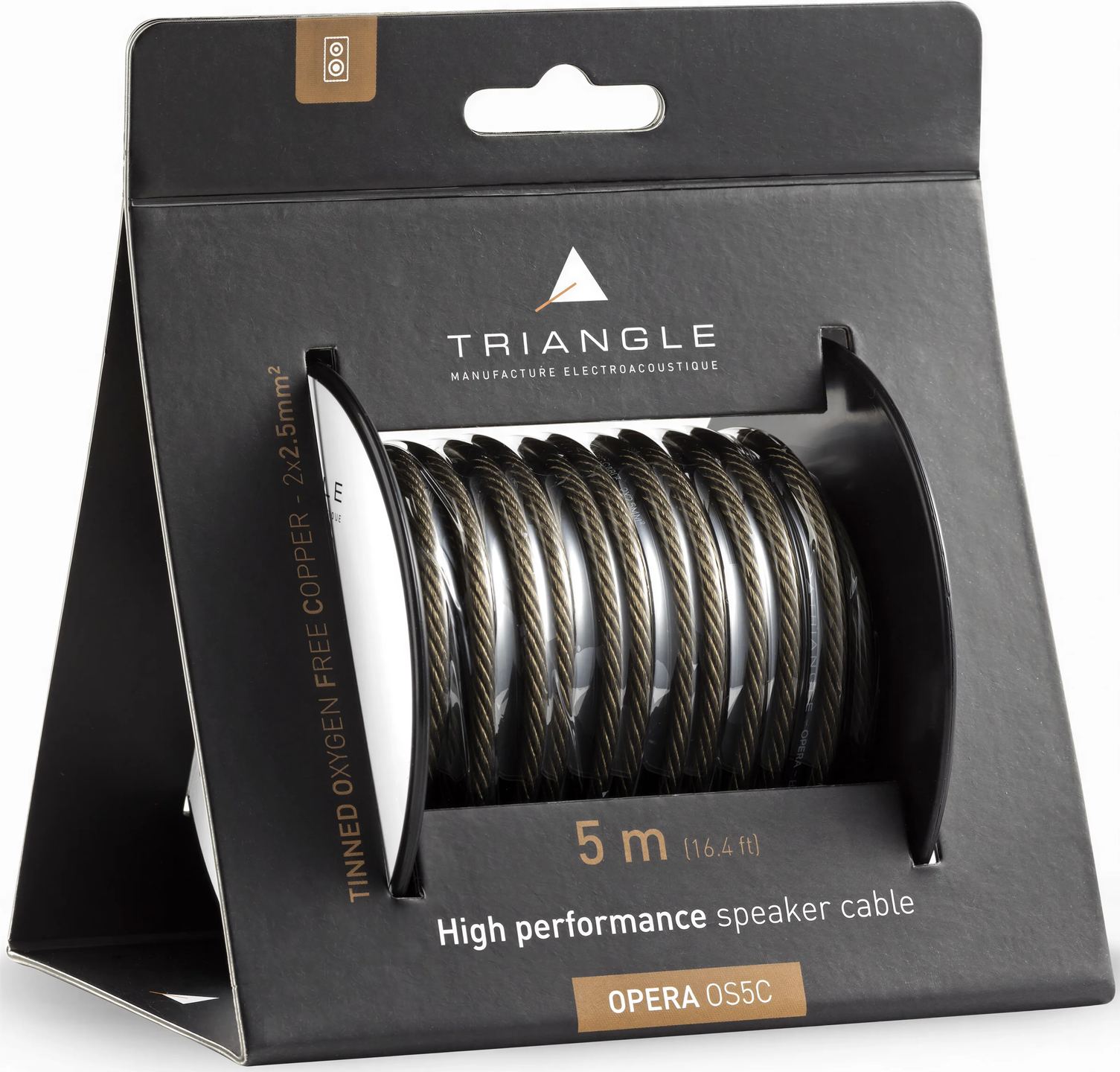
Between the amplifier and the passive speakers, the cable carries the entire music signal, including bass, and delivers the current required by the drivers. This five-metre coil of Opéra cable combines two 2.5 mm² conductors made of tinned oxygen-free copper, within a transparent sheath bearing markings. It is enough to connect a pair of speakers positioned on either side of a hi-fi stand, cutting each length to suit the room.
Tinned copper braided into multiple strands
Each conductor brings together 224 copper strands measuring 0.12 mm in diameter, arranged in seven braids of 32 strands. This copper is OFC (oxygen-free copper), with a purity of 99.99%: its manufacturing process reduces the metal’s oxygen content, and therefore the impurities lodged between its constituent crystals. The copper is then covered with a thin layer of tin. This tinning protects it from oxidation, the dark film that gradually spreads over a bare copper wire exposed to air, starting at the stripped ends where the cable meets the terminals. A conductor that stays clean maintains solid electrical contact over the years, and the tin also makes soldering easier if you choose to fit this type of connector. The stranded construction makes the cable flexible: it follows a skirting board or bends around the corner of a piece of furniture without resistance.
A 2.5 mm² cross-section suited to a living room
The cross-section refers to the copper surface area of each conductor. The larger it is, the lower the cable’s electrical resistance, and the less energy it takes from the signal on its way from the amplifier to the speaker. With 2.5 mm², a 2.5 m connection (equivalent to 5 m of copper counting the signal’s outward and return paths) has a resistance of around 0.035 ohm, a negligible value compared with the 4 to 8 ohm impedance of a typical speaker. The amplifier maintains control over the movements of the bass cone, and the tin layer, slightly less conductive than copper, makes no difference at this scale. This cross-section remains comfortably adequate for lengths of up to around fifteen metres with 4-ohm speakers. For longer distances, or speakers with very high current demands, Opéra cable is available in 4 mm².
Printed markings on a transparent sheath
The smoked transparent PVC sheath insulates the two conductors, provides mechanical protection and leaves the copper visible, allowing you to check the condition of the strands at a glance after cutting. It carries three types of markings. The polarity marking distinguishes the positive conductor from the negative, so that each red amplifier terminal can be connected to the red speaker terminal. If just one of the two speakers is connected the wrong way round, its cone moves backwards when the other moves forwards: the bass partially cancels out and the stereo image loses definition. Length markings help you cut two identical sections without a tape measure. Finally, arrows indicate the installation direction, from the amplifier towards the speakers, determined by the structure and braiding of the strands.
Five metres to share between two speakers
The coil contains five metres of two-conductor cable, giving two 2.5 m sections when cut in half, minus the few centimetres used for stripping. This length suits installations where the amplifier sits between the two speakers: a hi-fi system on a low cabinet, bookshelf speakers on either side of a shelf, or a small desktop system. The cable is suitable for all passive speakers, both floorstanding and bookshelf models, in stereo systems or for the front and centre channels in a home cinema system. The rear speakers in a multichannel system, often positioned far from the amplifier, require more cable, available in 10 and 100 m coils or cut to length by the metre. For connections, the stripped bare wire can be clamped directly into screw terminals, or fitted with Triangle BP450 banana plugs, which are more convenient if you frequently disconnect the speakers.