
Nicolas
cable matching the description
Comment from 15 February 2026 — Experience from 27 December 2025
Automatically translated — Show original (French)
câble correspondant à la description
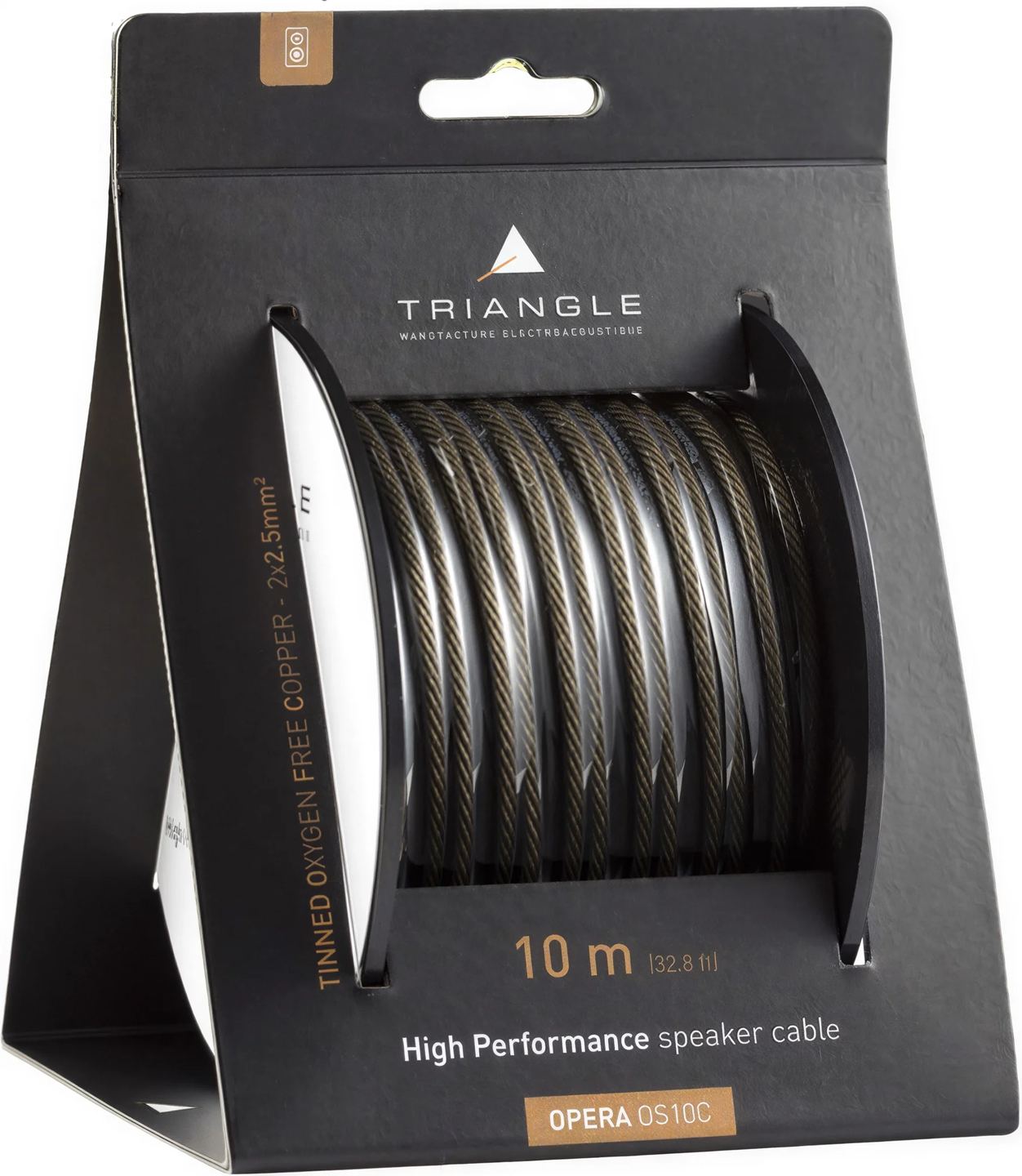
Connecting an amplifier to speakers does not require an exotic cable, but copper with a sufficient cross-sectional area that retains its qualities over time. The Opéra range from Triangle meets this need with 2.5 mm² tinned copper conductors, supplied here on a ten-metre reel that you cut to the required length. The transparent jacket has polarity markings to prevent connection errors.
Each conductor is made of oxygen-free copper strands (OFC, for Oxygen-Free Copper) with a purity of 99.99%. Triangle adds tinning: the strands receive a thin layer of tin. Bare copper eventually darkens when exposed to air, especially at the stripped ends clamped into terminals, and this oxidation gradually degrades the quality of the contact. Tin protects the copper from this ageing, and the brand highlights the resulting longevity. Tin conducts less effectively than copper, but the layer is very thin and, at audible frequencies, current flows through almost the entire thickness of the strands: its effect on the cable’s resistance is negligible.
The strands are assembled in a helical braid, meaning they are wound in a spiral around the conductor’s axis. This arrangement makes the cable flexible, allowing it to follow a furniture corner or the edge of a skirting board easily, while the strands stay together once the jacket is removed.
The cross-section, expressed in square millimetres, is the area of copper in each conductor. The larger it is, the lower the cable’s resistance and the better the amplifier maintains control of the speaker drivers, especially in the bass, where the current demand is highest. At 2.5 mm², resistance is around 0.014 ohm per metre of cable run, including both outgoing and return conductors. Over 5 m, a common distance between an amplifier and a speaker in a living room, it stays below 0.07 ohm: less than 2% of the impedance of a 4-ohm speaker, and less than 1% for an 8-ohm speaker. This margin covers the vast majority of installations; beyond around fifteen metres per speaker with a 4-ohm load, a larger cross-section becomes appropriate.
The 2.5 mm² cable remains thin enough to fit all screw terminals, standard banana plugs and most spring terminals still found on some compact amplifiers.
The transparent PVC reveals the copper and carries three markings: polarity, length and a direction indicator. The polarity marking is the most useful, distinguishing one of the two conductors so you can connect the amplifier’s + to the speaker’s +, and - to -, at both ends. A speaker connected the wrong way round operates out of phase with its neighbour: the bass weakens, the stereo image becomes diffuse, and the problem often goes unnoticed at first. The length markings make cutting easier without a tape measure, and the direction indicator helps orient the cables the same way from one speaker to the next.
The reel format lets you decide the length of each cable run. Ten metres covers a pair of speakers positioned up to 5 m from the amplifier, or an asymmetrical arrangement when the furniture is not centred, with 3 m on one side and 7 m on the other, for example. The same reel can serve the three front channels of a small home cinema system (left, centre, right) if the distances remain short. For a complete system with rear channels, the Opéra range is also available on 5 m and 100 m reels.
Triangle developed this cable to accompany its own speakers, but it is a standard conductor that connects to any passive speaker and any amplifier with binding posts.
No. A one-metre difference adds approximately 0.014 ohms of resistance, with no audible effect. It is better to cut each cable to the right length, with a little slack to move the speaker, rather than coil excess cable behind the furniture to make the lengths equal.
Yes. Bi-wiring connects each speaker using two pairs of cables, one for the bass section and one for the treble section, on models equipped with dual binding posts. A 10 m reel provides four 2.5 m lengths, enough to bi-wire a pair of speakers close to the amplifier. Remember to remove the jumpers connecting the speaker’s two sets of binding posts.
The OS25A uses the same cable but is factory-assembled: two 2.5 m lengths terminated with gold-plated banana plugs with anodized aluminium housings. The OS10C is supplied unterminated, in custom lengths, for distances exceeding 2.5 m or installations where each connection has a different length.
Bare wire clamped in a screw terminal provides direct, secure contact, as long as it is tightened from time to time. Banana plugs make frequent disconnections easier and prevent stray strands from sticking out. Triangle offers BP450 plugs with dual screw locking and silver plating, sold in packs of four and accepting wire cross-sections up to 3.6 mm². Check that your amplifier’s terminals accept banana plugs: on some devices sold in Europe, a cap blocks the central opening.
Strip one to one and a half centimetres, twist the strands between your fingers, then insert them fully into the terminal block before tightening. A single strand touching the adjacent terminal or the chassis can trigger the amplifier’s protection circuit or even damage it. Always connect with the amplifier switched off. Tinning helps here, as tinned strands hold together better once twisted.
On the contrary. Solder readily adheres to tin, and tinned ends are quicker and cleaner to solder than bare copper, which is often already slightly oxidized. This is an advantage when fitting solder-type plugs or terminals.
Under a skirting board or along a carpet, yes, avoiding door thresholds where the cable would be crushed every time someone passes. For a route through a partition wall, run it through corrugated electrical conduit: the cable stays protected and replaceable. If the route runs alongside electrical cables, cross them at right angles rather than following them for several metres.
Based on reviews from customers who purchased this product, summarised by AI
Nicolas
cable matching the description
Comment from 15 February 2026 — Experience from 27 December 2025
Stephane
A bit pricey, I think, but it does the job
Comment from 26 December 2025 — Experience from 22 December 2022
Goyo
The speaker cables seem very good to me
Comment from 20 November 2025 — Experience from 9 November 2025


