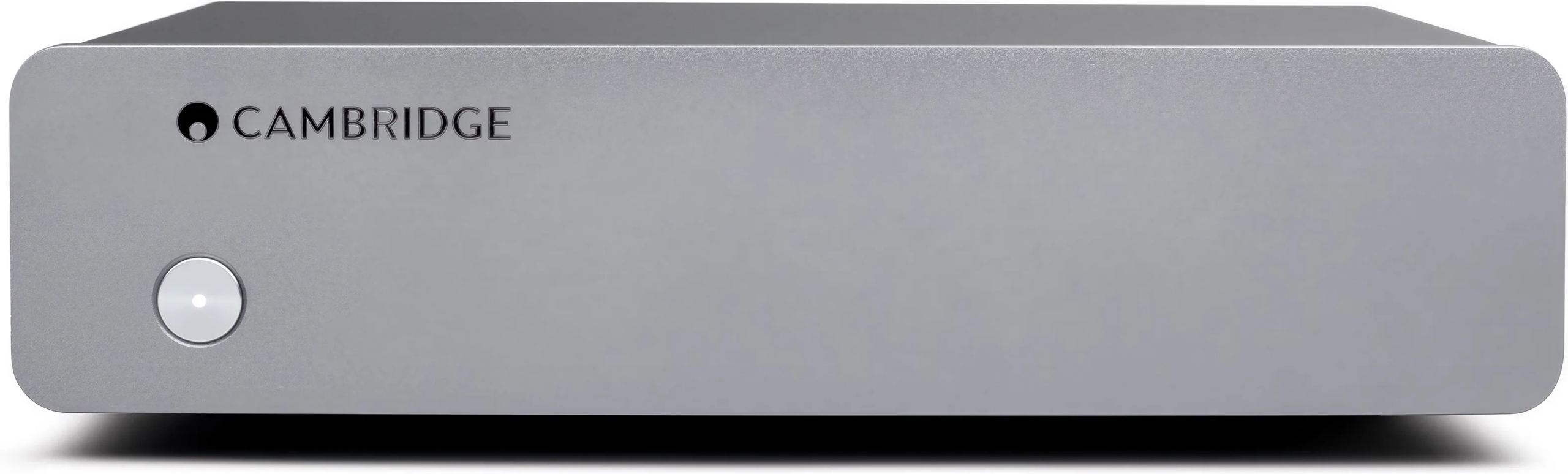
Connecting a turntable directly to an integrated amplifier, while expecting balanced sound at the right level, is generally not possible. The signal from a moving magnet cartridge remains too weak, and the RIAA equalization curve must be restored upstream. That is precisely the purpose of the Alva Solo: to handle this stage with electronics optimized for low noise, in a compact anthracite gray enclosure.
An ultra-slim format with careful construction
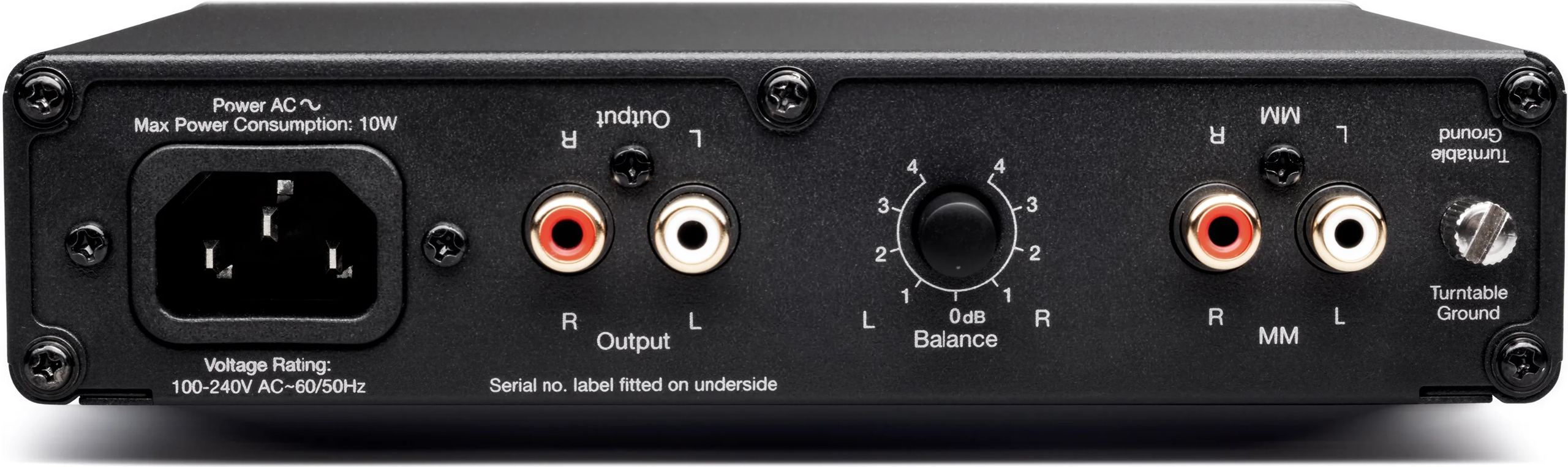
Steel and aluminum chassis, only 48 mm high, 176 mm wide, and 132 mm deep for 680 g. The format slips easily next to a turntable or onto an already crowded hi-fi shelf. One practical detail: the labels for the inputs and outputs on the back are printed in both reading directions, upright and upside down. When the Alva Solo is placed up high or against a wall, the markings can be read without having to contort yourself or shine a light on the rear panel.
Electronics in the service of silence
Inside, the printed circuit board uses surface-mounted components (SMD), with deliberately short signal paths. The power supply is a switching type: it operates outside audible frequencies, which limits mains hum, the classic nightmare of phono stages. On the measurement side, the equivalent input noise is around 0.09 µV (A-weighted), the signal-to-noise ratio exceeds 90 dB, and total harmonic distortion remains below 0.0025%.
A closely controlled RIAA curve
RIAA equalization accuracy is rated at ±0.65 dB between 30 Hz and 20 kHz. In concrete terms, this means the tonal profile of the record is reproduced as the sound engineers intended during mastering, without excessive peaks or dips in the midrange or treble. The overload margin above 30 dB handles the modulation peaks of well-cut records without audible saturation. Gain is set at 39 dB at 1 kHz, which brings a standard MM cartridge to a nominal output level of 300 mV, usable directly by any line input.
Subsonic filter and balance adjustment
Two practical options accompany the basic amplification. The subsonic filter cuts vibrations below the audible band, the kind that make a speaker or subwoofer bass driver pump because of a slightly warped record or mechanical transmission between the turntable and the floor. On older or somewhat worn pressings, the improvement in cleanliness is immediate. The balance adjustment, accessible on the rear, corrects any imbalance between the two channels of a cartridge, a common flaw at the entry level.
Compatibility limited to MM cartridges
The 47 kΩ input impedance and 100 pF capacitance place the Alva Solo within the standard values of a moving magnet phono stage. This covers the vast majority of cartridges supplied as standard on consumer and mid-range turntables: Audio-Technica AT-VM95 and VM700, Ortofon 2M series (Red, Blue, Bronze, Black), Goldring E3, Sumiko Rainier or Olympia, Nagaoka MP. On the other hand, moving coil (MC) cartridges, which require much higher gain and a different impedance load, are not supported. In that case, you need to turn to the Alva Duo, which adds an MC input, or to a dedicated phono preamp.
The Solo’s place in the Alva range
The Alva Solo is the entry-level model in Cambridge Audio’s current phono range. It succeeds the former CP1 in a slimmer format and with completely redesigned electronics. Above it, the Alva Duo adds the MC input, a second pair of RCA inputs, an MM/MC selector on the front panel, and a 6.35 mm jack headphone output with its own volume potentiometer. The Solo is limited to amplifying an MM cartridge, the RIAA curve, and the subsonic filter. No MC input, no headphone output: fewer functions, but the same care devoted to the pure phono section.
Connectivity and integration
On the rear, the Alva Solo features a stereo RCA input, a stereo RCA output, and a screw-down ground terminal to accommodate the turntable’s ground wire. The balance potentiometer completes the set. Maximum power consumption tops out at 10 W and remains below 0.5 W in standby, with automatic shutoff after 20 minutes without an input signal. The Alva Solo connects on the output side to any line input of an integrated amplifier (CD, AUX or Tuner), which makes it possible to bypass the internal phono stage of an old or overly basic amplifier.