Audioquest Forest optic 5m

Overview
The Forest digital optical cable from AudioQuest is designed with low-dispersion fiber and precisely polished interfaces. It reflects the brand’s approach to limiting signal loss caused by light dispersion, in order to preserve the temporal integrity of digital data. Positioned at an accessible price point, it incorporates technical elements found in the brand’s more advanced models.
Sophisticated Construction in Service of Music
The Forest stands out thanks to its revolutionary multi-fiber design. Unlike conventional optical cables that use a single large-diameter plastic fiber, the Forest employs several hundred high-purity synthetic fibers with a narrow aperture. This unique architecture allows light to be focused more precisely toward the receiver, drastically reducing temporal signal dispersion.
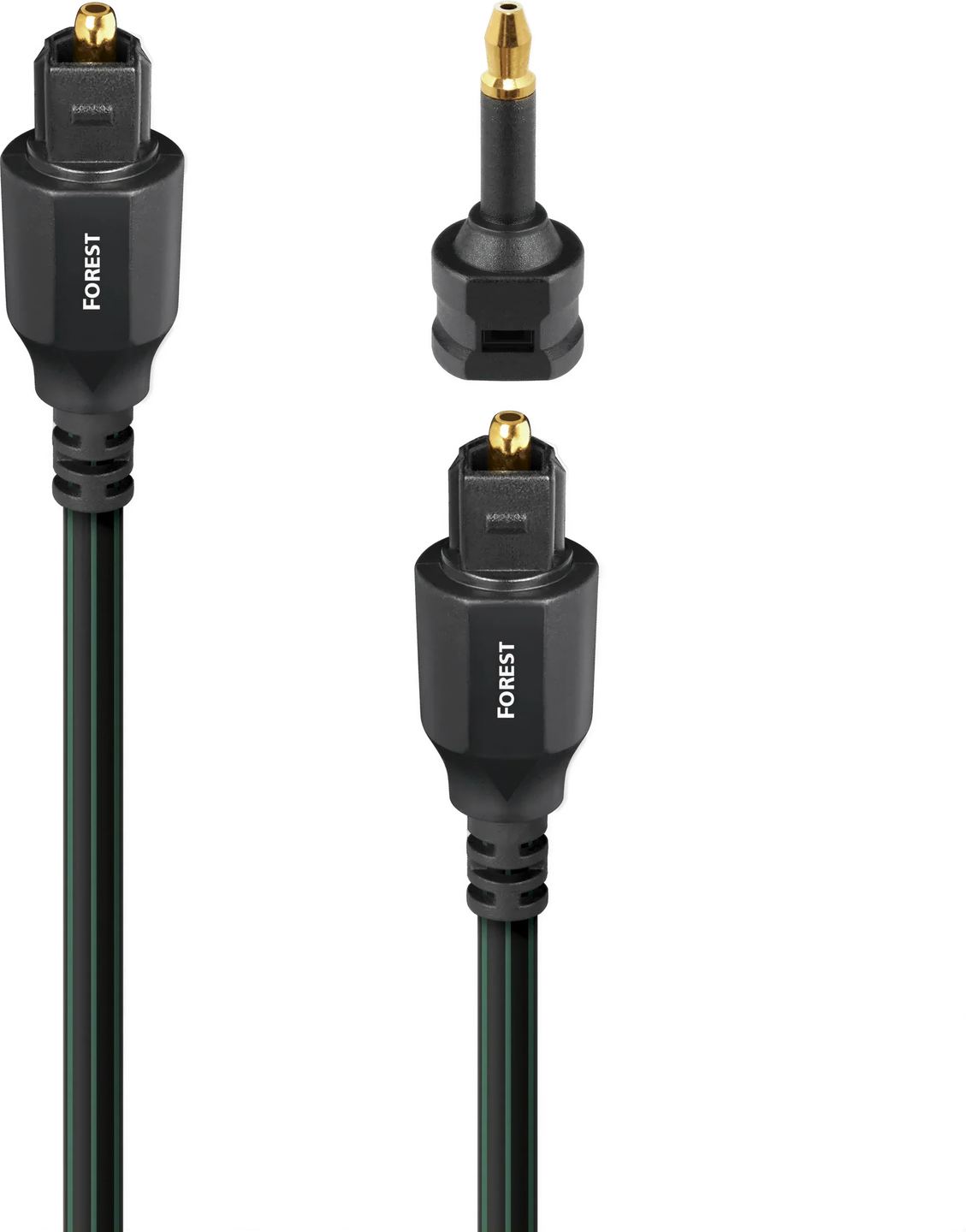
The outer sheath features a distinctive black and green braid, the visual signature of AudioQuest’s Forest range. This finish is not just aesthetic: it provides enhanced mechanical protection while maintaining optimal flexibility to facilitate installation in even the most demanding setups. The Toslink connectors are reinforced with a brass ferrule, ensuring perfect alignment and lossless light transmission.
Each fiber end is precision-polished to strict standards. This mirror-like finish on the optical interfaces ensures optimal contact between transmitter and receiver, minimizing stray reflections and maximizing the efficiency of light transfer. The result: a wider bandwidth and a significant reduction in synchronization errors.
Low-Dispersion Technology: Understanding the Innovation
Dispersion in optical cables is the main enemy of sound quality. When light travels through a standard optical fiber, imperfections and impurities in the material cause the light signal to scatter. Some light rays take longer paths, bouncing off the internal walls like a billiard ball off the rails, creating time delays.
The Forest’s low-dispersion fiber solves this fundamental problem. Thanks to an optimized refractive index and exceptional material purity, light travels more directly and coherently. This technology drastically reduces jitter—those micro-temporal variations that degrade the precision of digital audio signal reconstruction.
The use of multiple small-diameter fibers brings another crucial advantage. Each individual fiber naturally limits the entry angle of light, creating a kind of natural optical filtering. This physical characteristic further reduces the variety of possible light paths, minimizing the overall temporal dispersion of the signal.
The 0.5% solid silver conductors mentioned in the technical specifications also contribute to the Forest’s excellence. Although counterintuitive for an optical cable, these metal conductors are used in the electronic circuits of the connectors, where they eliminate the interaction distortions between multiple strands found in traditional twisted conductors.
Remarkable Versatility of Use
The Forest excels in a multitude of modern audio-video setups. Its robust design and high performance make it the ideal partner for contemporary soundbars, where digital signal quality directly determines sound spatialization and dynamics. Subwoofer owners will particularly appreciate the Forest’s temporal precision, essential for seamless integration of low frequencies.
The included mini-Toslink adapter greatly expands its range of use. This compact interface allows the Forest to connect to modern laptops, notably MacBooks equipped with an optical output integrated into the 3.5mm headphone jack. Game consoles also benefit from this extended compatibility, offering gamers uncompromising audio transmission for their most intense sessions.
In the context of sophisticated home theater systems, the Forest ensures a reliable link between digital sources and audio processors. Blu-ray players, TV set-top boxes, and other sources benefit from the cable’s generous bandwidth to transmit multichannel audio streams with absolute fidelity. The CL3/FT4 certification of certain versions even allows for in-wall installation in compliance with the strictest safety standards.
Technical Specifications
Physical Specifications
- Type: large-format to large-format fiber optic cable
- Construction: low-dispersion fiber with 0.5% solid silver conductors
- Sheath: black and green braid
- Insulation: interference-optimized design
Advanced Technical Features
- Low-dispersion, high-purity fiber optic
- enhances bandwidth
- reduces timing errors (jitter)
- Finely polished optical interface
- reduces transmission loss
- optimizes light transmission between connectors
- 0.5% solid silver conductors
- reduces strand interaction distortion
- more accurate signal transfer
Connectivity and Compatibility
- Connectors: standard Toslink
- Included adapter: mini-adapter for conversion to mini-Toslink format
- Compatibility: all devices equipped with Toslink or mini-Toslink ports
- Applications: soundbars, subwoofers, TVs, Blu-ray players, consoles, DACs, laptops, portable devices
Performance and Benefits
- Low jitter for more accurate audio reproduction
- Noticeable improvement in high frequencies and dynamic detail
- Reliable and durable digital transmission
- Optimized performance for home theater, hi-fi, and multimedia systems
Frequently asked questions
What concrete difference does the Forest’s low-dispersion technology make compared to a standard optical cable?
The Forest’s low-dispersion fiber minimizes time delays in light signal transmission. In practice, this results in more precise transient reproduction, better definition of instruments in the soundstage, and a notable reduction in listening fatigue during extended sessions. Users often report a surprising improvement in vocal clarity and soundstage depth.
Does the included mini-Toslink adapter affect the cable’s performance?
The adapter provided by AudioQuest maintains the integrity of the optical signal without measurable degradation. Its design ensures perfect alignment between the mini-optical output and the Forest cable. Tests show that performance remains identical whether the cable is used in standard Toslink configuration or with the mini adapter. This versatility allows you to optimize all your devices without compromise.
How does the Forest’s multi-fiber construction improve sound quality?
Each individual fiber in the Forest acts as a precise waveguide, naturally limiting the entry angles of light. This physical characteristic reduces the variety of possible light paths, thus decreasing temporal dispersion. The audible result is better rhythmic coherence, tighter bass, and a more natural reproduction of instrumental timbres.
Is the Forest suitable for long installation distances?
AudioQuest offers the Forest in lengths up to 16 meters, demonstrating the robustness of its design. The low-dispersion technology maintains signal integrity even over these significant distances, where conventional optical cables reach their limits. For home theater installations requiring a cable to cross an entire room, the Forest guarantees flawless transmission.
Why does AudioQuest use silver conductors in an optical cable?
The 0.5% solid silver conductors are integrated into the electronic circuits of the Toslink connectors, not in the optical fiber itself. These high-quality conductors ensure electrical-to-optical conversion without adding distortion. This attention to detail, even in the non-optical parts of the cable, illustrates AudioQuest’s holistic approach to optimizing every aspect of signal transmission.
- Eco-contribution included in the sale price.
- Manufacturer reference: OPTFOR05
- GTIN / EAN: 92592051553