

Primare I25 silver


Buy as a bundle and save
- Primare I25 silver
- Primare CD35 Prisma silver
Complementary product
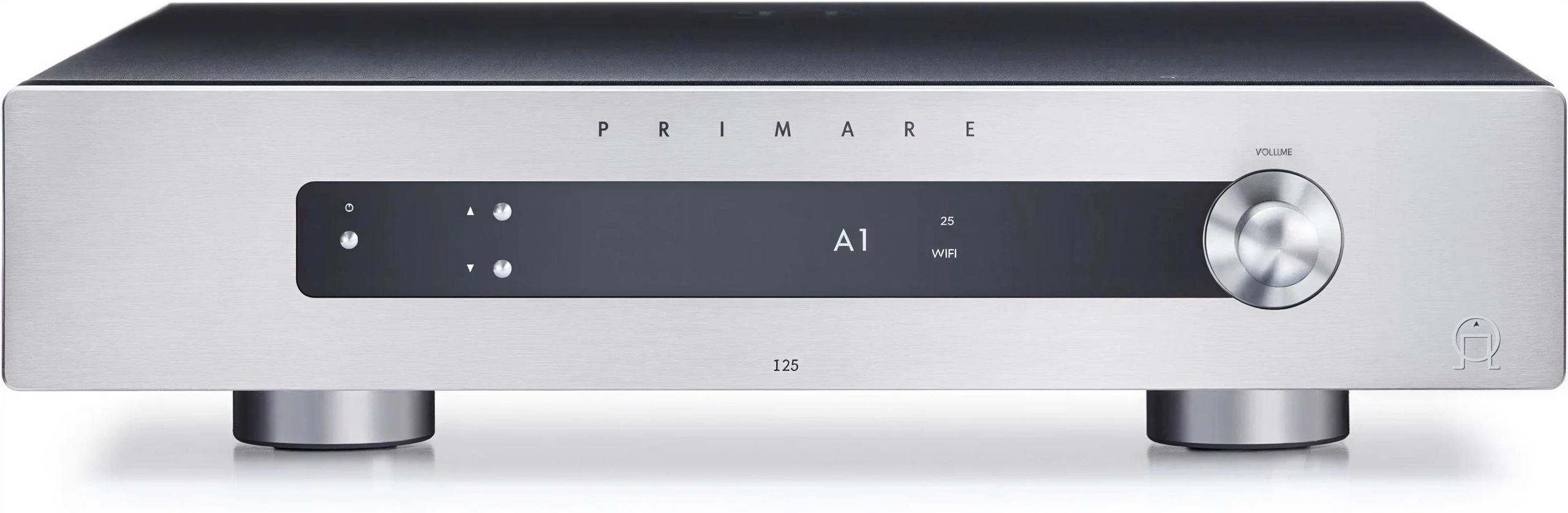
Primare I25, modular integrated amplifier
Combining preamplification and power in a compact chassis without compromising on quality requires careful engineering. This is the challenge taken on by Primare, a Swedish manufacturer committed to minimalist hi-fi. The I25 is a stereo transistor integrated amplifier that combines in-house analog Class D amplification with a modular design, capable of accommodating digital functions later depending on the system’s needs.
A Class D design that remains analog
Class D is an amplification technology known for its high efficiency: it dissipates little heat and allows compact devices. Primare offers its own version, called UFPD 2, whose control stage remains entirely analog, with no digital conversion of the audio signal.
In practical terms, the I25 delivers 100 watts per channel into 8 ohms, rising to 200 watts into 4 ohms. This doubling as impedance drops indicates a strong current reserve, useful for controlling demanding speakers and keeping bass under control. Across the entire audible range, the response remains flat within 0.2 dB between 20 Hz and 20 kHz, measured distortion falls below 0.01%, and the signal-to-noise ratio exceeds 100 dB. In short, the signal remains faithful to the source, against a quiet background and with little added coloration.
A clean and efficient power supply
An amplifier is also defined by how it draws power from the mains. The I25 features an active power factor correction power supply, known as APFC. Power factor describes how cleanly a device draws energy from the outlet: the better it is controlled, the less interference the device sends back into the electrical network and to other nearby connected components.
This power supply uses two converters operating in phase opposition, smoothing current draw and gaining around 5% efficiency compared with previous generations. It operates in so-called transition mode, which reduces switching losses. In listening and over time, this results in less interference and less strain on components, while the unit remains cool during operation.
An amplifier that evolves with the system
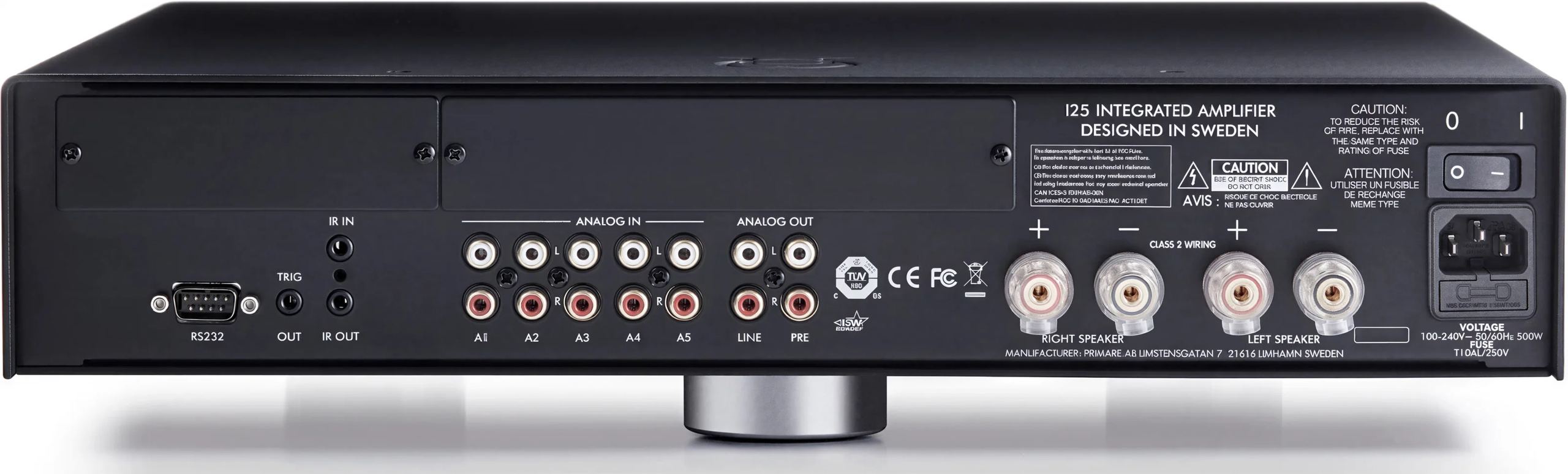
In its basic configuration, the I25 is a fully analog amplifier: its five RCA inputs accept line-level sources, such as a CD player or the output of a phono preamp. There is no built-in digital converter or network playback at this stage, and that is a deliberate choice.
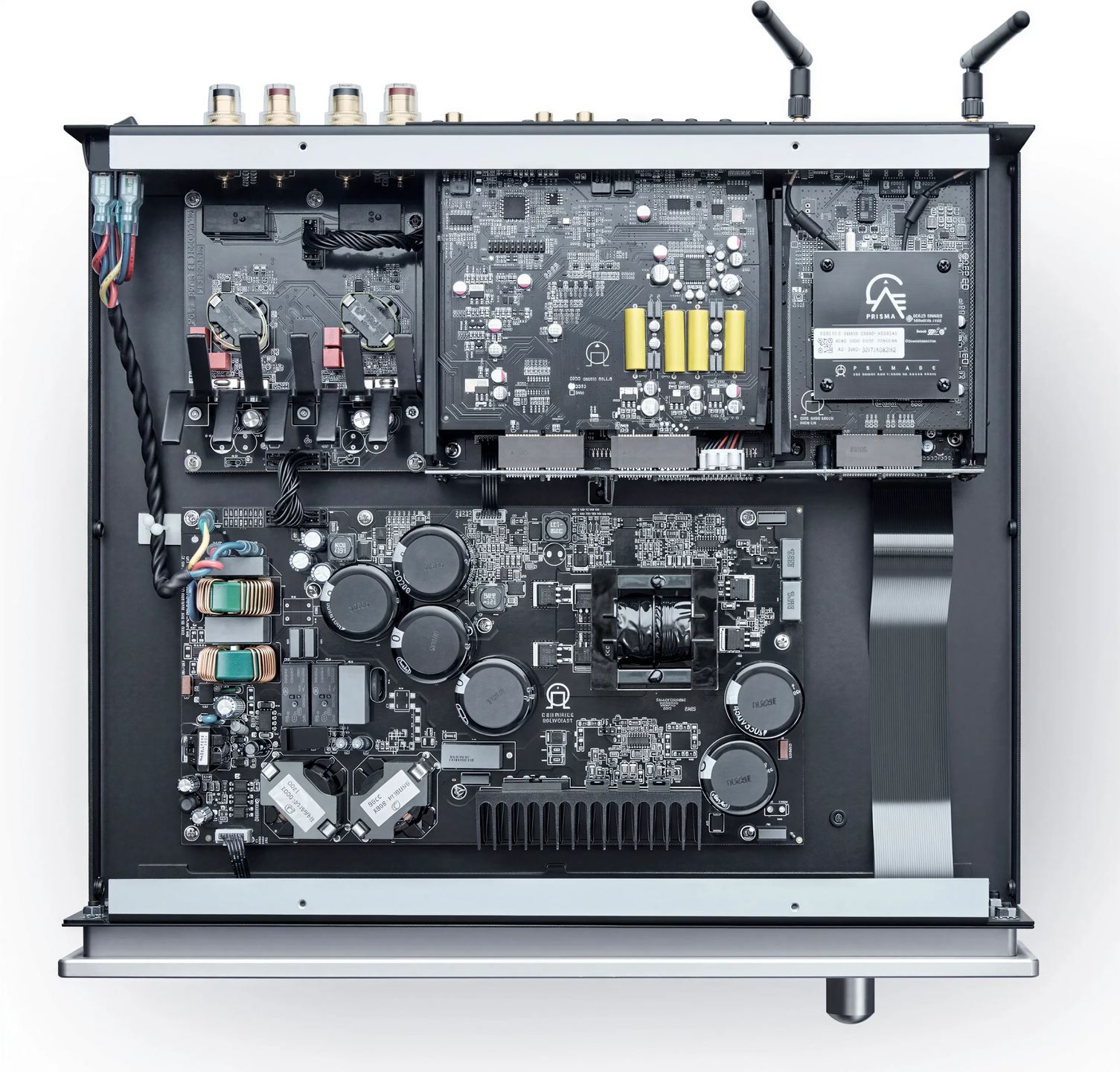
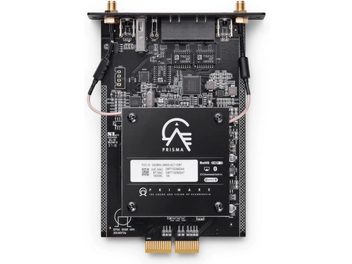
Its appeal lies in its modularity. Two modules can be added after purchase without changing the unit: the DM36, a digital-to-analog converter that provides access to digital sources and high resolution, and the SM35 Prisma, which adds network playback and app control. A system can therefore start simply, then gain digital capabilities and streaming when the need arises.
Connections and remote control
On the output side, the I25 offers a fixed-level line output and a variable preamplifier output. The first is suitable for feeding a recorder or a second zone; the second can drive a separate power amplifier or an active subwoofer, using the I25 as a preamplifier. Both outputs have an impedance of 100 ohms, making them easy to pair with downstream components.
The unit also includes the connections expected in a carefully designed installation: an RS-232 port, an infrared input and output, and a trigger output. These connections are used to link the I25 to a centralized control system and to automatically switch connected devices on or off at the same time as it.
A compact, understated chassis
At 10.6 cm high, 43 cm wide and 42 cm deep, the I25 fits on a shelf or in a cabinet without taking up much space. Its 11 kg weight reflects careful construction. On the front panel, Primare’s distinctive rotary control is used to adjust volume and select sources, offering precise operation. The style remains true to the brand’s Scandinavian heritage: clean lines and minimal ornamentation. The C25 system remote control is included with the unit.
Documentation
Technical Specifications
Amplification
- Output power:
- 2 × 100 W at 8 Ω
- 2 × 200 W at 4 Ω
- Amplifier module: Primare UFPD 2
- Power supply: Primare APFC
Audio Performance
- Output impedance: line and preamplifier 100 Ω
- Frequency response: 20 Hz - 20 kHz - 0.2 dB
- THD + N: < 0.01%, 20 Hz - 20 kHz, 10 W at 8 Ω
- Signal-to-noise ratio: > 100 dB
Connectivity
- 5 RCA analog inputs
- 1 line output
- 1 preamplifier output
- RS-232 port
- IR input/output
- Trigger output
Physical Characteristics
- Dimensions (W × D × H): 430 × 420 × 106 mm
- Weight: 11 kg
Accessories
- C25 system remote control
Frequently asked questions
Can a turntable be connected directly to the I25?
No, not as is. The I25 does not have a built-in phono preamp, and its inputs operate at line level. For a turntable, you need to use a phono preamp, either external or built into the turntable, before connecting it to one of the RCA inputs.
Should the DM36 and SM35 modules be installed immediately upon purchase?
No. The modular design lets you start with an analogue I25, then add the digital converter or network player later. The modules fit into the dedicated slots, avoiding the need to replace the amplifier to gain these features.
What is the difference compared with the I35 from the same range?
The I35 sits above the I25 in Primare’s range of integrated amplifiers. It delivers 150 watts per channel, adds balanced (XLR) inputs, and uses a larger chassis. The I25 is designed for a more compact footprint, with 100 watts per channel and unbalanced RCA connections. Both share UFPD 2 amplification and the same modular design.
Can a Class D amplifier deliver good sound quality?
Yes. Class D long carried a mixed reputation due to its early generations. Recent designs, such as the UFPD 2, combine high efficiency with low distortion and controlled response across the entire audible range. Quality depends primarily on the care taken in implementation, rather than on the principle itself.
Does the I25 require a lot of space for ventilation?
Very little. Class D efficiency limits heat buildup, allowing installation in a cabinet or rack with moderate clearance. A minimum amount of airflow is still recommended, as with any electronic equipment.
What type of speakers does the I25 perform best with?
Power that doubles into 4 ohms indicates a good ability to drive speakers that demand high current, including at low impedance. The final choice also depends on speaker sensitivity and room size: a low-sensitivity speaker in a large room requires more power than an efficient model in a smaller space.
- Eco-contribution included in the sale price.


