Florent
Excellent value for money for this cable.
Comment from July 13, 2026 — Experience from November 07, 2025
Automatically translated — Show original (French)
Excellent rapport qualité prix pour ce câble.
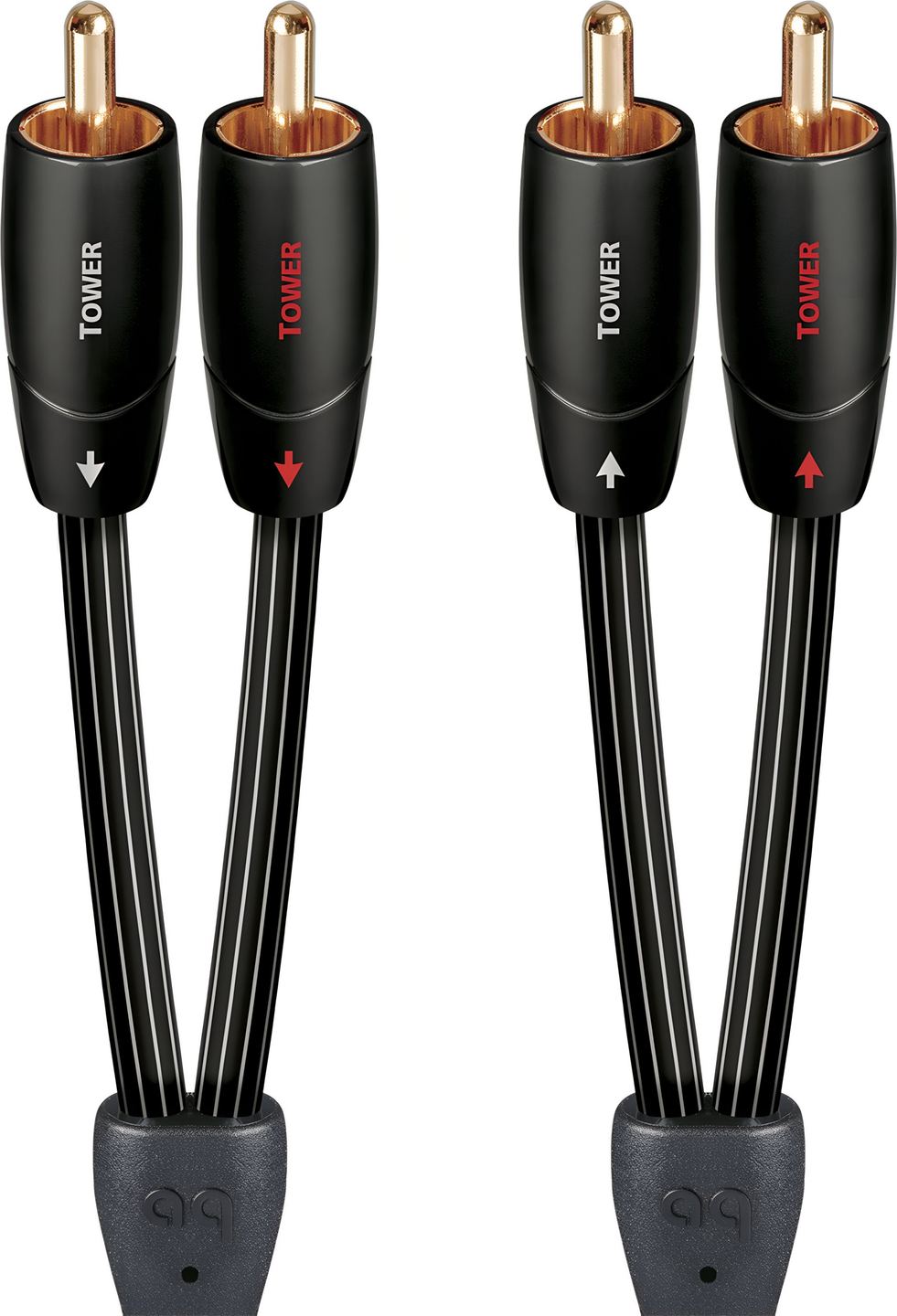
An analog interconnect cable that takes its name from London’s Tower Bridge: it is the first step in AudioQuest’s Bridges & Falls series, a range in which the American manufacturer concentrates most of its cabling technologies into a compact and affordable format. The Tower RCA uses the brand’s in-house recipe (solid long-grain copper conductor, low-loss insulation, noise-dissipation shielding) and offers it starting at 0.60 m, up to 20 m for long installations.
Most entry-level cables use stranded OFHC (Oxygen-Free High-Conductivity) copper conductors. The Tower RCA makes a different choice: a solid, single-strand LGC (Long-Grain Copper) conductor. The difference between the two lies in the metal’s crystal structure. LGC copper has longer grains, which reduces the number of crystal boundaries along the signal path. Each grain boundary acts like a micro-resistance that distorts the signal as it passes through. The fewer there are, the more faithful the transmission remains.
The choice of a single-strand conductor also has a direct consequence. In a stranded conductor, adjacent strands interact with each other under the effect of electromagnetic fields, which generates dynamic distortion (the signal is altered differently depending on its amplitude). A solid conductor eliminates this phenomenon. AudioQuest emphasizes one final point: the surface quality of the conductor acts as a guide for internal electric fields and external magnetic fields, hence the benefit of copper with low oxide and impurity content.
Any insulating material placed near a conductor absorbs a fraction of the signal energy, then releases it with a slight time delay. This phenomenon blurs transients and reduces dynamic contrast. The Tower RCA uses foamed polyethylene (PE) insulation, a material whose high air content limits this absorption. Polyethylene is a low-loss dielectric with a low-distortion profile, which makes it suitable for transmitting sensitive analog signals.
Achieving 100% shielding coverage is relatively simple. The real problem lies elsewhere: in traditional shielding, the noise energy and radio-frequency interference (RFI) captured by the shield are drained to the ground of the connected device. This stray energy then modulates the reference ground plane, which causes distortion in the audio signal.
AudioQuest’s metal-layer Noise-Dissipation System (NDS) works differently. An interposed metal layer absorbs and reflects most of the noise energy before it reaches the layer connected to ground. The shield still performs its barrier function, but without contaminating the device’s ground reference. The practical result is a lower noise floor, noticeable in low-level passages.
Many cables with unbalanced terminations (RCA) use a single path for ground and shielding. The Tower RCA separates these two functions thanks to a so-called asymmetrical double-balanced geometry, designed for unbalanced connections. This separation reduces impedance on the ground path, which promotes richer dynamic reproduction and a quieter background.
The Bridges & Falls series groups the left and right channels in a single jacket, with separate positive and negative conductors. This format produces a thin, flexible cable that is easy to install behind furniture or in a rack. One point to check before buying: the left and right RCA plugs are close together (less than 7.6 cm apart). If your devices’ inputs are spaced farther apart, AudioQuest recommends its Rivers or Elements series, whose plugs are independent.
The Tower RCA’s RCA plugs are assembled by cold welding, a high-pressure process that eliminates any traditional soldering. Tin solder, commonly used in connector assembly, introduces an additional alloy into the signal path, a potential source of distortion. The cold process avoids this added material.
The ground shells are stamped rather than machined. This manufacturing technique makes it possible to choose the metal based on its acoustic properties (low distortion) rather than its ease of machining. The gold plating protects the contacts against oxidation and ensures stable conductivity over time.
All internal conductors are direction-controlled (Direction-Controlled), a practice AudioQuest applies across its entire range to reduce residual RF noise.
The cable is sold individually. Each cable has two male RCA connectors on each side (left channel and right channel in the same jacket). A single cable is enough for a complete stereo connection.
The Tower and the Evergreen share the same type of conductor (solid LGC copper) and the same geometry. The Evergreen stands out with a braided fabric jacket and slightly larger-gauge conductors. Performance is similar, with the main difference being aesthetic and mechanical.
Yes. The cable carries an analog line-level or phono-level signal without restriction. For a moving-coil (MC) cartridge delivering a very low signal, the quality of the Tower RCA’s shielding (100% coverage with NDS dissipation) limits interference likely to degrade the signal-to-noise ratio.
The CL3/FT4 standard guarantees a level of fire resistance sufficient for installation inside walls. In standard use (visible cable or in a cable tray), it simply indicates that the jacket is robust and meets strict safety criteria.
AudioQuest controls the direction of its conductors at the factory (Direction-Controlled) to minimize RF noise. An arrow printed on the jacket indicates the recommended signal direction, from the source to the receiving device.
Florent
Excellent value for money for this cable.
Comment from July 13, 2026 — Experience from November 07, 2025
Michel
high-quality cable, excellent finish, a bit short for me but still used it
Comment from May 11, 2025 — Experience from June 14, 2020
Vincent
Good price range for quality RCA cables.
Comment from December 09, 2024 — Experience from October 31, 2024