Atoll Electronique MS120, compact network player and preamp
A chassis just 32 cm wide is enough here to house a network player, DAC and preamplifier with analogue volume control. Connected to an integrated amplifier, it acts as a simple source. Connected to a power amplifier or active speakers, it handles volume and selection of its six inputs. Atoll Electronique manufactures it in France, like the rest of its range.
Source or preamplifier, depending on the amplifier that follows
The two uses depend on a single function: bypass mode. This is activated by pressing and holding the dedicated button on the remote control, and a front-panel indicator shows its status. When enabled, it fixes the output level. The MS120 then connects to any line input on an integrated amplifier, which retains sole control of the volume. When disabled, it activates an analogue volume control using switched resistors. Relays select precision resistors, rather than moving a wiper along a potentiometer track or attenuating the signal in the digital domain. The player can then directly drive a power amplifier or a pair of active speakers, with a left-right balance setting that remains stored. Turning the volume down to zero opens the output relay and completely mutes the sound.
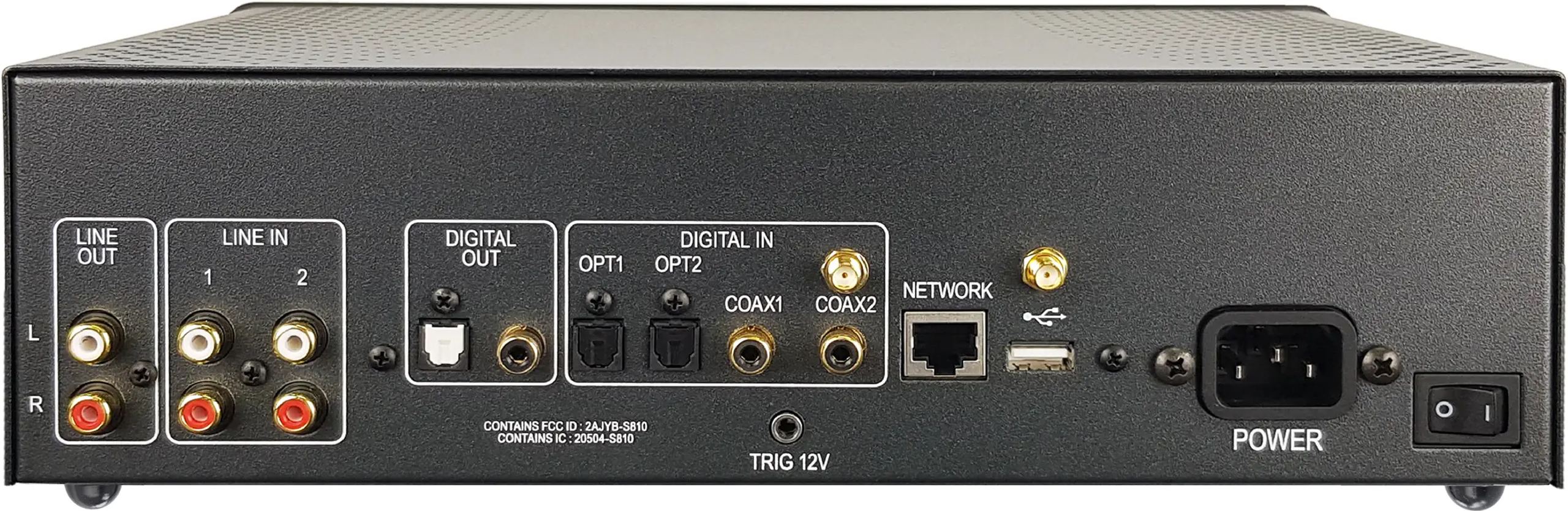
The 12 V trigger output, on a 3.5 mm jack socket, completes this setup. The connected power amplifier switches on and enters standby at the same time as the player, provided its own switch remains in the off position. Bypass can also apply to just one of the two analogue inputs, the one receiving a home cinema processor or amplifier. Volume control is disabled on that input to hand control over to the multichannel system, and this setting is retained even after a mains power interruption.
A Burr-Brown DAC and Class A stages without feedback
Conversion is handled by a Burr-Brown PCM1796 chip. It accepts PCM up to 24-bit / 192 kHz and DSD in DSD64 and DSD128, with a dynamic range and signal-to-noise ratio of 123 dB. Downstream, the preamplification stages use discrete components, operate in pure Class A and dispense with feedback. No circuit feeds part of the output signal back to the input to correct errors, which requires each stage to be inherently linear. The coupling and filter capacitors use metallised polypropylene film (MKP).
The power supply has several branches: one is dedicated to the audio stages, another to the DAC, for a total filtering capacitance of 5,435 µF. The analogue output delivers 2.8 V with an impedance of 22 Ω. This low value easily accommodates a long cable run to the amplifier. Class A also has its temperature requirements: the stages reach their ideal operating condition around half an hour after power-up. Standby mode therefore keeps them warmed up, with a power consumption of 7 W.
Online services, Roon and music stored at home
Qobuz, Tidal, Deezer, Amazon Music and HighResAudio are integrated into the device and app menus. Playlists, favourites and purchases from each account are directly accessible there. With Spotify Connect and Tidal Connect, playback starts from the service’s app on a phone, tablet or computer. The MS120 is compatible with Roon and Audirvana. Internet radio uses the Airable platform, which provides access to around 100,000 stations and podcasts, sorted by country, genre or popularity. A missing station can be added using its URL.
For personal libraries, the player browses DLNA and UPnP servers on the network, such as a NAS, by folder, album, artist, genre or composer. Two USB ports, one on the front and the other on the rear, read flash drives and hard drives formatted in FAT32, NTFS or EXT2/3/4. FLAC, ALAC, WAV, AIFF, DSF, AAC or MP3 files play without gaps between tracks (gapless playback), an important point for live albums or operas. Global playlists bring together tracks from the network and USB storage devices. Tracks from online services cannot be included, but each service has its own playlists.
Six inputs to bring the system’s other devices together
The MS120 also serves as a DAC for nearby devices. Its two coaxial inputs and two optical inputs accept up to 24-bit / 192 kHz. They accommodate a television, a console or a CD player used purely as a transport. The two analogue inputs accept a full CD player, a tuner or a phono preamp. Each input can be renamed or hidden from the main menu. Bluetooth 4.2 works as a receiver and allows music to be streamed from a visitor’s phone. The connection remains stable up to around five metres.
On the output side, the analogue RCA pair is accompanied by a coaxial digital output and an optical output, allowing an external DAC to be added as the system evolves. The front headphone output mutes the analogue output as soon as headphones are plugged in. For networking, the player connects via an RJ45 Ethernet port or Wi-Fi 802.11b/g/n. In automatic mode, it switches to the wired connection by itself as soon as a cable is plugged in.
Colour screen, remote control and remote operation
The 5-inch TFT screen, with a resolution of 800 × 480 pixels, displays the cover art, track title, album, format, resolution and elapsed time. It is not a touchscreen: navigation uses the buttons around it, the remote control or the ATOLL Signature 2 app for iOS and Android. The app mirrors the screen display, adjusts the analogue volume and wakes the device from standby as soon as a track is started. A web browser is also enough to control the player from a computer: simply enter its IP address followed by /webclient. Screen brightness is adjustable in steps and can be turned off completely, which is useful in a dark room.
The supplied remote also controls Atoll integrated amplifiers and preamps from the SE and Signature series, as well as the brand’s CD players. The volume and mute buttons can be assigned either to the network player or to the amplifier, depending on which device controls the level in the system. The chassis weighs 3 kg and features a 4 mm thick brushed aluminium front panel. It fits on a shelf or a piece of furniture where a standard 43 cm wide component would overhang.