


Benjamin
Sturdy and well-finished.
Comment from 17 March 2021 — Experience from 19 January 2021
Automatically translated — Show original (French)
Robuste et bien fini.
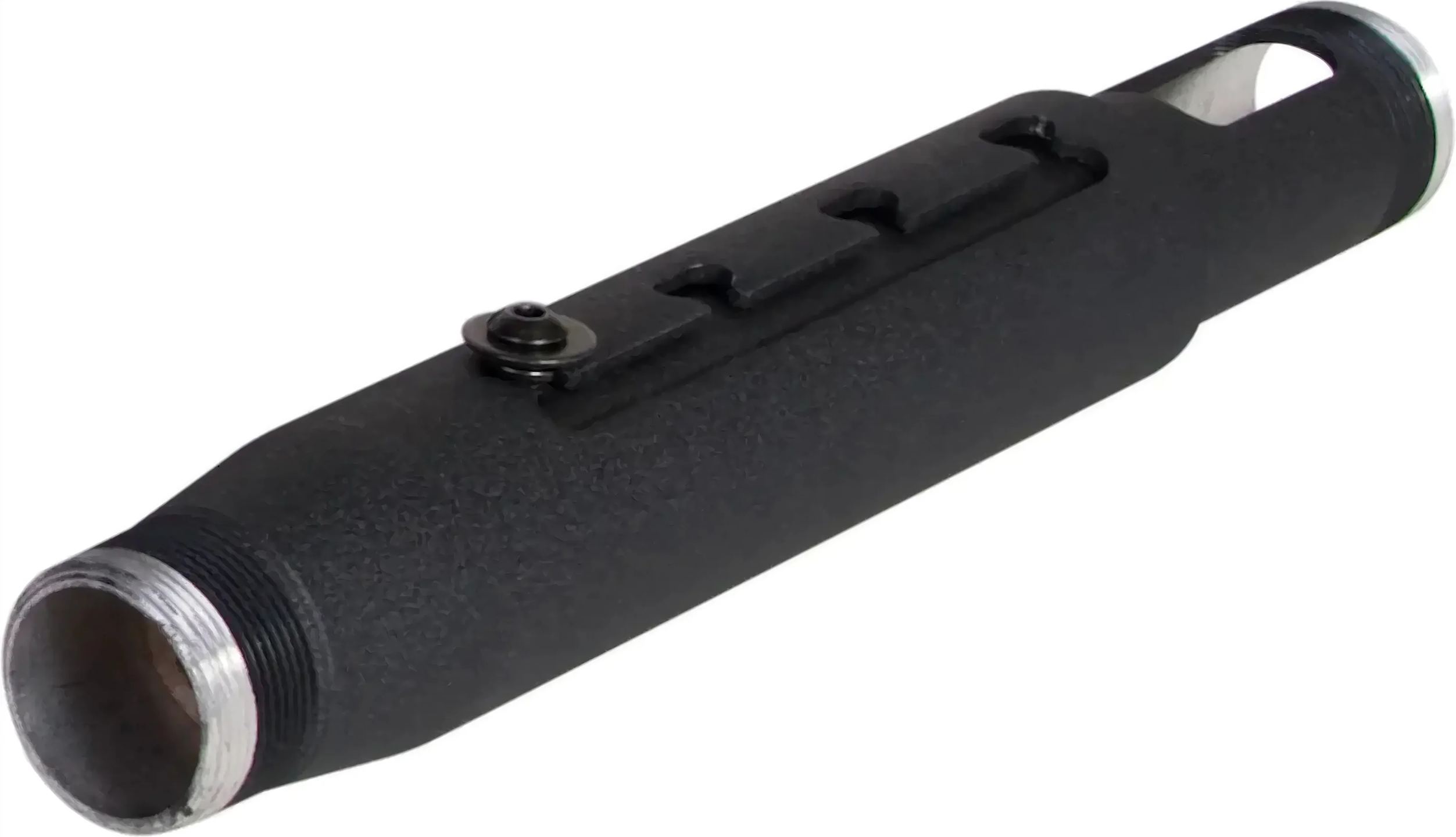
Between the ceiling and the screen, a projector lens needs to sit at the right height: too high, and the image spills over or becomes trapezoidal. This Chief extension column connects a ceiling plate to the projector mount and adjusts the drop from 30.5 to 45.7 cm. Adjustment requires no tube disassembly, making final alignment with the screen easier once the entire assembly is suspended.
The CMS012018 column belongs to Chief’s Speed-Connect range, a family of tubes that assemble simply by screwing together. Its telescopic aluminium body, with a 59 mm cross-section, slides through a series of notches spaced 2.54 cm (one inch) apart. To change the length, loosen the clamp, slide the tube to the desired notch, then secure the position with a clamping screw. Nothing needs unscrewing at either end: the ceiling plate and projector mount stay in place throughout the operation.
This notched adjustment is useful during installation. The ideal lens height can rarely be confirmed from a plan; it becomes clear once the image is projected. Being able to make corrections of a few centimetres without lowering everything again saves a trip up and down the stepladder and avoids choosing a column that is a few centimetres too short or too long.
Both ends have a 1.5-inch NPT thread (38.1 mm nominal diameter). NPT refers to an American tapered thread standard: the thread tightens as it is screwed in, creating a firm connection with no play. Chief has built an entire system around this standard, in which each component screws into the next.
At the top, the column takes the Chief CMA101 ceiling plate, a 127 mm disc that attaches to the ceiling through four holes or two opposing holes, depending on the available mounting surface. At the bottom, it takes a Chief projector mount: the universal RPAU and RSAU models, with adjustable arms that fit the mounting points of most projectors, or their RPMAU (RPA Elite series, with a keyed lock for theft protection) and RSMAU variants. Each connection is secured with a clamping screw, preventing the tube from unscrewing due to vibration or handling of the projector.
The hollow tube also serves as a conduit. HDMI cables, power cables or control cables run down from the ceiling through the inside of the column and emerge through a side opening near the mount. The result is neater than a bundle of cables hanging alongside the tube, especially in a living room where the projector is always visible. Cable length simply needs to be planned accordingly, allowing for the route inside the column and the slack needed for later height adjustments.
Chief specifies a maximum load of 226.8 kg, with TÜV and UL certifications confirming strength testing by independent organisations. A home projector generally weighs a few kilograms, or around ten for larger models: the margin is considerable. However, it is only meaningful if the entire chain is up to the task. The strength of a suspended installation depends on its weakest component, which is often the ceiling anchorage; this must be secured to a load-bearing structure (concrete slab, joist) using suitable fasteners. Chief recommends fitting by an installer, a reasonable precaution for a device suspended above a sofa.
No, the column is sold on its own. The box contains the tube, the clamping screw, the assembly hardware (screws, washers, nuts) and two Allen keys. The CMA101 mounting plate and the mount (RPAU, RSAU, RPMAU or RSMAU) are purchased separately to make up the complete assembly.
The Speed-Connect range is available in several lengths. For a shorter drop, the CMS009012 covers 22.9 to 30.5 cm; for a longer drop, the CMS018024 ranges from 45.7 to 61 cm. The calculation is made by adding the plate thickness, the column length and the height of the mount with the projector, then comparing the result to the desired lens height relative to the screen.
Yes, that’s the whole point of the notched system. Simply loosen the clamping screw, slide the tube, then retighten it. Since the projector remains suspended during the process, it’s best to have two people do it: one supports the unit while the other adjusts and locks the column.
It screws onto any accessory with a 1.5-inch NPT thread, whether from Chief or not. The official list (CMA101, RPAU, RSAU, RPMAU, RSMAU) covers the components that Chief has tested together, ensuring that the entire assembly can support the stated load.
Chief supports this use: with a flat-screen accessory with a 1.5-inch NPT thread, the column can suspend a television from the ceiling, for example in a room where no wall is suitable for wall mounting. Since the weight of a flat screen remains well below the load capacity, here again it is the ceiling anchorage that sets the actual limit.
The two supplied Allen keys are sufficient to tighten the column’s locking screws. You will also need tools for ceiling mounting (a drill, wall plugs or lag screws suitable for the mounting surface), a spirit level to check vertical alignment and, ideally, a second person to help position the projector.
Aluminium makes the column lighter, making it easier to handle overhead during installation and reducing the total load suspended from the ceiling. Its strength remains more than sufficient for a projector, as demonstrated by its certified load capacity of 226.8 kg.
Benjamin
Sturdy and well-finished.
Comment from 17 March 2021 — Experience from 19 January 2021


