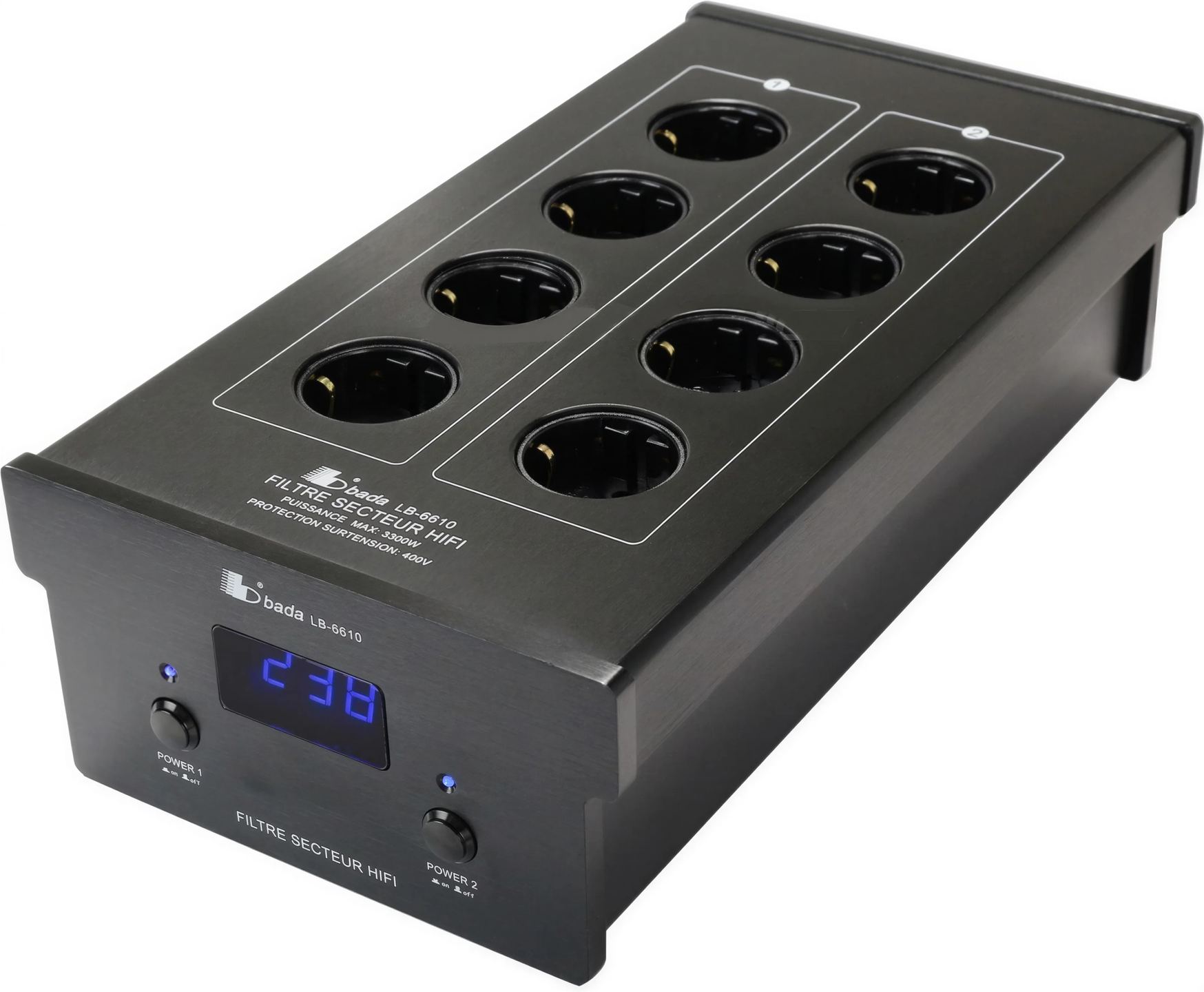
Bada LB6610 filtered power strip
A hi-fi system draws its power from a single wall socket, but its components do not use it in the same way: a network player or a converter consumes a few watts steadily, while an amplifier demands strong bursts of current in time with the music. This Bada power strip separates the two groups across two banks of four filtered sockets, each with its own switch, in a heavy enclosure with aluminium panels.
Two banks of four sockets according to power consumption
The first bank accommodates low-consumption devices: CD player or Blu-ray player, tuner, converter, network player, turntable, as well as an internet router, NAS and computer. The second handles equipment that requires more current: integrated or power amplifier, home cinema amplifier, subwoofer and active speakers. Each bank has its own front-panel switch, making it easier to power up a system of separate components: first turn on the sources, then the amplification, and follow the reverse order when switching off to avoid switching noises through the speakers. The same arrangement allows the amplifiers to be switched off while leaving the router or NAS powered on. The eight Schuko sockets have gold-plated contacts, a metal that does not oxidise and maintains a stable contact surface through repeated connections.
CLC filtering with toroidal inductors and WIMA capacitors
The domestic mains supply carries more than just the 50 Hz sine wave: switching power supplies in chargers, computers and household appliances feed high-frequency interference back into it, which travels to audio equipment. The power strip attenuates this with a CLC filter, comprising a capacitor, an inductor, then a second capacitor. This circuit acts as a low-pass filter: the 50 Hz current passes freely, while high frequencies are impeded by the inductor and shunted by the capacitors. Bada winds its inductors on gapped toroidal cores, with a small break in the magnetic core that delays saturation as current demand increases, and pairs them with WIMA MKP polypropylene film capacitors, a type of capacitor with a stable capacitance value and low losses. The filtering does not regulate the voltage or reconstruct the waveform: the power strip distributes the mains voltage with some of its interference removed.
Internal wiring in 2.5 mm² OCC copper
The interior is wired with 2.5 mm² OCC copper conductors. The abbreviation refers to a continuous casting process (Ohno Continuous Casting) that produces copper with very elongated crystals, with few grain boundaries along the conductor. This 2.5 mm² cross-section is the same as that used for socket circuits in French domestic installations, so the power strip does not create a bottleneck between the wall and the equipment. The unit accepts a total of 3,300 W and 15 A at 220 to 240 V, a limit to be considered against the combined consumption of the connected equipment: there is ample headroom for a stereo system, whereas a home cinema packed with Class A amplifiers or powerful subwoofers warrants a calculation beforehand.
Protection and rear-panel IEC inlet
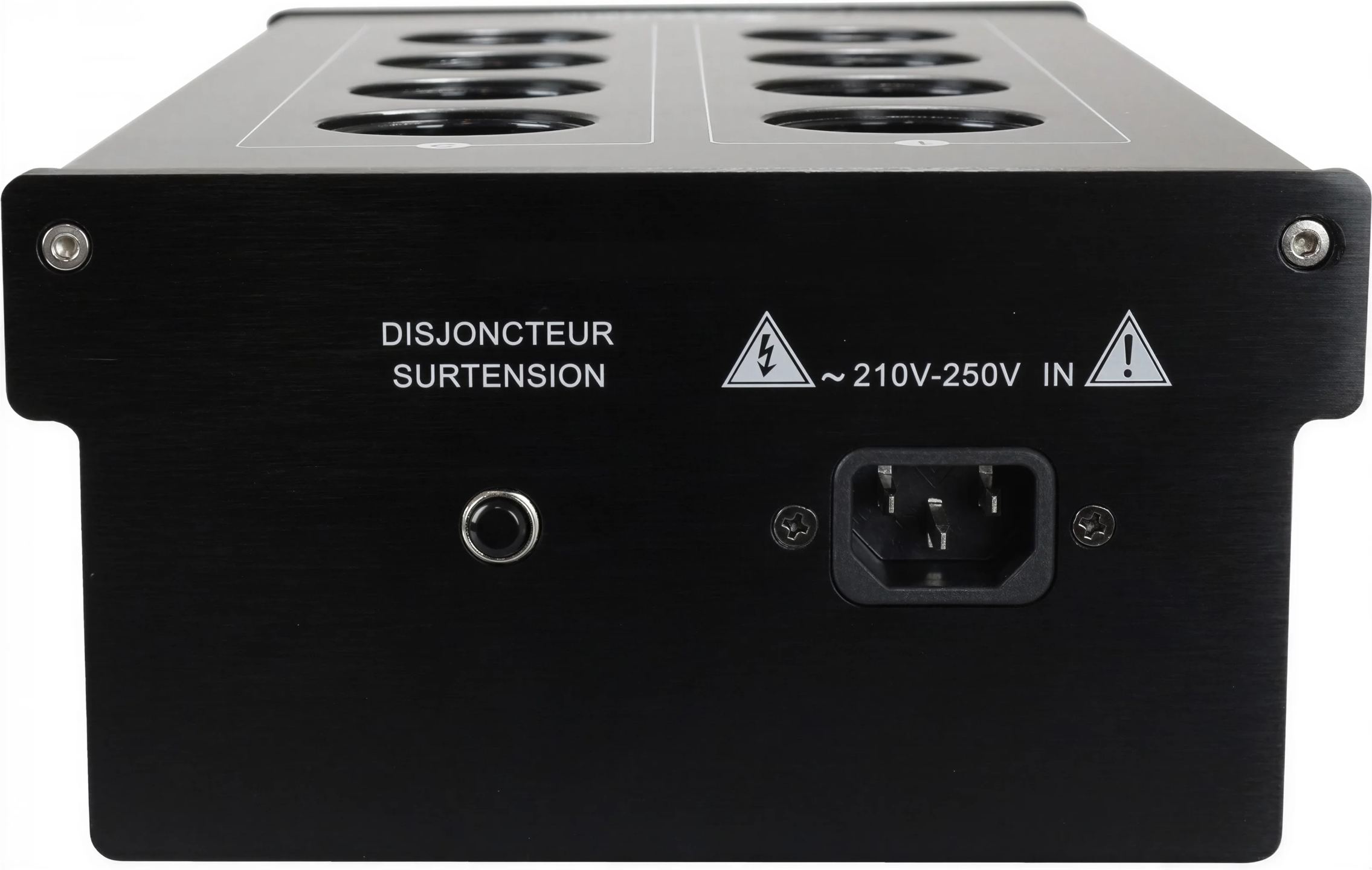
A main circuit breaker protects the installation against overvoltages up to 400 V and is reset using a button on the rear. Also at the rear, the power cord connects to a three-pole IEC inlet (live, neutral and earth). The supplied standard 1.5 m cable connects the power strip to the wall socket, and its detachable design leaves the option of a better-quality power cord when the time comes to upgrade this part of the system. This length requires the power strip to be placed within one and a half metres of the socket.
Observe the live orientation of each device
In a French wall socket, the earth pin allows insertion in only one orientation. A Schuko socket, with earthing provided by side clips, accepts the plug either way round, and this matters in hi-fi: depending on the orientation, the primary winding of a device’s transformer is connected to live at one end or the other, and the leakage current flowing to the chassis changes. The correct orientation, which gives the lowest voltage between chassis and earth, is sometimes marked on the plug or in the manual; otherwise, it can be measured with a multimeter, with the device disconnected from its interconnect cables. The hybrid CEE 7/7 plugs fitted to most equipment sold in France fit into the power strip’s sockets in both orientations.
Front-panel voltmeter and aluminium chassis
A front-panel digital voltmeter, controlled by an Atmel microcontroller, continuously displays the mains voltage. The standard specifies 230 V with a tolerance of 10%, and the display shows where your supply falls within this range and how it varies throughout the day: information about what the equipment’s power supplies receive, which the power strip displays without correcting it. The chassis features 8 mm-thick aluminium panels and weighs 5 kg, measuring 340 mm long, 180 mm wide and 100 mm high. With eight often stiff power cords connected to it, the power strip stays in place on the floor or on a furniture shelf.