
Akopian
Excellent choice.
Musical.
Well-balanced.
Robust.
Comment from 5 July 2021 — Experience from 25 March 2021
Automatically translated — Show original (French)
Excellent choix.
Musical.
Équilibré.
Solide.
Musical.
Équilibré.
Solide.
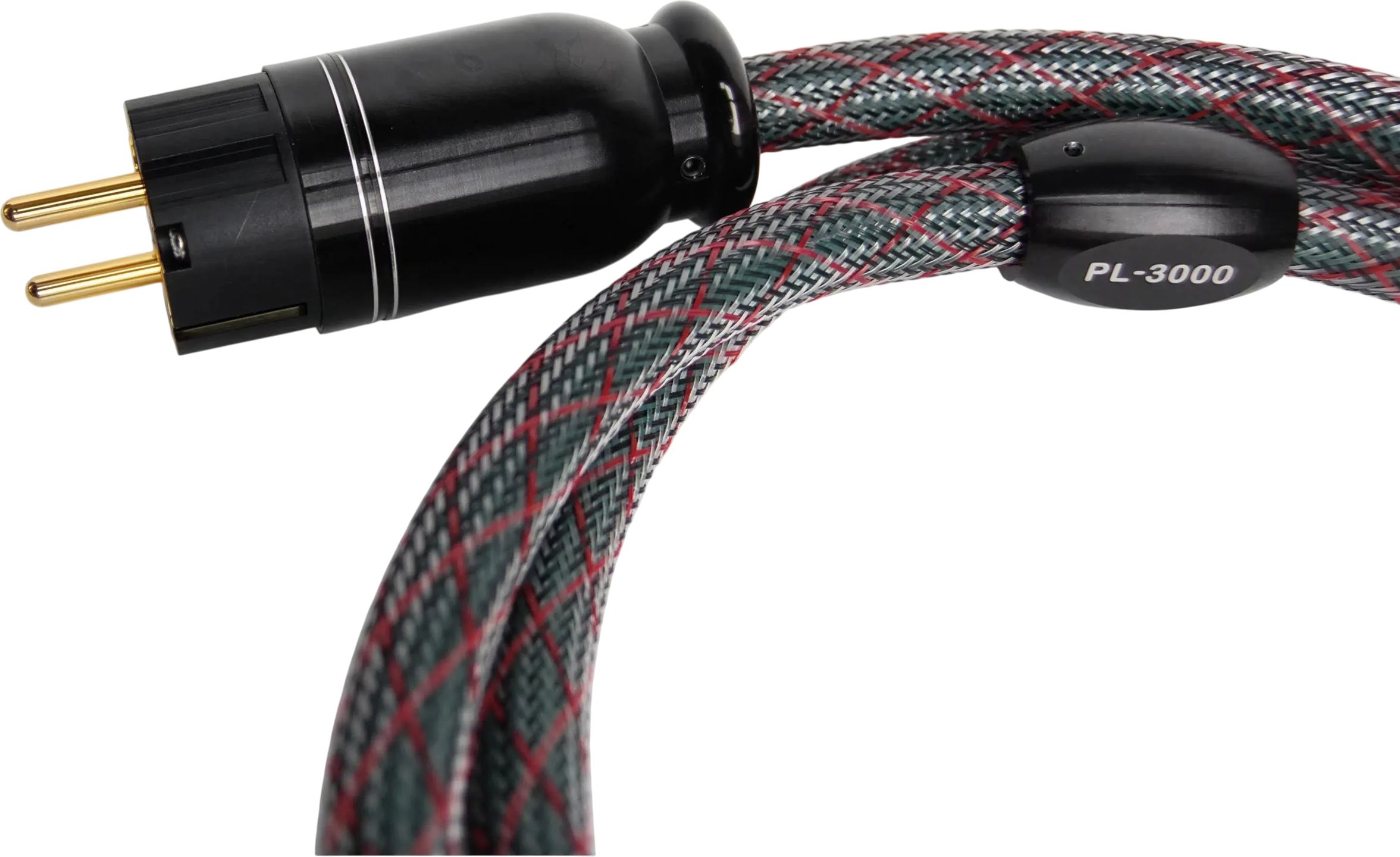

Between the wall socket and the amplifier, the supplied power cord is often the most modest component in the chain: thin conductors, no protection against interference and carelessly moulded plugs. The PL3000 upgrades this final metre and a half with high-purity copper, a generous cross-section, shielding and metal plugs with gold-plated contacts. It sits at the top of the Bada power cord range, above the PL1800.
The conductors are made from 99.99% pure oxygen-free copper (OFC), obtained through a slow deoxygenation process. Removing oxygen from the metal limits the formation of oxides between the copper grains, those small, less conductive areas that multiply over time in ordinary copper. Conductivity therefore remains stable over the years.
The 3.5 mm² cross-section matters just as much as purity. A cord supplied with a device usually makes do with 0.75 mm², sometimes 1 mm². Over a metre and a half, including the return path, the PL3000 has a resistance of around 0.015 Ω, compared with 0.07 Ω for a 0.75 mm² cord. The difference matters most with an amplifier using a linear power supply: its capacitors recharge in short pulses at the peak of each half-cycle, with current peaks far higher than average consumption, and a thick conductor handles these demands without a significant voltage drop. This needs to be kept in perspective: fifteen or so metres of 2.5 mm² household wiring already represent around 0.2 Ω upstream of the socket. The cord does not overhaul the electrical installation; it avoids adding a weak point at the end of it.
A sheet of aluminium surrounds the conductors. This type of shielding acts on high-frequency interference travelling through the mains or through the air in a living room equipped with an internet router, charger switching power supplies or light dimmers. It works in both directions: it protects the current reaching the device and prevents the cord from radiating towards the interconnect cables running alongside it behind the cabinet.
The 50 Hz magnetic field surrounding any power cable, however, passes through a thin sheet of aluminium. For this low-frequency component, positioning remains the best protection: keep power cords away from RCA or XLR connections and, when they must cross, have them cross at right angles rather than letting them run in parallel.
The PL3000 terminates in a male Schuko plug at the mains end and a female IEC C13 connector at the device end. Both connector bodies are aluminium, and their contacts are gold-plated. Gold does not oxidise, so contact resistance remains the same after years of plugging and unplugging, whereas a nickel-plated or bare brass contact tarnishes and loses connection quality. The metal body gives the connectors a firm grip, so they sit in the socket without play.
The C13 connector fits into the trapezoidal, three-pin C14 inlet found on the vast majority of amplifiers, CD players, converters and network players. The standard rates it for 10 A, or around 2,300 W at 230 V: it is this figure, rather than the conductor cross-section, that sets the cord’s operating limit. This capacity comfortably covers typical hi-fi electronics.
The amplifier is the first place to use the PL3000, since it is the device that draws the most current and whose current demands benefit most from a large cross-section. Source components come next, particularly when they share a cramped cabinet with interconnect cables protected by the shielding.
At a metre and a half long, the cord easily connects a power distribution unit placed on the floor or on a shelf to devices in a hi-fi rack. Its Schuko plug fits naturally into a distribution unit with Schuko sockets, such as those in Bada’s LB series. A shielded 3.5 mm² cross-section makes for a stiffer cable than the original cord: it is best to allow a few centimetres of clearance behind the device so that the C13 connector does not put strain on the inlet.
A French socket has a protruding earth pin, whereas a Schuko plug provides an earth connection through two side clips. A Schuko plug with a central hole (the so-called hybrid format, CEE 7/7) fits into a French socket while maintaining the earth connection. Without this hole, the plug connects to a distributor or power strip with Schuko sockets.
The cord has no orientation marking. A Schuko plug is reversible: depending on how it is inserted, the live wire connects to one or the other pin on the device. Some enthusiasts compare the two positions by listening, and testing poses no risk to the equipment since both orientations are allowed by the standard.
Yes, provided the device has a three-pin C14 inlet. Many TVs and small devices use an ungrounded figure-eight inlet (C7), which does not accept the PL3000’s C13 plug.
No, the two complement each other. The PL3000’s shielding protects the cable run itself, but the current coming from the outlet already carries interference from the home’s electrical network. Filtering it is the job of a filtered power distributor or a power conditioner placed upstream, into which the PL3000 is then plugged.
Up to 10 A, yes. Some high-power power amplifiers use an IEC C20 inlet, rated for 16 A and recognizable by its wider horizontal pins: it requires a cable fitted with a C19 connector, which the PL3000 does not have.
A network player or converter draws little current, so a large conductor cross-section plays a secondary role here. Shielding and contact quality remain useful: these devices often incorporate digital circuits and power supplies sensitive to high-frequency interference, and they sit alongside interconnect cables in the cabinet.
Akopian
Excellent choice.
Musical.
Well-balanced.
Robust.
Comment from 5 July 2021 — Experience from 25 March 2021


