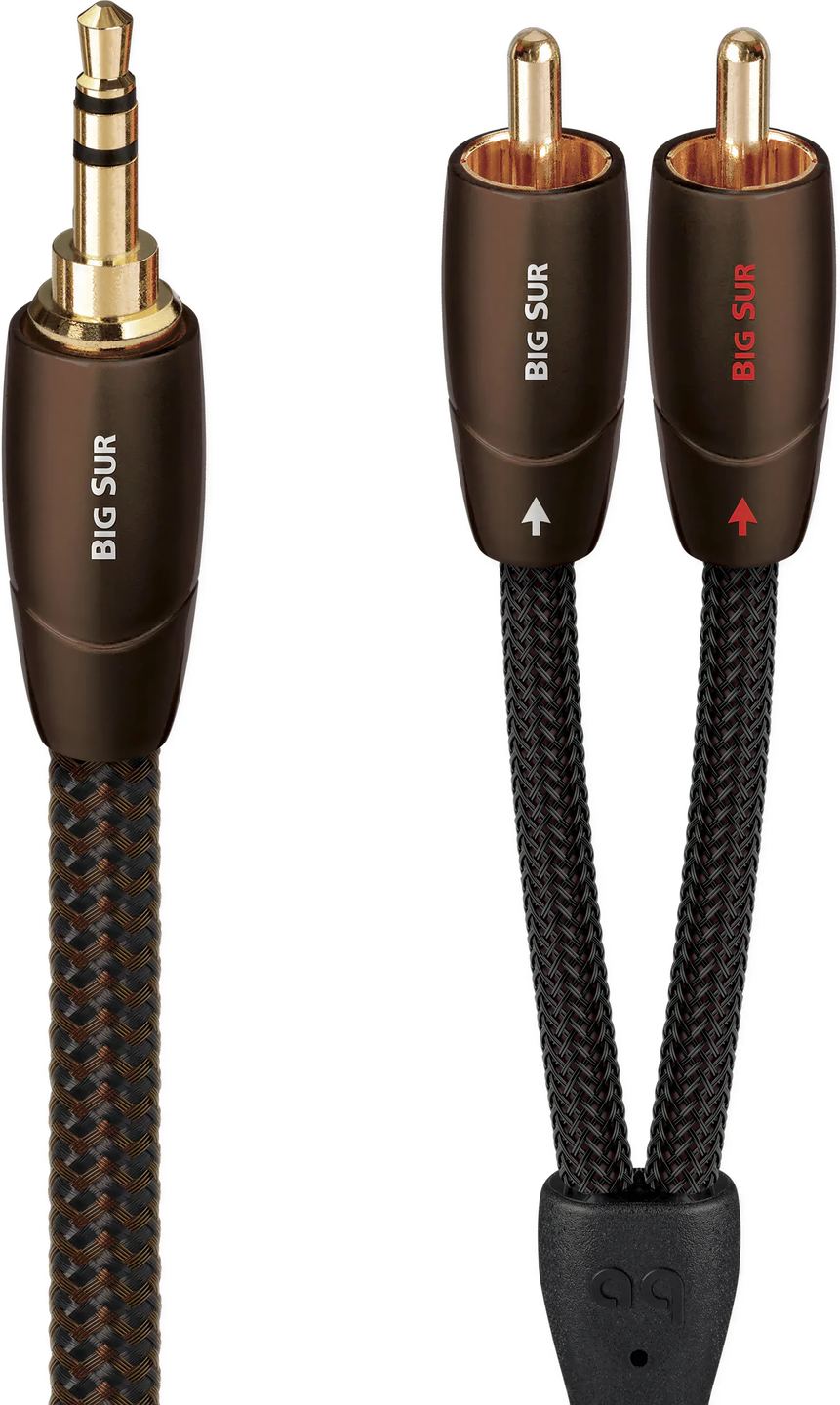
Connecting a smartphone, portable DAC, or computer to a hi‑fi amplifier requires converting a mini‑jack output to a stereo RCA input. AudioQuest’s Big Sur fulfills this role with five meters of cable, a length sufficient for setups where the source is located a reasonable distance from the amplification system. This model sits at the top of the Bridges & Falls series, just below the Californian brand’s silver‑technology cables.
PSC+ copper and solid conductors
The Big Sur uses copper processed with the Perfect Surface Copper+ (PSC+) method, a more advanced version of the PSC used on the Golden Gate. AudioQuest applies a proprietary surface treatment designed to reduce the metal’s micro‑roughness. These irregularities, even when invisible, can disrupt the flow of electrons and generate artifacts in the audio signal.
The conductors are solid core, not stranded. This distinction matters: in a multi‑strand cable, each strand can interact electrically and magnetically with its neighbors. These interactions create distortion phenomena that solid conductors inherently avoid. The Big Sur fully leverages this principle along its entire five‑meter length.
Geometry designed for unbalanced signal
Most consumer RCA cables use a single conductor for both ground and shielding. The Big Sur separates these two functions thanks to its “asymmetrical double‑balanced” geometry. The shield captures radio and electromagnetic interference, while a dedicated conductor provides the return path for the signal to ground. This separation reduces contamination of the signal by captured noise.
The ground‑side impedance is intentionally lower than that of the signal path. AudioQuest claims that this configuration improves perceived dynamics, particularly on fast transients and passages with strong contrast.
Foamed polyethylene insulation
The insulation surrounding the conductors plays a role that is often underestimated. Any solid material in contact with copper absorbs part of the electrical energy, stores it, then releases it with a slight time delay. This phenomenon smears micro‑details and can create a sense of sonic “blur”.
The Big Sur uses foamed polyethylene (Foamed‑PE), a material whose structure contains air bubbles. Air absorbs almost no energy, and polyethylene exhibits a distortion profile considered benign by cable designers. This combination limits the energy storage‑and‑release effects that affect other, denser insulators.
Purple copper terminations with gold plating
The Big Sur’s mini‑jack and RCA plugs are made from “Purple Copper”, a high‑purity copper that AudioQuest reserves for its upper‑range models. This metal replaces the nickel or standard OFHC used on more affordable cables. The plugs are then gold‑plated to resist oxidation and maintain a stable electrical contact over time.
The connection between conductor and plug is made by cold‑weld. This process applies intense mechanical and electrical pressure to fuse the metals without using an intermediate solder alloy. The absence of conventional solder (tin‑lead or silver) eliminates a transition zone whose electrical properties differ from those of copper.
Noise‑dissipation system
Home environments are full of interference sources: Wi‑Fi routers, phones, light dimmers, household appliances. The Big Sur incorporates an NDS (Noise‑Dissipation System) made up of metallic layers and carbon‑loaded synthetic materials.
This multilayer shielding absorbs and reflects radio frequencies before they reach the equipment’s ground plane. Without this protection, captured interference can modulate the ground reference and introduce audible background noise, which is particularly troublesome with low‑level sources such as smartphone headphone outputs.
A single jacket for both channels
Like all cables in the Bridges & Falls series, the Big Sur combines the left and right channels in a single brown‑and‑black braided jacket. This design makes the cable thin and flexible, easy to install behind furniture or along a baseboard. The trade‑off with this configuration: the RCA plugs are close to each other, spaced about 7 cm apart.
If the L and R inputs on your amplifier are more than 8 cm apart, installation is still possible but the cable will be under slight tension. For equipment with widely spaced connectors, AudioQuest recommends its separate‑jacket series (Rivers or Elements).
Typical uses
The mini‑jack‑to‑RCA format suits many situations. Connecting a portable DAC like the FiiO M11 to a Sugden amplifier, plugging a MacBook’s headphone output into active speakers, or hooking up a portable audio player to a desktop headphone amp: all these use cases make full use of the Big Sur’s characteristics.
The cable also works in the opposite direction (RCA to mini‑jack) if your setup requires it, but AudioQuest indicates an optimal connection direction with arrows printed on the jacket. This direction corresponds to the orientation of the shielding, designed to drain interference back toward the source.