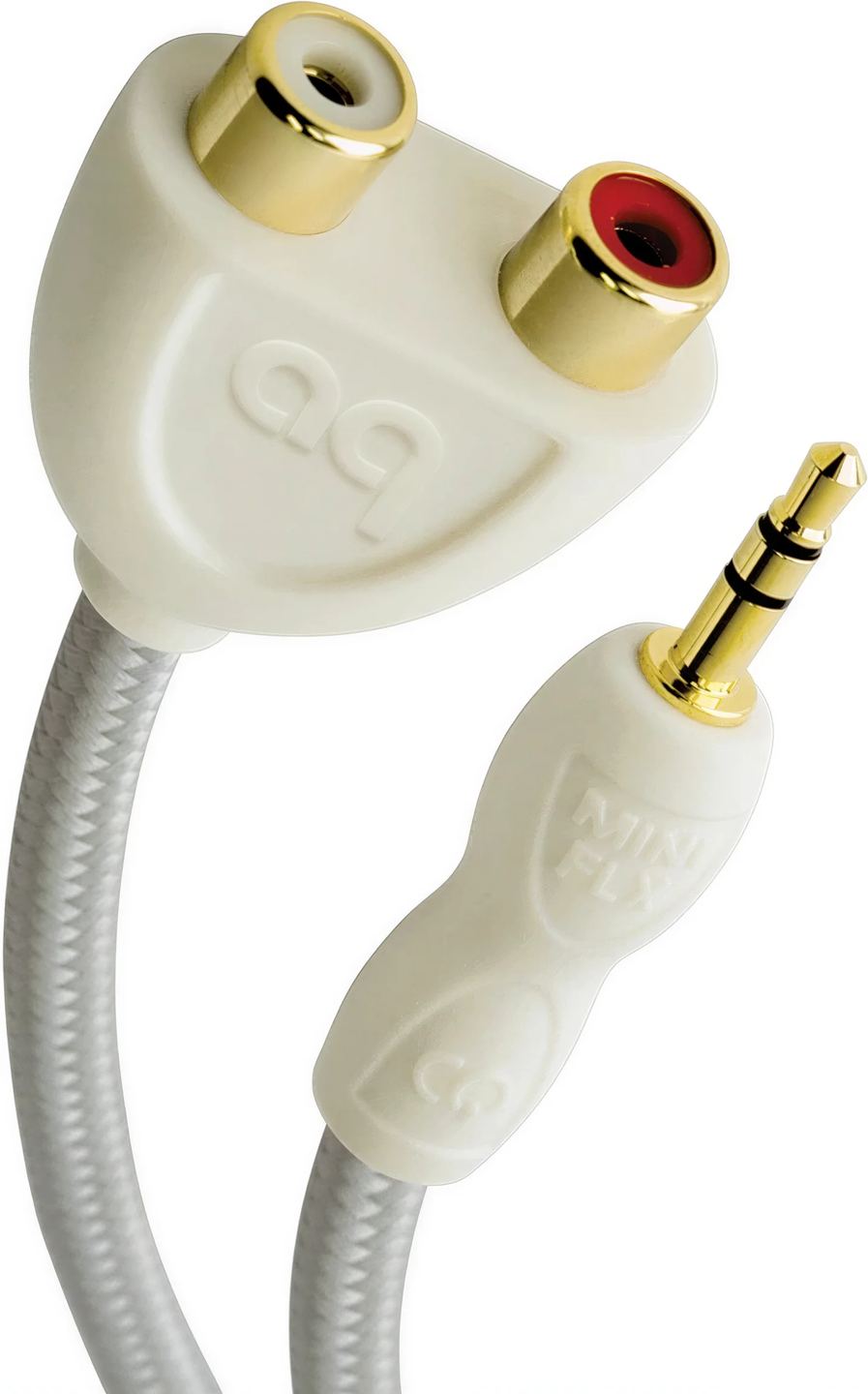
AudioQuest FLX-Mini/RCA Adapter
A headphone output on one side, a pair of RCA cables on the other: this situation often arises when connecting a phone, laptop or portable music player to an amplifier or active speakers. AudioQuest offers a short, flexible 15 cm extension lead, terminated with two female RCA sockets. It accepts the interconnect cable already in place and relieves the mini-jack socket of any mechanical strain.
A flexible extension rather than a rigid block
The most common mini-jack-to-RCA adapters are single-piece moulded blocks. Plugged into a device’s headphone socket, they bear the full weight of both RCA cables and exert leverage on a 3.5 mm socket that is far from robust, especially on a phone or laptop. Here, 15 cm of cable separates the male plug from the two female sockets: the RCA cables rest on the furniture or hang freely, and the mini-jack plug bears only its own weight. The silver and white braided sheath remains slim, allowing the adapter to pass behind a device positioned against a wall or through a narrow cable opening.
Solid PSC+ copper from one connector to the other
Each conductor is a single strand of Perfect-Surface Copper+ (PSC+), AudioQuest’s proprietary copper. A solid conductor eliminates the electrical and magnetic interactions that occur between the dozens of fine wires in a stranded conductor. PSC+ adds two things: a very smooth, polished surface along which part of the signal travels, and high purity that limits grain boundaries, the borders between the small crystals that make up all metals and that the signal must cross. Over 15 cm, contacts and mechanical stability matter more than metallurgy, but this attention to detail prevents the adapter from becoming the weakest link in a connection with a good-quality RCA cable. The solid strand remains flexible at this cross-section; it is simply best to avoid repeatedly bending it at a sharp angle in the same place, right next to the connectors.
Connecting a portable source to a hi-fi system
The 3.5 mm stereo mini-jack plug carries both channels over three contacts: the tip for the left channel, the ring for the right, and the sleeve for ground. The adapter routes them to two RCA sockets labelled left and right, where you connect the cable running to a line input on the amplifier (AUX, CD, Tuner) or to the RCA inputs on active speakers.
A headphone output delivers a level that varies with the source device’s volume. The right setting is to turn this volume up fairly high, to around three-quarters, then adjust the listening level using the amplifier’s volume knob. A source volume that is too low forces you to turn up the amplifier and makes hiss more noticeable; at maximum volume, some phones or computers clip and make the sound harsh.
An adapter that works in both directions
A passive adapter simply connects contacts to one another: the signal can travel in either direction. The FLX-Mini/RCA can therefore also connect a source with RCA outputs (CD player, tuner, phono preamplifier) to a device whose only input is a female mini-jack socket, such as a tabletop radio, active computer speakers or a car stereo equipped with an auxiliary input. The RCA cable from the source connects to the two female sockets, and the mini-jack plug goes into the AUX input. A CD player’s line level, around 2 V, is suitable for the vast majority of these inputs.