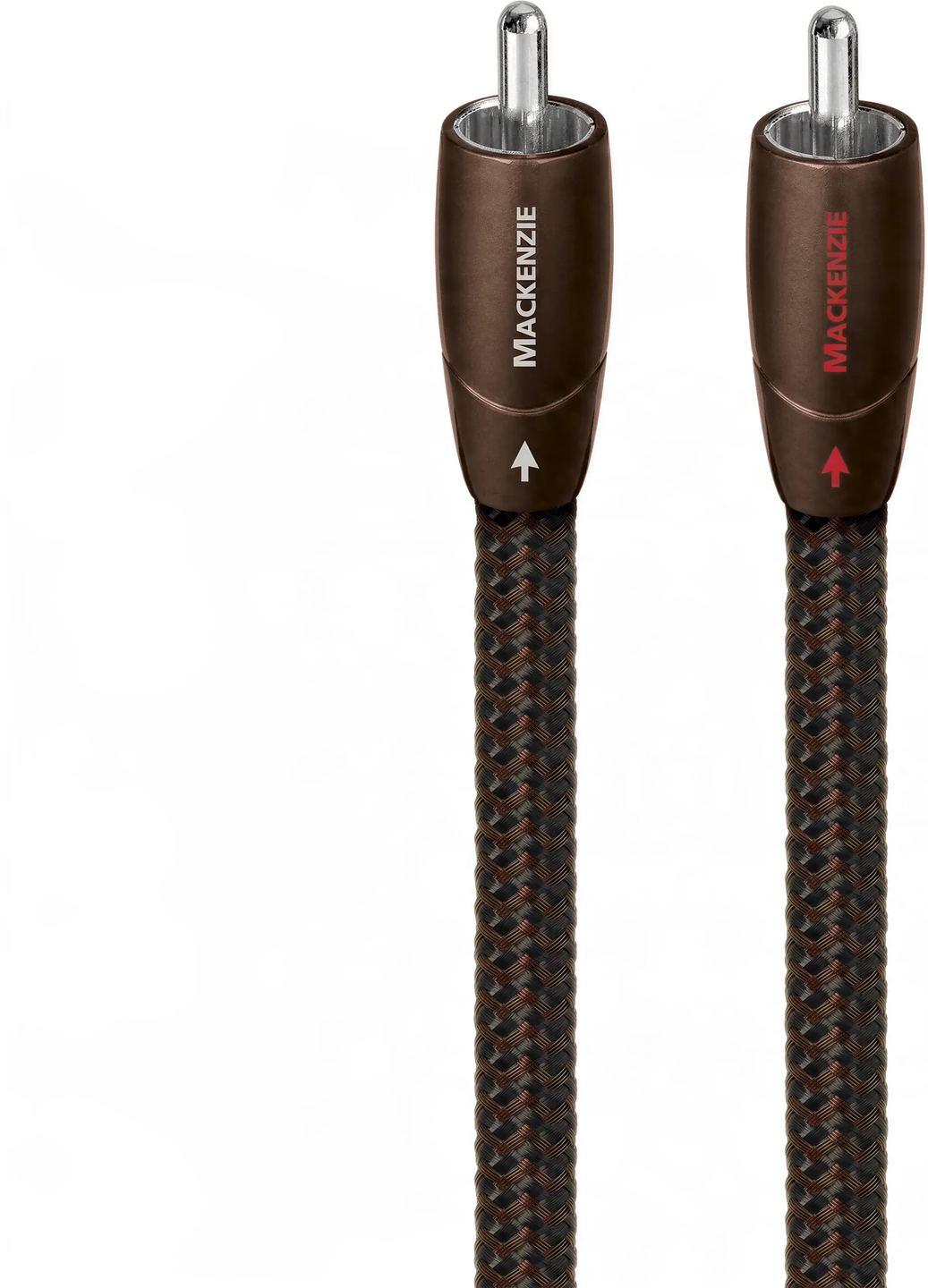
AudioQuest Mackenzie RCA, analog interconnect cable
Between a player and an amplifier, the analog signal is only a few volts and retains a trace of everything it passes through: the metal of the conductors, the insulation around them, the interference picked up along the way. AudioQuest built this cable by addressing each of these points, with higher-purity copper, a separate ground conductor and plugs assembled without solder. It sits in the middle of the brand’s Rivers series, named after North American rivers.
Solid PSC+ copper for every conductor
All conductors are made of PSC+ (Perfect-Surface Copper+), the brand’s most refined grade of copper at this price level. The metal has fewer grain boundaries, meaning fewer borders between its constituent crystals, and its surface is carefully smoothed. AudioQuest attributes some of the distortion a signal suffers as it passes through ordinary copper to these boundaries.
The conductors are solid: each is a single wire, rather than a bundle of thin, twisted strands. In a stranded cable, the strands touch and interact electrically and magnetically, which the brand considers the main source of distortion in a conventional interconnect. A solid conductor eliminates the problem at its source. The trade-off is mechanical: the cable is less tolerant of tight, repeated bends than a stranded model. It is better to route it behind the equipment once and leave it in place rather than twist it every time it is handled.
A ground path that no longer runs through the shield
In most RCA cables, the shield also serves as the return conductor: the metal braid that protects the signal is also part of the circuit. The Mackenzie’s Triple-Balanced geometry separates these functions with three distinct conductors, one for the positive signal, one for the negative signal and a third dedicated to the ground reference. The shield is confined to its protective role, and both signal poles have conduction paths of equal quality.
This design does not turn an RCA connection into a balanced connection. The RCA connector remains inherently unbalanced, and the noise rejection characteristic of XLR connections is not present here. The benefit lies in a cleaner signal return, which no longer mixes with interference currents picked up by the shield.
Air-filled insulation
Around the conductors, AudioQuest uses nitrogen-injected hard-cell foam. The injection creates air pockets in the material, and air is the best possible insulator for an audio signal. Any solid insulation absorbs a little energy and then releases it with a slight delay, superimposing it on the original signal. The greater the proportion of air, the less this occurs. The rigidity of the cells has a second benefit: it keeps the spacing between the conductors constant along the entire length of the cable, even when it is bent.
The next model up in the series, the Yukon, takes this approach further with conductors housed in polyethylene air tubes.
A carbon network to combat radio interference
A shield that completely covers the cable is easy to make. The difficulty lies in what it then does with the radio interference it picks up: a traditional shield absorbs it and then drains it to the equipment ground, which also serves as the reference for the audio signal. The noise modulates there and ends up veiling the sound.
The Mackenzie’s three-layer dissipation system alternates metallic layers with carbon-loaded synthetic materials. This combination absorbs or reflects most of the interference before it reaches the equipment ground. In a room filled with sources of radiation (internet router, Wi-Fi, switching power supplies, phones), this is the design feature that works hardest day to day.
Connection direction indicated by arrows
The conductors are directional: AudioQuest controls the direction in which the copper is drawn and then installed, to encourage radio-frequency noise to drain in a given direction. Arrows printed on the plugs indicate the connection direction, from the source to the device receiving the signal. Reversing the cable does not cut off the sound or damage anything, but the brand’s intended orientation is lost.
Cold-welded pure copper plugs
The RCA plugs are built around a high-purity red copper body, in other words unalloyed copper, which is more conductive than the brass used in most standard plugs. Silver plating is applied directly to this copper, without an intermediate underlayer. The conductor is connected to the plug by high-pressure cold welding: the two metals are joined by pressure, without adding tin, avoiding the introduction of a lower-quality metal at the precise point where the signal passes from one component to the other. The downside of this process is that a damaged plug cannot be resoldered at home.
The cable connects any device with a line output to an analog input: CD player, DAC, network player, phono preamplifier or tuner to an integrated amplifier, receiver or preamplifier, or a preamplifier to a power amplifier.