Fernandez
Second-hand product, Very good
Comment from May 13, 2026 — Experience from May 02, 2026
Automatically translated — Show original (French)
Produit seconde main,Très bien
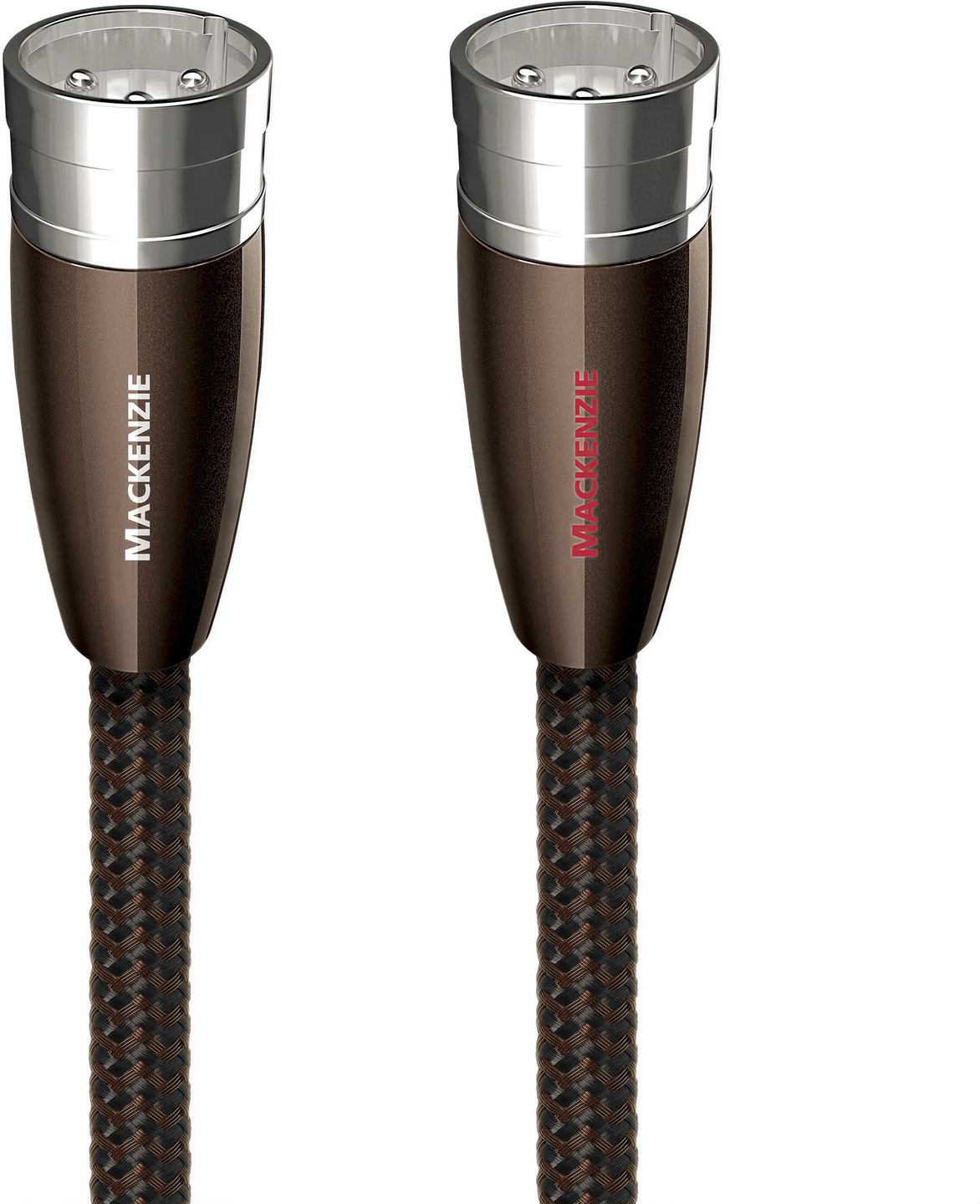
Moving from an RCA connection to a balanced connection changes the way noise travels between two devices. The principle is well known: two signals of opposite polarity, a separate ground, and an input stage that subtracts one from the other. But the cable must maintain this balance from end to end. This is the territory of the second tier of AudioQuest’s Rivers series, positioned between the Red River and the Yukon.
Triple Balanced geometry is based on three independent conductors: one for the positive signal, one for the inverted signal, and a third dedicated to the ground reference. The shielding covers the entire length and carries no signal. The distinction is far from cosmetic. In a cable where the shield serves as the return conductor, radio-frequency interference picked up by this envelope modulates the devices’ ground reference, and this modulation ultimately appears in the audio signal. By separating the two functions, Mackenzie leaves the shield with its sole role as a barrier. The same geometry is found on the RCA version of the cable, where the two signal conductors remain separate from the ground.
The conductors are made from Perfect Surface Copper+, the finest copper in the AudioQuest catalogue, surpassed only by PSS silver reserved for higher series. The work focuses on surface condition: the wire is protected at every stage of drawing and manufacturing to remain smooth, with the brand aiming to reduce distortion linked to grain boundaries. This marks the difference from the Red River, which remains a step below in metallurgy.
All conductors are solid rather than stranded. AudioQuest’s argument concerns the electrical and magnetic interaction between neighbouring strands, which a solid conductor eliminates by design. It is best understood for what it is: a matter of purity and geometry, not gauge. At audio frequencies, skin effect remains marginal with such fine gauges.
Achieving full-coverage shielding costs little. Preventing captured radio frequencies from reaching the devices’ ground plane requires more, which is the purpose of the in-house noise-dissipation system. Three alternating layers of metal and carbon-loaded synthetic materials “shield the shield”: they absorb and reflect most of the unwanted energy before it reaches the layer connected to ground. The Red River makes do with dissipation through a metal layer; the move to the three-layer carbon network is the other structural difference between the two models.
In a contemporary hi-fi cabinet, the benefit is tangible: switch-mode power supplies, internet boxes, Class D amplifiers and lighting dimmers saturate the radio spectrum around the equipment, and this pollution ultimately enters through analogue interconnects.
Hard-Cell Foam insulation is polyethylene expanded by nitrogen injection, creating gas pockets in contact with the conductor. Nitrogen absorbs virtually no energy and therefore does not release it in the form of distortion, unlike solid PVC. The foam’s rigidity serves a second purpose: it keeps the spacing between conductors constant along the entire length, stabilising the cable’s characteristic impedance.
The trade-off is noticeable during installation. Mackenzie is a firm cable, sheathed in a black and brown braid, which requires a few centimetres of clearance behind the rack and does not tolerate tight bends well. For restricted cable runs, it is better to allow a little slack than to force the bend radius right at the connectors. The Yukon, one tier above, uses polyethylene air tubes.
The male and female XLM connectors are assembled without solder. AudioQuest cold-welds the conductor to the pin, since solder is a foreign alloy inserted into the signal path. The ground bodies are stamped rather than machined: the metal can therefore be selected for its electrical properties rather than its machinability. The contact is silver deposited directly onto high-purity purple copper, without the nickel underlayer commonly found on standard connectors.
This construction has a practical consequence: the cable is made to order in the Irvine, California workshops and cannot be re-terminated at home. Non-catalogue lengths and terminations must go through the retailer, with a lead time. The conductors are oriented according to a direction determined by the manufacturer through listening tests, and an arrow printed on each connector indicates the connection direction, from source to destination.
One point deserves to be stated clearly: common-mode noise rejection is the job of the receiving component’s differential input stage, not the cable. Mackenzie cleanly carries the two polarities; it does not create balance. Some devices fitted with XLR sockets convert the signal back to unbalanced immediately behind the connector; the connection works, but the expected benefit is reduced. Checking what the electronics actually do upstream and downstream avoids disappointment.
Where a balanced connection delivers on its promise, it tolerates long cable runs without significant degradation, something an RCA connection handles less well. By convention, the XLR output delivers a level approximately 6 dB higher than the RCA output of the same device, a difference that becomes noticeable when comparing two inputs by ear.
The cable connects any equipment fitted with analogue XLR sockets: digital-to-analogue converter to preamplifier, preamplifier to power amplifier, network player or CD player to an integrated amplifier, audio interface or console to active speakers. A stereo connection requires two cables, one per channel.
One caveat to keep in mind: this is an analogue cable. An AES/EBU digital connection, which also uses XLR connectors, requires a 110-ohm characteristic impedance and a cable designed for that purpose. Using an analogue interconnect for this path sometimes works, but may lead to read errors depending on length and sampling rate.
AudioQuest offers the Mackenzie XLR individually or as a pair. A standard stereo connection requires two cables, one per channel. Purchasing individually is mainly intended for mono connections, such as a subwoofer with an XLR input or a center channel.
The cable has a female connector and a male connector. The female connector plugs into the source output, and the male connector into the input of the receiving component. The arrow printed on the connectors confirms this direction of flow, from the source to the destination.
It is electrically possible, but the adapter connects the inverted signal pin to ground. The connection becomes unbalanced again, the level drops by approximately 6 dB, and the benefits of the three-conductor geometry disappear. For an RCA connection, the RCA version of the Mackenzie uses the same internal design.
The pinout is compatible and phantom power would pass through without difficulty, but that is not its intended use. Mackenzie is an installation cable, rigid, made to order in a specified length. A stage cable requires flexibility and resistance to repeated handling that this construction is not designed for.
Yes. The catalog covers several standard lengths, and AudioQuest accepts specific lengths and terminations through an authorized dealer. As each unit is assembled to order, these requests extend the delivery time.
Fernandez
Second-hand product, Very good
Comment from May 13, 2026 — Experience from May 02, 2026
Alain
Very good quality, detailed and balanced sound, in a word perfect
Comment from September 08, 2025 — Experience from August 28, 2025