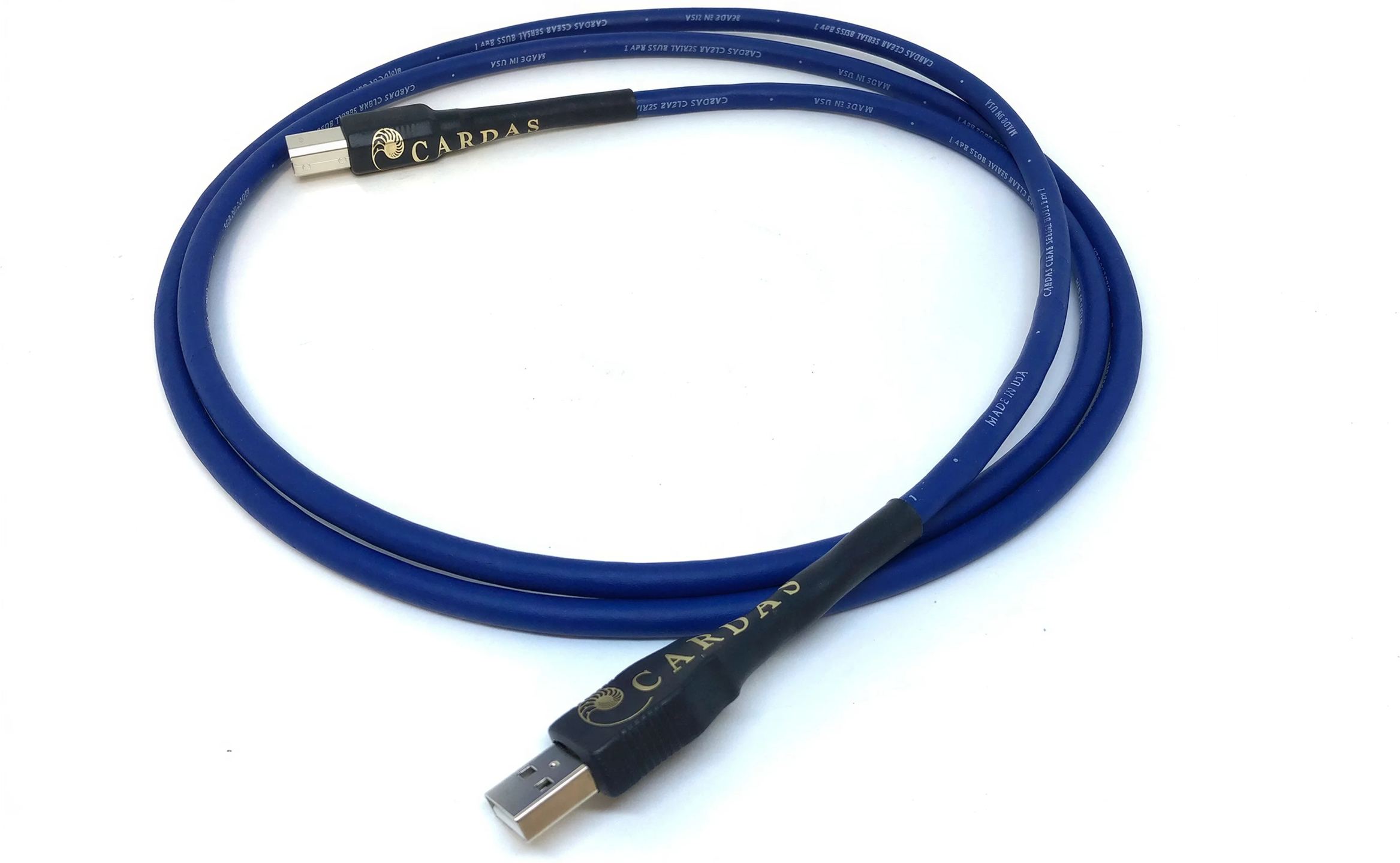
Cardas Clear USB Cable 1 m
Between a computer, or a network player, and a DAC, a USB connection carries more than just music: it also carries a 5 V power supply and electrical noise from the device sending the stream. For this cable, Cardas has used the conductors from its Clear series, the same ones found in its high-end interconnects and speaker cables, and arranged them to keep data separate from power. Each cable is hand-terminated in Oregon.
Clear series conductors go digital
Each conductor is a bundle of strands of 99.9999% pure, oxygen-free Grade 1 copper, which Cardas coats individually with a clear enamel. This Litz principle electrically isolates the strands from one another: current is distributed across the entire cross-section rather than concentrating on the surface or passing from one strand to another. The strand diameters are not identical. They follow a progression based on the golden ratio, the brand’s signature since its beginnings, which spreads out the resonances specific to each diameter rather than combining them at a single frequency.
The layers of strands are wound in a cross-field arrangement, meaning in alternating directions from one layer to the next, so that their magnetic fields partially cancel one another out. At the center, a Kevlar core supports the assembly: this is the matched propagation principle used in Clear cables, which equalizes the speed at which the signal travels through the different strands. The insulation is a very thin extruded PTFE (Teflon) jacket, a material with low dielectric losses.
A star quad that separates data and power
A USB 2.0 cable has four conductors: two for data, two for the 5 V power supply and ground. Cardas arranges them in an asymmetrical star quad. The thinner data pair is twisted and separately shielded; the power pair, with a larger cross-section, runs alongside it, and the whole assembly is held together by PFA tape, a variant of Teflon. A damping strand integrated into the structure inhibits the propagation of the computer’s clock signals toward the audio section of the system.
This separation has a practical purpose. In an ordinary USB cable, the power current and its interference travel immediately alongside the data, and the computer’s ground connects directly to the DAC’s input. Isolating the two pairs does not eliminate this noise, but reduces its coupling with the digital stream.
Double shielding and a flexible jacket
Around the quad, the final shielding combines a layer of aluminum foil on Mylar, a tinned copper braid and a winding of enameled wire. The foil blocks high frequencies, while the braid covers a lower range and ensures ground continuity. The outer jacket is made of thermoplastic rubber (TPR). With a diameter of approximately 5.6 mm, the cable remains flexible and bends easily behind furniture or on a desk, which is not always the case with high-end USB cables featuring multiple jackets.
Transfer impedance rather than strict compliance with the standard
The USB 2.0 standard specifies a differential impedance of 90 Ω for the data pair. Cardas has made a different choice: optimizing transfer impedance, which measures the amount of external interference that the shielding allows to reach the internal conductors, rather than targeting a characteristic impedance calculated over the full wave. The result is a cable whose behavior does not vary with length, within USB usage limits. The compromise remains reasonable over one meter: at this distance, the USB 2.0 data rate of 480 Mbit/s is handled with ample headroom, and an audio connection, even in DSD512, uses only a small fraction of it.
The one-meter length suits the most common setup, a computer or server placed near the DAC. It provides enough flexibility to route around furniture without leaving excess cable trailing.
Where to connect it in an audio system
The Clear USB connects a source that outputs a USB audio stream (computer, network player with USB output, digital transport, music server) to a DAC with a USB input, or to an integrated amplifier that has one. With a DAC operating in asynchronous mode, now the norm, it is the DAC’s clock that controls playback timing: the cable has no influence on synchronization; its role concerns the electrical noise it does or does not transmit to the input. The benefit therefore also depends on the isolation of the DAC’s USB input: a device already equipped with well-designed galvanic isolation will let less noise through.
This is a USB 2.0 cable. It works with a hard drive or printer, but without USB 3 data rates. Like all Cardas products, it is assembled to order in Bandon, Oregon, where the brand also draws wire and supplies copper to other manufacturers; the connectors are hand-terminated.