Skip to content
HomeCineSolutionsFrance
EN
Quote
Contact
Account
Basket
-13%
€175
Reference price: €200
Available on order
Delivery on 3 November 2026 (from €8.90)
Fast delivery: on 31 October 2026
Notify me when it's back in stock
Protect your product
+€22
Extended warranty to 5 years +
Accidental damage cover for 3 yearsWhat are the benefits?
Choose your options

Overview

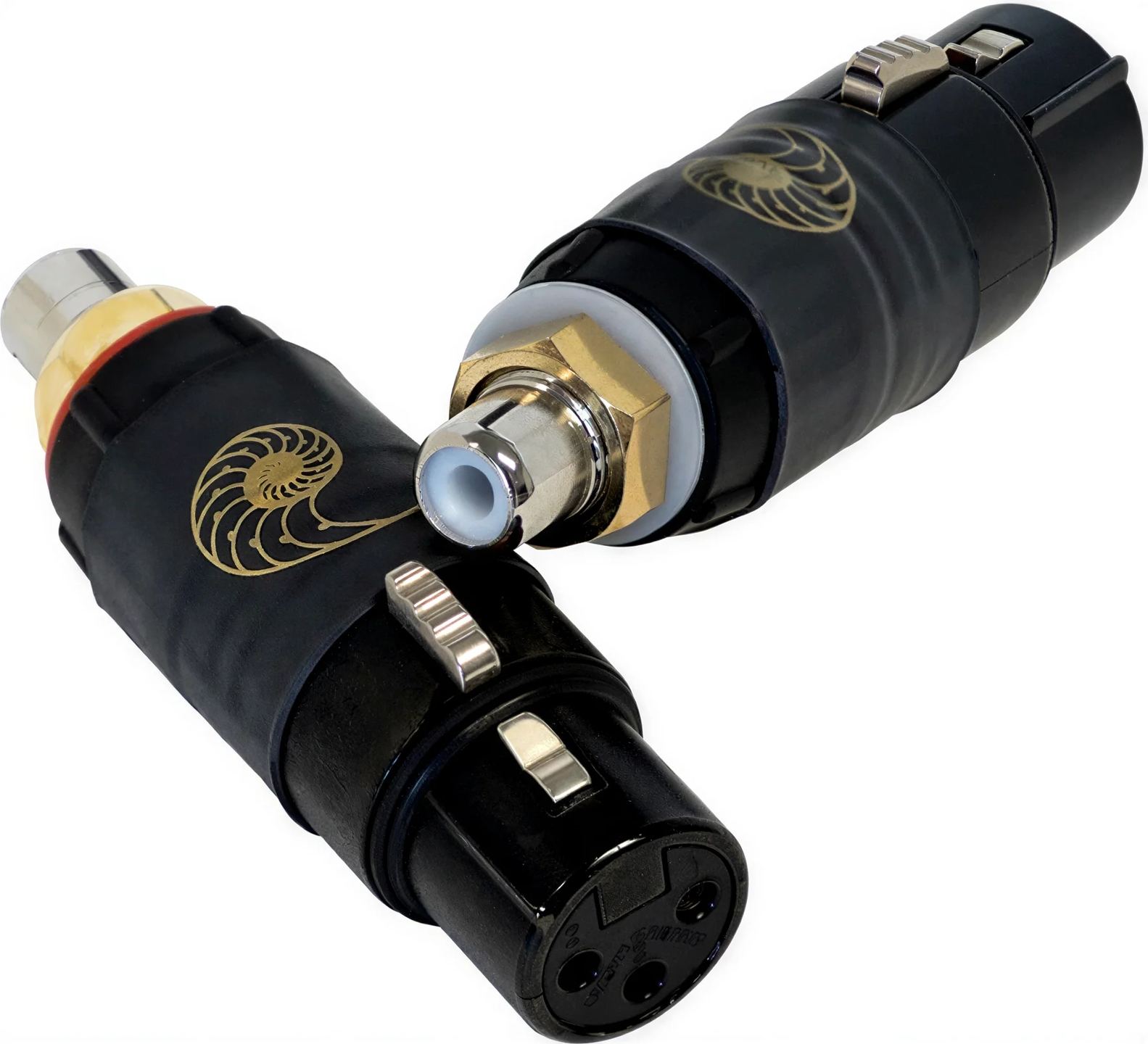
A player with only RCA outputs paired with an amplifier that only accepts XLR, or a balanced cable you would like to keep using with an unbalanced input: as a system evolves, the two standards often end up crossing paths. Cardas hand-assembles a pair of adapters that bridges the two worlds in its workshop in Bandon (Oregon). Each adapter pairs a Neutrik XLR plug with an RCA connector made by the brand itself.

A Neutrik plug and a Cardas connector

On the XLR side, Cardas turns to Neutrik, a Swiss manufacturer whose plugs are the professional industry’s benchmark for mechanical strength and locking security. On the RCA side, the connector comes from the Cardas workshops. Its body is made of brass with a high copper content, a non-magnetic alloy: there is no ferrous metal in the signal path. The contact surfaces are silver-plated with a rhodium coating. Silver conducts electricity very well, while rhodium, a hard metal in the platinum family, protects it from oxidation and wear caused by repeated connections. Inside, the two plugs are connected using the brand’s internal hookup wire and soldered with Quad-Eutectic alloy, an in-house solder with a low melting point.

Four configurations depending on the connection direction

A male plug carries the pins or center pin, while a female plug receives them. The adapter comes in four combinations: female RCA to male XLR, female RCA to female XLR, male RCA to male XLR, and male RCA to female XLR. To choose, simply look at what will plug into each side. A female RCA to male XLR version, for example, receives the end of an RCA cable and plugs directly into an amplifier’s XLR input. A male RCA to female XLR version does the reverse: it plugs into an RCA socket and accepts the male plug of an XLR cable.

Internal wiring of the XLR pins

An XLR socket has three pins: pin 1 for ground, pin 2 for the signal, and pin 3 for an inverted copy of that signal. An RCA connector has only two contacts, the center pin and the ground ring. In the Cardas adapter, pin 2 connects to the center pin and pin 1 to the RCA ground. Pin 3 is connected to ground on three of the four versions. On the female RCA to female XLR version, it is left floating, with no connection.

This conversion has consequences worth knowing about. The connection becomes unbalanced, and the interference rejection inherent in an end-to-end XLR connection is lost. When a device with an XLR output feeds an RCA input, only half of the balanced signal is used, resulting in a level around 6 dB lower: simply turn the volume up a little. Finally, connecting pin 3 of a balanced output to ground poses no problem for most devices, but some output circuits do not tolerate it well. The source device’s manual remains the best way to check.

Adapter or dedicated cable, depending on the installation’s duration

Cardas itself recommends reserving its adapters for temporary use: testing a device, troubleshooting, or a temporary setup. If the RCA/XLR pairing is to last, an interconnect cable terminated with RCA at one end and XLR at the other avoids two additional contact points, and all Cardas interconnect cables can be ordered in this form. The brand also points out that a device with RCA sockets for both outputs and inputs is best kept connected via RCA: using an adapter to connect to an XLR input offers no benefit. Weight must also be taken into account. An XLR plug and its cable weigh more than a simple RCA plug, and the assembly acts as a lever on the device’s RCA socket. Leaving a little slack in the cable and supporting it behind the cabinet reduces strain on the socket’s solder joint.

Technical Specifications

Connectivity

  • Set of 2 connectors
  • Brand: NEUTRIK
  • Contacts: rhodium and silver

Frequently asked questions

Why are the adapters sold in pairs?

A stereo connection uses one cable per channel, left and right. The set of two therefore provides a complete stereo connection between two devices.

Does an RCA to XLR adapter make an unbalanced output balanced?

No. The adapter only changes the connector’s shape, not the nature of the signal. An RCA output remains unbalanced even when connected to an XLR input, and the interference protection provided by a balanced connection does not apply. To benefit from it, both devices must have true balanced circuits and be connected by an XLR cable from end to end.

Can it be used for an S/PDIF or AES/EBU digital connection?

These adapters are designed for analog signals. A coaxial S/PDIF digital connection operates at 75 ohms, an AES/EBU connection at 110 ohms, and converting from one to the other requires impedance matching that this setup does not provide. A digital cable suited to each device’s format remains preferable.

Is it possible to get different pin wiring?

Yes. Cardas makes its adapters to order, and specific wiring can be requested, for example to leave pin 3 floating on a version that normally connects it to ground. This request is made when placing the order, which extends the delivery time.

What should I do if a hum occurs after connecting?

When switching from a balanced connection to an unbalanced connection, the grounds of the two devices become directly connected, which can create a ground loop. This is heard as a low, steady hum. Plugging both devices into the same outlet or power strip often solves the problem. If the noise persists, a version with pin 3 not connected to ground may also change the result with certain sources.

How do you maintain rhodium-plated contacts?

A soft, dry cloth is sufficient. Rhodium does not oxidize under normal conditions of use. Avoid abrasive products or contact cleaning erasers, as they wear away the plating without providing any benefit.

What's the difference compared to Cardas Clear adapters?

Clear adapters are the brand’s high-end version. They use only Cardas components, including on the XLR side, instead of the Neutrik connector. Their body is machined from a single block of brass, and the signal passes from one connector to the other without any intermediate solder joints. The standard adapters in this listing pair a Cardas RCA with a Neutrik XLR, leaving the benefits of the Clear range for installations where the adapter remains permanently connected.

User reviews

Jean-Pierre

These Cardas adapters allowed me to avoid sending my high-end CD player back to the manufacturer. I use its XLR outputs to compensate for the malfunction of one of the RCA outputs. Transporting such a device can be risky and cause malfunctions

Comment from 11 September 2026 — Experience from 22 June 2026

Automatically translated — Show original (French)
Ces adaptateurs Cardas m'ont permis d'éviter un retour chez le fabricant pour mon lecteur CD haut de gamme. J'utilise ses sorties XLR pour pallier le défaut de fonctionnement d'une des sorties RCA. Un transport d'un tel appareil peut être risqué et provoquer des dysfonctionnements

Fernando

Adapters of very high quality, as usual with Cardas. They enhance the sound quality of my setup.

Comment from 25 November 2024 — Experience from 20 November 2024

Automatically translated — Show original (French)
Des adaptateurs de très haute qualité comme d’habitude chez Cardas. Augmente la qualité sonore de mon installation.
  • Eco-contribution included in the sale price.
  • Manufacturer reference: ADAPTATEUR SUR MESURE
HomeCineSolutions
Loading