

Cardas Clear Adapter
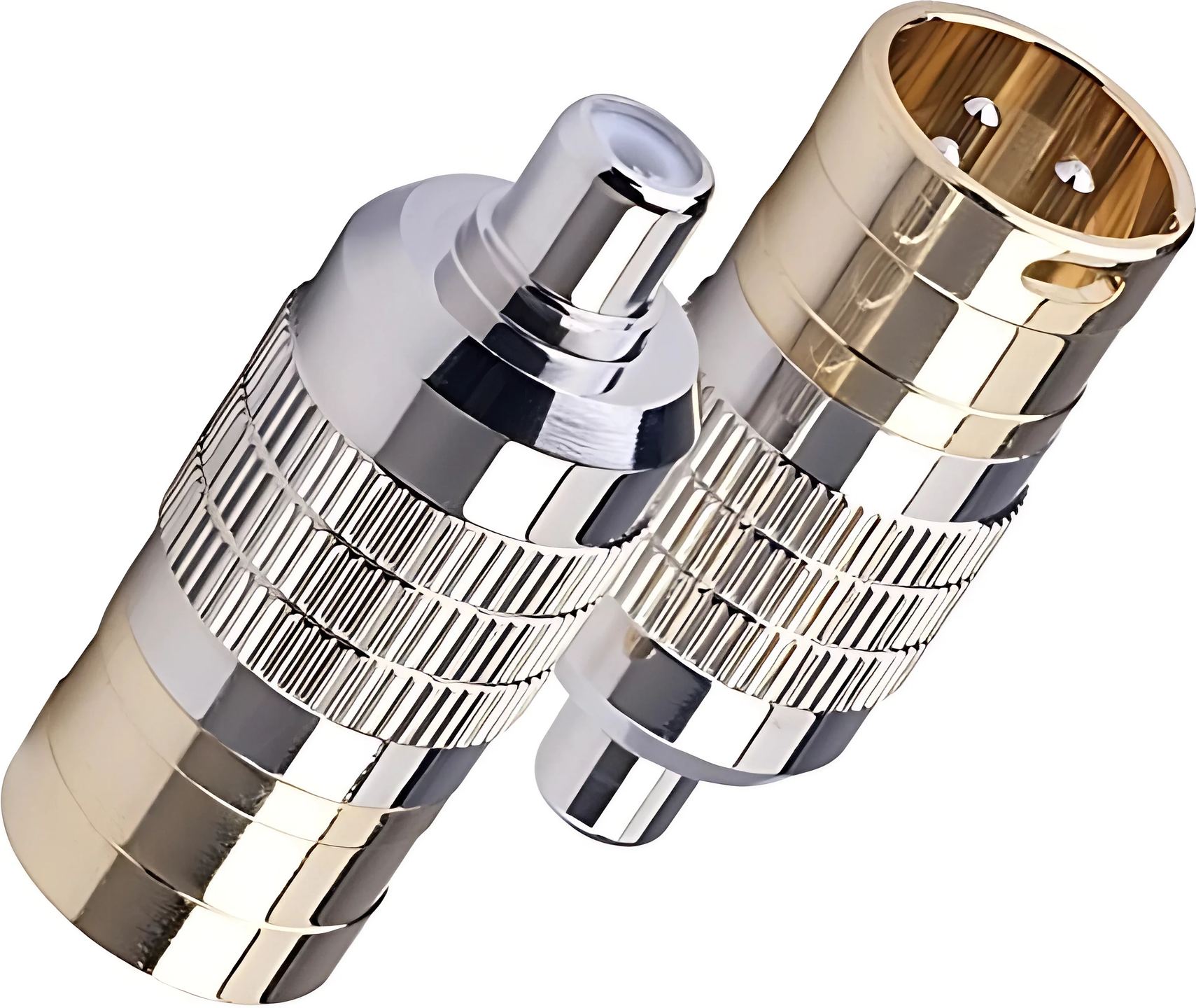
Cardas Clear Adapter, between RCA and XLR
A player with only RCA outputs, an amplifier that only accepts XLR: without an intermediate component, the two devices cannot connect to each other. Cardas makes its Clear adapters exclusively with its own components, from the brass body to the rhodium-over-silver-plated contacts, with shielding at the ends against radio interference. They are sold in pairs and come in five configurations, one for each connection scenario.
Five configurations to suit the socket being connected
The choice depends on the device’s socket, because the adapter always takes the opposite gender. On almost all hi-fi equipment, an XLR output is male and an XLR input is female. An XLR cable therefore has a female end on the source side and a male end on the amplifier side.
- Female RCA > male XLR: connects to an amplifier’s XLR input and accepts an RCA cable coming from the source.
- Female RCA > female XLR: attaches to a source’s XLR output and accepts an RCA cable running to the amplifier.
- Male RCA > female XLR: plugs into the amplifier’s RCA input and accepts the male end of an XLR cable.
- Male RCA > male XLR: plugs into the source’s RCA output and accepts the female end of an XLR cable.
- Female RCA > female RCA: joins two RCA cables end to end for extra length.
In the first four cases, the adapter can be placed at either end of the connection, and the available cable length often determines which cable to keep: RCA or XLR.
Eutectic brass and rhodium-over-silver contacts
The body is machined from a bar of eutectic brass. A eutectic alloy has the distinctive property of solidifying all at once, at a single temperature, producing a homogeneous structure without areas of differing composition. The brass is non-magnetic, as are all the adapter’s components: there is no ferrous material in the signal path.
The contacts receive an underlayer of silver, a very good conductor, covered with rhodium. Rhodium conducts less well than silver, but it is a hard metal that does not oxidize and withstands the wear of repeated connections. The thin surface layer keeps the contact clean over time, while the silver underneath provides conduction.
End shielding against high frequencies
In a hi-fi rack, streamers, digital converters and Wi-Fi modules radiate high frequencies, and digital circuits produce clock signals, the rapid oscillations that time their operation. Clear connectors have shielding at their ends, where they meet the socket, which blocks this radio-frequency interference and these clock signals at the point where the adapter is inserted into the connection. This shielding protects the connection point. The rest of the path depends on the cable connected to it.
A connection that remains unbalanced
The adapter changes the shape of the connector, not the nature of the signal. An RCA connection carries an unbalanced signal: one conductor for the signal, ground for the return. A balanced XLR connection carries two copies of opposite polarity, and comparing them at the receiving end eliminates noise picked up along the way. Between an RCA source and an XLR input, there is only one copy of the signal: the amplifier receives an unbalanced connection, and the noise rejection inherent to balanced connections does not apply.
The level also varies. A balanced output generally delivers twice the voltage of an RCA output, or around 6 dB more. An RCA source connected to an XLR input therefore requires the volume to be turned up a little higher than with a true balanced source. In the other direction, an XLR output adapted to RCA transmits only the positive phase and returns to a level close to RCA.
Cardas makes this clear: when both devices have RCA sockets, it is better to connect them via RCA than to use an adapter to access the XLR input. For a permanent installation, a cable terminated with RCA at one end and XLR at the other avoids two additional contact points. The adapter has its place when one of the devices only offers XLR sockets, or when the cabling needs to change from one system to another.
Pins 1 and 3, wiring specific to each version
An XLR connector has three pins: 1 for ground, 2 for the in-phase signal, 3 for the inverted signal. On the female RCA > female XLR version, which attaches to a source’s output, pin 3 is left open, with no connection to ground. Connecting the inverted output of a balanced stage to ground amounts to short-circuiting it, which some devices do not tolerate well.
On all other versions, pins 1 and 3 are connected together. On the input side, this connects the amplifier’s inverted path to ground rather than leaving it floating, where it would pick up noise. This wiring suits the vast majority of equipment, and Cardas provides the reverse wiring on request for devices that require it.
Cardas components from end to end, made in the United States
Cardas offers two families of adapters. The standard models combine Cardas RCA plugs with Neutrik XLR connectors. Clear adapters use only in-house components, including Clear XLR connectors and their end shielding. They are made in the United States.
In use, an adapter extends the connector by a few centimeters and creates leverage on the socket. With a heavy or stiff cable, it is better to support the cable or leave it in a gentle curve behind the rack to avoid pulling on the device’s RCA socket.
Technical Specifications
Materials and Finishes
- Eutectic brass body
- Rhodium-silver plated contacts
- Non-magnetic
Protection and Performance
- Protection against radio frequency interference (RF)
- Protection against clock signals
General Information
- Made in the USA
- Pack of 2 connectors
Frequently asked questions
Are these adapters suitable for an AES/EBU or coaxial S/PDIF digital connection?
No. An AES/EBU digital connection over XLR requires a cable and connectors with a characteristic impedance of 110 Ω, while coaxial S/PDIF over RCA requires an impedance of 75 Ω. These adapters are intended for analog signals. Switching between these two digital formats also requires level and impedance matching, which a simple connector adapter does not provide.
Why are they sold in pairs?
A stereo connection uses two cables, one per channel, so two adapters. For a mono connection, such as a subwoofer connection, only one is used and the second is kept as a spare.
How can I tell if my device requires a specific pin wiring configuration?
The device’s manual or its manufacturer are the only reliable sources on this point: Cardas does not maintain a list of affected devices. If the manual specifies that pin 3 of a balanced output must not be connected to ground, the female RCA > female XLR version already complies with this requirement.
Can you connect two adapters in series, for example RCA to XLR followed by XLR to RCA?
Technically yes, but each adapter adds two contact surfaces and a little weight to the socket. A chain of adapters generally indicates that a cable with the right connectors would be simpler and more reliable.
Is the female RCA > female RCA suitable for placing a subwoofer farther away?
It connects two RCA cables end to end, which comes in handy when you need an extra meter or two. For a permanent installation, a single cable of the right length is still preferable: fewer connections, less risk of poor contact.
Can the adapter be used with a phono preamplifier?
Yes, between the phono preamplifier output and the amplifier, where the signal is already at line level. Between the turntable and the preamplifier, the signal is hundreds of times weaker, and the turntable’s ground wire connects separately: this section is best kept as a direct cable connection, without an intermediate junction.
- Eco-contribution included in the sale price.
- Manufacturer reference: ADAPTATEUR CLEAR SUR MESURE


