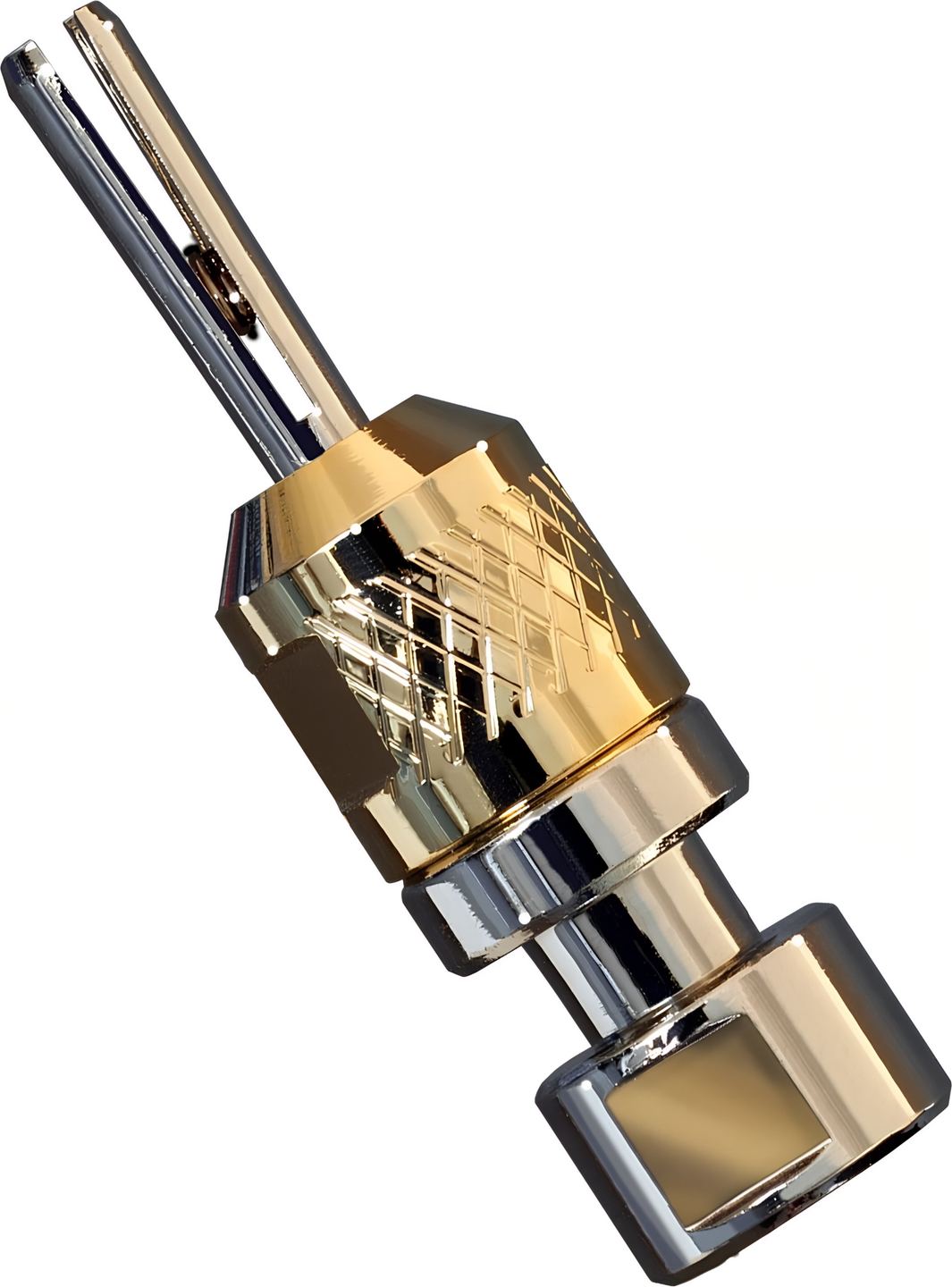
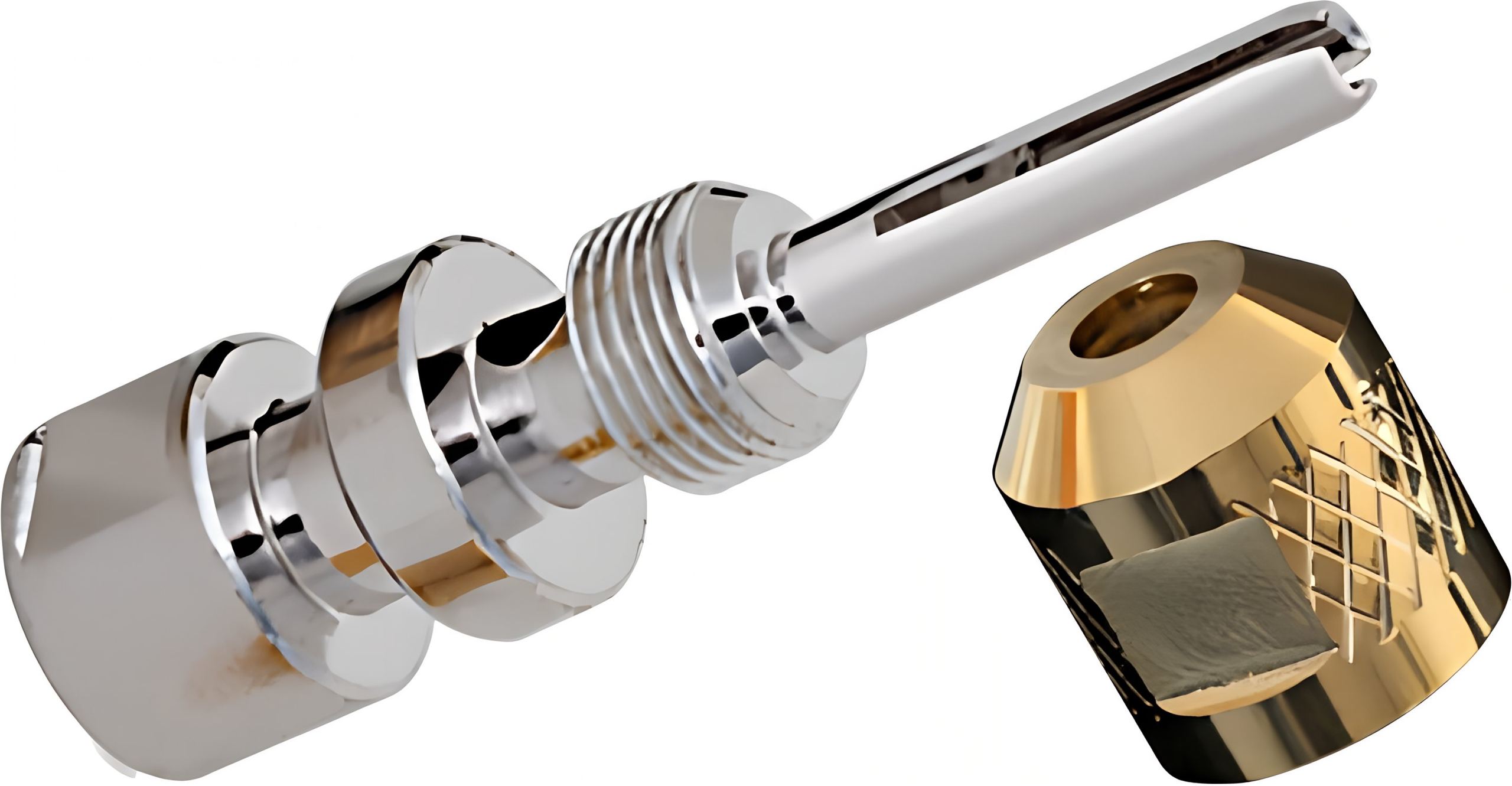
A banana plug is judged on two points: the quality of its contact with the terminal and the strength of its connection to the cable. This one, made by Cardas in Oregon, is soldered to the conductor, also accepts a spade or bare wire under its gold-plated nut, and can accommodate a second banana plug at the rear. A seemingly simple component that requires a soldering iron but proves useful in many ways in a hi-fi system.
Non-magnetic brass beneath double plating
The body is made of eutectic brass, a high-copper alloy that Cardas uses throughout its connector range. Eutectic here refers to an alloy whose components melt and solidify together at a single temperature, resulting in a homogeneous metal. This brass is non-magnetic: no layer of nickel, a ferromagnetic metal often used as a plating underlayer, is inserted into the signal path. This is the main difference from the CABE, Cardas’s budget banana plug, which is nickel-plated.
The surface first receives a layer of silver, an excellent conductor, followed by a layer of rhodium. This platinum-group metal is harder than gold and does not oxidize, so the tip maintains a clean contact after repeated connections and disconnections. The clamping nut, made of gold-plated brass, is the only gold-colored part of the plug.
Solder, spade or bare wire: connection methods
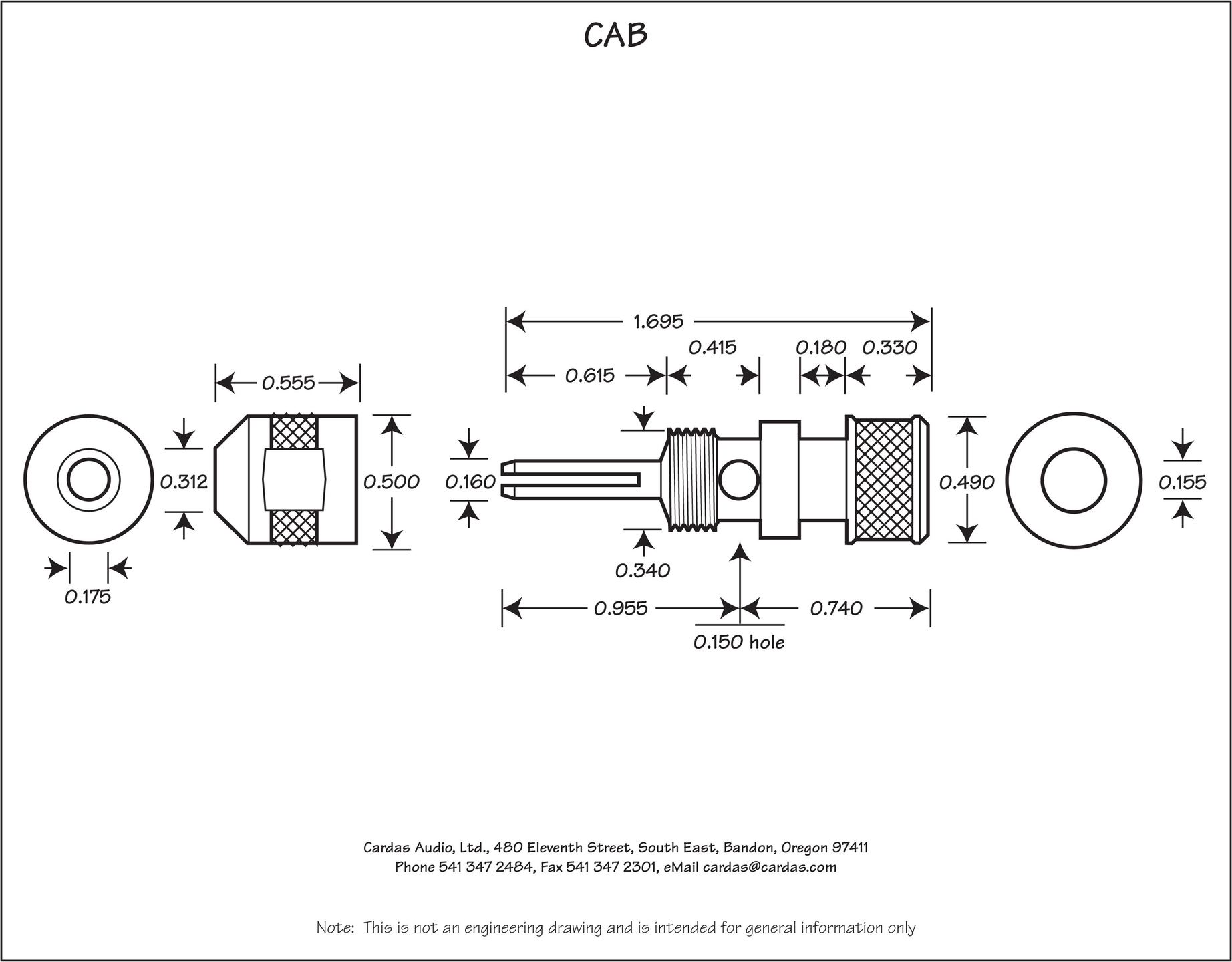
The primary use involves soldering the cable into the tapered hole at the rear of the plug. Its 6 mm diameter accommodates a thick conductor, up to the equivalent of 3 AWG (approximately 26 mm²), far larger than most speaker cables. Cardas recommends its Quad Eutectic solder and rosin flux. With a brass component of this size, a sufficiently powerful iron is needed to heat the entire piece and achieve a shiny solder joint rather than a cold, grainy connection. The CAB cannot be crimped or screwed onto the cable: without soldering, it does not fulfill its primary function.
The gold-plated nut offers two other possibilities. A spade with an opening wider than 6.3 mm can be secured underneath it, turning the CAB into a spade-to-banana adapter, useful for connecting a cable already terminated with spades to terminals better suited to banana plugs. A side hole also accepts bare wire up to 3.5 mm in diameter, clamped by the same nut without soldering.
A split tip and a stackable banana plug
The tip is split and spring-loaded: its segments spread inside the terminal to increase the number of contact points and hold the plug in place without play. This is a conventional design, but the CAB’s careful manufacturing ensures firm insertion without excessive force.
From the top, the plug accepts another 4 mm banana plug. This allows two cables to be connected to the same terminal, for example to connect a subwoofer at speaker level in parallel with the speakers, or to bi-wire from an amplifier equipped with only one pair of terminals per channel.
The CAB’s body is entirely metal, with no insulating sleeve. On closely spaced terminals, two exposed plugs positioned too close together can touch and cause a short circuit at the amplifier output; careful cable identification and spacing are essential. Some amplifiers sold in Europe also have their terminals blocked by caps that prevent banana plug insertion: the CAB can then be used with a spade or bare wire, or only at the speaker end.
The CAB among Cardas banana plugs
Cardas offers three solderable banana plugs. The CAB, sold individually, uses the same materials as the CABD, supplied in pairs and joined by a removable plastic spacer that also acts as an insulator and sets the center-to-center spacing between the positive and negative poles. The simpler CABE retains the non-magnetic brass and a 6.35 mm hole, but has nickel plating, with no clamping nut or stacking hole. The CAB is the right model when a cable’s two conductors reach the terminals separately, or when the terminal spacing does not match that of a dual banana plug.