Bertrand
No listening room calibration
Comment from July 24, 2026 — Experience from February 17, 2022
Automatically translated — Show original (French)
Pas de calibrage de la pièce d'écoute
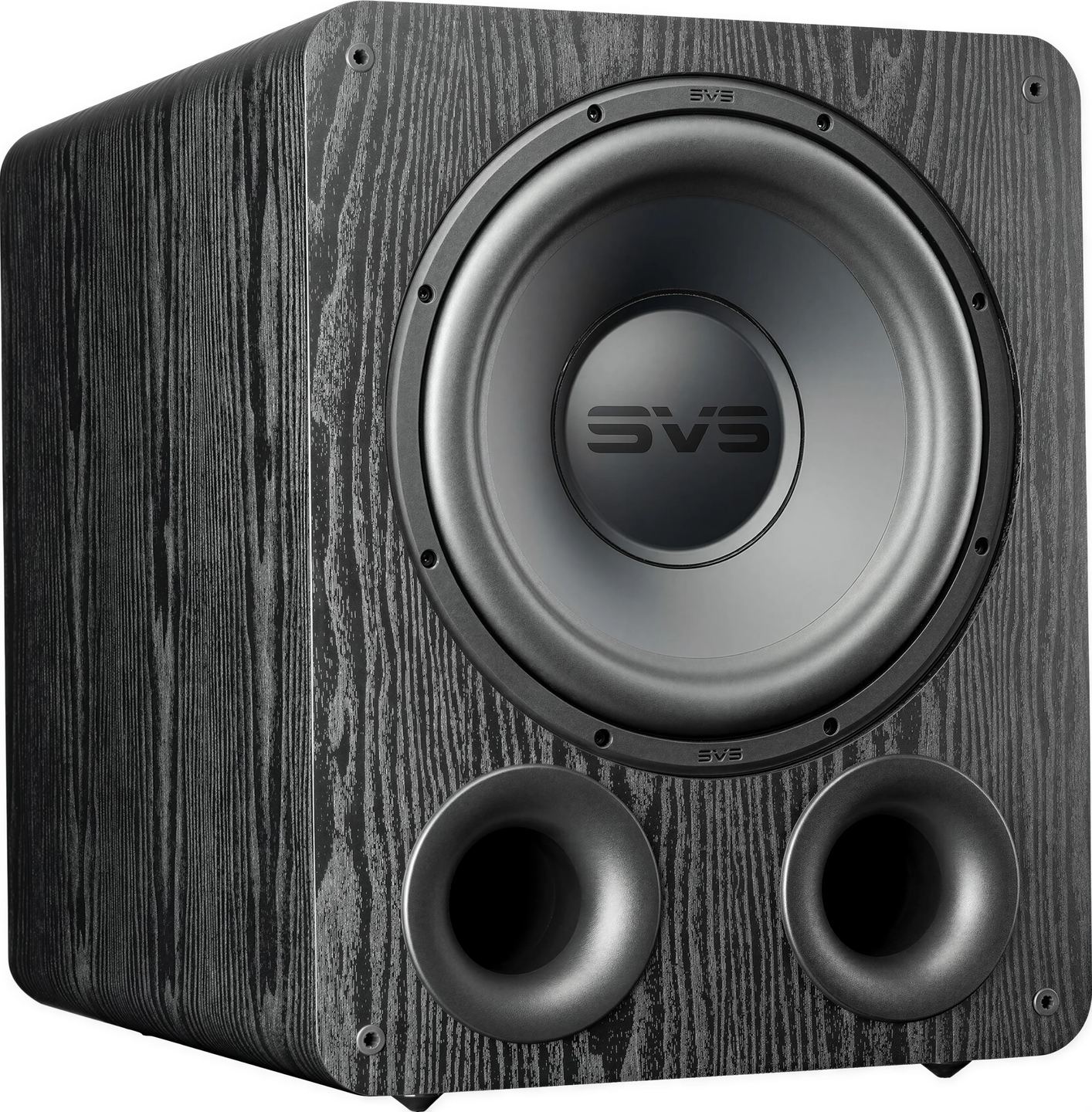

Bass is best when it goes low, fast, and clean. The SVS PB-1000 PRO, the dual-port bass-reflex version of the 1000 Pro series, aims for that balance between extension, power, and control. A direct successor to the PB-1000, it replaces the original’s 25 cm driver with a completely redesigned 30 cm unit, adds more powerful Sledge amplification, and inherits the brand’s in-house Bluetooth app.
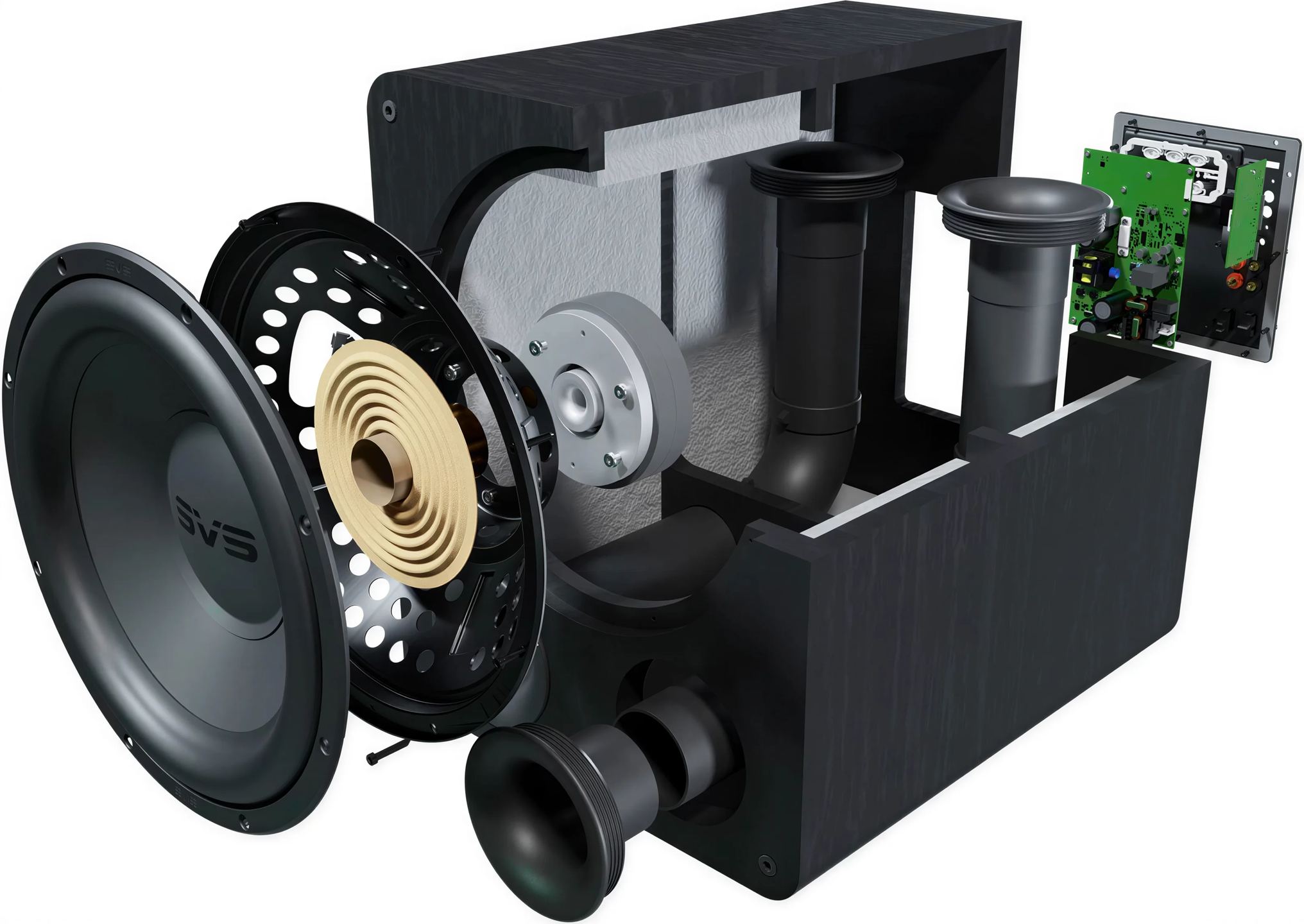
The transducer has been redesigned from the ground up. With its diameter increased to 30 cm, a lightweight and rigid fiber-composite cone, injected ultra-long-throw surround, dual high-power ferrite motor, and dual-layer voice coil, every part is sized to move a lot of air without losing linearity. The frame itself was optimized using finite element analysis (FEA), a simulation method used in mechanics to distribute stress across a structure and identify weak points before manufacturing. In terms of excursion, SVS specifies an Xmax of 13.1 mm (maximum linear excursion) and an Xmech of 26.8 mm (mechanical margin before bottoming out), values that give the cone the necessary headroom to handle the LFE peaks of movie soundtracks without distortion.
At the controls is a Sledge STA-325D in class D with high-current discrete MOSFETs, rated at 325 W continuous RMS and just over 820 W dynamic peak power. The high-efficiency LLC power supply limits heat build-up under prolonged use, and a 50 MHz / 56-bit Analog Devices DSP manages filtering, limiting, and the subwoofer’s dedicated EQ curve. It follows the same amplification + DSP chain logic found in the brand’s higher-end models, adapted here to a more accessible format.
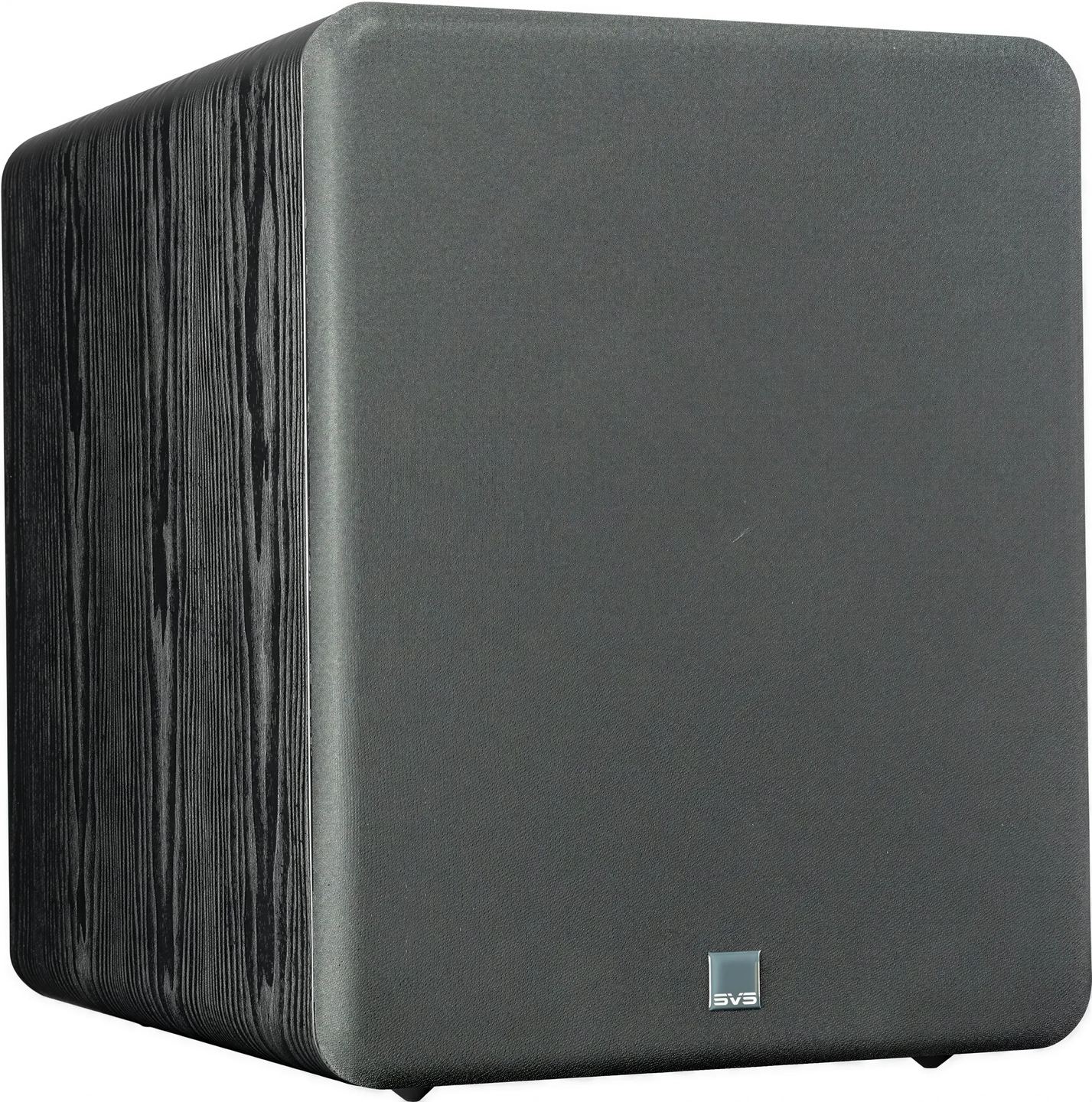
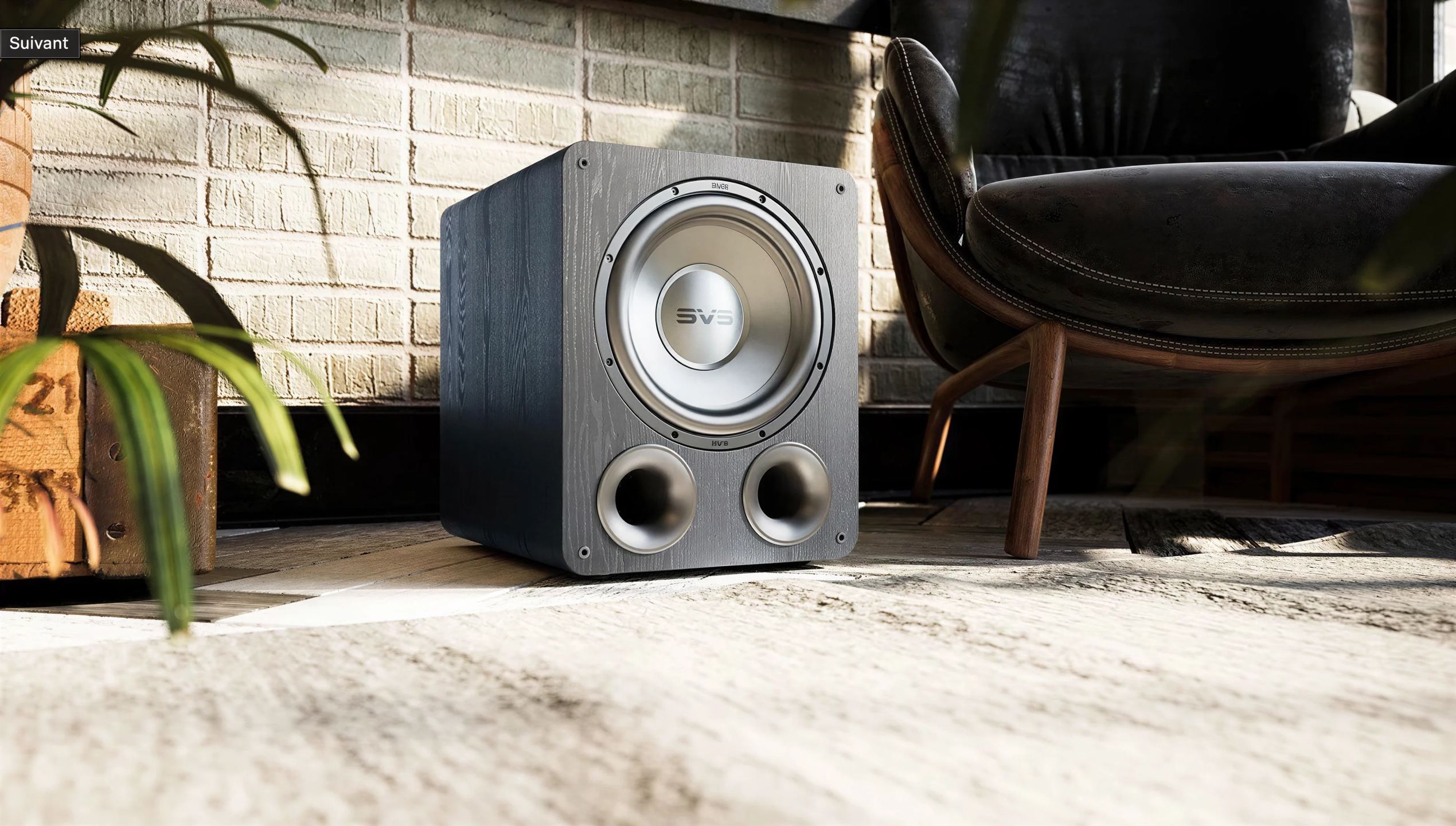
The bass-reflex loading uses two 6.35 cm (2.5-inch) front ports positioned below the driver. The enclosure is made of thick MDF with internal bracing and acoustic insulation treatment. The iso-elastomer feet decouple the subwoofer from the floor, helping reduce vibration transfer to neighboring rooms, especially on wooden floors. The anti-resonant ABS protective grille clips onto the front and can be removed to expose the driver and ports, a look some may prefer from an aesthetic standpoint.
The frequency response covers 17 Hz to 260 Hz at ±3 dB in bass-reflex mode (ports open). By inserting the two supplied foam plugs, the subwoofer switches to sealed mode with a response of 19 Hz to 260 Hz at ±3 dB, a more gradual roll-off, and bass generally perceived as tighter. The choice depends on the program: action movies, video games, and very low-bass music benefit from the useful 17 Hz reach of bass-reflex mode, while some music listening gains clarity in sealed mode, at the cost of two hertz of extension. Both configurations remain accessible without any hardware modification, leaving the possibility to test according to the room and content.
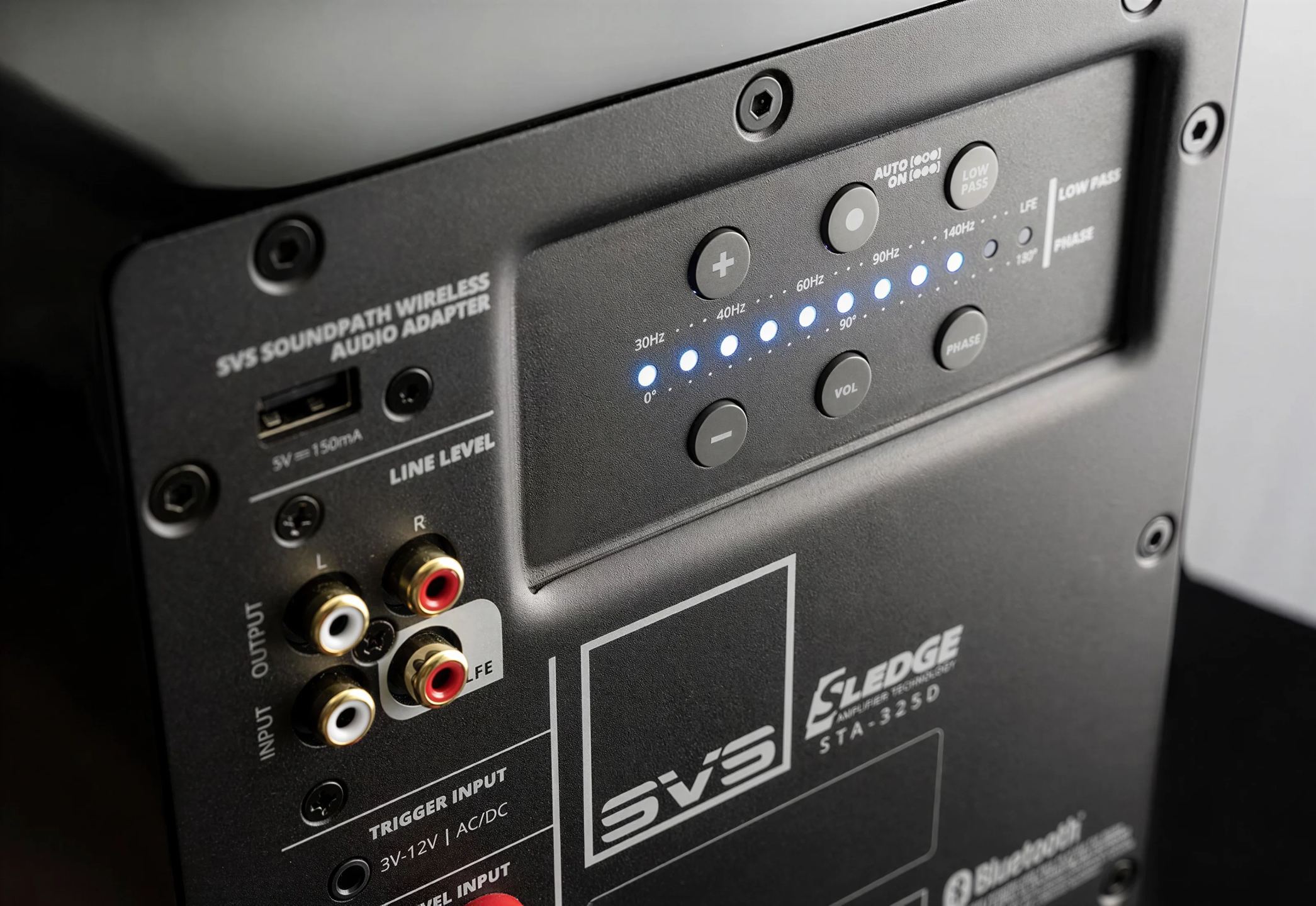
The SVS app for iOS and Android communicates with the subwoofer via Bluetooth. It gives access to volume, the low-pass filter adjustable to the nearest hertz, phase adjustable from 0° to 180°, polarity, room gain compensation, and a three-band parametric equalizer. Three customizable presets can be freely named according to use (music, cinema, video games, late-night listening at reduced volume), with real-time visual feedback on the amplifier’s LED bar IFC interface. On the rear of the subwoofer, physical controls for level, low-pass filter, phase, and auto/on mode remain available for basic adjustments without a smartphone.
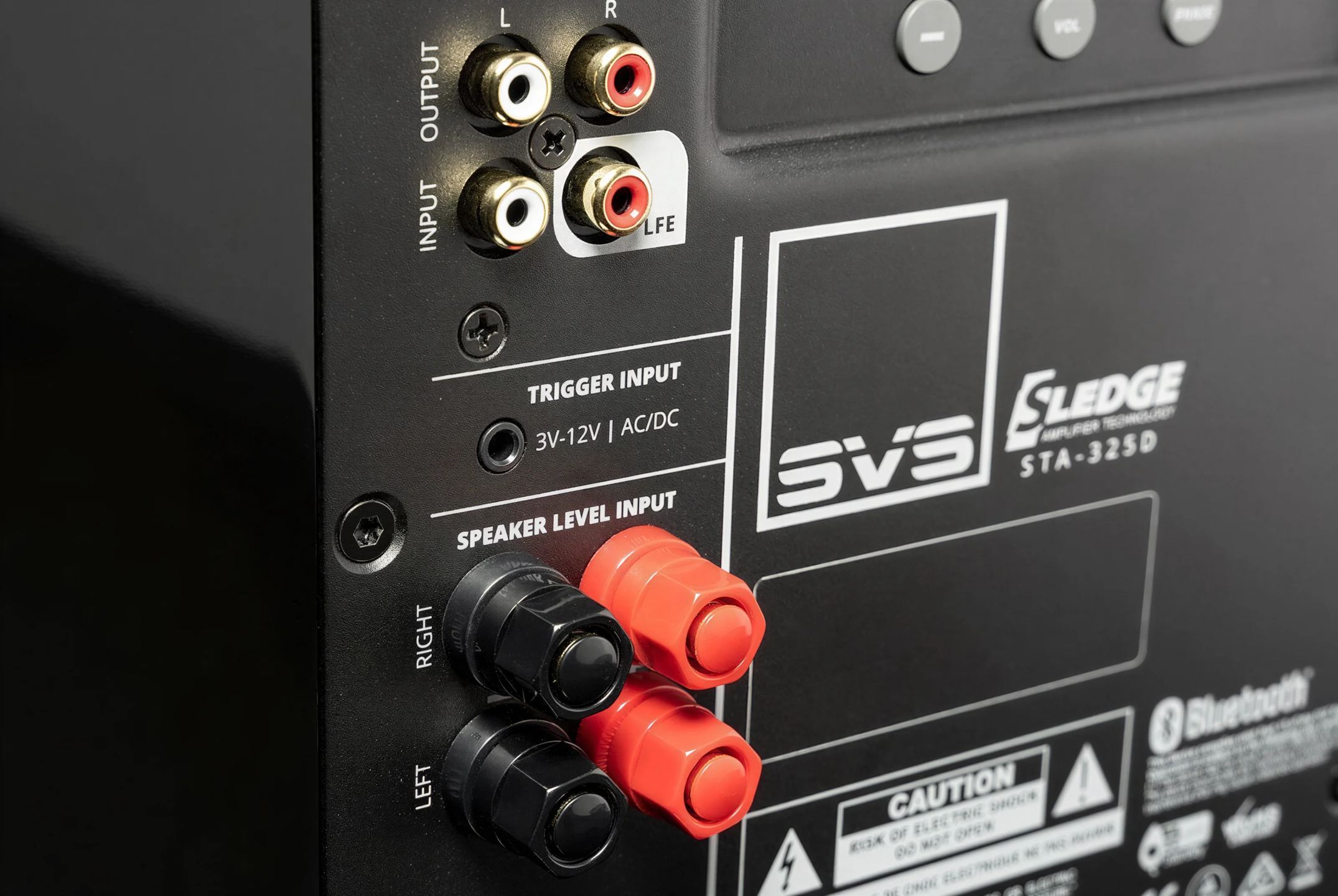
The rear panel offers a stereo RCA line input and output, a high-level input on binding posts (useful with an integrated amplifier lacking a dedicated subwoofer output), a 3 to 12 V trigger input, and a USB power port for the optional SVS SoundPath wireless adapter. The power cable is detachable. Auto/on mode reduces the subwoofer to less than 0.5 W in standby when no signal is detected, in compliance with the European ErP directive on standby power consumption.
SVS is expanding its range of subwoofers for Home Cinema. The brand is announcing the arrival of two new models: the SB-1000 Pro sealed subwoofer and the PB-1000 Pro ported subwoofer. They benefit from the technologies of the 16 Ultra series, launched a few years ago now.
No. SVS offers this model only in matte black ash finish, unlike the SB-1000 Pro in the same range, which is available in black ash, piano gloss black, and piano gloss white. The PB-1000 PRO finish remains consistent with its home theater-oriented positioning, where a matte veneer blends into the darkness of a dedicated room.
Yes. The high-level input on binding posts is wired in parallel with the integrated amplifier’s speaker outputs using a simple speaker cable. The subwoofer’s high input impedance (20 kΩ) makes the load negligible for the main amplifier. The subwoofer’s low-pass filter is then adjusted directly on the unit, most often around 80 Hz, depending on the low-frequency extension of the main speakers.
The SB-1000 Pro is the sealed version of the series, more compact, reaching down to 20 Hz with bass that is usually drier. The PB-1000 PRO (ported box) reaches 17 Hz, moves more air thanks to its two ports, and delivers more acoustic output in the deep bass, at the cost of a larger enclosure. Both share the same 30 cm driver, the same Sledge STA-325D amplification, and the same DSP.
No. The essential settings (level, low-pass filter, phase, auto/on mode) are on the rear panel. The app adds extra convenience with adjustment to the nearest hertz and the three-band parametric EQ, and remains useful for adjusting the subwoofer from the listening position. It is not required for everyday use of the PB-1000 PRO.
Yes. Pairing two PB-1000 PRO units is handled through the processor or source amplifier by sending the same LFE signal to both subwoofers. This configuration improves response uniformity across different listening positions by smoothing the room’s resonance modes, and increases the available acoustic output. Each subwoofer retains its own settings, which can be stored separately in the SVS app.
The PB-1000 PRO retains the bass-reflex principle but with a driver increased from 25 to 30 cm, a more powerful Sledge amplifier (325 W RMS instead of 300 W), an enclosure with two front ports instead of one, a 50 MHz DSP, and a Bluetooth app absent from the previous model. The -3 dB low-end extension goes from 19 Hz to 17 Hz, and dynamic peak power rises from about 700 W to more than 820 W.
A standard speaker cable is suitable, stripped at both ends, or terminated with spades depending on the amplifier’s binding posts. The PB-1000 PRO accepts wire gauges up to 12 AWG (about 4 mm²). Polarity must be observed on both sides: amplifier positive to subwoofer positive, negative to negative, in parallel with the corresponding speakers.
Based on reviews from customers who purchased this product, summarised by AI
Bertrand
No listening room calibration
Comment from July 24, 2026 — Experience from February 17, 2022
Vincent
Excellent!
Very happy with my purchase, I even ordered a second one.
It exceeded my expectations. The SVS app on the phone is practical. I recommend it
Comment from April 23, 2026 — Experience from February 01, 2026
Loïc
Perfect, nothing to complain about.
Comment from January 07, 2026 — Experience from December 21, 2025