

Electrocompaniet ECP-2 MKII black
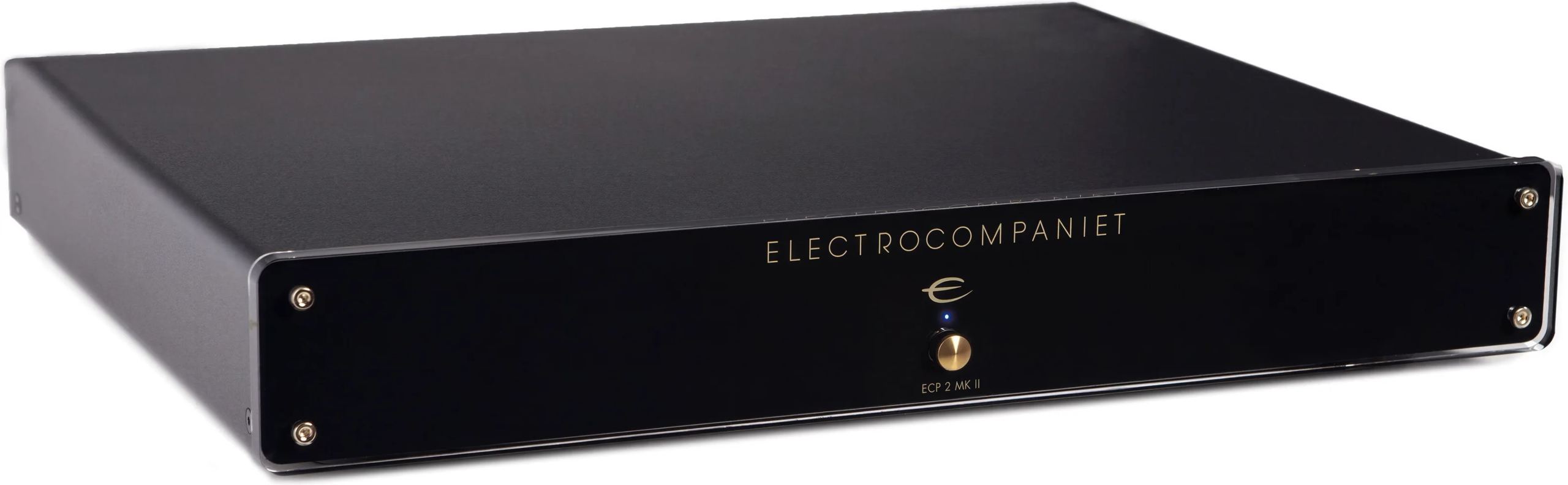


Electrocompaniet ECP-2 MKII black, the Classic Line phono preamp
A cartridge delivers a signal thousands of times weaker than that of a line-level source, which must be amplified and corrected before reaching any amplifier. This is the role of a phono preamp. Electrocompaniet has offered the ECP-2 under this name since 2015; the MKII version retains the principle while housing it in a redesigned enclosure, matched to the format of the rest of its Classic Line range.
A chassis resized to match the Classic Line
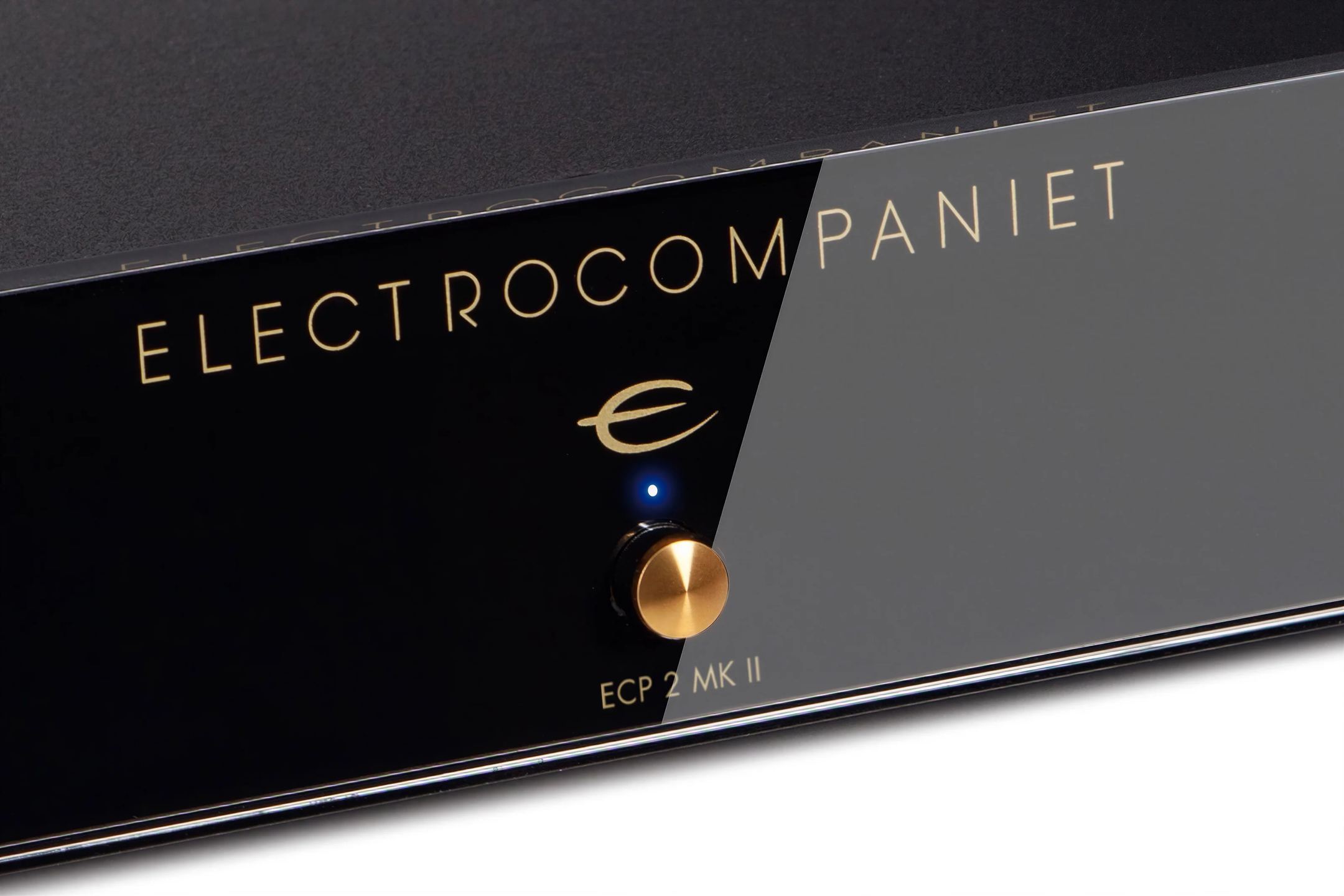
The first ECP-2 was narrower than the brand’s amplifiers and preamps. The MKII version corrects this mismatch: it adopts the line’s standard 470 mm width and sits seamlessly beside an ECI 6 MKII or another component from the same family. The front panel follows the design of the MKII models.
The aluminium enclosure serves a less obvious purpose than aesthetics: it shields the input stages, which handle extremely low voltages, from surrounding electromagnetic fields. At this signal level, even the slightest picked-up interference would become audible through the speakers.
Adjusting gain and loading for each cartridge
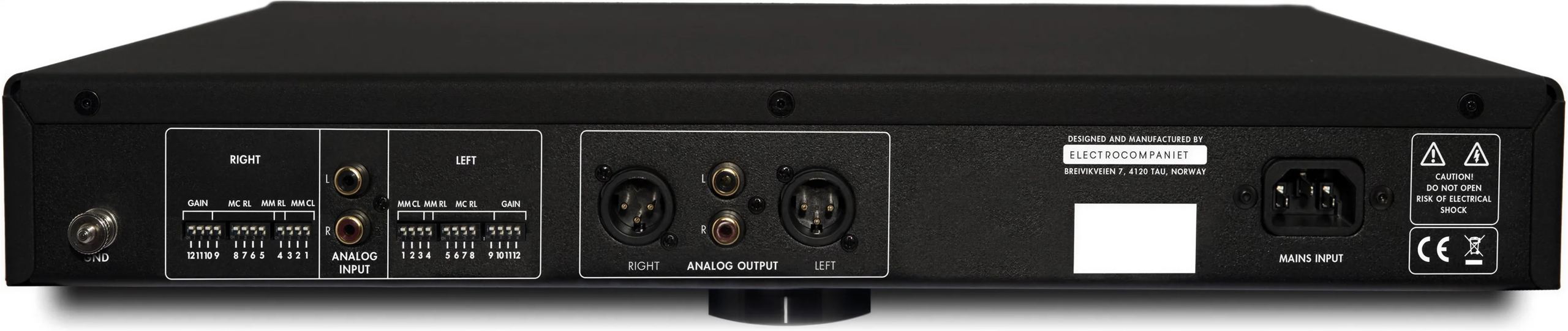
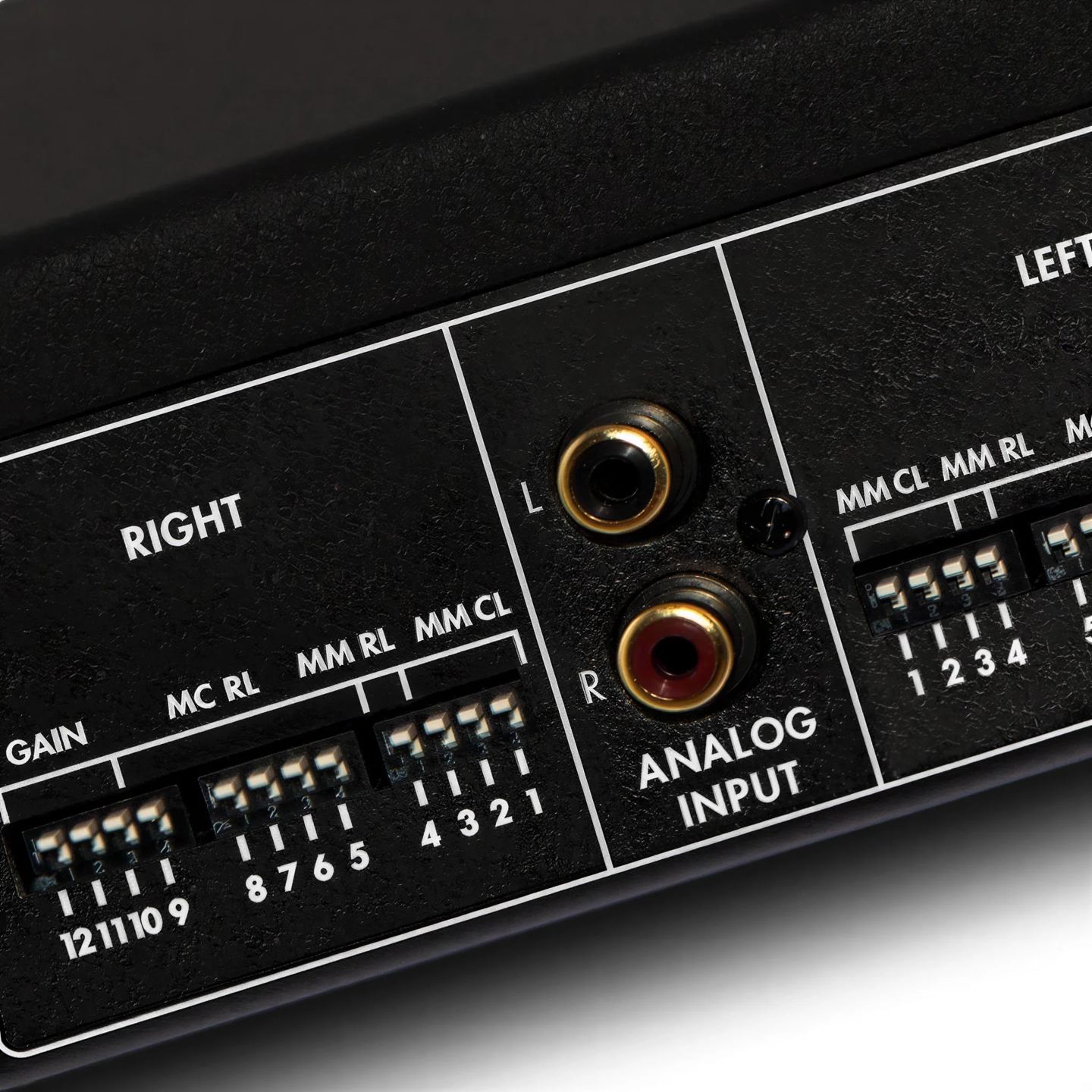
This is where the unit stands out. A moving magnet cartridge and a moving coil cartridge do not have the same output level or loading requirements, and the ECP-2 MKII supports both from the same input stage. Gain is adjustable in 5 dB steps, from 39.8 to 71.4 dB via RCA outputs and from 45.8 to 76.4 dB via XLR. The upper range covers very low-output MC cartridges, while the lower range suits more generous MM models.
Loading is also configurable: resistance from 10 Ω to 47 kΩ, capacitance from 0 to 350 pF. An MM generally requires 47 kΩ and a precise capacitance value, otherwise the treble may rise or fade; an MC requires much lower resistance, often from a few dozen to a few hundred ohms. Adjusting these values means matching the preamp to the cartridge rather than imposing a single setting on every setup.
RIAA correction and controlled noise floor
Record cutting follows the RIAA curve, which attenuates bass and boosts treble; the preamp must apply the inverse correction accurately, otherwise tonal balance shifts. Electrocompaniet specifies a maximum deviation of ± 0.1 dB from the theoretical curve and a response held to ± 0.2 dB from 20 Hz to 20 kHz.
The signal path relies on instrumentation amplifiers and high-end operational amplifiers, supported by premium discrete components, all with DC coupling: no coupling capacitor is inserted to colour the sound. The structure remains fully balanced from end to end, in keeping with the brand’s other electronics.
Noise and distortion figures follow the same approach: harmonic distortion and noise below 0.003% at 1 kHz, channel separation above 85 dB. A subsonic filter operates at -3 dB from 11 Hz, with a 24 dB-per-octave slope, to remove infrasonic content from warped records or tonearm resonances without affecting useful bass. Overload margin, above 31 dB, handles the most violent cutting transients without clipping.
Inputs, outputs and system integration
Input is via a pair of RCA connectors, with a ground terminal for connecting the tonearm ground wire and eliminating hum. On the output side, the unit offers both RCA and XLR. The balanced connection makes complete sense when connected to a preamp or amplifier equipped with XLR inputs, such as an ECI 6 MKII, and remains quieter over long cable runs thanks to low output impedance (100 Ω unbalanced, 200 Ω balanced). Maximum output level of 17.5 V RMS provides a comfortable reserve before the next stage.
For installation, allow for a 9 kg unit measuring 470 × 372 × 78 mm, preferably positioned away from power supplies and digital sources, due to the interference sensitivity inherent to very low signal levels.
Documentation
Technical Specifications
Phonographic Specifications
- Gain at 1 kHz:
- RCA: Adjustable from 39.8 to 71.4 dB
- XLR: Adjustable from 45.8 to 76.4 dB
- Adjustable Loads:
- Resistive (RL): 10 Ω to 47 kΩ
- Capacitive (CL): 0 to 350 pF
- Audio Performance:
- Maximum output level: 17.5 V RMS (+25 dBV)
- Overload margin: > 31 dB at 1 kHz
- Output impedance: 100 Ω unbalanced, 200 Ω balanced
- Frequency response: 20 Hz to 20 kHz ± 0.2 dB
- RIAA correction accuracy: ± 0.1 dB
- Subsonic filter: -3 dB at 11 Hz, 24 dB/octave
- Channel separation: > 85 dB, 20 Hz to 20 kHz
- Total harmonic distortion + noise: < 0.003% at 1 kHz
- Signal-to-noise ratio:
- 96 dB, 1 kHz, A-weighted, reference output 10 dBV
- 91 dB, 1 kHz, A-weighted, reference input 5 mV
- 67.4 dB, 1 kHz, A-weighted, reference input 500 μV
Connectivity
- RCA analog input
- RCA and XLR analog audio output
- Ground terminal
Physical Specifications
- Dimensions: 470 × 372 × 78 mm (W × D × H)
- Weight: 9 kg
Frequently asked questions
How do I choose the right loading values for my cartridge?
Start with the cartridge manufacturer’s recommendations: a load resistance for an MC, a capacitance for an MM (taking into account the tonearm cable capacitance). These values provide a reliable starting point, which you can then fine-tune by ear, a few notches up or down, until you find the tonal balance that suits you.
Does this preamp replace the phono preamp already built into my turntable or amplifier?
Yes. You disable or bypass the built-in phono stage, connect the turntable to the ECP-2 MKII, then run its output to a line input on the amplifier. You gain finer control over gain and loading, along with a lower noise floor than that of a generic built-in phono stage.
Is it mandatory to use the XLR outputs?
No, RCA outputs are sufficient and provide full functionality. XLR becomes worthwhile if the next component has balanced inputs, and with long cables, where the balanced connection better rejects interference picked up along the way.
Can it be paired with an amplifier from another brand?
Yes. Its outputs operate at standard line level, in both RCA and XLR, and can be connected to any preamplifier or integrated amplifier with a line input. Pairing it with Electrocompaniet electronics featuring XLR inputs remains the most direct way to take advantage of the balanced output.
Is a step-up transformer needed for a moving-coil cartridge?
No. The gain range, which goes up to 76.4 dB in XLR, directly supports low-output MC cartridges without the need for an external step-up transformer.
Is it worth it with an entry-level cartridge?
Yes. The ability to adjust gain and loading also benefits a modest cartridge, and the low noise floor benefits any source. It is also an investment that remains relevant should you upgrade your cartridge to a more ambitious model, as the input stage adapts to the new one.
- Eco-contribution included in the sale price.


