Electrocompaniet ECI 6 MKII
Since 1973, a small company based on Norway’s west coast has built its transistor amplifiers around the same idea: limiting negative feedback to avoid a type of distortion that conventional measurement fails to detect. The ECI 6 MKII takes up this approach in a stereo integrated amplifier capable of driving demanding speakers. It is based on the chassis of the ECI 5 MK II, with a redesigned power supply and a more sophisticated preamplifier module.
A lineage without negative feedback
The story of Electrocompaniet began at a 1973 conference, when Finnish researcher Matti Otala presented his work on transient intermodulation distortion (TIM), a signal degradation that the tests of the time did not measure but that the ear could perceive during fast passages. Two Norwegians, Per Abrahamsen and Svein Erik Børja, drew inspiration from it for their first amplifier, a 2 x 25 W stereo model. The brand has never strayed from this guiding principle.
On the ECI 6 MKII, the input stage is built with discrete circuits, operates in Class A and uses no negative feedback. The output stage, meanwhile, applies a moderate amount, calibrated to keep bass under control without hardening the upper spectrum, while maintaining an open midrange. Design, component production and assembly all take place at the Norwegian factory.
Power and control of demanding loads
The power figures set the tone: 2 x 125 W into 8 ohms, 2 x 200 W into 4 ohms, 2 x 370 W into 2 ohms. Power rises almost proportionally as impedance drops, a sign of a generous power supply and genuine current reserves. Peak current exceeds 100 A, damping factor exceeds 350, and output impedance remains below 0.02 ohm.
In practical terms, this provides a firm grip on low-sensitivity speakers or those with a tortuous impedance curve, the kind that make more modest integrated amplifiers struggle. The reinforced power supply compared with the ECI 5 MK II works precisely toward that goal. The stated frequency response extends from 1 to 150 kHz, and harmonic distortion remains below 0.004% across the audible spectrum.
Analogue connectivity and upgradeability
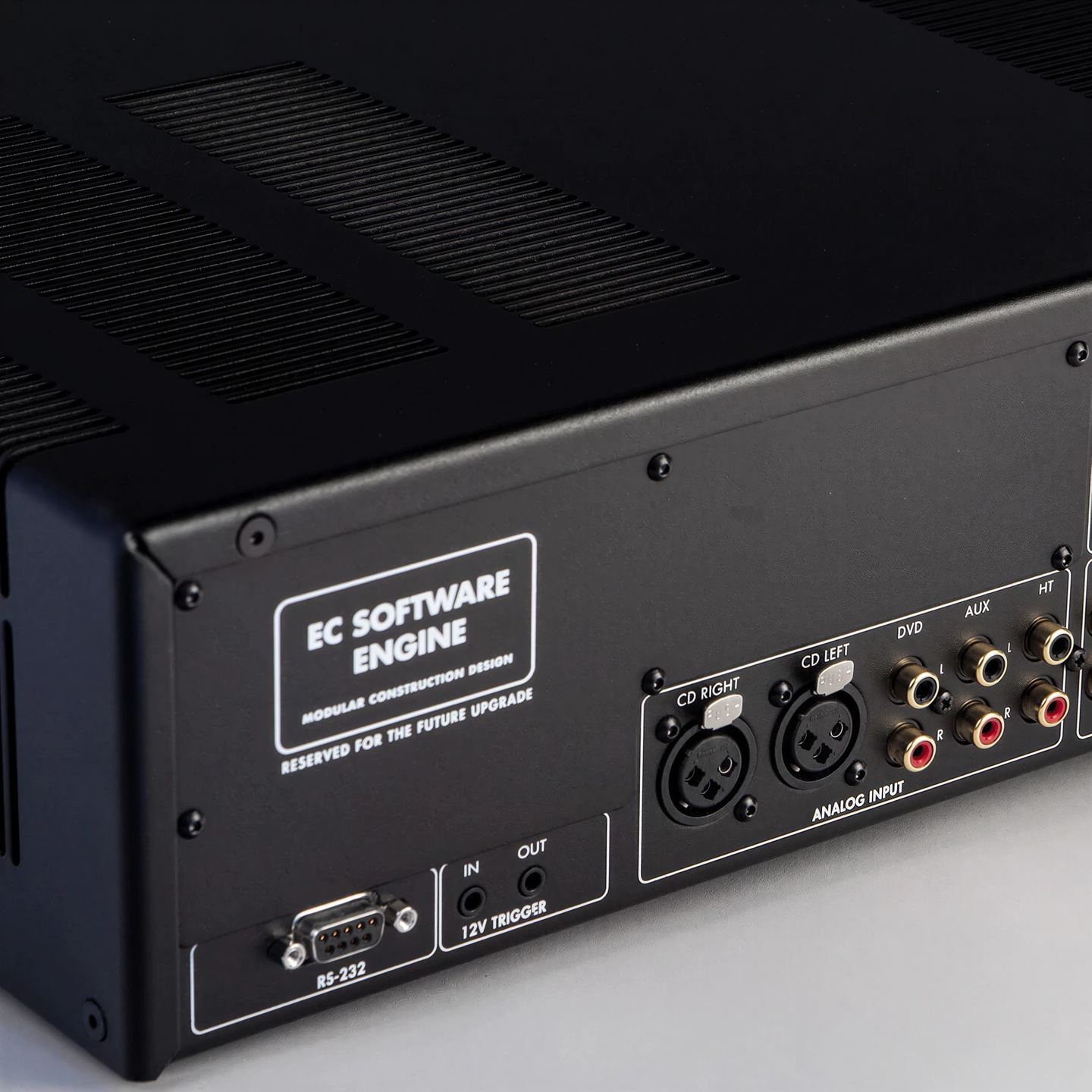
In terms of connections, the ECI 6 MKII remains firmly analogue: one balanced XLR input and three unbalanced RCA inputs, with no digital section. The balanced signal path reflects an in-house tradition: the brand wires its high-end electronics in differential configuration from end to end. Two preamplifier outputs, one XLR and one RCA, open the door to system upgrades: adding a power amplifier for bi-amplification, or connecting an active subwoofer.
One input features fixed gain for home theater integration. It bypasses the volume control and lets a multichannel processor control the level, so the front left and right channels pass through the ECI 6 MKII power stage without double gain control. The RS232 port and 12 V trigger input/output make automation easier in a controlled installation.
This analogue foundation is not the final word. The chassis is modular: upgrading to the ECI 6 DX MKII version adds a digital-to-analogue converter and a network player inside the same unit, for those who may want to connect digital sources or streaming later on.
A heavy integrated amplifier, made in Norway
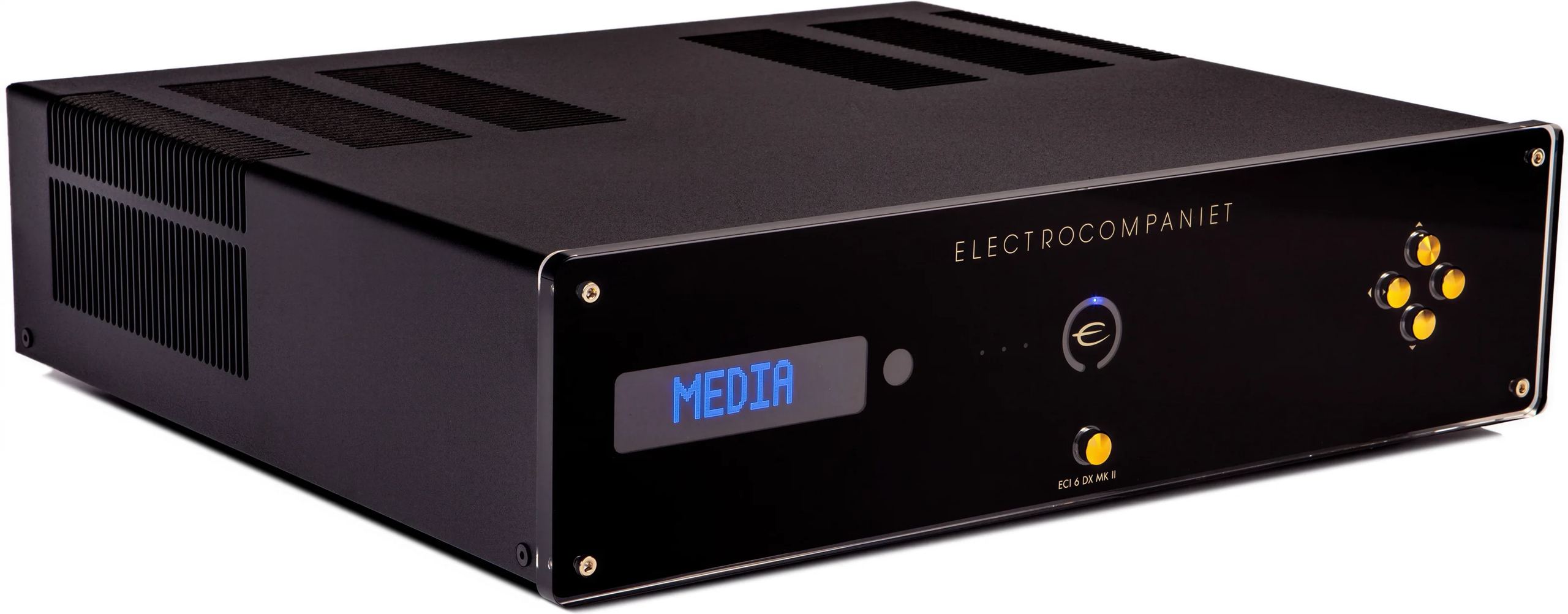
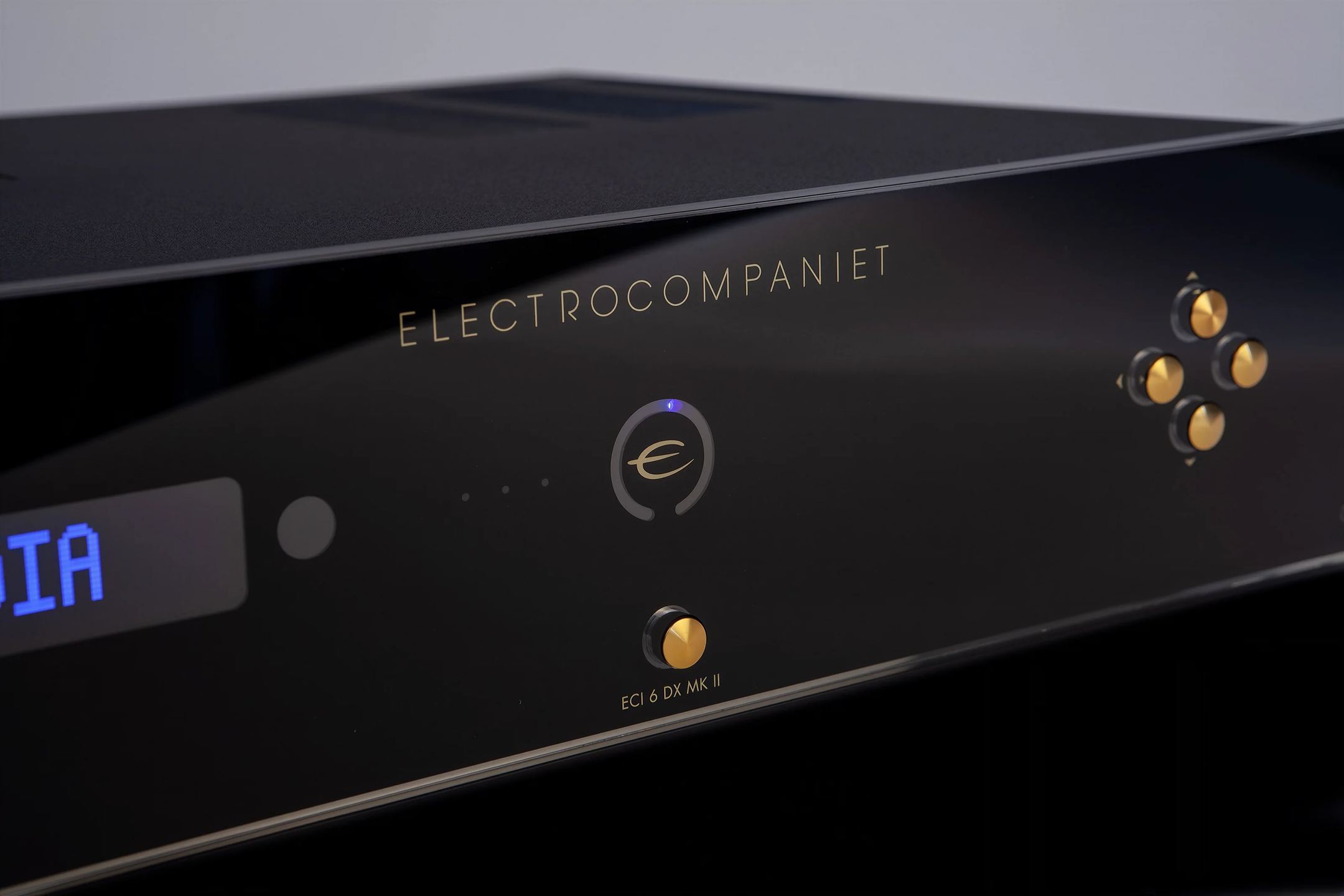
The thick acrylic front panel, with its small copper-coloured buttons, defines the understated aesthetic of the Classic Line range. The rest follows the same logic: 20.5 kg on the scales, 470 mm wide, 128 mm high and 430 mm deep once the speaker terminals are included, a size that requires a sturdy shelf and some space behind it. At idle, power consumption drops to 1 W; in operation, it peaks at around 110 W.
Technical Specifications
Nominal Output Power
- 2 × 125 W at 8 Ω
- 2 × 200 W at 4 Ω
- 2 × 370 W at 2 Ω
- All measurements performed at 120 V, 240 V, 50 Hz, 60 Hz
Digital Section
- Digital-to-Analog Converter (DAC): 24-bit, 192 kHz
- Sampling Rate Converter: 24-bit, 192 kHz
- Inputs: S/PDIF, 2 × optical (Toslink), 1 × USB
- USB: asynchronous up to 24-bit, 192 kHz
- S/PDIF: 24-bit, 192 kHz
- Optical: 24-bit, 96 kHz
Supported Formats
All common formats, including: WAV, WAVE, MP3, AAC+, Vorbis, ALAC, FLAC, APE, WMA up to 192 kHz, 24-bit, DSD up to DSD 128 (5.6 MHz)
Preamplifier Section
- Input impedance (balanced input): 47 kΩ
- Maximum input level: 10 V RMS
- Noise floor (1 V RMS, 20-20 kHz, balanced): -135 dB
- Total Harmonic Distortion + Noise (THD+N) (1 V RMS, 20-20 kHz, balanced): < 0.004%
- Gain (balanced): 0 dB
Amplifier Section
- Output impedance: < 0.02 Ω
- Frequency response: 1 to 150 kHz
- Channel separation: > 120 dB
- Total Harmonic Distortion (THD) (20 to 20 kHz): < 0.004%
- Maximum peak current: > 100 A
- Damping factor at 8 Ω: > 350
- Input sensitivity at 120 W: 1.3 V RMS
- Home theater (HT) input sensitivity at 120 W: 1 V RMS
- Home theater input gain: × 36 (31 dB)
Connectivity
- 3 × RCA analog inputs
- 2 × XLR analog inputs
- 1 × preamplifier output RCA and XLR
- 2 × digital coaxial and optical inputs
- 1 × RS232 port
- 1 × 12 V trigger input and output
General Characteristics
- Power consumption: 110 W
- Dimensions:
- Width: 470 mm
- Depth (with speaker terminals): 430 mm
- Height: 128 mm
- Weight: 20.5 kg