
Marc
It gets the job done.
Comment from 22 September 2023 — Experience from 10 August 2023
Automatically translated — Show original (French)
Il fait le job.
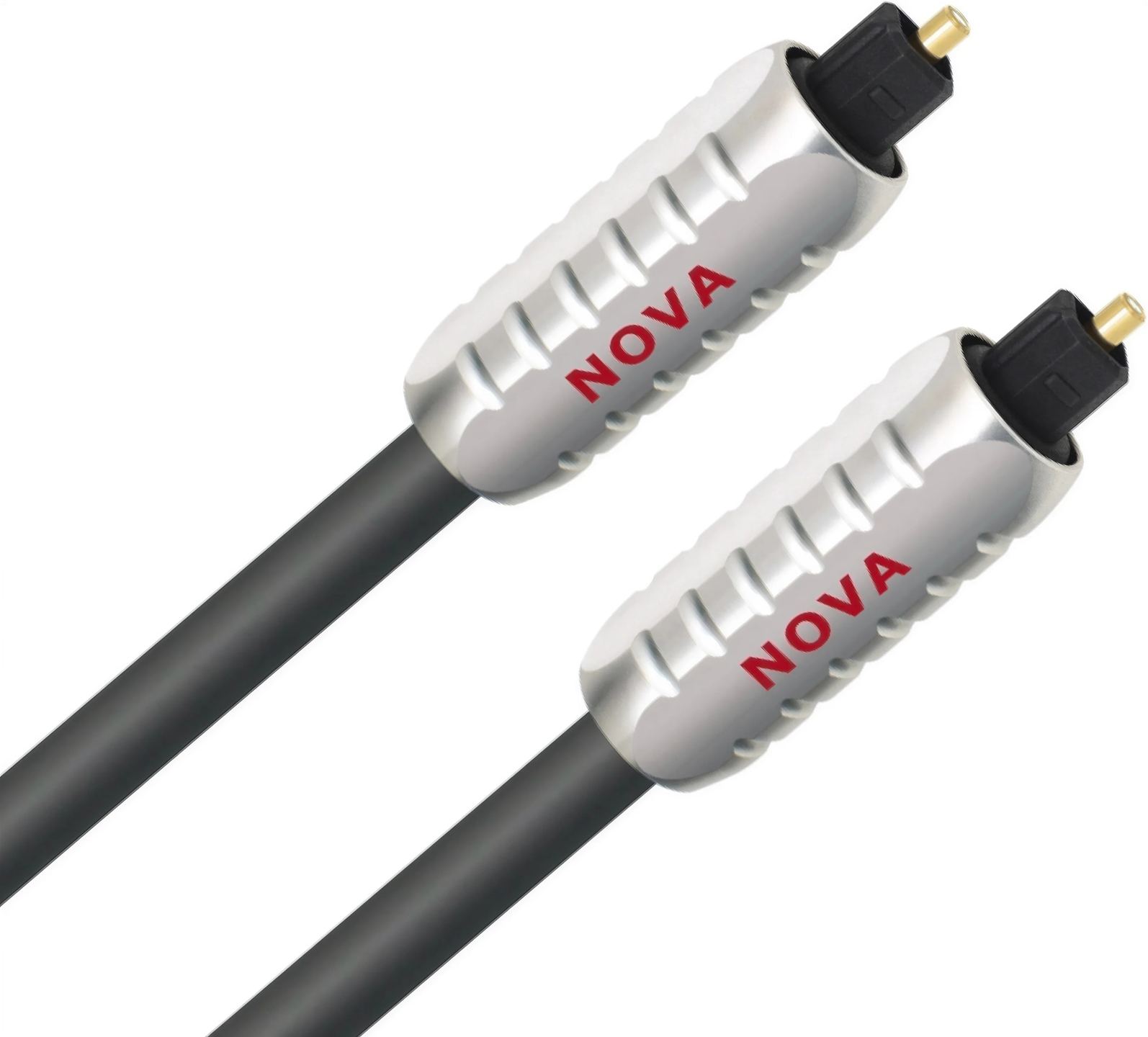

Connecting a television to a soundbar or a CD player to a converter using light rather than copper wire has an often-overlooked advantage: no current flows from one device to the other. Wireworld, an American cable manufacturer founded by David Salz, treats this connection with the same care as its electrical cables. The Nova uses a single-strand acrylic fiber whose ends are polished three times.
The signal travels through a single strand of acrylic polymer (PMMA, the material used in plexiglass), surrounded by optical cladding that reflects light back toward the center whenever it reaches the edge. This single-strand construction is the most common in Toslink cables. It is flexible and withstands handling well, without the fragility of very fine glass fibers. In the Wireworld range, the Nova is the entry-level optical cable. The higher-tier Supernova uses a bundle of 338 borosilicate glass fibers.
Light enters and exits the fiber through its two cut faces, and this is where much of the transmission quality is determined. A rough cut leaves microscopic scratches that scatter light in all directions. Part of the signal is lost, and stray light blurs the transitions between on and off that encode the data. Three polishing passes produce a smooth surface that transmits more useful light and sharper signal edges.
The aim is to reduce jitter (in English, jitter). The term refers to small irregularities in the timing of digital data, which the converter must reconstruct before turning it into sound. A clean light signal leaves less uncertainty about the exact instant of each transition. The final effect also depends on the receiving device: a converter that retimes the data itself (known as reclocking) is less sensitive to this parameter than a simpler input circuit.
The Nova NTO has a standard Toslink connector at each end. This square, keyed connector is used for the optical output on televisions, TV set-top boxes, consoles, CD and Blu-ray players, as well as the input on amplifiers, home theater receivers, soundbars and converters. Since the connection is purely optical, it completely isolates the two devices. No ground loop can form, and electrical noise from a set-top box or computer does not travel with the signal.
The format carried is S/PDIF, the standard shared by optical and coaxial digital connections. It supports stereo PCM, generally up to 24 bits / 96 kHz and up to 192 kHz on some devices, as well as Dolby Digital and DTS in 5.1. Lossless Blu-ray formats and Dolby Atmos (Dolby TrueHD, DTS-HD Master Audio) exceed its capacity and use an HDMI eARC connection.
Push the connector in until you feel a slight click, without forcing it. If it will not go in, check its orientation, as the square shape only fits one way. An active optical output shows a red glow at the end of the socket, allowing you to quickly check that the source is transmitting. The fiber accommodates gentle curves, but a sharp bend causes it to lose light and can crack it. This is the point to watch behind furniture placed flush against a wall: it is better to let the cable form a loop than to crush it against the wall.
The NTO, shown here, has a Toslink connector at each end. The NMO combines a Toslink connector with a 3.5 mm optical mini-plug, the format found on some computers, portable players and small converters. The fibre and polishing are the same.
No. The fiber transmits light the same way in both directions, and both ends are identical.
The Supernova replaces the acrylic strand with 338 borosilicate glass fibers, also with polished ends. Glass is more transparent than acrylic, further reducing light loss. It’s the next step up for a high-quality source and converter. The Nova remains the logical choice for connecting a TV, set-top box or console.
Both carry the same S/PDIF signal and the same formats. Coaxial is a 75-ohm electrical cable with RCA or BNC connectors, and it electrically connects the two devices. Optical isolates them completely. The choice depends first on the available connections. When both are present, optical has the advantage if the source is electrically noisy, such as a computer or a set-top box.
The problem often comes from the TV’s digital audio output setting rather than the cable. If the connected device cannot decode the format being sent, the sound cuts out or produces noise. In the TV’s sound menu, the PCM option almost always resolves this issue, at the cost of switching to stereo. The Auto or Bitstream options preserve 5.1 if the connected device can decode it.
The polished face of the fibre is particularly vulnerable to dust and fingerprints, which scatter light just as a poorly finished cut would. When the cable is unplugged, it is best to protect the ends. If a face is dirty, a puff of air or a soft, dry cloth is enough. Cleaning products and paper towels may scratch it.
The data arrives intact in both cases: an optical cable does not alter the transmitted digits. The difference lies in timing accuracy, and therefore jitter, and its effect depends on how the receiving device’s converter handles it. In a system with well-executed digital-to-analog conversion, a well-polished fiber is a fitting link in the chain. With an entry-level soundbar, the difference will be more subtle.
Marc
It gets the job done.
Comment from 22 September 2023 — Experience from 10 August 2023


