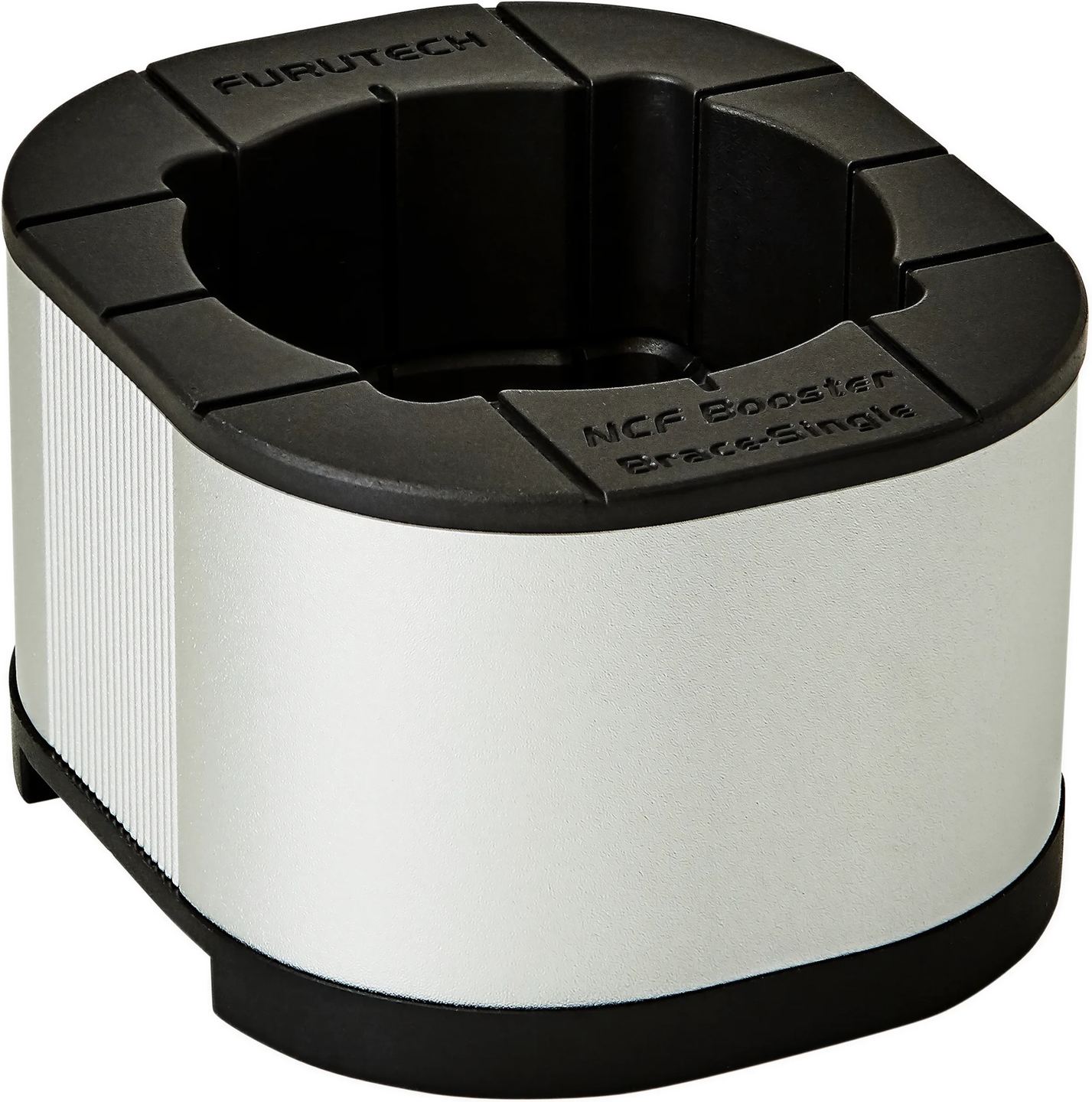
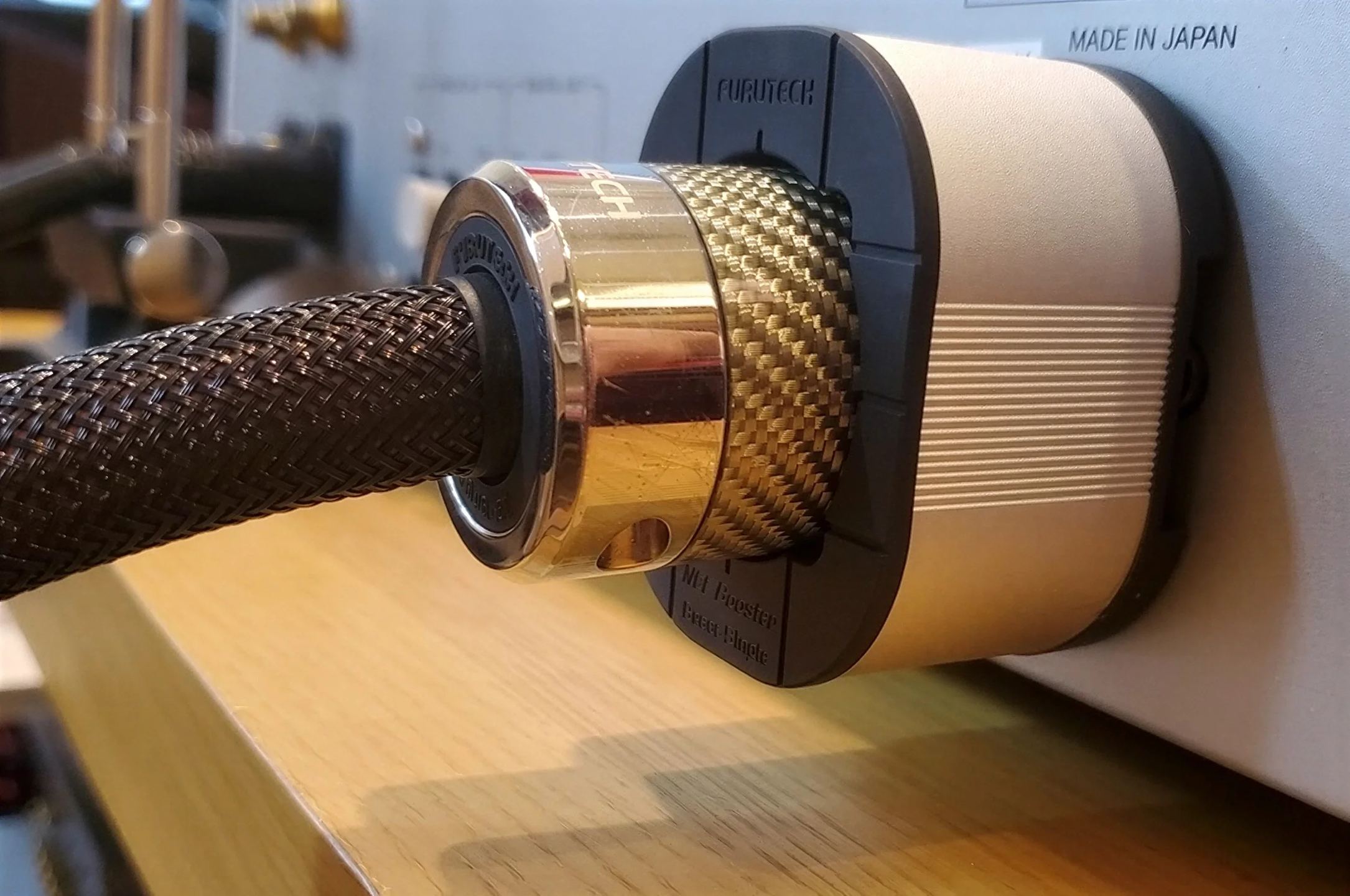
Furutech NCF Booster Brace Single: vibration-damping support for mains plugs
A high-end mains cable often weighs several hundred grams, and its plug, inserted into a wall socket or the back of a component, bears all that weight as a cantilevered load. The contact gradually loosens, and vibrations from the cable travel up to the connection point. This support ring surrounds the plug, adheres around the socket and dampens these movements at the precise point where current enters the system.
A ring that supports the plug flush with the socket
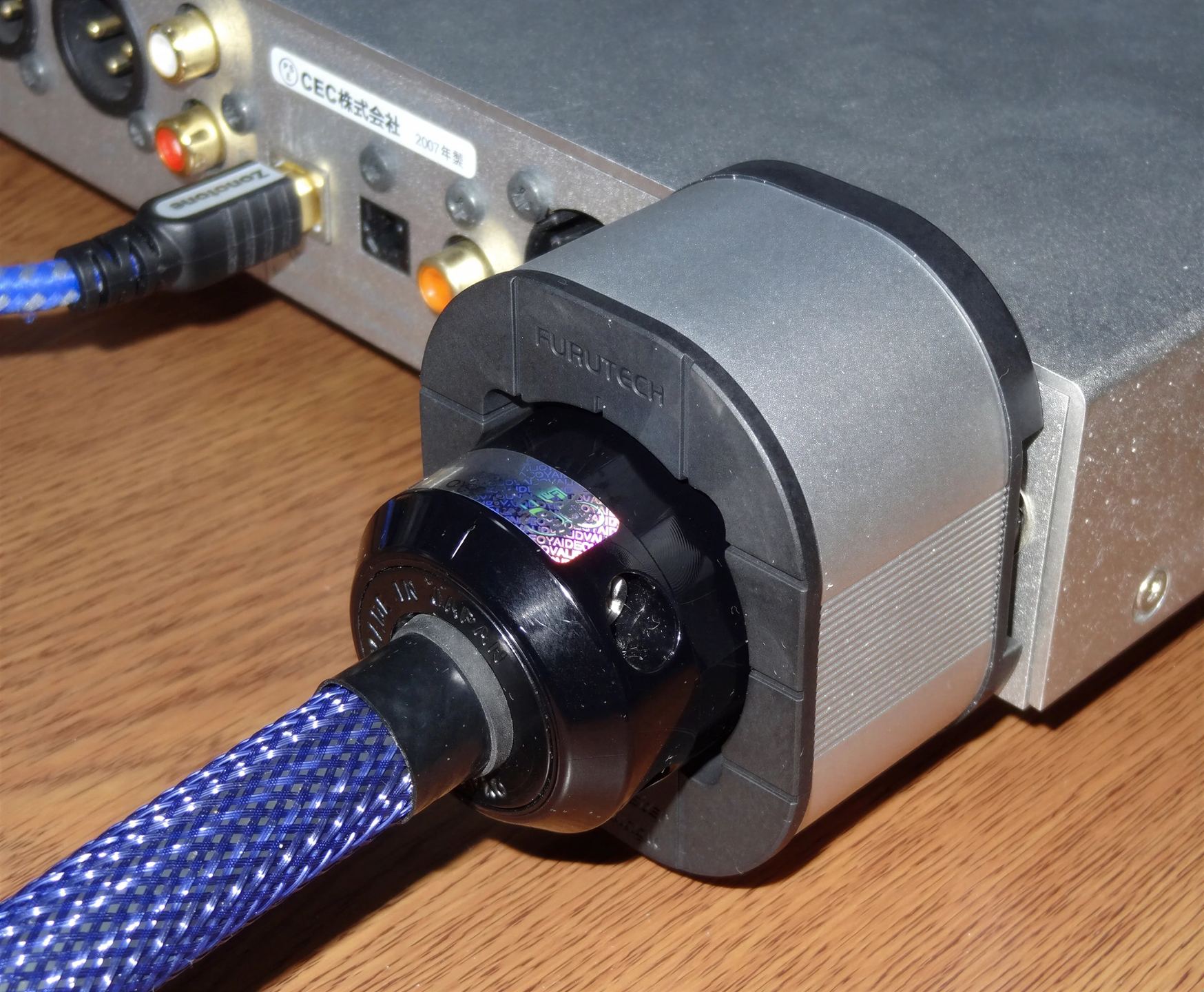
The principle is simple: a collar with a 40 mm internal diameter fits around the body of the plug, then attaches with adhesive to the surrounding surface, whether a wall socket plate, the top of a power strip or the rear panel of a component. The plug no longer rests solely on its pins: it is supported by a part firmly attached to the socket, limiting the sag caused by a heavy, stiff cable and reducing the transmission of vibrations between the cable and the contacts.
These vibrations have several sources. An amplifier’s transformer hums slightly during operation, the speakers make the furniture vibrate, and a thick mains cable acts like a lever that transmits every movement to the plug. The Booster Brace Single works only on this mechanical level: it does not filter the current and has no electrical contact with the conductors.
Filled nylon, aluminium and an air chamber
Despite weighing just 67.5 g, the part combines several materials with distinct roles. The body is made of nylon resin filled with NCF (Nano Crystal² Formula), Furutech’s proprietary compound, which combines a crystalline material with ceramic nanoparticles and carbon powder. NCF serves to dissipate static electricity and dampen vibrations, which explains its presence in the brand’s connectors, sockets and accessories.
Grooves cut into the body’s surface limit surface vibrations. Around it, a bead-blasted and then anodised aluminium alloy housing encloses a partitioned internal structure: an NCF column channels vibrations away, a damping wall also made of NCF breaks up resonances, and a semi-enclosed air chamber uses the pressure of the air inside to counteract movement. The idea is to put several materials of different densities to work rather than a homogeneous block, which would have its own resonant frequency.
The rear face, which is adhered to the surface, is not perfectly flat: it has slight grooves, unlike the double model in the range.
Wall socket, power strip or equipment inlet
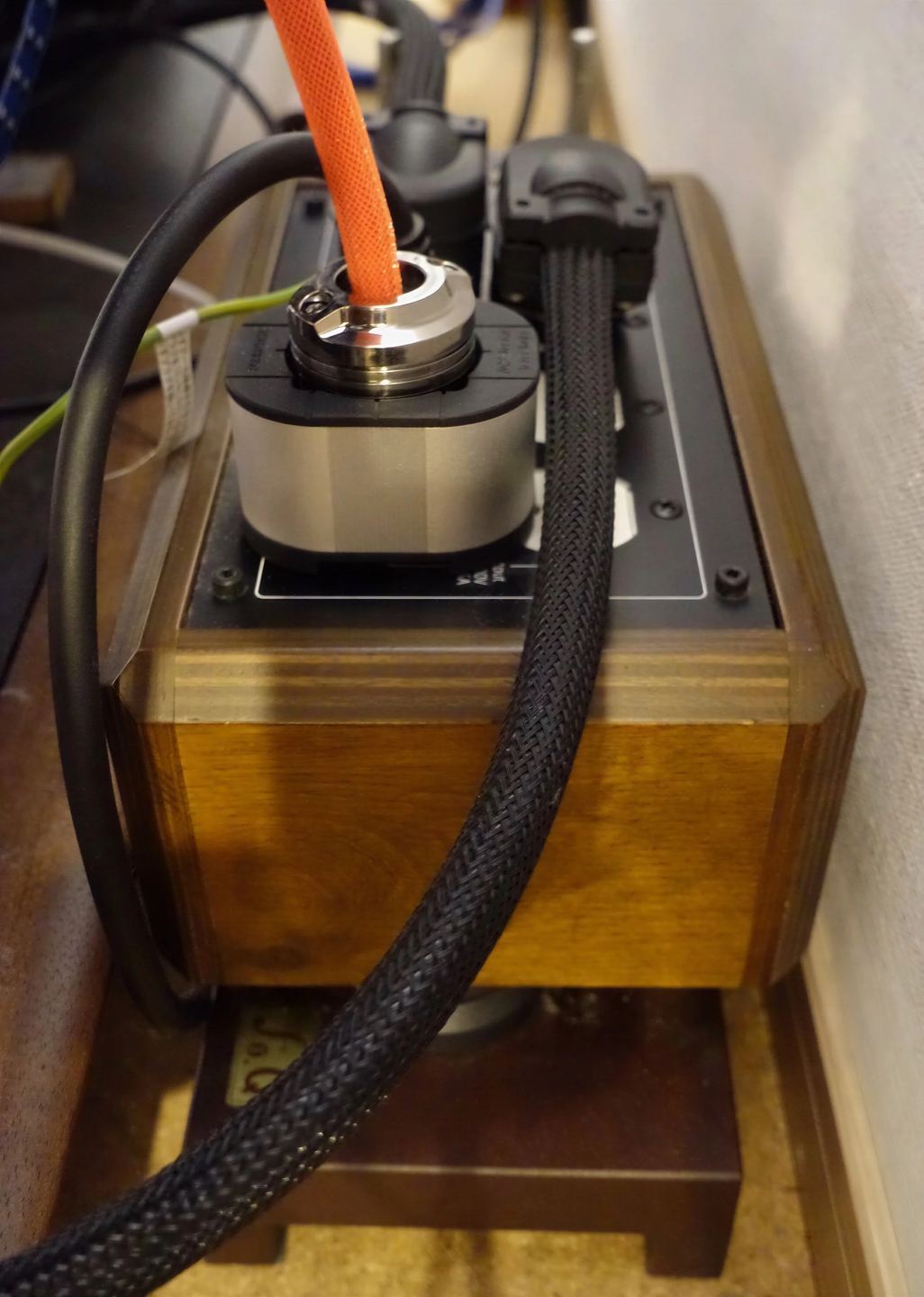
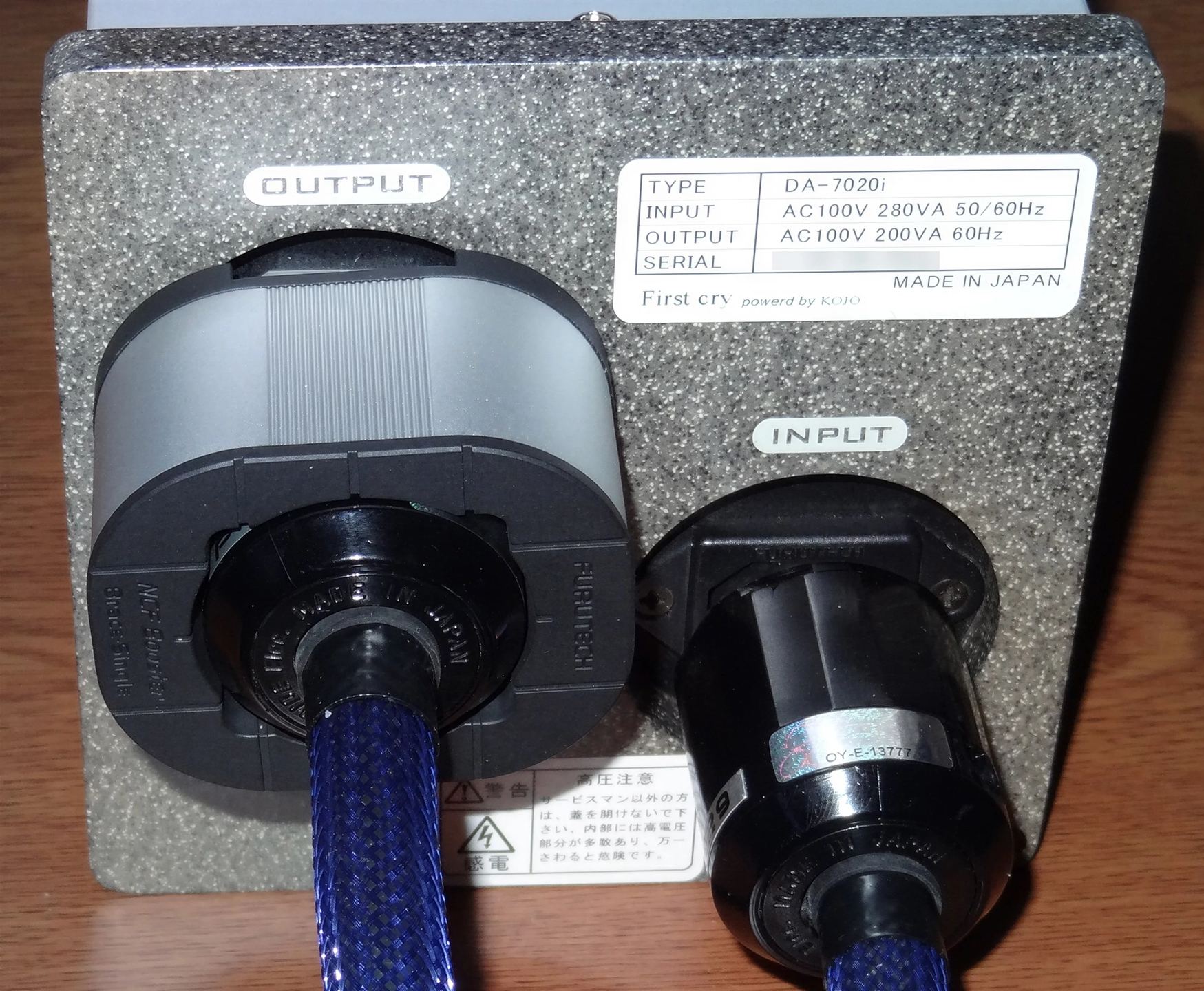
The Booster Brace Single accepts Schuko plugs, IEC connectors (the female plug that connects to the back of components) and American plugs. It can therefore be fitted in three places in the system: on a single wall socket, on a power strip or mains distributor, and on the IEC inlet of an amplifier, a source or a power conditioner. Its external dimensions, 54.3 × 64.8 × 38.5 mm, remain compact, making installation easier at the back of a component where space is often limited.
This width has a drawback on power strips: two units cannot fit side by side on neighbouring sockets. To support two adjacent plugs, Furutech offers the NCF Booster-Brace, the double version in the same range. Plugs whose bodies exceed 40 mm in diameter, or whose shape extends well beyond the pins, will not fit through the ring.
The model is part of the NCF Booster series, which includes cable supports placed on furniture (NCF Booster, Booster-Signal for interconnect cables) and rings adhered around sockets (Booster-Brace and Booster-Brace Single). It works with any plug, regardless of brand.
An adhesive mounting that requires careful positioning
The Booster Brace Single comes with double-sided adhesive already applied to its rear face, along with two replacement adhesives. The bond is strong and leaves no residue when removed. The replacements allow two repositionings, leaving some scope to try another point in the system, but making it advisable to check alignment before attaching it: the plug must pass through the ring without strain, and the surface around the socket must be clean and flat enough for the adhesive to make contact across its full width. On some curved or textured wall plates, the contact area is reduced.