Pathos InPol Remix MkII, the hybrid Class A integrated amplifier
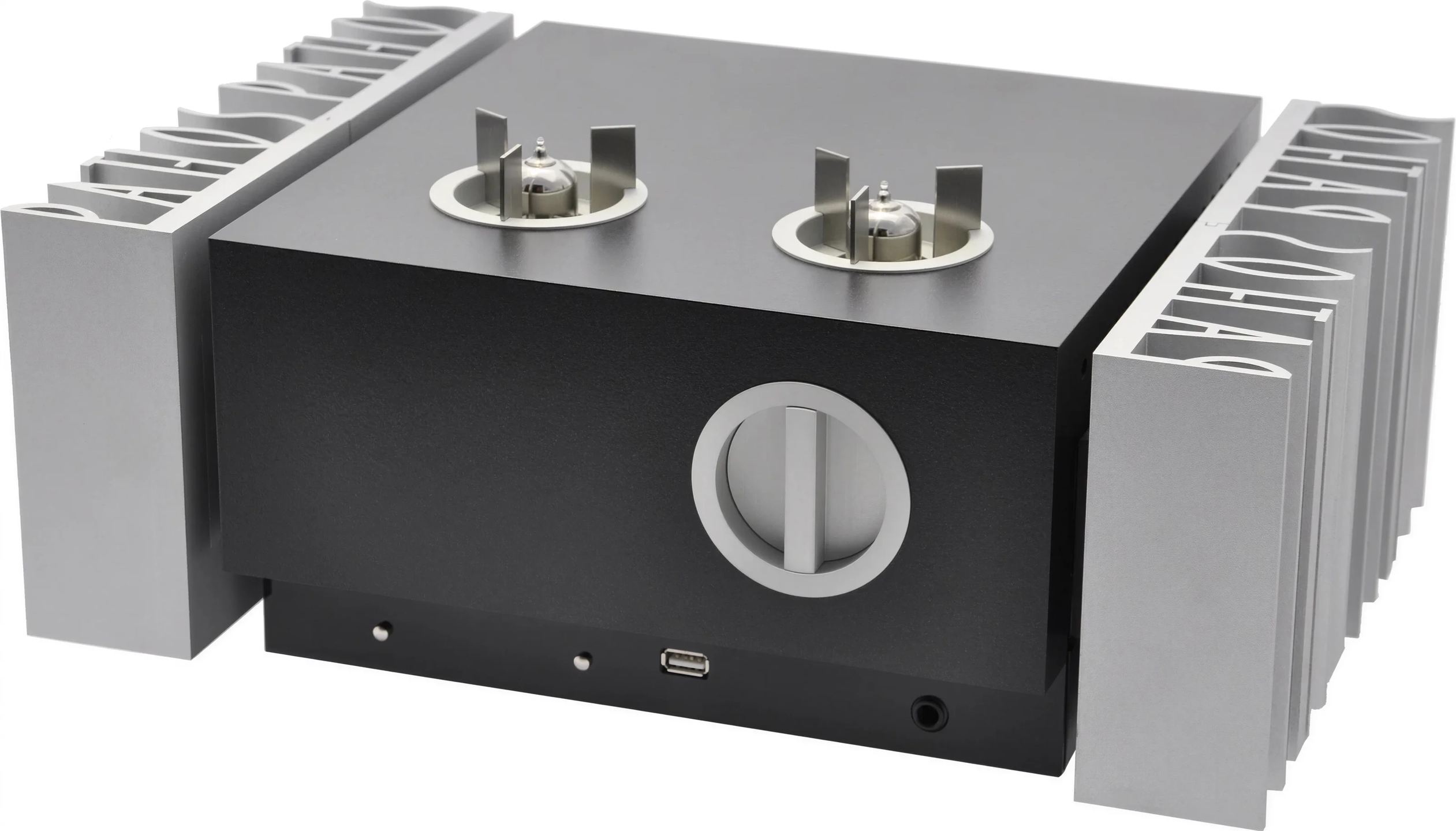
Two triodes sit flush on top of the chassis, protected by their aluminium rings. They set the tone: beneath the cover, a tube input stage and a transistor output stage coexist, with the whole unit operating in pure Class A. Manufactured in Vicenza by Pathos Acoustics, this integrated amplifier brings the in-house InPol circuit into a compact format, with a balanced input, a fully fledged headphone output and an optional digital converter.
A compact chassis with visible tubes
Pathos has designed and assembled its devices in Italy since 1994, with a recognisable visual signature. On the Remix MkII, the pair of tubes is mounted vertically in the centre of the top panel, topped with aluminium rings that protect them. The sides feature sculpted aluminium heat sinks designed to dissipate the heat generated by Class A operation. The volume knob, also made of anodised aluminium, falls naturally to hand.
The enclosure measures 280 mm wide, 180 mm high and 370 mm deep, weighing 13.5 kg. That is little for a Class A integrated amplifier, allowing installation on a standard hi-fi cabinet. The finish shown here is matte black; Pathos also offers the Remix MkII in other colours and finishes.
The tube provides voltage, InPol provides current
Operation is based on the InPol circuit, short for Inseguitore Pompa Lineare, which can be translated as “linear pump follower”. Pathos patented it when it was created and uses it in several of its amplifiers. The principle divides the work into two stages. A pair of Electro-Harmonix ECC88 triodes amplifies the voltage of the input signal: the tube shapes the music. This is followed by the transistor-based InPol stage, which operates as a follower with a voltage gain of 1 and high current gain. In other words, it does not alter the signal shaped by the tube; it simply provides the current needed to drive the speakers.
This stage operates in pure Class A, without global feedback, meaning without a loop that sends part of the output signal back to the input to correct deviations. The transistor conducts over the entire signal, without switching, which avoids the crossover distortion found in Class AB designs. The MkII version uses a dual InPol circuit: two bridge-mounted InPol cells driven in opposite phase, increasing available power and lowering output impedance. The entire design is fully balanced, from the XLR connector to the speaker terminals.
Measured power and speaker choice
On paper, power appears modest: 25 watts per channel into 8 ohms, 38 watts into 4 ohms. This is the trade-off of Class A and an output stage with a single component per channel. This figure should be put into perspective: in a medium-sized room, at normal listening levels, these 25 watts go further than one might think. On the other hand, a large room, inefficient speakers or very high levels will quickly reach the limit.
Output impedance is 0.9 ohms, giving a damping factor of around 9 into 8 ohms. This factor reflects how firmly the amplifier controls the bass driver. The value remains higher than that of a conventionally designed tube amplifier, but lower than that of a large transistor amplifier with heavy feedback. Put simply, the Remix MkII sounds best with speakers of reasonable sensitivity and a stable electrical load.
Like any Class A device, it dissipates heat continuously, even without music. The heat sinks and top panel become warm: it needs space around it and should not be enclosed in a closed cabinet.
Microprocessor-controlled volume and bias
Volume adjustment does not use a conventional potentiometer. The knob sends information to a microprocessor, which controls two Burr-Brown PGA2310 circuits, one per channel. Level is adjusted in 180 steps of 0.5 dB, with perfect balance between the two channels and repeatability unavailable from a mechanical potentiometer.
The same microprocessor manages the bias of the InPol stage, meaning the idle current that keeps the transistors within their Class A operating range. The remote control provides access to volume, input selection and inversion of the preamplifier output polarity, useful when the associated power amplifier itself inverts the signal phase.
Balanced inputs, preamp outputs and headphone output
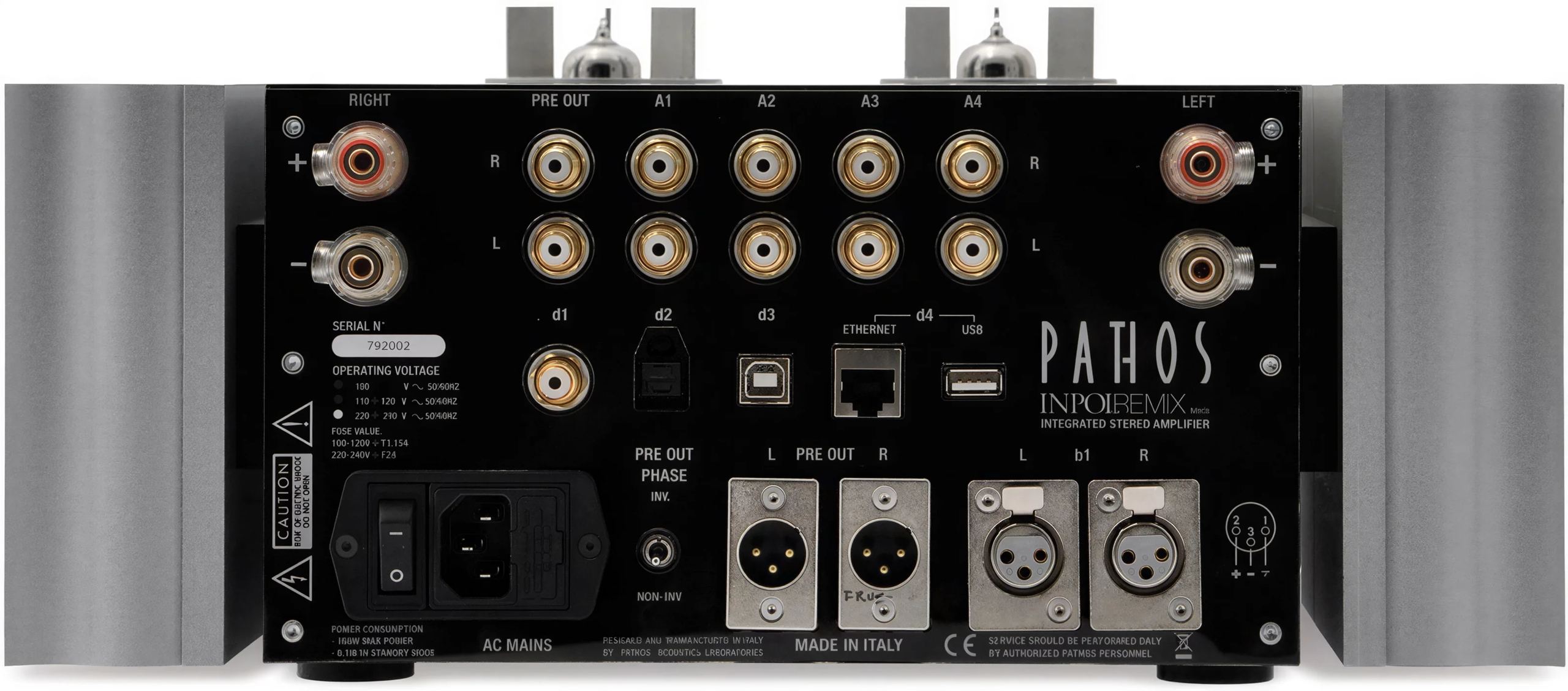
The analogue connectivity includes one balanced XLR line input and four unbalanced RCA line inputs. The balanced input carries the signal on two wires in opposite phase, helping reject noise picked up along the way, an advantage with long cable runs. Input sensitivity is 470 mV and input impedance is 47 kilohms, values compatible with most sources.
Two preamplifier outputs, one XLR and the other RCA, follow the volume setting. They can drive a power amplifier, active speakers or a powered subwoofer, or allow the Remix MkII to be used as a standalone preamplifier.
The headphone output is not a last-minute addition. It has its own stage, with a 6.35 mm jack socket, and delivers 2.65 watts into 32 ohms with an output impedance of 0.45 ohm and a distortion rate of 0.025%. Its frequency response extends up to 400 kHz. Enough to power demanding headphones, including high-impedance models.
The optional HiDac EVO digital module
In its basic version, the Remix MkII is an analogue amplifier: an external source (network player, CD player, converter) must be connected to its line inputs. To integrate the digital section into the device, Pathos offers the HiDac EVO card.
This module is based on an ESS Sabre 9018K2M converter. It accepts PCM files up to 32-bit/384 kHz, as well as DSD (high-resolution format) files in DSD64 and DSD128 via USB. Three digital inputs then appear on the rear panel: a Type-B USB port for a computer, a coaxial S/PDIF input and an optical S/PDIF input (digital audio connections) for a transport, CD player or television. The card also adds network playback, with Ethernet and Wi-Fi, AirPlay compatibility and access to files shared on a NAS, all controlled from the Pathos application. Bluetooth, however, is not supported.
Frequently asked questions
Are highly sensitive speakers absolutely required?
Not necessarily highly sensitive, but good sensitivity helps. With 25 watts in Class A and a moderate damping factor, the Remix MkII feels at home with speakers rated at around 88 dB or above, with a stable electrical load, in a reasonably sized room. Power-hungry speakers or very large rooms demand more than it can provide.
Do the tubes wear out quickly?
The two ECC88 tubes are used in the input stage: they operate at low levels, far from the demands of a tube power stage, and last a long time. They remain accessible on top of the device for replacement when the time comes. The output stage uses transistors and does not wear in the same way.
Does the amplifier get very hot?
Yes. Class A consumes power and dissipates heat continuously, including when there is no signal. The heat sinks and top panel become hot to the touch. Space should be allowed around the device, and it should not be placed in an enclosed cabinet.
Is the digital converter included?
No, the HiDac EVO card is optional. Without it, the Remix MkII works only with analogue sources connected to its line inputs. The converter can be added to provide digital inputs and network playback.
Can it be used only as a preamplifier?
Yes. The XLR and RCA preamplifier outputs follow the volume setting and can feed a power amplifier, active speakers or a powered subwoofer. The output polarity switch works with power amplifiers that invert phase.
Does it support Bluetooth?
No, even with the HiDac EVO card. The latter enables network playback (Ethernet, Wi-Fi, AirPlay, NAS sharing) but not Bluetooth. For a Bluetooth connection, an external receiver connected to a line input is required.
How does it differ from Pathos’s larger InPol models?
The Remix MkII brings the InPol principle into a compact chassis, with more modest power, an integrated headphone output and an optional digital section. The brand’s higher-end InPol models aim for greater power and more substantial construction, often in separate components.