Philippe
Good cable; you can hear a difference in sound.
Comment from 20 July 2022 — Experience from 9 July 2022
Automatically translated — Show original (French)
Bon câble ; on sent une différence sonore.
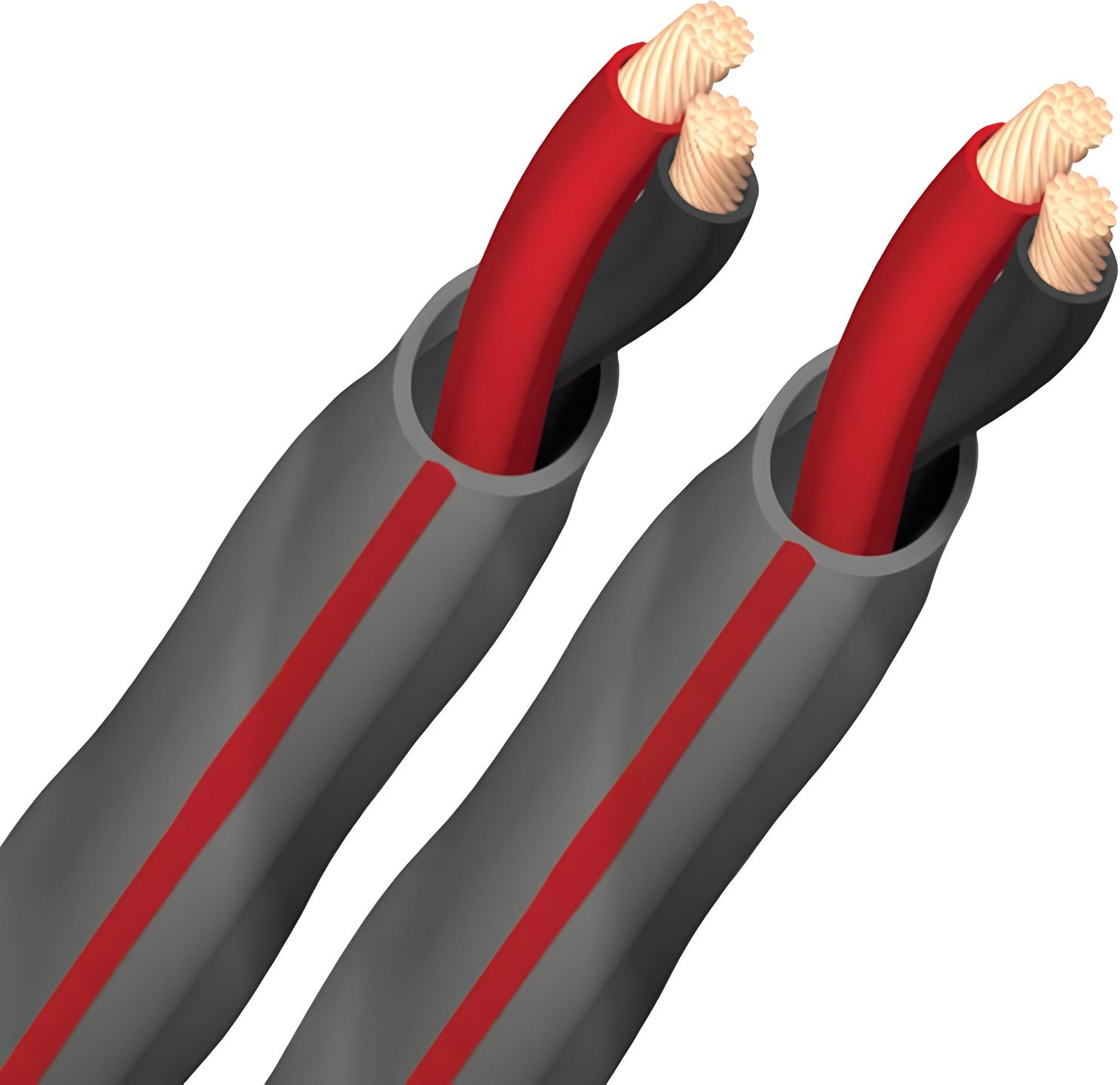
A speaker cable that ends up inside a partition wall, above a suspended ceiling or in a trench at the bottom of the garden is not something you replace every other day. This one combines two 1.31 mm² long-grain copper conductors, semi-solid strand construction and a grey jacket approved for both in-wall installation and direct burial. Sold by the metre, it can be cut to the exact length of each connection between the amplifier and the speakers.
Viewed under a microscope, a copper conductor consists of adjacent crystals, or grains, and each boundary between two grains represents a small discontinuity along the signal path. AudioQuest’s LGC (Long-Grain Copper) has longer grains than the OFHC (oxygen-free high-conductivity) copper used in ordinary cables, meaning fewer boundaries per metre, along with fewer oxides and impurities in the metal.
The way this copper is assembled matters just as much as its purity. In a conventional stranded cable, dozens of fine strands twist around and change position along the cable, and each interacts electrically and magnetically with neighbours that are never the same from one point to the next. Semi-Solid Concentric construction aims to eliminate these changing interactions: the strands, fewer in number and packed around a centre, maintain a fixed position relative to one another along the entire length. The resulting conductor sits between flexible stranded wire and solid wire. It holds the shape you give it inside a partition wall or along a skirting board, but bends less readily around tight corners and requires careful stripping.
A speaker cable forms a loop: current flows from the amplifier through one conductor and returns through the other. The farther apart these two conductors are, the larger the loop area and the higher the cable’s inductance, which progressively attenuates the upper frequencies as the length increases. The two conductors in the SLiP-DB 16/2 are twisted in a spiral (Spiral Geometry), an arrangement that minimises this area. Over two or three metres behind a piece of furniture, the difference remains modest; over the ten- or fifteen-metre runs of an in-wall installation, geometry has a greater influence on the final balance.
The conductors are also direction-controlled (Direction-Controlled), a principle AudioQuest applies to all its cables to limit radio-frequency noise. With cable sold by the metre, this means installing every length in the same direction.
The EasySLiP jacket is deliberately minimalist: a thin, smooth PVC covering that slides without snagging through a conduit, behind plasterboard or above a suspended ceiling. Its grey colour with red stripes makes it instantly distinguishable from electrical cables when several systems share the same partition wall.
It carries CL3 and FT4 approvals. The first, established under North American UL standards, classifies the cable among low-voltage signal cables permitted inside walls (up to 300 V); the second corresponds to a Canadian flame propagation test on a vertical bundle of cables. The DB (Direct Burial) suffix indicates that the jacket can withstand direct burial in the ground, without conduit, to feed outdoor speakers at the bottom of a garden or around a patio. Running the cable through TPC conduit remains good practice: it protects it from a spade strike and allows it to be replaced without reopening the trench.
Each conductor measures 1.31 mm², equivalent to 16 AWG in the American wire gauge system. In copper, a connection has approximately 0.026 ohm of resistance per metre, including both the outgoing and return paths. A common rule of thumb is to keep cable resistance below 5% of the speaker’s impedance, a threshold beyond which the level drops noticeably and the amplifier has less control over the woofer’s movement. For 8-ohm speakers, this allows a run of around 15 metres; for 4-ohm speakers, closer to 7 to 8 metres.
These distances cover most in-ceiling speakers, zones in a multiroom system, rear channels in a home cinema and outdoor speakers close to the house. Beyond that, or with low-impedance speakers far from the amplifier, the 2.08 mm² (14 AWG) cross-section in the same SLiP-DB family reduces resistance by a good third.
The jacket carries metric markings with sequential numbering every 30 cm, up to 150 m. Simply noting the number at the start and finish tells you the length installed without unrolling a tape measure, making it easier to prepare several runs to different rooms.
When ordering, simply add up each run, then allow 30 to 50 cm of spare cable at each end to work comfortably inside a recessed back box or behind an amplifier. The bare ends connect to screw or spring terminals, or can be fitted with banana plugs or spade connectors. With semi-solid strands, a correctly sized wire stripper prevents nicking the copper.
The first number indicates the AWG (American Wire Gauge) size of each conductor, the second the number of conductors. The AWG scale works in reverse: the smaller the number, the thicker the wire. 16 AWG corresponds to 1.31 mm², 14 AWG to 2.08 mm², and 12 AWG to 3.31 mm². A “16/2” cable therefore contains two 1.31 mm² conductors, one outgoing and one return for a speaker.
Since the conductors are directional, AudioQuest’s convention is to lay the cable from the amplifier toward the speaker. For cable sold by the meter, note the direction when cutting and keep it the same for all connections. This direction has nothing to do with polarity, which should be observed as usual by connecting the amplifier’s + to the speaker’s +.
These are North American standards. They provide information on fire performance and suitability for installation in walls, but do not replace a European classification. For a detached house, they give a good indication of the quality of the cable jacket; for a project subject to specifications (public-access buildings, offices), have the cable choice approved by the installer or inspection body.
No. The NF C 15-100 standard prohibits routing low-current wiring, including audio connections, through the same conduits as power circuits. Provide a dedicated conduit for speaker cables, which also makes them easier to replace later.
Yes, provided you run two lengths of cable per speaker: one pair for the bass terminals and another for the treble terminals, connected to the same output at the amplifier end. The jumpers or plates linking the speaker’s two sets of terminals must then be removed.
It’s best to avoid it on a screw terminal. Tin slowly creeps under pressure, the clamping loosens over time, and the contact deteriorates. Freshly stripped bare copper twisted in the direction of the strands, or a screw-type or crimp-type banana plug, provides a more durable connection.
It’s not essential. With this cross-sectional area, a three-metre difference between the left and right channels amounts to less than a tenth of an ohm, with no audible effect on stereo balance. It’s better to cut each cable to the right length than to coil up the excess behind a piece of furniture.
Philippe
Good cable; you can hear a difference in sound.
Comment from 20 July 2022 — Experience from 9 July 2022