Didier
More power with plenty of punch, I love it
Comment from 26 June 2026 — Experience from 8 May 2026
Automatically translated — Show original (French)
Plus de puissance avec beaucoup de pêche j'adore


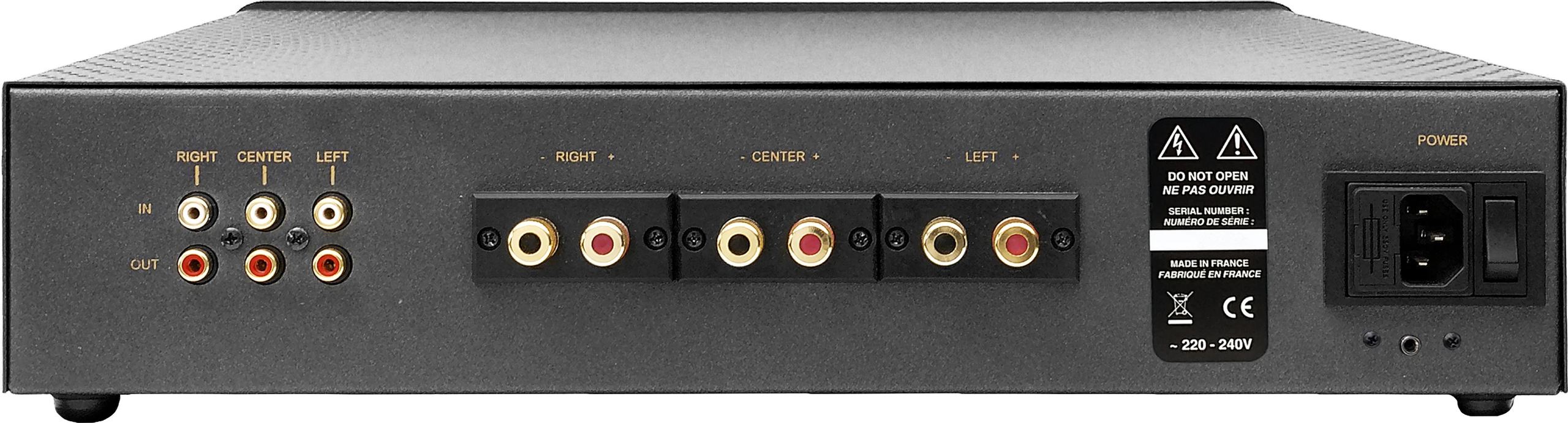
The Atoll AV100 is a three-channel power amplifier designed to support home theater receivers on their most heavily used channels. Capable of delivering 100 watts per channel into 8 ohms and 140 watts into 4 ohms, this unit follows the French manufacturing tradition of Atoll Electronique, which favors discrete electronic components and a minimalist design. Equipped with two toroidal transformers totaling 680 VA and a filtering capacity of over 44,000 microfarads, it aims to restore power reserves to the front and center speakers in a multichannel setup.
The AV100 addresses a recurring issue in home theater systems: overloading the built-in amplification. Modern multichannel receivers must drive five, seven channels or more simultaneously, which heavily taxes their power supply. By offloading amplification of the three front channels (left, center, right) to a dedicated power amp, the receiver is relieved of a major burden. Its power supply can then focus on the surround channels and Dolby Atmos effects, while its processing section benefits from increased current reserves.
This approach brings a often-overlooked advantage: a more homogeneous front soundstage. The three front speakers reproduce the main plane of a film’s sound image. Using a three-channel amplifier rather than a stereo amp plus the receiver for the center channel ensures these three speakers receive exactly the same type of amplification. This coherence translates into a smoother soundstage and more precise localization of dialogue.
The AV100 is connected via the pre-out outputs of the home theater receiver. These outputs, found on mid-range and high-end models, provide an unamplified signal that the AV100 takes over. Level settings, delay management, and room correction remain handled by the receiver, while the AV100 simply amplifies the signal it receives faithfully. There is therefore no conflict in settings and no added complexity in system calibration.
The AV100’s output stage is based on MOS-FET (Metal-Oxide-Semiconductor Field-Effect Transistor) transistors. These components differ from classic bipolar transistors in how they operate. While a bipolar transistor is current-driven, a MOS-FET is voltage-driven, with a very high input impedance. This characteristic simplifies the design of the bias circuit and reduces demands on the preceding stage.
MOS-FET transistors have a very low on-state resistance (RDS-on), allowing them to switch high currents with minimal losses. In an audio amplifier, they provide notable linearity and the ability to handle fast transients. Their electrical behavior is reminiscent of vacuum tubes, with harmonic distortion that falls off progressively rather than creating abrupt clipping. This trait contributes to the smoothness of the sound reproduction.
The AV100’s power supply is built around two 340 VA toroidal transformers, for a total of 680 VA. The toroidal shape offers several advantages over classic EI-core transformers. First, electromagnetic radiation is confined inside the circular structure, limiting interference with other components. Second, iron losses are reduced thanks to better magnetic flux circulation. The toroidal transformer also operates quietly, without the characteristic hum of laminated models. These qualities make it a logical choice for electronics targeting sonic neutrality.
The total filtering capacity reaches 44,210 microfarads, distributed over several capacitors. This energy reserve allows the amplifier to respond to sudden current demands imposed by dynamic scenes, whether it’s an explosion in an action movie or a full orchestral tutti. The amplification stages are built in a symmetrical configuration with discrete components, an approach that minimizes wiring lengths and uses star-grounding to avoid parasitic ground loops.
The AV100’s front panel is stripped down to essentials: an Atoll logo and a power LED. This simplicity is not an aesthetic stance but a logical consequence of the unit’s function, which requires no front-panel controls. The 4 mm thick brushed aluminum front plate features a slight curve that softens the overall lines. Two finishes are available: natural aluminum or black.
The 1.5 mm steel chassis provides the rigidity needed to support the transformers and dissipate vibrations. The top and sides are perforated with multiple ventilation holes arranged in concentric patterns. This passive cooling is sufficient in normal use, even though the unit runs hotter during the first few hundred hours as the components burn in. Once this period is over, heat dissipation becomes moderate.
The rear panel houses all connectivity. It includes three RCA inputs for the left, center, and right channels, along with the corresponding speaker binding posts. These screw terminals accept bare wire, spades, or banana plugs. The IEC mains socket allows the supplied power cable to be replaced by a higher-performance model if desired. A power on/off switch completes the basic equipment.
A trigger option is available on purchase. This feature, already present on the model shown here, allows the receiver to automatically switch the AV100 on and off via a 12 V link. Without this option, the user must manually operate the rear switch each time, which can be inconvenient in a setup integrated into furniture.
The technical specifications show a unit capable of delivering 100 watts RMS per channel into 8 ohms and 140 watts into 4 ohms. Peak power reaches 180 watts per channel, indicating the amplifier’s ability to handle brief but intense signal peaks. The bandwidth extends from 5 Hz to 200 kHz, well beyond the audible spectrum, ensuring no limitation at the frequency extremes. The 1.3-microsecond rise time reflects rapid response to transients. The 100 dB signal-to-noise ratio ensures a low enough noise floor to remain inaudible in normal listening conditions.
In a home theater configuration, its transparency and precise imaging are especially useful. Dialog, carried by the center speaker, gains in presence and intelligibility. Movements within the sound field become smoother, details emerge clearly even in complex scenes. Its power handling lets you raise the volume without the amplifier showing signs of strain, even with demanding speakers that dip low in impedance.
One point to note: the AV100 performs best when driven by a preamplifier or processor capable of delivering a signal with sufficient gain and drive. Paired with a too-soft source, it will not give its full potential. Its 1.77 V input sensitivity and 47 kΩ input impedance steer the choice toward quality receivers able to drive the unit without nearing their limits.
No, the receiver must have pre-out outputs for the front channels. These outputs, found on mid-range and high-end models, allow the signal to be taken before the power stage. Entry-level receivers, which lack these outputs, cannot be used with the AV100.
The trigger option greatly simplifies everyday use, especially when the AV100 is installed in furniture. Without it, the amplifier must be switched on and off manually via the rear switch. For a visible, easily accessible setup, you can do without it. For discreet integration, it becomes almost essential.
Its ability to deliver 140 watts into 4 ohms and its substantial current reserves allow it to power demanding speakers. Tests have confirmed its capacity to handle loads that dip low in impedance. However, particularly power-hungry speakers or models with very pronounced impedance drops in the bass may reach the limits of this 100-watt-per-channel amplifier.
Although designed for home theater, there is no reason not to use two of the three channels in a stereo hi-fi system. The unit’s musicality and its design, close to Atoll’s stereo amplifiers, make it a relevant choice for this use. The third channel can remain idle with no issues.
During the first 300 to 400 hours of use, the amplifier runs hotter than it will in steady-state operation. This burn-in phase is normal and allows the components to stabilize. It is recommended to ensure good ventilation during this period. Afterwards, heat dissipation becomes moderate.
There is no technical restriction, but that would miss its primary purpose. The front channels reproduce the main plane of the sound image and place the greatest demands on amplification. This is where the benefit of a dedicated power amp is most noticeable. The less demanding surround channels can easily remain powered by the receiver.
Didier
More power with plenty of punch, I love it
Comment from 26 June 2026 — Experience from 8 May 2026
Cyrille
Hello,
After a break-in period (essential), I’m getting a very good sound performance with the addition of this AV100 to my home theater system --> Denon 3800 preamp.
More power on the front stage (front and center speakers) of my 5.2.1 Elipson kit. Clearer voices, more detail but also more impact.
Very satisfied with the Atoll product, but also with the HOMECINESOLUTIONS team, always quick to give good advice and information about delivery times, not to mention the great discount when buying the product!
I will gladly trust this team again for my future purchases!
Cyrille
Comment from 20 February 2026 — Experience from 31 January 2026
Yvon
Power amplifier connected to my Marantz amp on the 7015 for the front LCR channels for 2 years.
It is more suited for a home cinema amp on the central and surround speakers. For my Triangle Antal EZ towers, I’m going to pair it with an Atoll IN 200 or AM200 amp. This amp is robust. It doesn’t overheat and is very musical. Be cautious with the highs on the Triangle towers, as they can be a bit too pronounced.
With proper adjustments on the source and especially with an Atoll preamplifier that matches, it’s fantastic!
Comment from 6 February 2025 — Experience from 19 December 2022