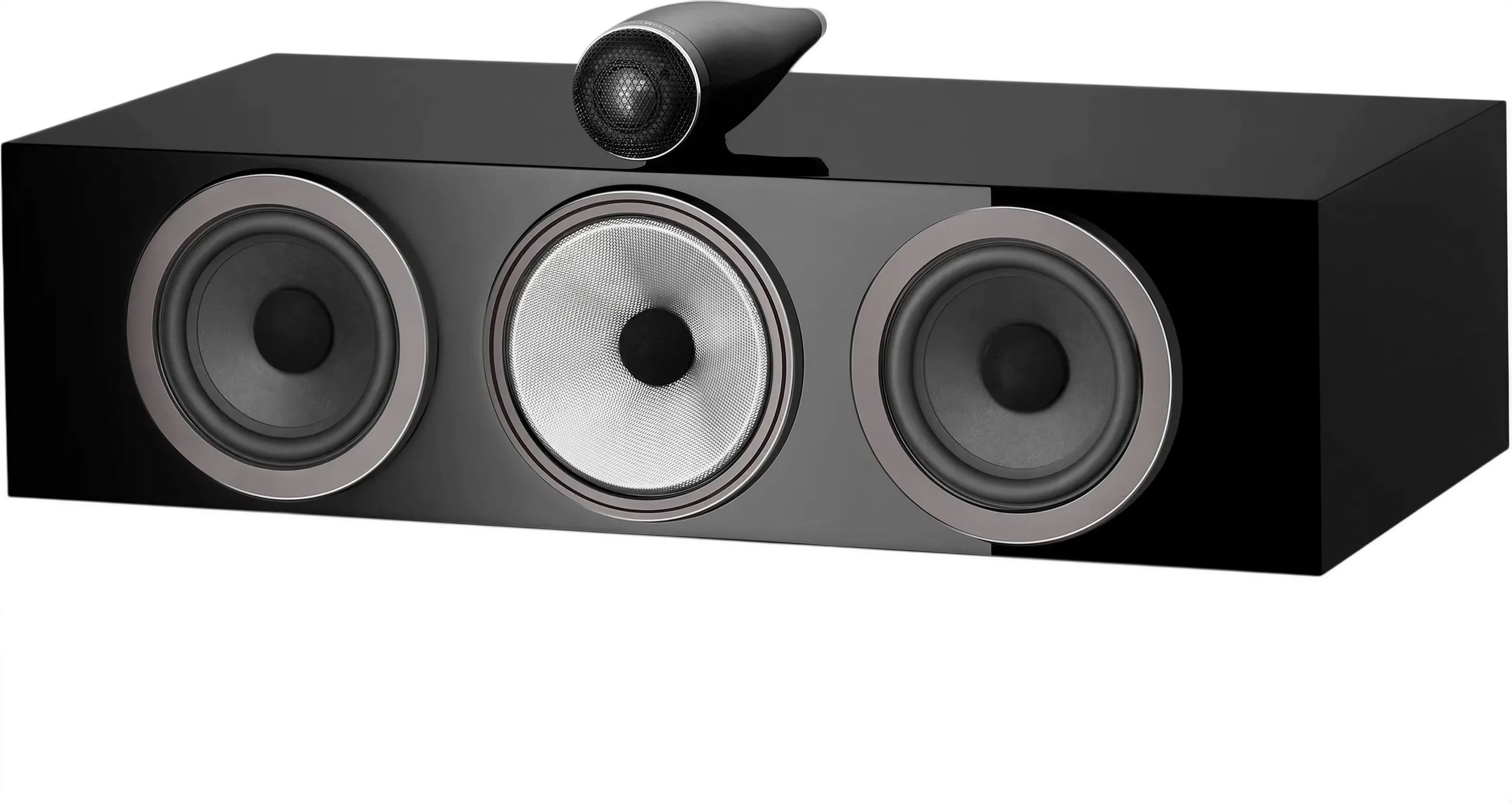
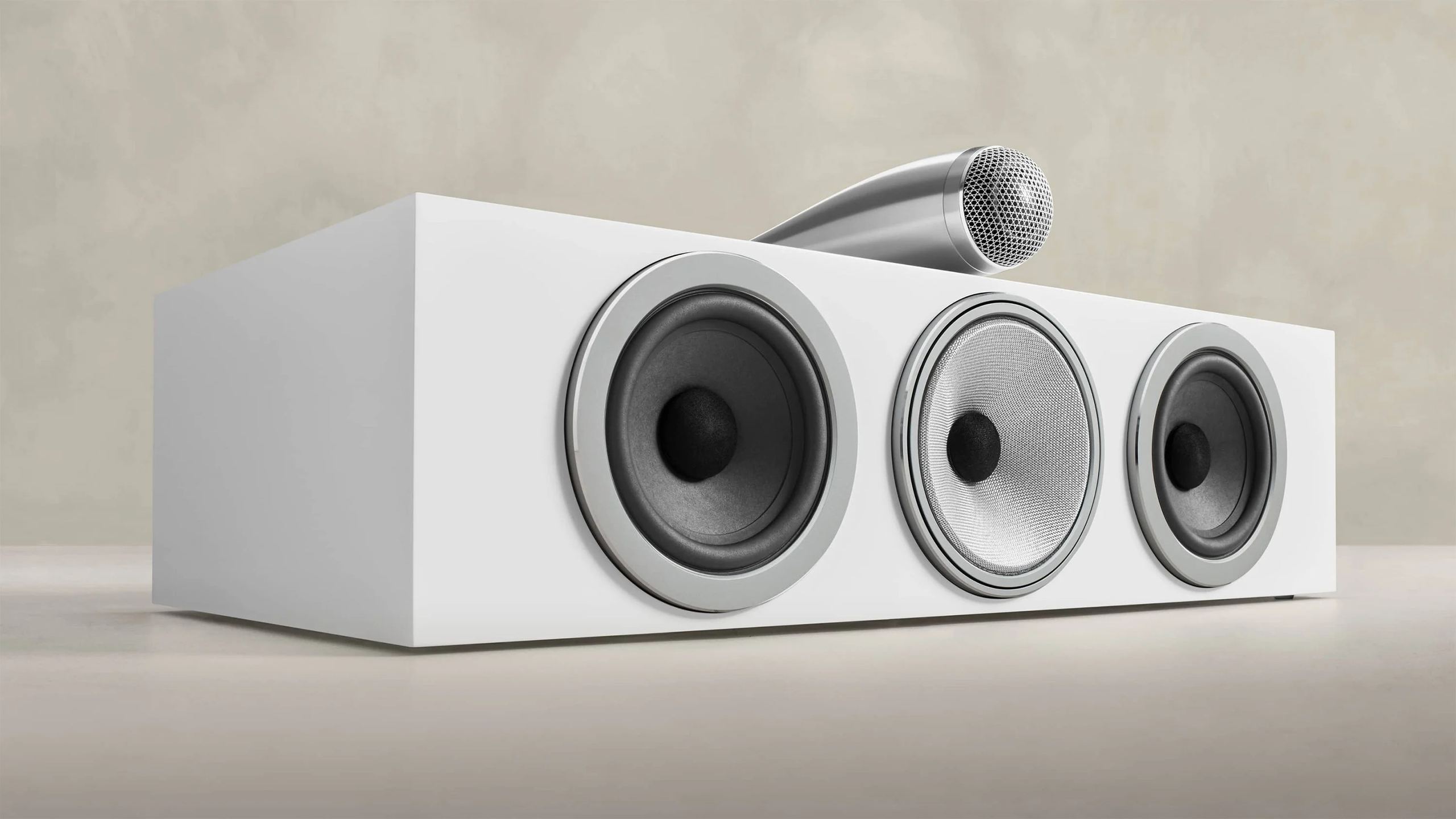
Bowers & Wilkins HTM71 S3, the center channel speaker in the 700 S3 series
Reproducing a voice accurately in the middle of a busy soundtrack remains one of the most delicate tasks in home theater. The larger of the two center channel speakers in the 700 S3 series from Bowers & Wilkins tackles this problem head-on with a three-way design that separates the midrange and treble from bass duties. The expected result: Clear dialogue, whatever the scene.
Separating voices from the rest of the spectrum
A center channel speaker has an ungrateful role: carrying almost all of a film’s dialogue while the side channels handle the ambiance. The HTM71 S3 meets this constraint with a three-way design, where the midrange has its own driver instead of sharing the task with the bass. This midrange is also mechanically decoupled from the rest, which limits interference between woofer movement and voice reproduction.
The stated frequency response extends from 45 Hz to 33 kHz, with a maintained response of ± 3 dB between 50 Hz and 28 kHz. The 89 dB sensitivity (measured at 2.83 V at one meter) and the nominal 8 Ω impedance, with a minimum of 3 Ω, place the speaker in a category that works with most amplifiers. Bowers & Wilkins recommends power between 30 and 200 W per channel, a fairly wide range that leaves room depending on the size of the room.
A tweeter isolated from the cabinet
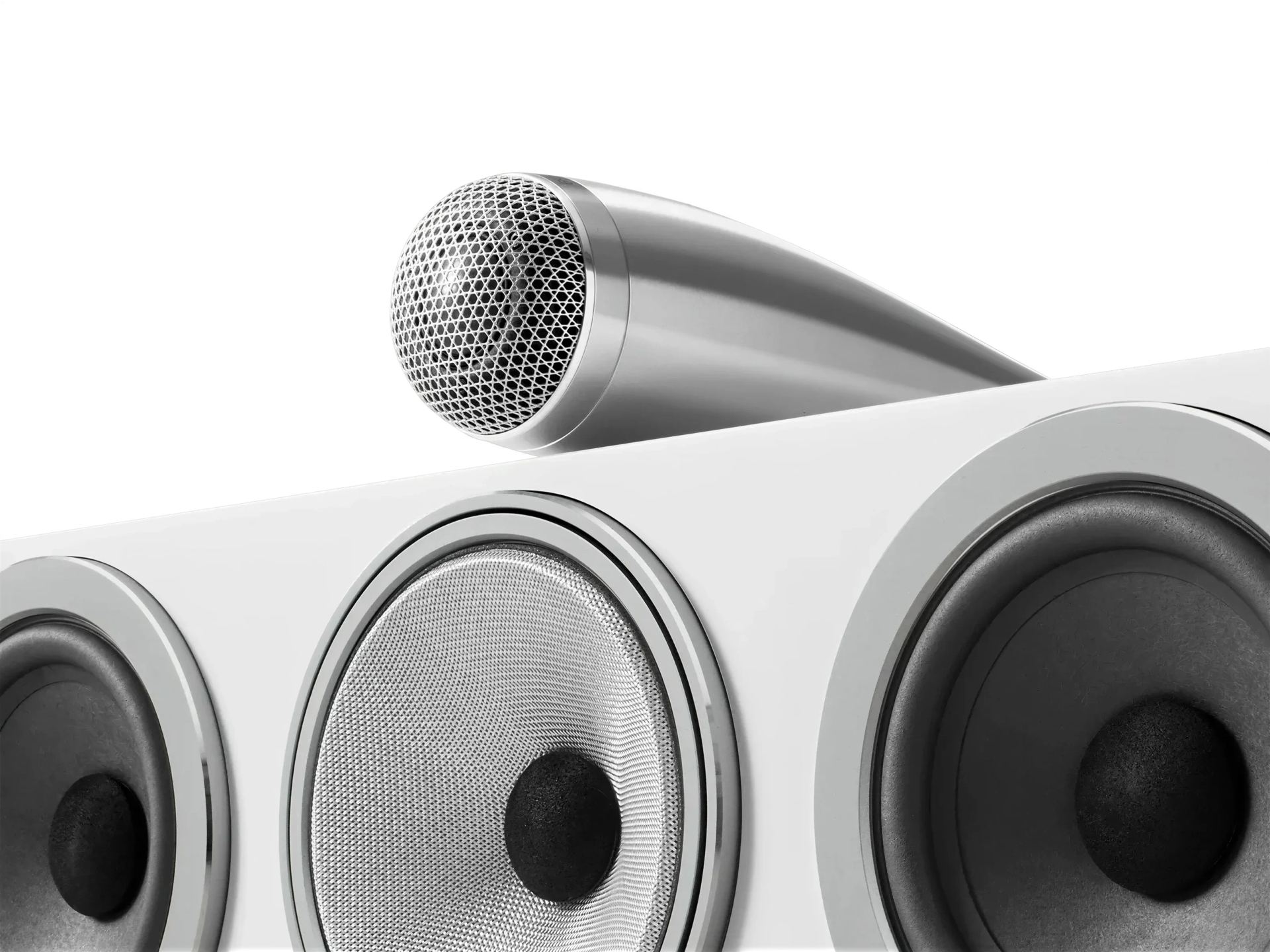
The brand’s most recognizable feature is found here: the tweeter housed in its own enclosure, mounted on top of the speaker. This “Solid Body” enclosure is milled from a block of solid aluminum, a mass that resists resonance better than a hollow structure. For this generation, the rear loading tube is longer and tapered in the manner of a Nautilus, filled with an absorbing material that dissipates the wave emitted behind the dome.
The dome itself measures 25 mm and uses carbon rather than the aluminum of previous generations. Its rigidity pushes the first breakup mode well beyond the audible band, which results in clean treble and precise effects placement. The tweeter is completely isolated from the cabinet by a damping gel connection, so that bass vibrations do not contaminate the high frequencies.
The Continuum midrange and its new suspension
At the center of the front panel, a 130 mm midrange driver features the Continuum diaphragm, that gray composite cone with which Bowers & Wilkins replaced its old yellow fiber cones. Its purpose: to avoid the abrupt behavioral breakups that color the sound when a conventional diaphragm leaves its comfort zone. The rendering gains in neutrality, especially on voices and instrumental timbres.
This midrange also uses FST technology, which eliminates the traditional peripheral surround, and a biomimetic suspension inherited from the 800 Diamond series. The latter replaces the fabric spider with an open structure that reduces parasitic air pressure and the coloration it causes. The aim of these choices is a readable midrange, without overstatement.
Two Aerofoil bass drivers and a profiled port
The bass relies on two 130 mm Aerofoil diaphragm drivers, a variable-thickness design: syntactic foam sandwiched between two layers of cellulose, thicker at the center and thinner at the edges. This profile provides rigidity where the diaphragm needs it without weighing down the whole, a condition for bass that is both deep and fast.
These woofers operate in a bass-reflex loading opened by a FlowPort with an aerodynamic profile. The port design smooths airflow at high volume and raises the threshold for turbulence noise. Bowers & Wilkins publishes its harmonic distortion figures, a transparency that is uncommon among manufacturers: below 90 dB at one meter, 2nd- and 3rd-harmonic distortion remains below 1% from 90 Hz to 22 kHz, and below 0.5% between 120 Hz and 20 kHz.
A refined cabinet with a curved front baffle
Compared with previous generations, the design has become slimmer. The cabinet is narrower and its front baffle slightly curved, a shape borrowed from the 800 Diamond series that limits wave diffraction on the edges and reduces internal standing waves. The midrange and bass drivers are housed in aluminum mounts that protrude from the front baffle, decoupled from the cabinet to contain vibrations.
Visible screws disappear in favor of a magnetic grille that can be fitted and removed without any visible markers. At the rear, a double pair of terminals allows bi-wiring or bi-amplification for those who want to separate the power supply for the bass and the upper part of the spectrum. The speaker measures 628 mm wide, 233 mm high including the tweeter, and 356 mm deep including the grille and terminal panel, for 17.5 kg, a weight that requires a solid support.
The evolution from the HTM71 S2
The move from the S2 to the S3 mainly comes down to the reorganization of the drivers. Where the previous model combined a 100 mm midrange and two 150 mm bass drivers, this version adopts a 130 mm midrange supported by two 130 mm bass drivers, while keeping a similar height. The decoupled carbon dome tweeter and latest-generation Aerofoil diaphragms accompany this change, resulting in a better-controlled frequency range and contained distortion.
2 130 mm bass drivers with aerodynamic membrane (Aerofoil)
Performance
Frequency range: 45 Hz to 33 kHz
Frequency response (± 3 dB): 50 Hz - 28 kHz
Sensitivity: 89 dB SPL (2.83 V RMS, 1 m)
Recommended amplification: 30 W - 200 W at 8 Ω (undistorted signal)
Impedance
Nominal: 8 Ω
Minimum: 3 Ω
Harmonic Distortion (90 dB, 1 m)
< 1% from 90 Hz to 22 kHz
< 0.5% from 120 Hz to 20 kHz
Dimensions
Speaker only: 628 × 165 × 318 mm
Height with tweeter: 233 mm
Depth with grille and terminal: 356 mm
Weight: 17.5 kg
Frequently asked questions
Must it necessarily be paired with speakers from the same series?
+
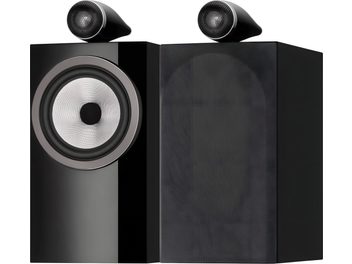
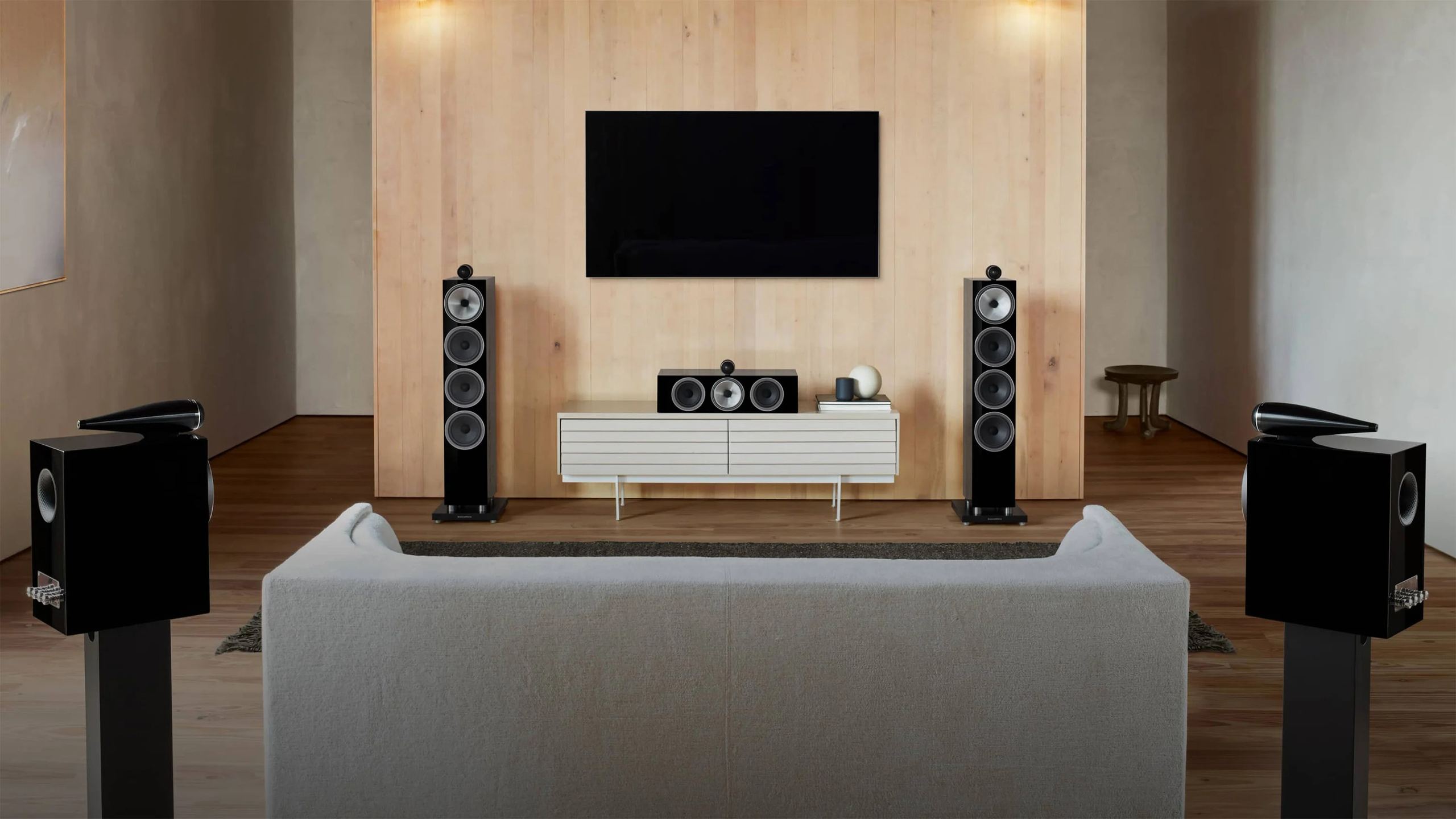
No, but the tonal match benefits from it. The HTM71 S3 shares its drivers and voicing with the floorstanding and bookshelf speakers in the 700 S3 series, which ensures sonic continuity when an effect moves from left to right across the center channel. With front speakers from another range, integration remains possible, at the cost of a slight difference in character on voices.
Does the tweeter mounted on top complicate installation?
+
You need to allow for the height: the speaker reaches 233 mm including the tweeter, versus 165 mm for the cabinet alone. In a closed unit, it’s best to check that the shelf leaves the tweeter room to breathe, with no hard surface directly above it that would reflect the treble. Placed on a low unit under the television, it requires no particular precautions.
Is it better to listen to the speaker with or without its grille?
+
The magnetic grille remains acoustically unobtrusive. Removing it sometimes opens up the highs very slightly, but the difference is minor. The choice comes down mainly to driver protection and visual preference.
Is the double pair of terminals useful without dedicated equipment?
+
From the factory, the terminals are connected by jumpers for standard single-wire wiring. They are only useful if you want to bi-wire or bi-amplify, separating the power supply for the bass from that of the midrange-treble. For a standard connection, simply leave the jumpers in place.
Which amplifier should I choose given the impedance?
+
The nominal 8 Ω impedance drops to 3 Ω in certain parts of the spectrum. An amplifier or AV receiver capable of delivering current into a low load will handle these dips better, especially at high volume. The 30 to 200 W range leaves the field open, from a beefy home theater receiver to a dedicated power amplifier.
Is the HTM71 S3 also suitable for music listening?
+
Yes. Its three-way design and Continuum midrange reproduce the singing voice with the same care as dialogue. In a multichannel setup, it handles the center tracks of music mixed in surround or filmed concerts, with the same clarity as in a film.
Can it be mounted on the wall?
+
Its size and weight of 17.5 kg make it better suited to placement on a piece of furniture or a shelf. Bowers & Wilkins does not provide integrated wall mounting for this model. A very rigid, properly sized wall bracket remains an option, provided that free space above the tweeter is maintained.
User reviews
Frédéric
I use it in home theater and hi-fi stereo/spatial audio combined with a Marantz amplifier. They are excellent. No listening fatigue, precise, the highs are not too bright as you can sometimes read about this brand. I love it. On the other hand, it is tall. I had to buy a new stand for my TV so that it wouldn't hide the picture. If you can mount the TV on the wall, there's nothing to worry about of course
Comment from 19 June 2026 — Experience from 27 November 2025
Automatically translated — Show original (French)
je l'utilise en home cinema et hi-fi stéréo/spatial audio combinées à un ampli Marantz. Elles sont extra. Aucune fatigue auditive, précises, les aigues ne sont pas trop brillant comme on peut parfois le lire sur cette marque. Je l'adore.
Par contre elle est haute. J'ai du acheter un nouveau pied pour ma TV afin qu'elle ne cache pas l'image. Si vous pouvez accrocher la TV au mur aucun soucis à se faire bien sur
Patrick
As a complement to my 702 S3 Very good product
Comment from 18 February 2026 — Experience from 8 January 2026
Automatically translated — Show original (French)
En complément de mes 702s3
Très bon produit
Jean marc
Really great, both in terms of aesthetic finish and sound quality.
Comment from 28 November 2025 — Experience from 4 December 2023
Automatically translated — Show original (French)
Vraiment top, aussi bien les finitions esthétiques, que la qualité du son.
Eco-contribution of €0.75 included in the sale price.
To better understand our visitors, measure marketing effectiveness and personalise ads, we and our partners use cookies and mobile advertising identifiers on your device. This data makes it possible to display personalised and non-personalised ads and measure their performance. Some cookies, which are technically necessary, are exempt from consent. You can accept those that require your consent, refuse them by clicking “Reject”, or customise your choices via “More options”.
To find out how Google uses the data collected once you have given your consent, see Google’s Business Data Responsibility site (opens in a new window).
You can change or withdraw your consent at any time via the “Cookies” link. Your choices will apply on our site for 12 months.