Each year, dozens of European journalists gather to select the best electronic products of the year. Awarded by a diverse and impartial jury, the EISA (Expert Imaging and Sound Association) awards recognize exceptional products for their performance, design, or ergonomics.
Overview
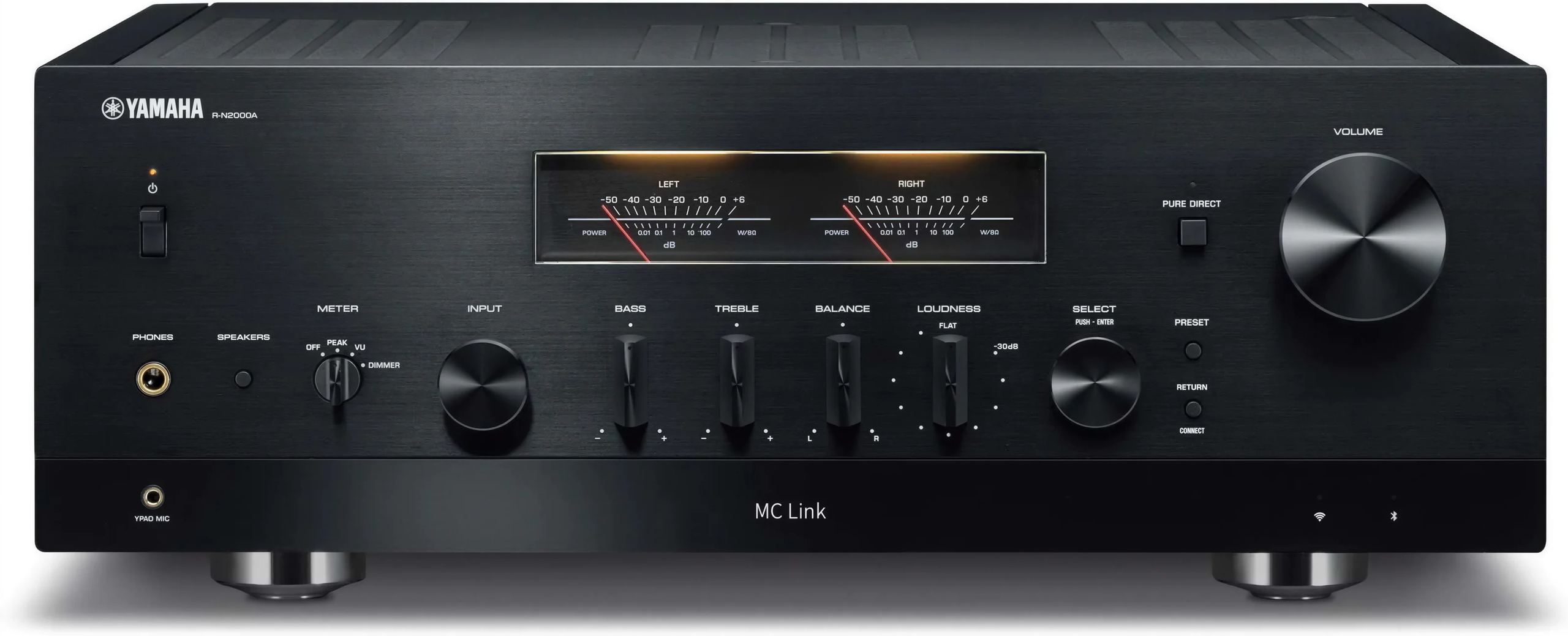
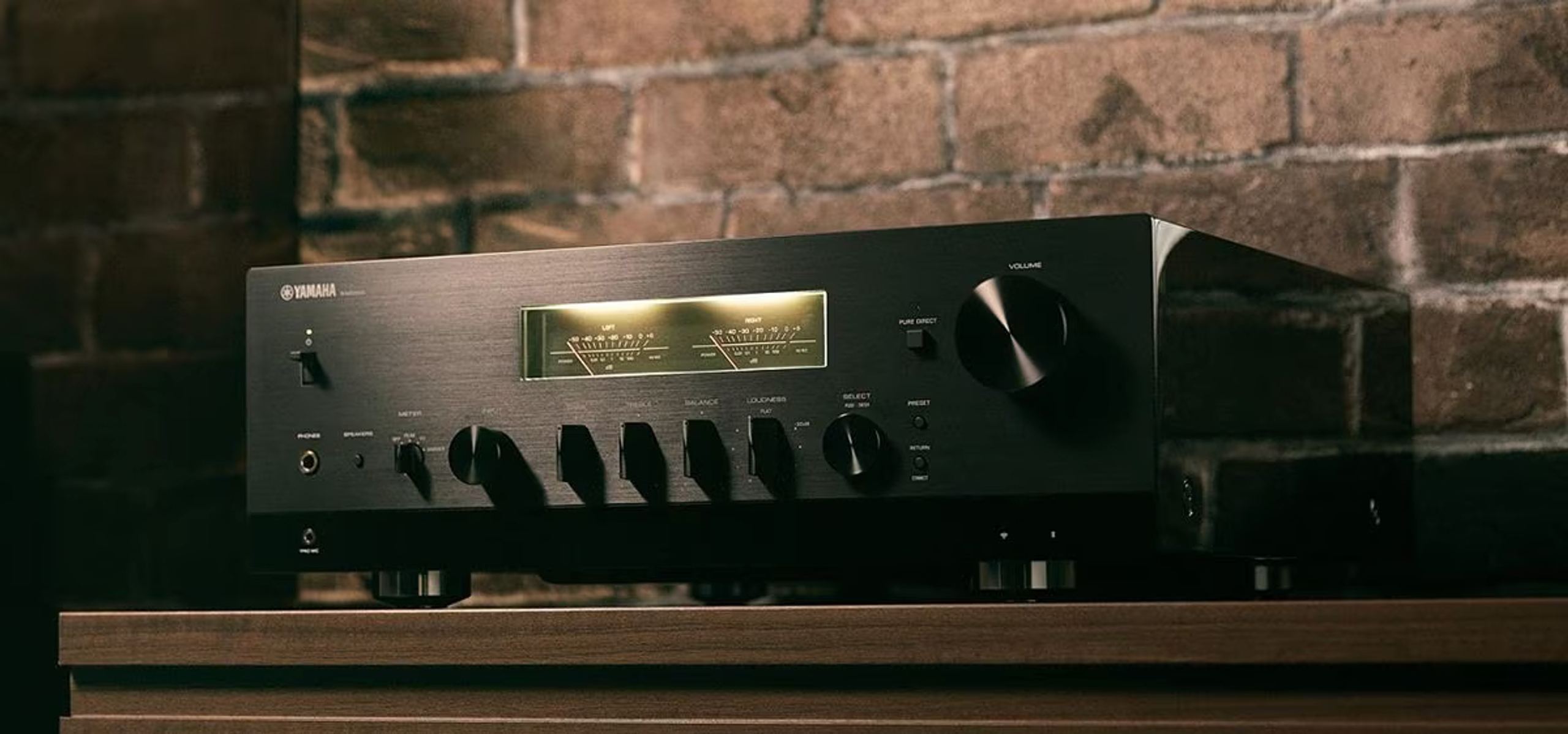
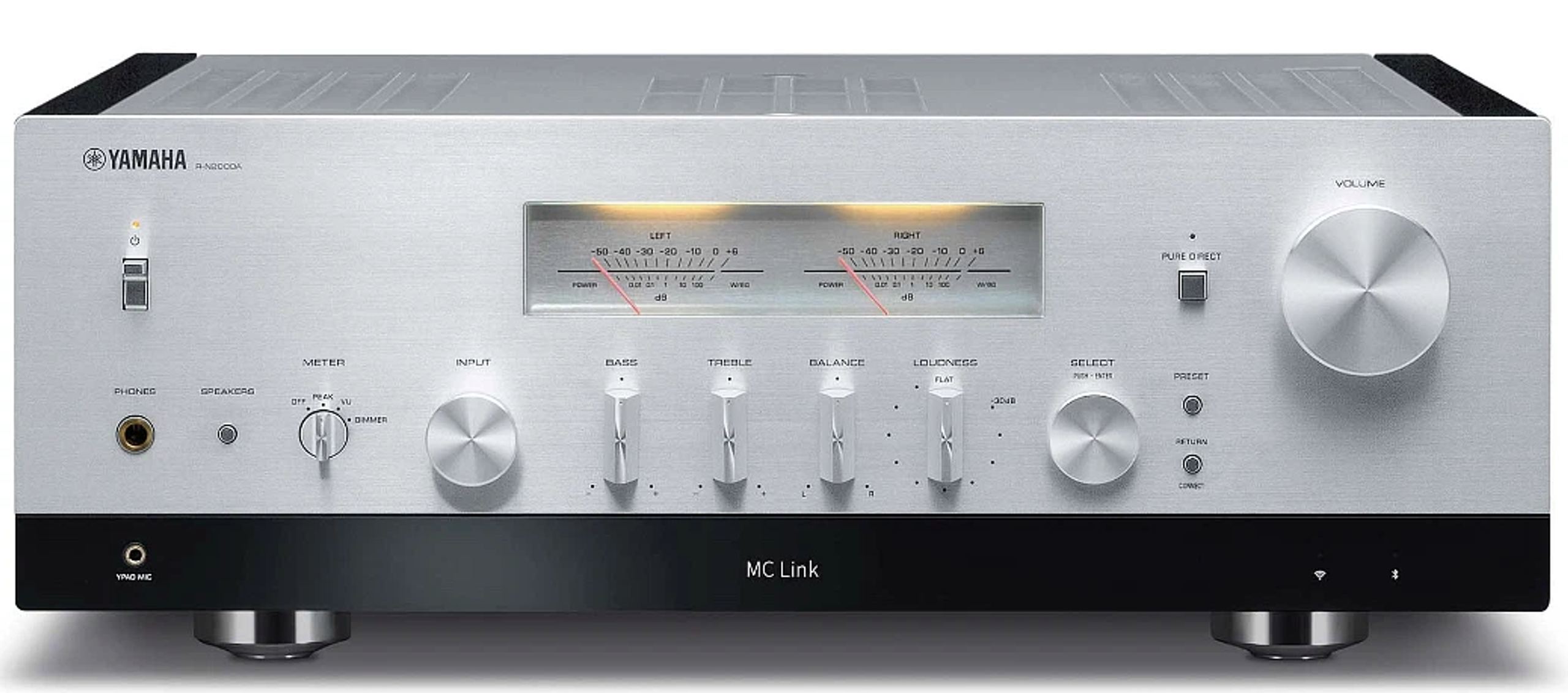
The Yamaha R-N2000A is a connected integrated amplifier combining A-S series amplification with MusicCast network features. It incorporates an ESS Sabre ES9026PRO converter, a floating balanced design, an oversized toroidal transformer and the YPAO R.S.C. acoustic calibration system. It supports DSD 11.2 MHz and delivers 190 watts per channel into 8 Ω.
The result of a dual technical heritage
The R-N2000A represents a rare synthesis in the hi-fi world. Yamaha has chosen to graft the amplification foundations of its renowned A-S series A-S1200 integrated amplifier onto the network electronics and acoustic correction system of the R-N803D. This hybrid approach meets a long-ignored demand: an amplifier capable of competing with traditional integrated amplifiers while offering the flexibility of a modern network player.
This approach continues the work Yamaha began in the 1970s, when the Japanese brand launched its first generation of integrated amplifiers with the 700 series. Founded in 1887 by Torakusu Yamaha to manufacture organs, the company diversified into audio electronics during the 1950s, developing expertise that draws directly on its mastery of musical instruments. This dual expertise—making instruments and reproducing their sound—still shapes the design philosophy of Yamaha products today.
The R-N2000A notably inherits the Top-ART (Total Purity Audio Reproduction Technology) concept, which aims to minimize interference and distortion through rigorous balanced design. This technology, developed for the flagship models of the A-S series, finds a particular application here: unlike conventional connected amplifiers where digital processing dominates, the R-N2000A places analog amplification at the heart of its identity.
A construction designed around vibrations
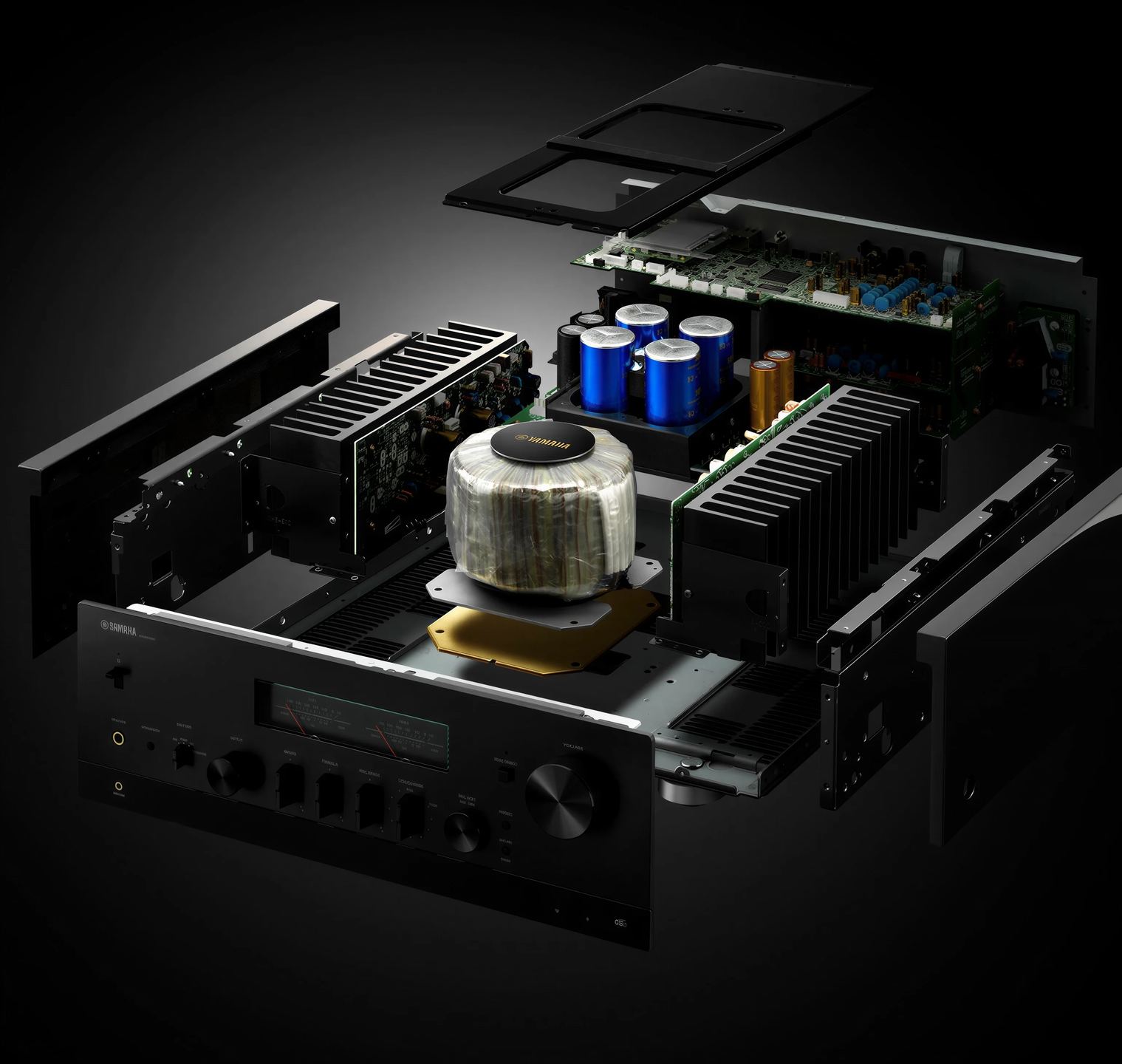
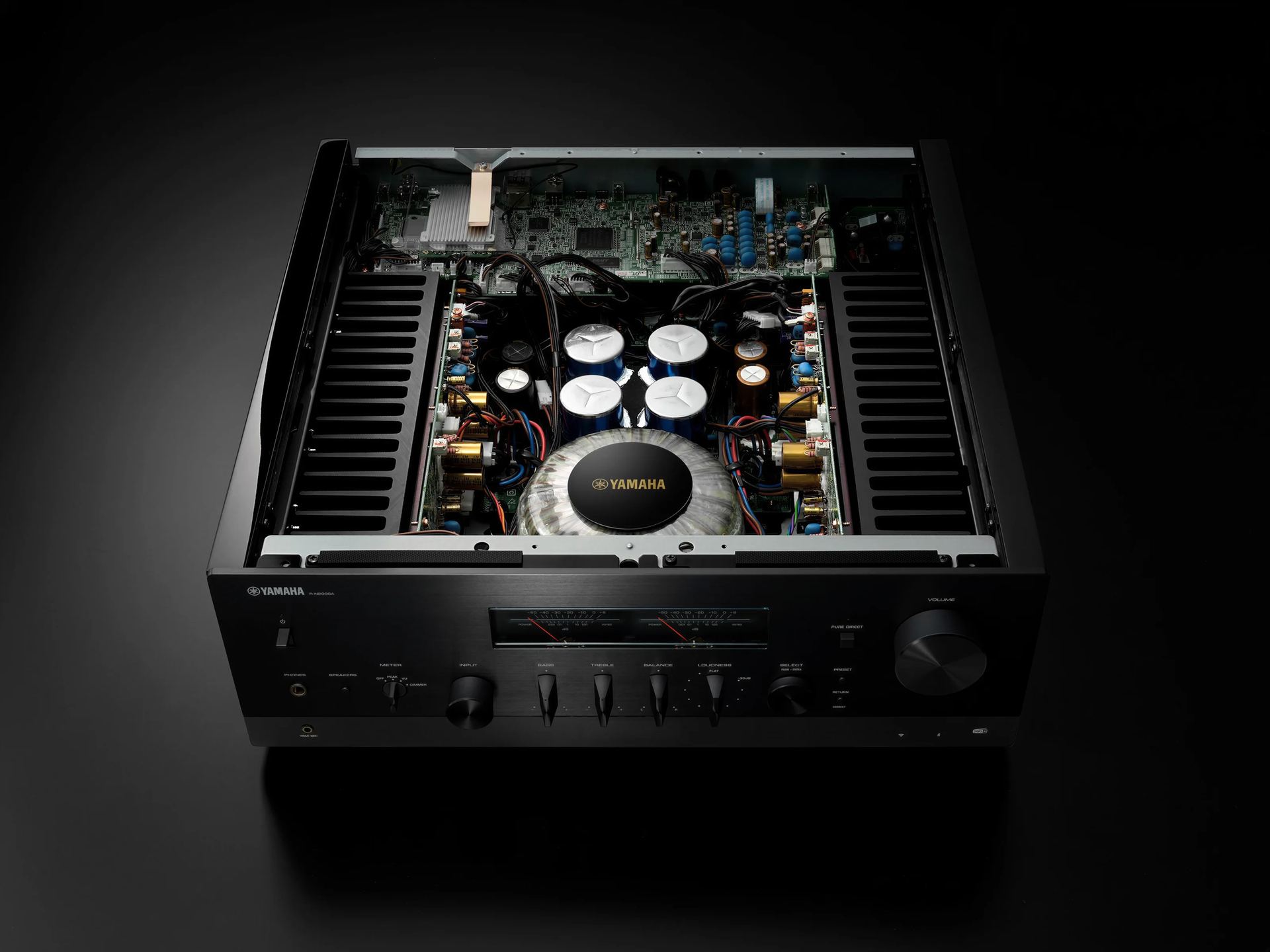
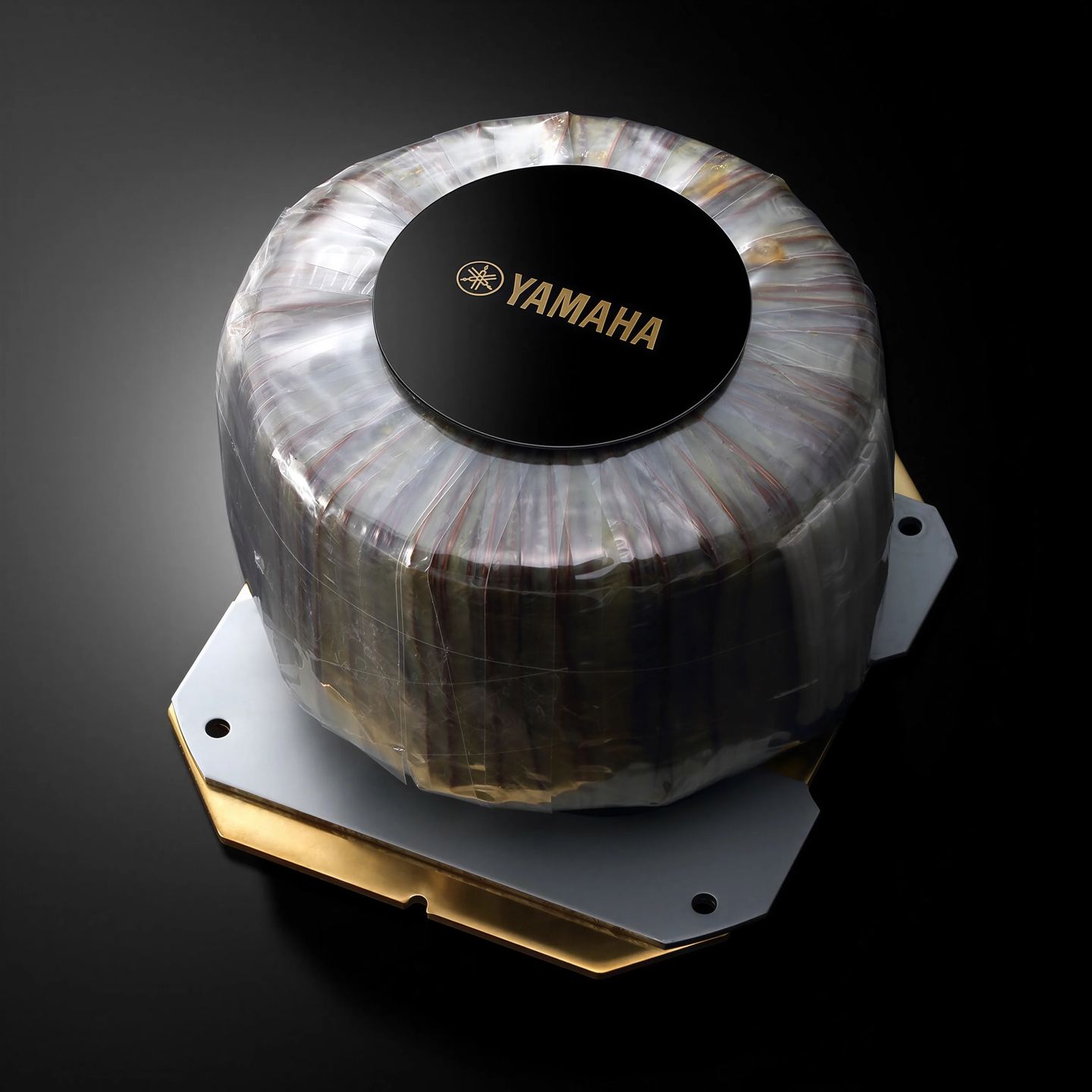
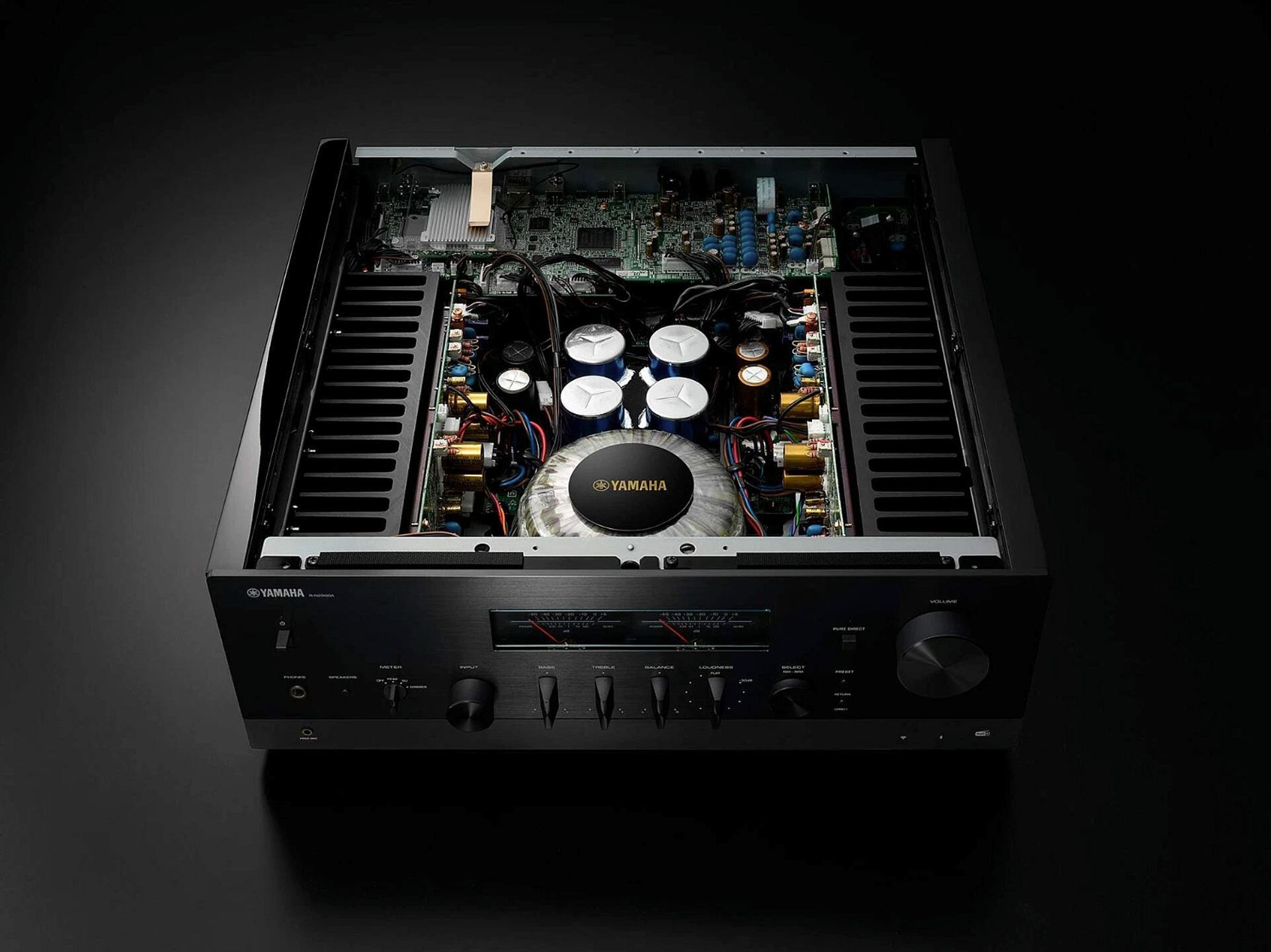
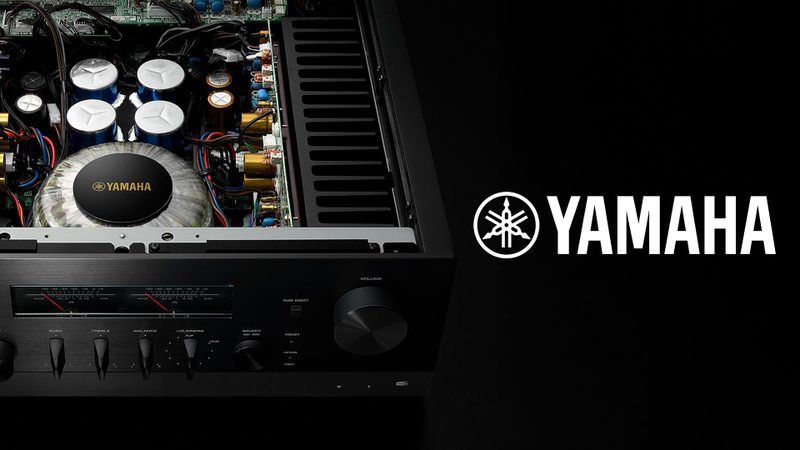
Opening the chassis reveals an unusual layout. The 600 VA toroidal transformer sits at the center of the unit, flanked by the left and right amplification blocks arranged in perfect symmetry. This “folded-book” configuration is not merely aesthetic: it ensures optimal weight balance and reduces crosstalk between channels. The result is channel separation reaching levels rarely seen in this category.
The transformer rests on a 3 mm-thick brass plate that acts as an interface between the coil and the chassis. This material choice contributes to the “mechanical grounding concept” developed by Yamaha, which aims to control the path of vibrations through the structure. The heat sinks, the four 18,000 µF filtering capacitors and the transformer are directly bolted to the chassis, creating a continuous mechanical chain that dissipates unwanted resonances rather than allowing them to propagate through the electronics.
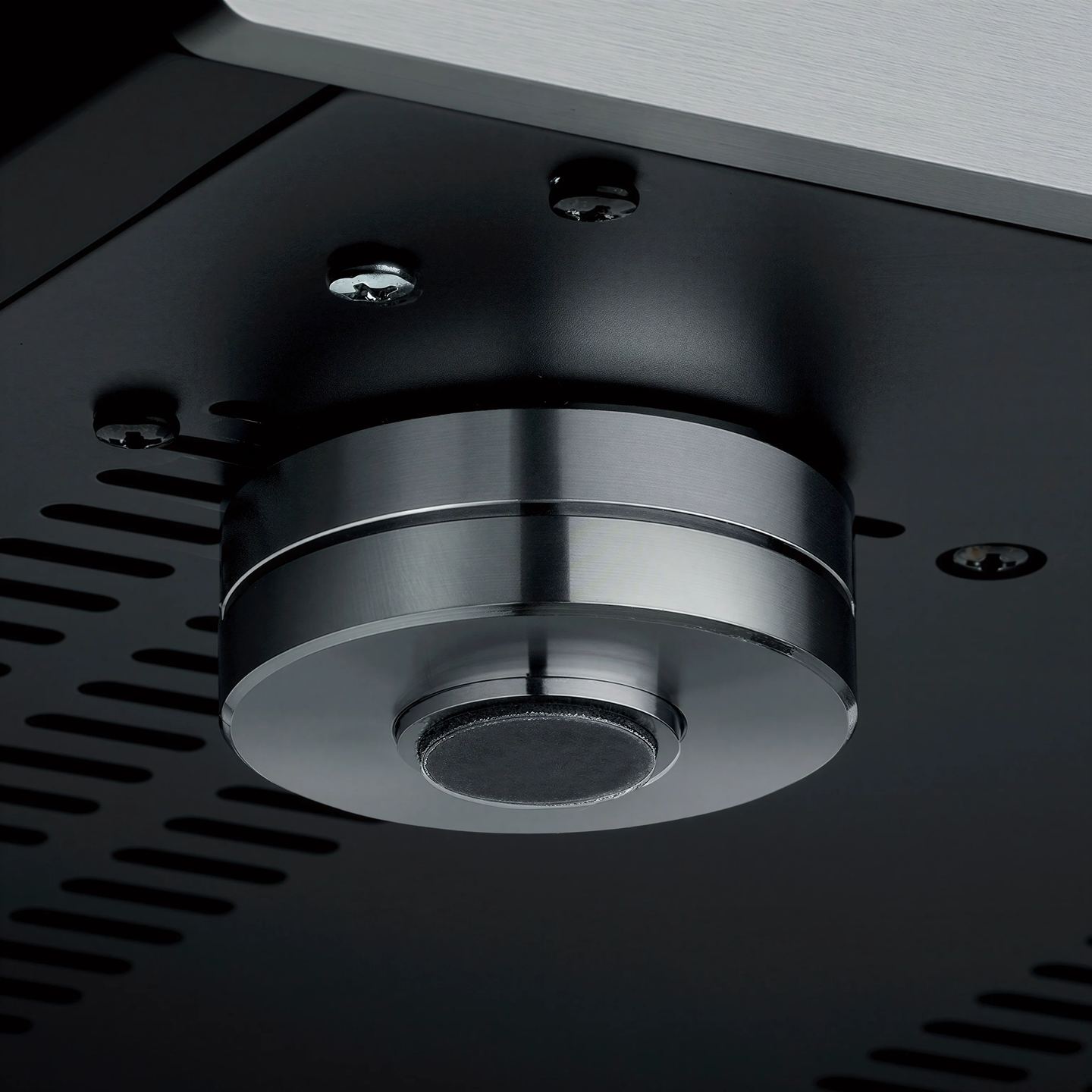
Silver-plated brass feet complete this system. Unlike rubber feet that absorb vibrations, these establish mechanical coupling with the supporting surface. The bolts are welded directly to the main chassis, forming a monobloc structure whose vibrational behavior has been optimized to reinforce bass response. This approach differs from conventional isolation solutions and reflects Yamaha’s belief that active vibration control delivers better results than simple passive absorption.
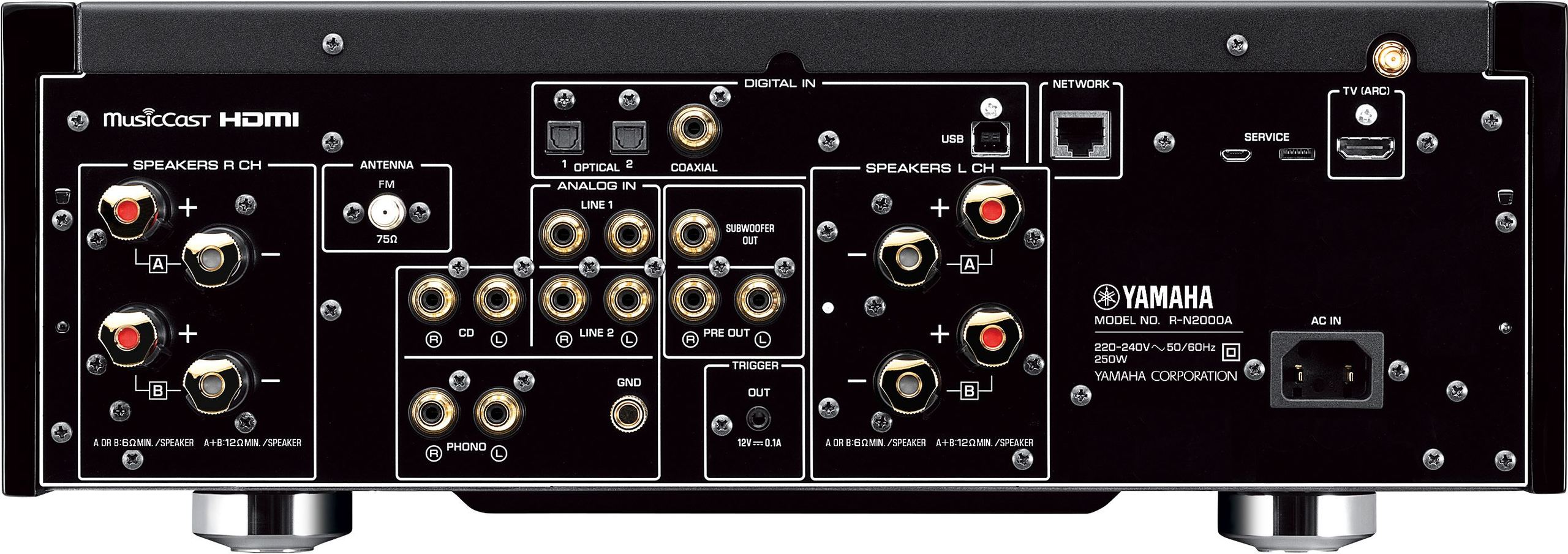
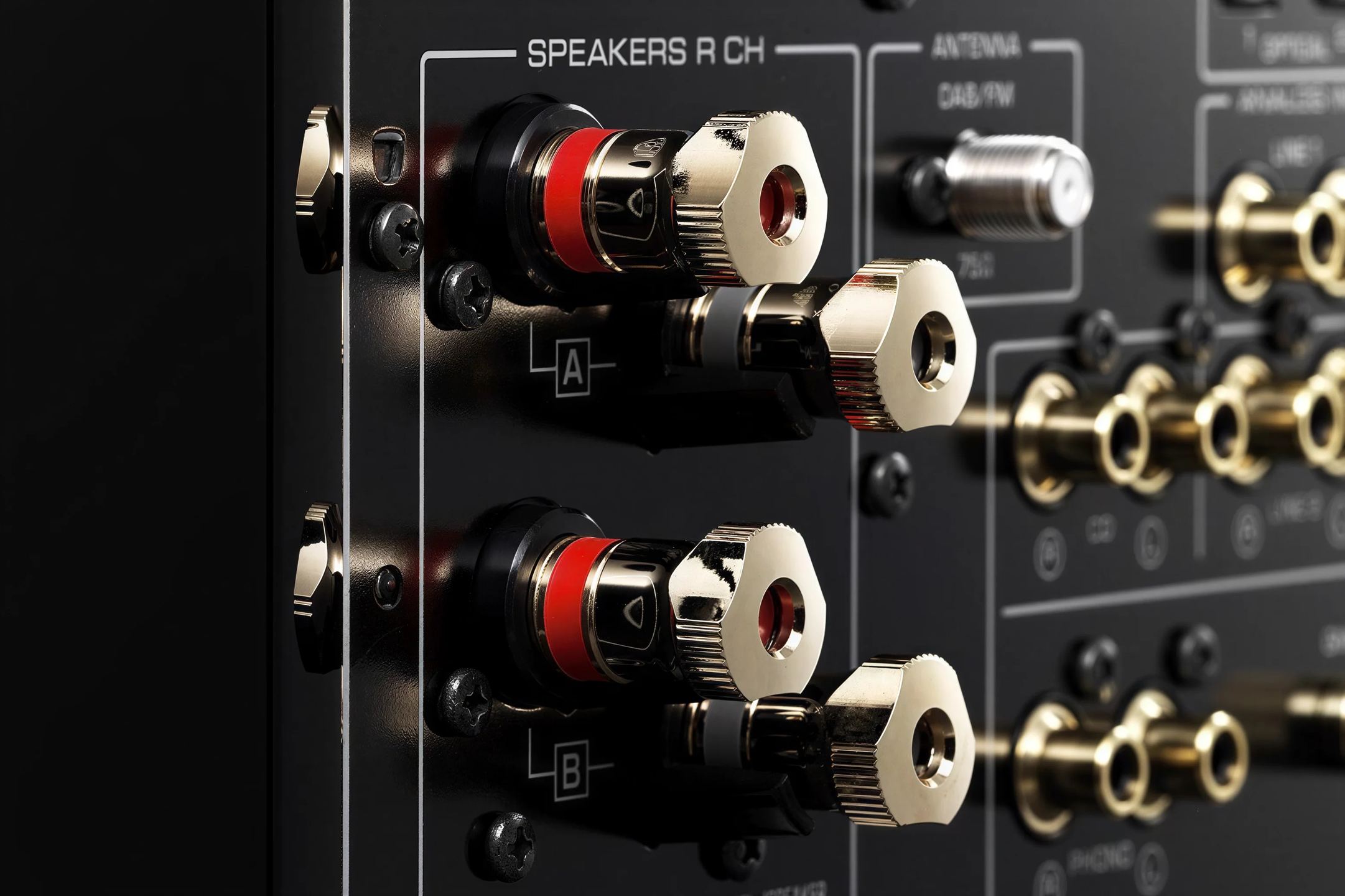
The chassis features a reinforced double-bottom construction, a technique borrowed from the A-S2200 and A-S3200 models. Brushed aluminum side panels frame the whole unit, while machined pure brass speaker terminals provide uncompromising cable connection. These connectors allow two pairs of speakers to be connected (A/B configuration) or a single pair to be bi-wired.
Floating balanced amplification
The R-N2000A’s power section is based on an uncommon floating balanced design. The amplification circuit, including the power supply, is completely decoupled from chassis ground. This electrical independence eliminates the influence of voltage variations and ground noise, two often-overlooked sources of audio signal degradation.
The output stages operate in Class AB in a balanced push-pull configuration. This architecture uses parallel-mounted power MOSFET transistors, with each channel having its own power supply to ensure stereo separation. Rated power reaches 190 watts into 8 Ω and 145 watts into 4 Ω, with dynamic power rising to 215 watts into 2 Ω. These figures demonstrate substantial current capability, essential for controlling speakers with complex loads.
Frequency response extends from 5 Hz to 100 kHz (+0/-3 dB), even reaching 20 Hz to 20 kHz (+0/-0.3 dB) in Pure Direct mode. Activated at the touch of a button, this mode bypasses all processing circuits—tone controls, balance, YPAO equalizer—to provide the most direct signal path possible. Signal-to-noise ratio peaks at 110 dB in Pure Direct mode, placing the R-N2000A among the quietest amplifiers on the market.
To minimize circuit impedance, Yamaha uses heavy-gauge cables for ground connections. The outputs of the amplification section use screw connections to reinforce grounding, a technical detail that helps achieve an open soundstage. This attention to the signal path reveals a philosophy in which every component and every connection contributes to the final result.
The ESS Sabre ES9026PRO digital converter
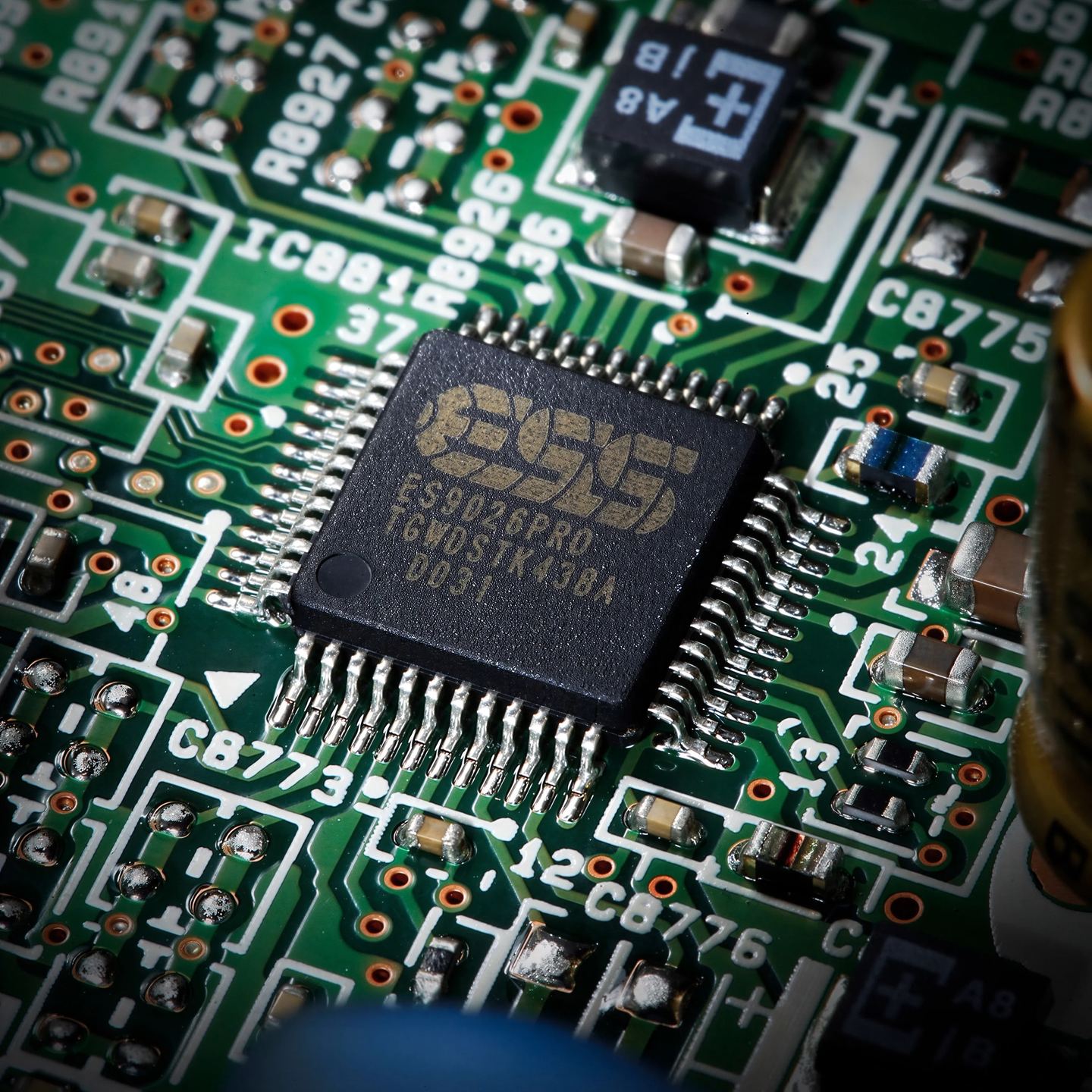
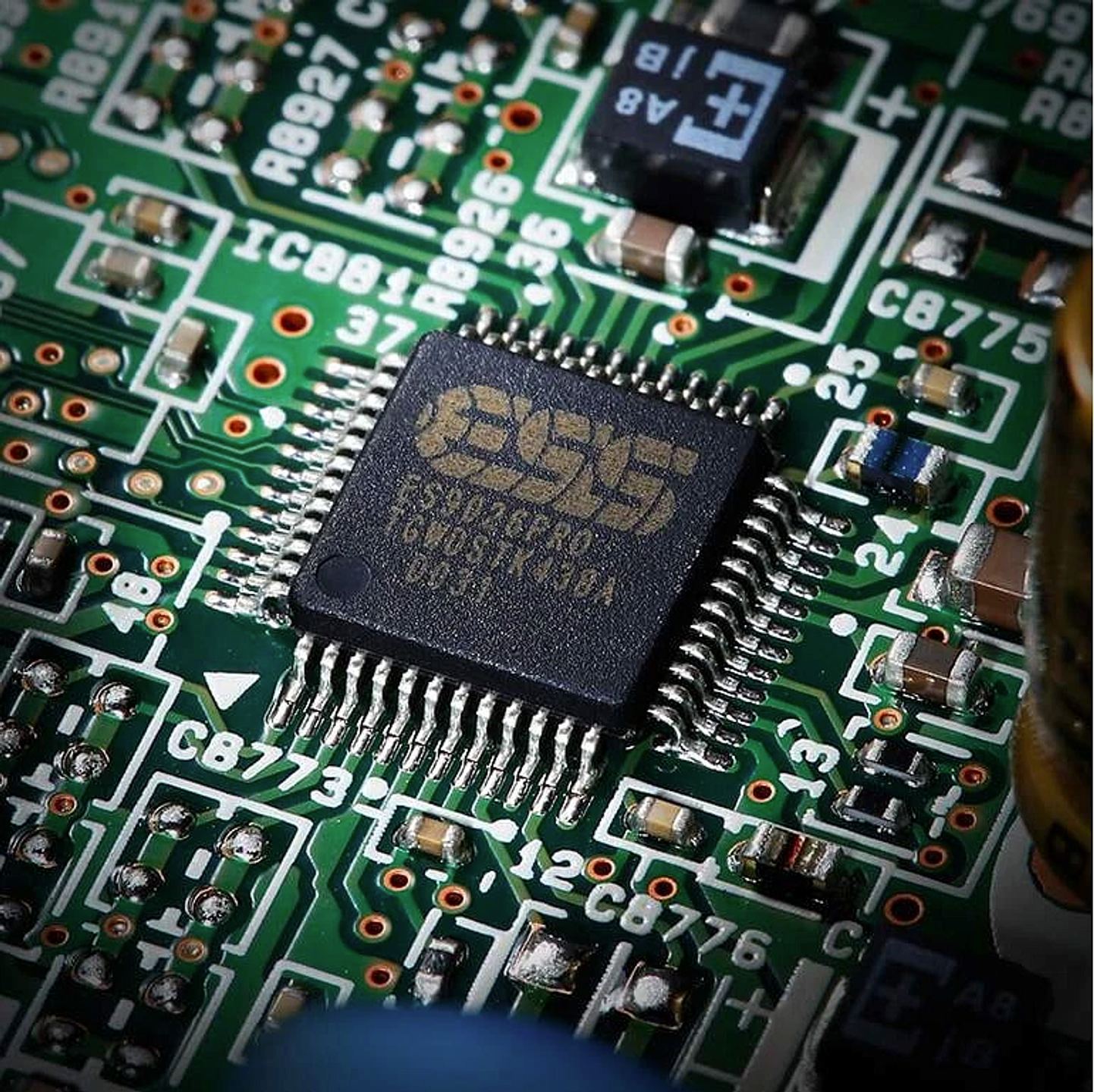
The digital section is built around the ESS Sabre ES9026PRO converter, a high-end PRO series chip developed by ESS Technology. This 32-bit, 8-channel DAC offers remarkable specifications: 124 dB dynamic range and -110 dB total harmonic distortion. These performances place it among the most transparent converters available, well above the ES9006AS fitted in the R-N803D.
The ES9026PRO incorporates the HyperStream II system with Time Domain Jitter Eliminator, ESS’s proprietary technology that eliminates timing jitter independently of the source. This capability is particularly relevant in a network context where multiple digital sources can exhibit varying levels of jitter. The converter operates in four-channel mode for stereo output, a configuration that optimizes current distribution and improves linearity.
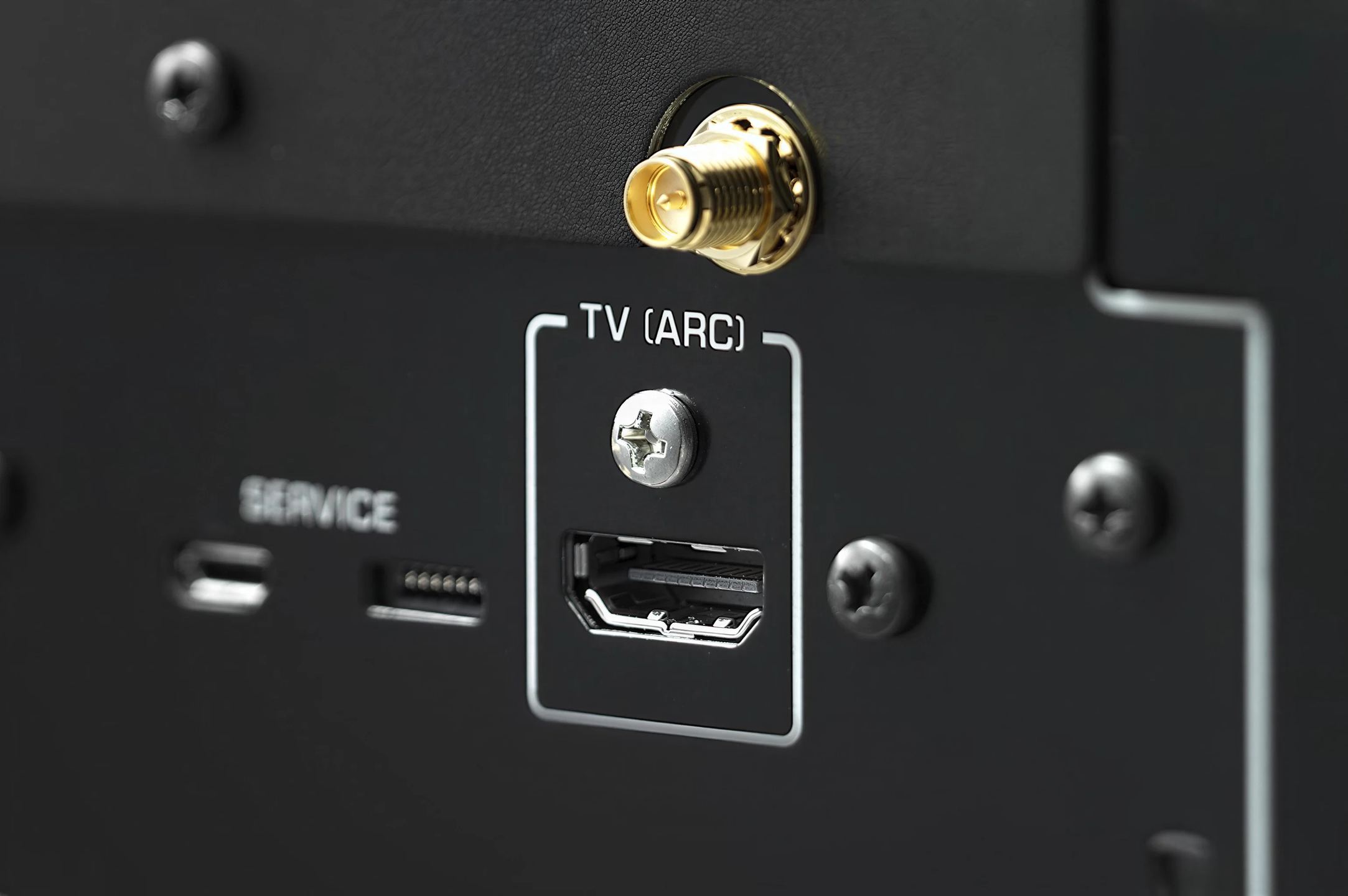
The R-N2000A accepts PCM streams up to 384 kHz in 32-bit and native DSD files up to 11.2 MHz. This extensive compatibility makes it possible to take advantage of the high-resolution catalogs offered by streaming services such as Qobuz or Tidal, as well as personal libraries stored on a NAS server. Digital inputs include two optical connections, one coaxial connection and an asynchronous Type B USB port, complemented by an HDMI ARC input that makes connecting to a TV easier.
The analog section has not been overlooked: three RCA line inputs and a phono input (compatible with MM and MC cartridges) allow traditional sources and a turntable to be integrated. This analog/digital duality makes the R-N2000A a central hub capable of managing an entire hi-fi system, from vinyl records to high-resolution files.
The YPAO R.S.C calibration system
The Yamaha Parametric Room Acoustic Optimizer, initially developed for home theater amplifiers, appears in a stereo integrated amplifier with the R-N2000A. This auto-calibration function analyzes room acoustics using a supplied microphone, then calculates the corrections required to optimize frequency response and phase.
The procedure takes just a few minutes. The microphone, positioned at the main listening point, captures the test bursts emitted by the speakers. The system measures frequency response, identifies room resonances, assesses distances and determines levels. This data feeds a 64-bit parametric equalizer operating at 192 kHz, a level of precision rarely achieved by automatic correction systems.
The R.S.C module (Reflected Sound Control) acts specifically on early reflections, the waves that bounce off walls before reaching the listener. Unlike conventional equalizers that only process frequency response, R.S.C also adjusts the time domain to reduce the impact of early reflections. The system takes wall materials and speaker positioning into account to adapt its corrections.
Three correction levels are available: Flat (neutral response), Front (emphasizes clarity and detail), Natural (preserves the room’s acoustic character). A YPAO Volume function completes the system by applying variable equalization according to listening level, compensating for variations in the human ear’s sensitivity to different frequencies. For purists, all these functions can be disabled via Pure Direct mode.
MusicCast and multiroom connectivity
The MusicCast system forms the backbone of the R-N2000A’s connectivity. This proprietary multiroom platform allows content to be streamed to several Yamaha devices distributed across different rooms, or alternatively enables different sources to be listened to in different zones. Connection is established via a wired Ethernet network or Wi-Fi, ensuring stable transmission for high-resolution files.
The MusicCast Controller app (iOS and Android) centralizes control. Its interface provides direct access to integrated streaming services: Spotify Connect, Apple Music, Deezer, Amazon Music, Tidal, Qobuz, Napster. DLNA and UPnP protocols enable playback from a NAS or networked computer. AirPlay 2 support expands possibilities within the Apple ecosystem, while Bluetooth (SBC and AAC codecs) provides a fallback solution for quick wireless connections.
The integrated FM tuner offers 40 presets. A supplied telescopic antenna ensures reception, complemented by a coaxial connector for an external antenna if required. The front-panel OLED display provides playback information—source, format, resolution—with good readability even from a distance.
The 12 V trigger output allows the power-on of peripheral equipment to be automated (external power amplifier, active subwoofer). A variable line output makes it easy to add a power amplifier in a bi-amplification configuration, while the pre-amplified subwoofer output allows the integration of a subwoofer to extend bass response.
What the press says
The Yamaha R-N2000A is a top-of-the-line, powerful, connected, and intelligent Hi-Fi amplifier. It features a fully developed MusicCast network player and YPAO acoustic correction system. Its ergonomics and functions are as impressive as its performance. Its mastery, ease, and rendering of great neutrality and perfect balance also make it very versatile, capable of powering speakers of almost all sizes and types.
Automatically translated — Show original (French)
Le Yamaha R-N2000A est un ampli Hifi haut de gamme, puissant, connecté et intelligent. Il est doté d'un lecteur réseau MusicCast et d'un système de correction acoustique YPAO parfaitement aboutis. Son ergonomie et ses fonctions sont aussi convaincantes que ses performances. Sa maîtrise, son aisance, son rendu d'une grande neutralité et d'un parfait équilibre le rendent en outre très polyvalent, capable d'alimenter des enceintes de presque toutes tailles et tous types.
Wireless connectivity: Wi-Fi, Bluetooth (SBC / AAC)
Other connections: Ethernet RJ45, 12 V trigger output, FM antenna socket
Physical Characteristics
Dimensions (W × H × D): 435 × 157 × 473 mm
Dimensions with antenna: 435 × 233 × 473 mm
Weight: 22.1 kg
Frequently Asked Questions
What is the difference between the R-N2000A and the R-N803D?
+
The R-N803D, predecessor to the R-N2000A, used a 505 VA EI transformer, capacitors totaling 12,000 µF, and an ESS Sabre 9006AS DAC limited to 192 kHz/24-bit. The R-N2000A moves upmarket with a 600 VA toroidal transformer, 18,000 µF capacitors per pair, and the ES9026PRO DAC capable of processing 11.2 MHz DSD. Its construction adopts the reinforced chassis of the A-S series with a mechanical grounding concept, absent from the R-N803D. The amplification benefits from a more sophisticated symmetrical floating design inherited from the A-S1200. These developments result in higher power, a better signal-to-noise ratio, and improved control of demanding speakers.
Is the YPAO system essential?
+
YPAO R.S.C is primarily effective in rooms with pronounced acoustic issues: resonance modes, significant early reflections, and asymmetrical speaker placement. In an acoustically treated room or when speakers are optimally positioned, its benefit is reduced. The R-N2000A lets you choose whether to activate correction, enabling A/B comparisons. The three correction levels (Flat, Front, Natural) offer different compromises depending on preferences. For critical listening at moderate volume, the YPAO Volume function is relevant. Pure Direct mode disables all these functions to prioritize signal purity.
Can the R-N2000A be used as a preamplifier?
+
The preamplified output (Pre Out) allows the R-N2000A to be used as a preamplifier to drive one or more external power amplifiers. This configuration is of interest to those who wish to bi-amp their speakers or have additional power reserves. The output signal benefits from digital processing (conversion, YPAO equalization if enabled) and volume control. Conversely, the Main In input turns the R-N2000A into a pure power amplifier, bypassing the internal preamp to connect an external preamplifier. This versatility makes system upgrades easier.
What file formats are supported?
+
The R-N2000A plays PCM formats (WAV, FLAC, AIFF, ALAC) up to 384 kHz at 32-bit via USB or network. DSD files (DSF, DFF) are supported up to 11.2 MHz natively, without PCM conversion. Lossy compressed formats (MP3, WMA, AAC, MPEG-4 AAC) remain compatible with existing libraries. Streaming services generally provide 16/44.1 FLAC for the standard tier, and 24/96 or 24/192 FLAC for HD subscriptions. 24/192 FLAC and 5.6 MHz DSD files offer a good balance between quality and size for a personal library. 11.2 MHz DSD remains the preserve of specialized recordings.
Do VU meters have a technical function?
+
The R-N2000A’s VU meters serve primarily a visual and aesthetic purpose. Unlike studio peak meters, they do not accurately measure instantaneous output power. Their mechanical inertia instead reflects the average musical dynamics, creating an animation that follows the rhythm. This analog representation of the audio signal establishes a sensory connection between the listener and the music, a feature appreciated by many music lovers. The VU meters can be disabled via the menu if their illumination is distracting in certain listening conditions. Technically, they do not affect sound quality in any way, but they contribute to the product’s identity.
Should you prioritize a wired or Wi-Fi connection for MusicCast?
+
Wired Ethernet offers superior stability and bandwidth, which are particularly important for high-resolution files (24/192, DSD). Wi-Fi is suitable for standard formats and makes installation easier without cabling constraints. A properly configured Wi-Fi 5 (802.11ac) network is generally sufficient for streaming 24/192 files, but may reach its limits with 11.2 MHz DSD or simultaneous playback on several MusicCast devices. Wi-Fi interference (dense neighborhoods, microwaves) and distance from the router affect connection quality. For critical use, Ethernet remains preferable. The 12 V trigger output can control a network switch to save energy.
User reviews
Bernhard
A heavyweight in every respect. Technically and visually, Yamaha devices have always been beyond reproach, but the level of analog and digital functionality and quality integrated here is hard to beat even by significantly more expensive devices.
Comment from September 07, 2026 — Experience from May 02, 2025
Automatically translated — Show original (German)
In jeder Hinsicht ein Schwergewicht. Technisch und optisch sind Yamaha-Geräte schon immer über jeden Zweifel erhaben, aber was hier an analoger und digitaler Funktionalität und Qualität integriert wurde, ist auch von wesentlich teureren Geräten kaum zu topen.
Jean-Marc
It's certainly a very good amplifier, but I didn't like its sound signature, especially in the midrange.
Comment from August 28, 2026 — Experience from February 10, 2023
Automatically translated — Show original (French)
C'est certainement un très bon ampli, moi je n'ai pas aimé sa signature musicale notamment dans les médiums.
Gerard
Build quality 9/10 Simple setup 9/10 At first listen, the first impressions are disappointing Flat sound after a week everything settles down Well-controlled bass Smooth midrange The amp is not very demonstrative but can be listened to for a very long time without fatigue YPAO does the job by removing the few resonances in the low end Very satisfied with my purchase
Comment from May 05, 2026 — Experience from April 27, 2026
Automatically translated — Show original (French)
Qualité de fabrication 9/10
Mise en route simple 9/10
Ecoute,les premieres sont décevantes
Son plat après une semaine tout s’arrange
Basses bien tenues
Médium doux
L’ampli n’est pas très démonstratif mais s’écoute très longtemps sans fatigue
YPAO fait le job en supprimant les quelques résonances dans le grave
Très satisfait de mon achat
To better understand our visitors, measure marketing effectiveness and personalise ads, we and our partners use cookies and mobile advertising identifiers on your device. This data makes it possible to display personalised and non-personalised ads and measure their performance. Some cookies, which are technically necessary, are exempt from consent. You can accept those that require your consent, refuse them by clicking "Refuse", or customise your choices via the settings screen.
To find out how Google uses the data collected once you have given your consent, see Google’s Business Data Responsibility site.
You can change or withdraw your consent at any time via the "Consent and cookies" link. Your choices will apply on our site for 12 months.