

Electrocompaniet AW800M
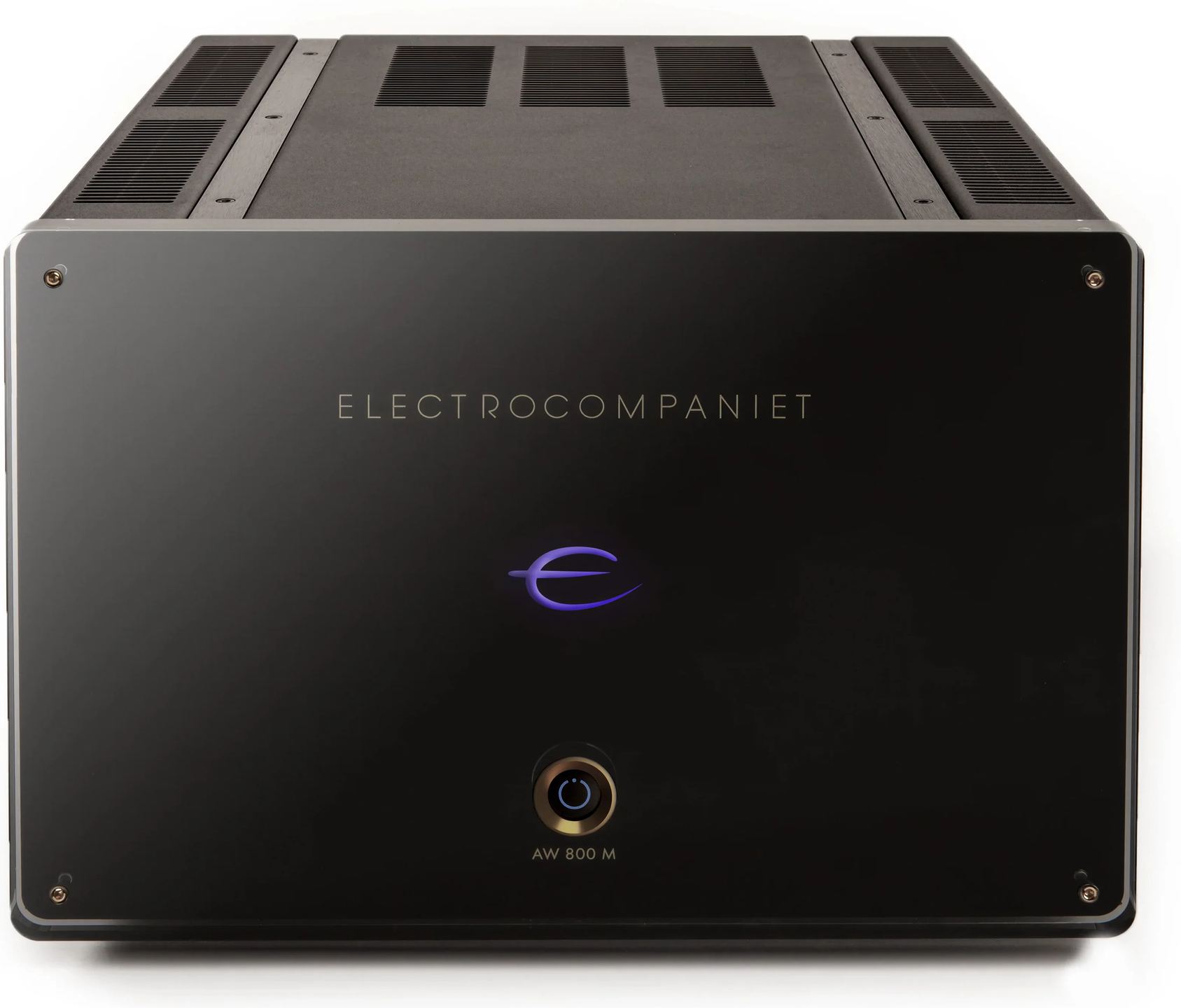
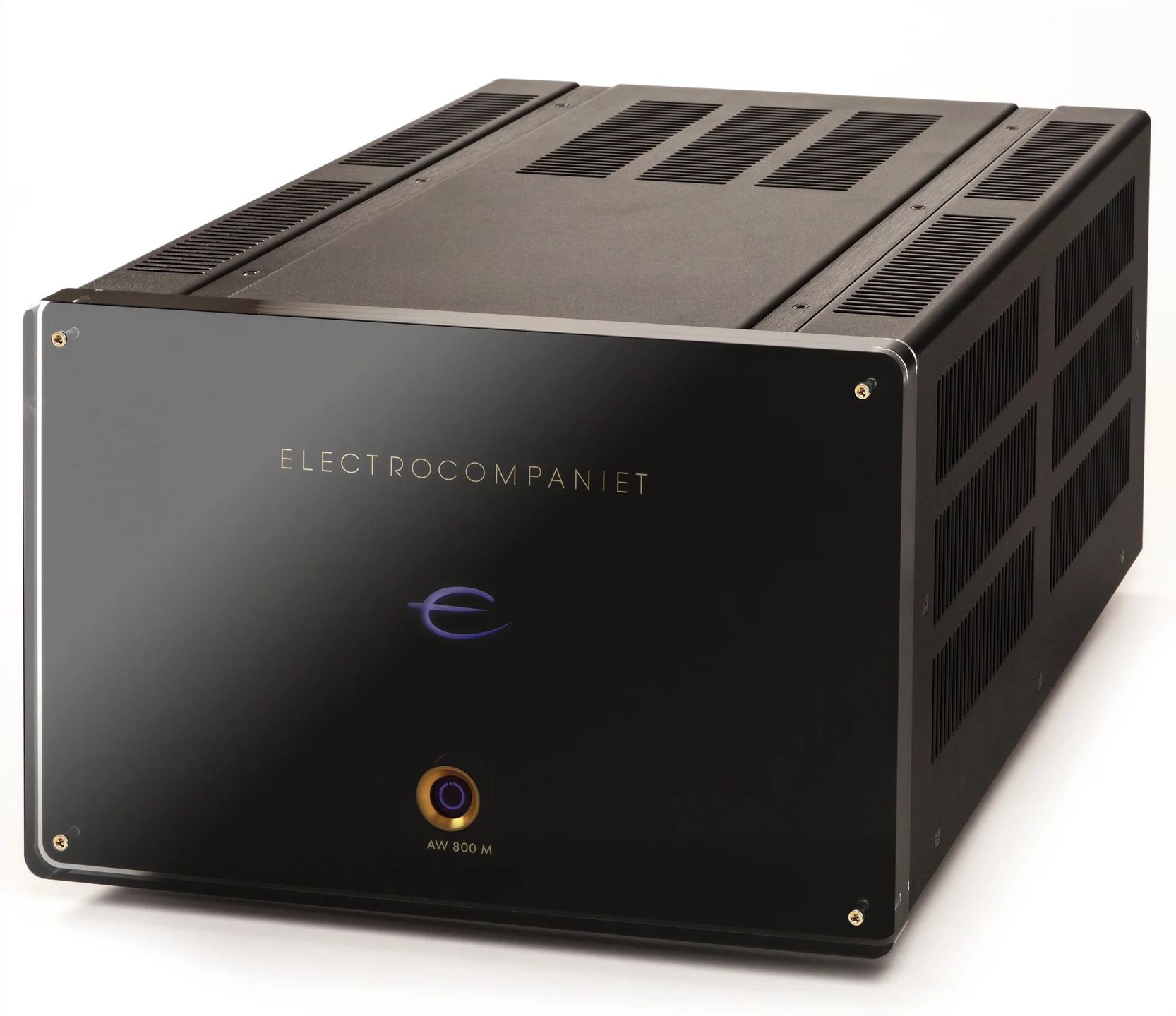
Electrocompaniet AW 800 M, the reference monoblock
Norway, 1976: Electrocompaniet launches its first amplifier, a 25-watt two-channel model quickly noticed for its transparency. Half a century later, the manufacturer places a flagship monoblock at the top of its catalogue, designed to continue this lineage. Eight hundred watts into 8 ohms, an oversized power supply and three switchable operating modes: the brand’s current flagship is still entirely produced in its Norwegian factory.
Twenty-five years after the NEMO AW 600
For a quarter of a century, the AW 600 NEMO occupied the top of the Electrocompaniet range. Renowned for driving speakers considered difficult, it has been used in several leading recording studios. The AW 800 M succeeds it after three years of development, with a launch timed for the brand’s fiftieth anniversary and the NEMO’s twenty-fifth anniversary.
The manufacturer redesigned the electronics from the ground up while claiming the same sonic signature as previous generations. The silhouette remains recognisable, with the dark front panel and raised logo characteristic of the brand, allowing the unit to blend visually into both older and newer Electrocompaniet systems.
An output stage that ignores the load
At its core, the design is based on a direct-coupled, wide open-loop bandwidth topology, combined with a high slew rate (270 V/μs) and very wide-band stages. Feedback remains low, preserving the signal’s phase coherence.
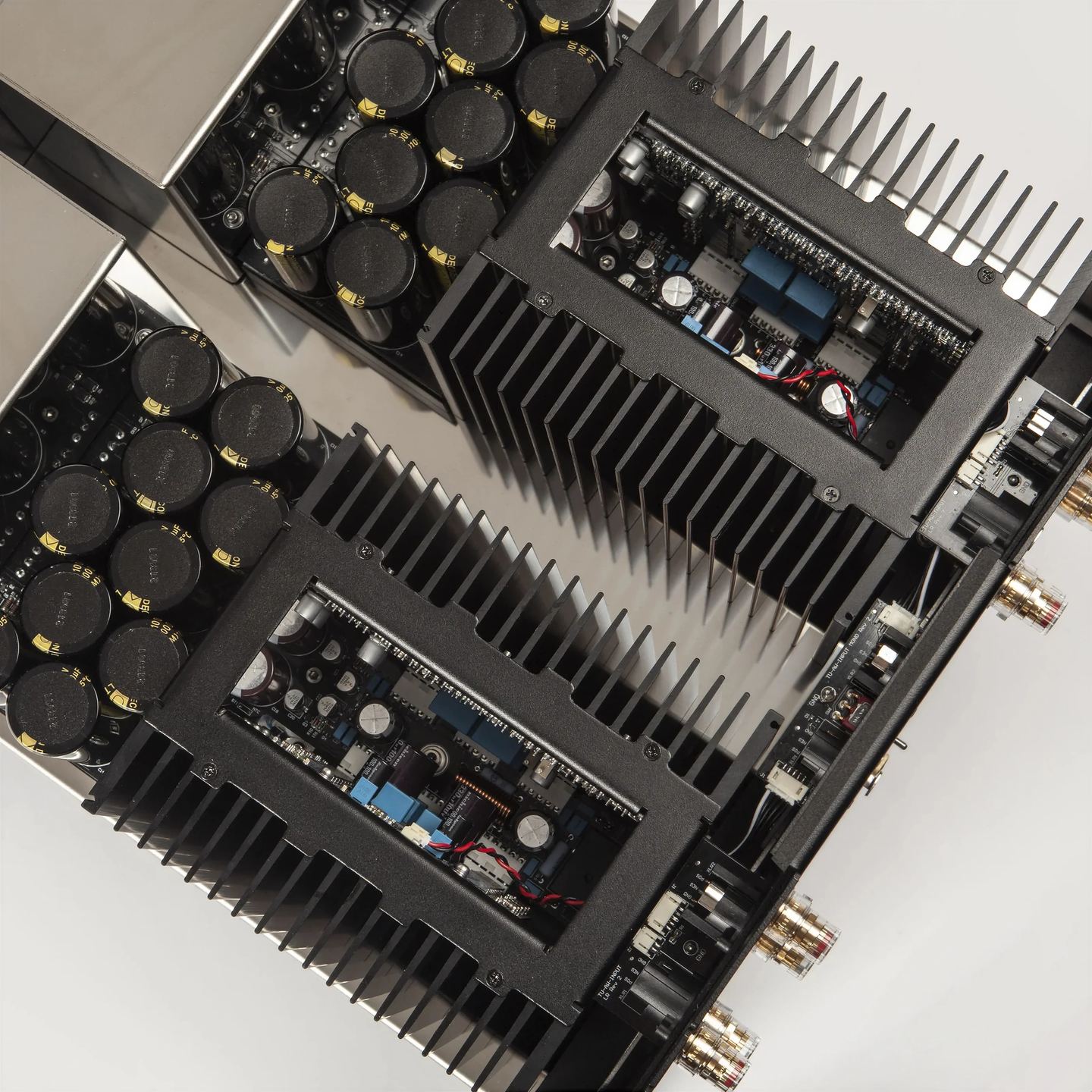
The new feature is the output stage. It brings together 32 high-bandwidth, high-current bipolar transistors, capable of effortlessly delivering very high current. Its structure isolates the input and driver stages from the load, so the output remains firm and virtually insensitive to the connected speaker. A less disturbed stage requires less feedback, and distortion drops very low: 0.0006% total harmonic distortion plus noise, 0.001% intermodulation.
The assembly operates in Class AB, with around ten watts in pure Class A before switching, while all stages preceding the output also operate in Class A. The damping factor exceeds 1000 into 8 ohms: the amplifier maintains a strong electrical grip on the bass driver diaphragm, helping to control demanding speakers and tighten bass response.
An oversized power supply in the service of silence
Powering such an output stage requires reserves. Electrocompaniet has increased filtering to 210,000 μF in total and entrusted current delivery to two toroidal transformers, magnetically and electrostatically shielded to keep noise at bay. The mains input is continuously filtered for both mains and radio frequencies before the transformers.
The internal ground reference has been very generously oversized and kept away from rectification and output currents. The stated result: a clean signal regardless of the power required, with a stable soundstage and the blackest possible background at any listening level. Signal-to-noise ratio reaches 95 dB referenced to 1 W into 8 ohms, and 122 dB referenced to full power. Note that the manufacturer achieves its best results by connecting the unit directly to the mains rather than through a power conditioner, as filtering is already built in.
Mono, stereo, bi-amping: an upgradeable chassis
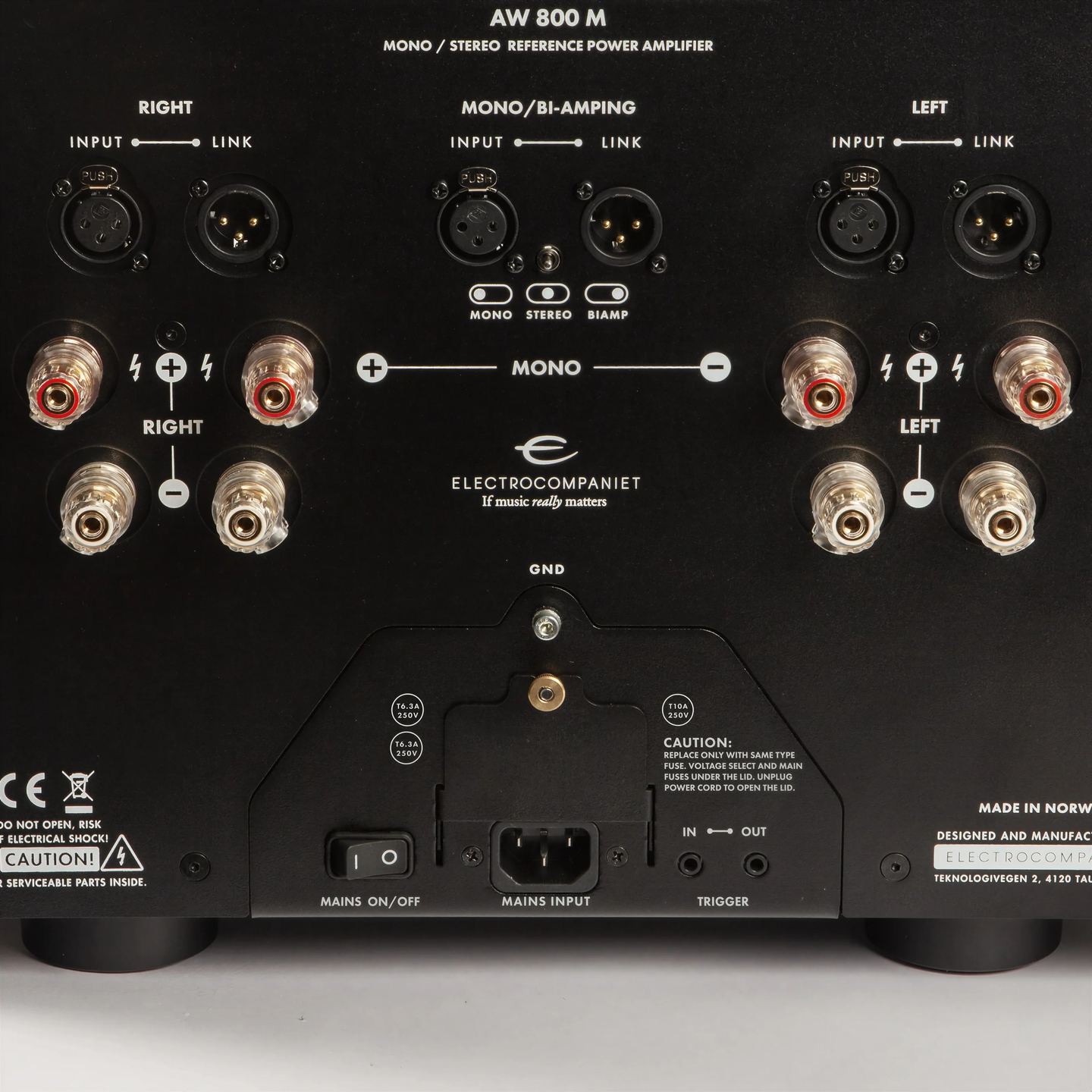
A switch on the rear changes the amplifier from mono to stereo or bi-amping mode. This flexibility allows a system to evolve without starting from scratch: a single AW 800 M can already drive a pair of speakers in stereo, at 300 watts per channel into 8 ohms. To take advantage of the 800 watts available in mono mode, one unit is required per speaker, for a total of two. Bi-amping mode dedicates a single block to both drivers of one speaker.
Power rises significantly as impedance drops, a sign of a generous power supply and substantial current reserves:
| Load | Stereo (per channel) | Mono |
|---|---|---|
| 8 Ω | 300 W | 800 W |
| 4 Ω | 600 W | 1500 W |
| 2 Ω | 1000 W | 2200 W |
For connections, the link is balanced via XLR, with dedicated inputs for mono and bi-amping modes. There are speaker terminals, a ground terminal, and 12 V trigger input and output connections to synchronise power-on with the rest of the system. The 330 kΩ input impedance makes pairing with a balanced preamplifier easy.
A modular chassis assembled in Norway
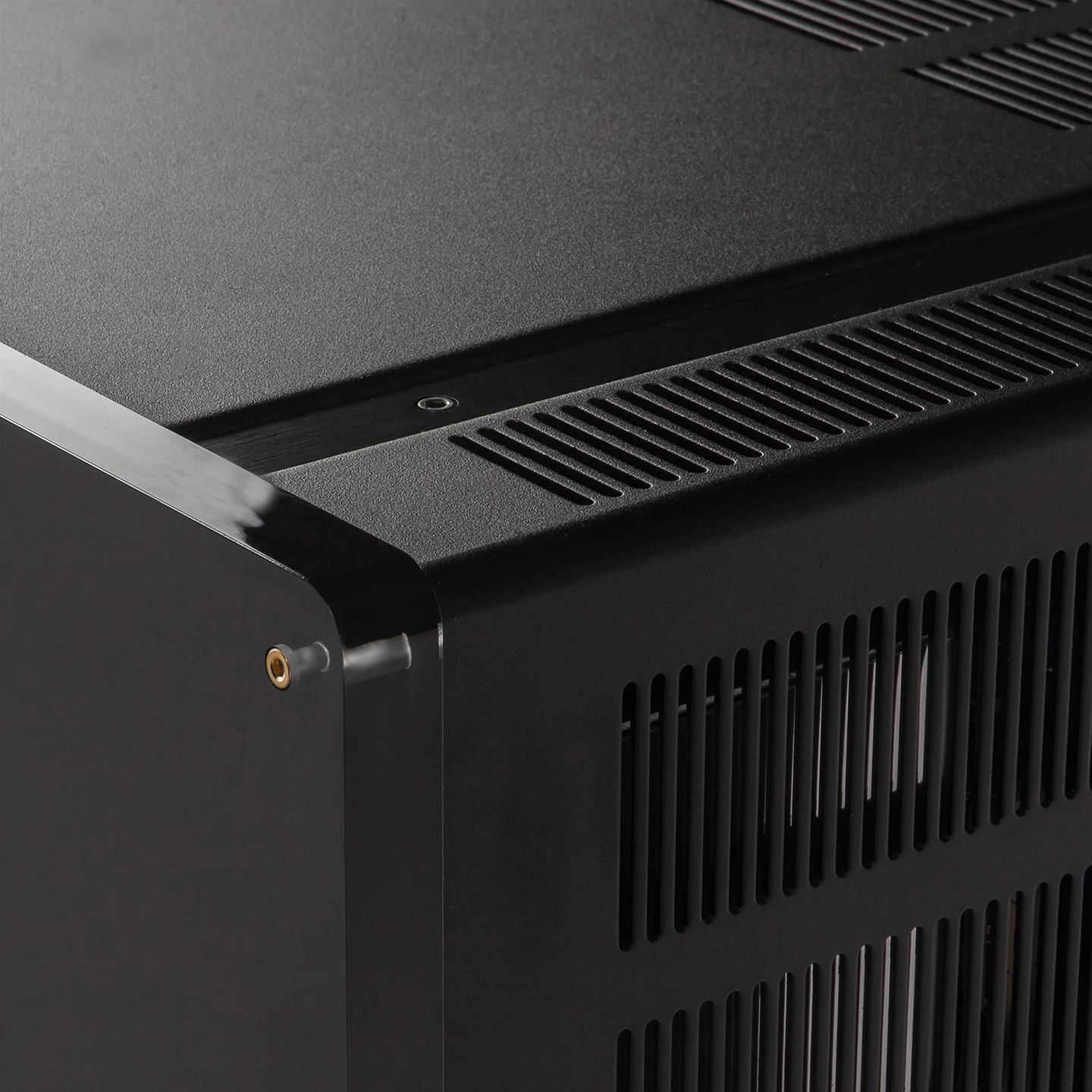
Construction has also been revised. The chassis adopts a fully redesigned modular structure, topped with two black brushed aluminium rods that stiffen the assembly while defining its upper surface. The tinted acrylic front panel features a raised logo and a new power button, all in a matte finish that follows the brand’s timeless style. The unit rests on SoundCare SuperSpikes, which isolate vibrations without marking the furniture.
The size must be taken into account: 55 kg per block, measuring 406 mm wide, 488 mm deep and 292 mm high. A mono system therefore requires space and a sturdy support for two units. Several convenience settings accompany installation: selectable automatic standby, switchable ambient lighting, a 115/230 V mains voltage selector, and consumption below 0.5 W in standby.
What the press says
Although the brand sometimes uses the term Class A to describe the sound quality of its products, its power amplifiers are Class A/B amplifiers, which makes sense given their power ratings. The architecture of the AW 800M is quite straightforward, based on a dual-mono and symmetrical design. The two amplification channels therefore have the same architecture while being completely separate, on either side of the amplifier.
Automatically translated — Show original (French)
Technical Specifications
Audio Performance
- Input impedance: 330 kΩ
- Frequency response:
- Active input filter: 0.5 - 220 kHz
- Disabled input filter: 0.5 - 1.1 MHz
- Voltage gain:
- Balanced mono input: 35 dB (× 56)
- Balanced stereo input: 29 dB (× 28)
- Noise and signal-to-noise ratio:
- Noise referred to input (20-20 kHz): < 2 μV
- Signal-to-noise ratio ref. 1 W / 8 Ω load: 95 dB
- Signal-to-noise ratio ref. full power: 122 dB
- Distortion:
- Total harmonic distortion + noise: 0.0006%
- Intermodulation: 0.001%
- Other characteristics:
- Slew rate: 270 V / μs
- DC output voltage: < 5 mV
- Damping factor (8 Ω): > 1000
Output Power
Stereo Mode
- 2 × 300 W at 8 Ω
- 2 × 600 W at 4 Ω
- 2 × 1000 W at 2 Ω
Mono Mode
- 800 W at 8 Ω
- 1500 W at 4 Ω
- 2200 W at 2 Ω
Connectivity
- Inputs: Balanced XLR, balanced mono, bi-amplification
- Outputs: Speaker terminals
- Other: Mains power, 12 V trigger (input/output), ground terminal
Physical Characteristics
- Dimensions (W × D × H): 406 × 488 × 292 mm
- Weight: 55 kg
- Protections: DC, overload, temperature
- Standby power consumption: < 0.5 W
Frequently Asked Questions
Do you need two AW 800 M units to listen in stereo?
No. A single unit is sufficient in stereo mode: it delivers 300 watts per channel into 8 ohms and drives a pair of speakers. The second unit is only needed for mono mode, where each speaker receives its own 800-watt amplifier.
Does the amplifier accept an unbalanced RCA input?
The connection is designed to be balanced via XLR connectors, in keeping with the electronics’ fully balanced design. A source or preamplifier with XLR outputs is therefore the logical companion. With a component equipped only with RCA connectors, an adapter is required, at the expense of signal balance.
Can it be connected to a power conditioner?
It is possible, but the manufacturer states that the best results are achieved by connecting it directly to the wall outlet. The mains input already incorporates continuous and radio-frequency filtering, and the transformers are shielded, which limits the benefit of additional upstream treatment.
How does it handle a difficult speaker?
Power nearly doubles with each halving of impedance, reaching 2200 watts into 2 ohms in mono, and the damping factor exceeds 1000. The amplifier therefore retains strong control over low or fluctuating loads, where many electronics falter.
What is bi-amping mode?
It dedicates one block to the two sections of the same speaker, bass on one side and treble on the other, each receiving its own amplification from the same chassis. This requires a speaker whose crossover allows this separate wiring.
Is it designed to work with the rest of an Electrocompaniet system?
Its visual design matches both current and older Electrocompaniet devices, and the 12 V trigger input and output allow power-on to be daisy-chained with a preamplifier from the brand or another compatible source.
- Eco-contribution included in the sale price.




