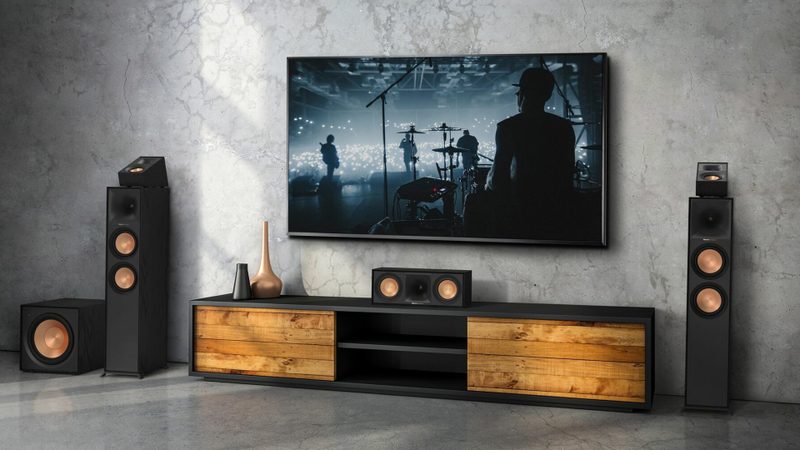
Reaching below 20 Hz with a 30 cm driver requires a precise balance between amplification, cone and cabinet volume. In the Reference Premiere series, Klipsch has chosen an entirely forward-facing design: the driver and port fire from the front, in a 31 kg cabinet that fits equally well into a home theater or a stereo system. An optional wireless receiver allows it to be positioned without running a cable from the amplifier.
A copper-colored Cerametallic cone that reaches down to 16.5 Hz
The 30 cm driver uses the copper-colored Cerametallic cone found in Reference Premiere speakers. This material combines lightness and rigidity: the cone follows the signal without deforming, even when driven hard. Klipsch has paired it with a very long-excursion motor. Excursion is the distance the cone moves back and forth. The greater the excursion, the more air the driver moves, and it is this volume of air that produces deep bass at high levels without distortion.
The stated frequency response extends from 16.5 to 138 Hz at ±3 dB, meaning the level stays within a narrow window across this entire range. Below 20 Hz, bass is felt more than heard: the pressure of a pipe organ, the rumble of an explosion or an engine at the movies. The maximum output reaches 121 dB, enough to fill a large living room or dedicated room without pushing the amplification to its limits.
400 watts of Class D power, with an analog preamplifier
The built-in amplifier delivers 400 W continuously and up to 800 W on peaks, those brief bursts of energy that accompany an impact or a kick drum attack. The power stage is Class D, a highly efficient technology that generates little heat and packs plenty of power into a small space. Upstream, Klipsch has retained an analog preamplifier: the signal arriving from the receiver or amplifier is not converted to digital before being amplified.
The power switch offers three positions. In automatic mode, the subwoofer turns on as soon as it detects a signal and returns to standby after 15 to 20 minutes of silence. In standby, it consumes 0.5 W.
Aerofoil front port and flexible placement
The subwoofer uses a bass-reflex design: a port lets the driver’s rear wave escape to reinforce the deepest bass. On the RP-1200SW, this port is a horizontal slot on the front, with an aerodynamic Aerofoil profile combined with internal geometry unique to Klipsch. This profile limits turbulence in the air passing through the port, and therefore the unwanted chuffing sometimes heard from a subwoofer driven hard. Bass stays clean and tight.
Since the driver and port fire forward, the subwoofer can be placed right against a wall or in a corner without compromising its performance. However, sufficient floor space is needed: at 43.2 cm wide, 48 cm high and, most notably, 65.8 cm deep, the MDF cabinet takes up space, and its 31.1 kg weight requires two arms to install it. Rubber feet dampen vibrations transmitted to the floor. The cabinet is finished in scratch-resistant ebony wood-look vinyl, with rounded corners, and the woven fabric grille is held in place by steel rods.
Wired or wireless connection with the WA-2 kit
On the rear are two line-level RCA inputs. The left one, labeled L/LFE, accepts the single cable from the subwoofer output of a home theater receiver. With a stereo amplifier equipped with preamp outputs, both inputs are used. Three controls complement the connections: level, a low-pass filter adjustable up to 160 Hz, which sets the frequency above which the subwoofer stops playing, and a 0/180° phase switch.
A third socket accepts the receiver from the Klipsch WA-2 wireless kit, sold separately. The transmitter connects to the amplifier’s subwoofer output, the receiver to the RP-1200SW, and the link operates at 2.4 GHz. The subwoofer can then be placed at the other end of the room, provided there is a power outlet nearby. Up to four WA-2 kits can operate in the same room, and the RCA and wireless inputs remain usable at the same time.
Bass-reflex with aerodynamic laminar port on the front
Drivers
30 cm woofer with Cerametallic cone
Acoustic Performance
Frequency response: 17-140 Hz (± 3 dB)
Sensitivity: 121 dB
Connectivity
RCA stereo line input switchable to low-frequency (LFE) input
Input for Klipsch WA-2 wireless receiver (sold separately)
Amplification
Type: Class D amplifier with analog preamplifier
Power: 400 W RMS, 800 W peak
Dimensions and Weight
Dimensions (W × H × D): 43.2 × 48 × 65.8 cm
Weight: 31.1 kg
Frequently asked questions
How do I adjust the low-pass filter with a home theater receiver?
+
Turn the setting to maximum (160 Hz) and let the receiver handle the split between the speakers and subwoofer. Its bass management then applies the crossover frequency selected in the menu, often around 80 Hz. If both filters remain active, their effects combine and create a dip in the lower midrange.
Can it be used with a stereo amplifier?
+
Yes, if the amplifier has a subwoofer output or RCA preamp outputs. The RP-1200SW has no speaker-level input, so an amplifier with only speaker terminals is not suitable. In this case, the subwoofer’s crossover does the work: Klipsch recommends setting it between 50 and 90 Hz with floorstanding speakers, and between 90 and 150 Hz with small bookshelf speakers.
What is the phase inverter used for?
+
It aligns the movement of the subwoofer cone with that of the main speakers. Depending on the distance between the subwoofer and your listening position, the waves can reinforce or cancel each other out around the crossover frequency. Listen to a track with a steady bass line in both positions, and keep the one where the bass sounds fullest.
Where should it be placed in the room?
+
Front-firing output allows placement close to the wall. A corner boosts bass levels, but it can also emphasize certain frequencies and make the bass less defined. A simple method: place the subwoofer at your listening position, play a bass-heavy passage, then crawl along the walls on all fours. The spot where the bass sounds most balanced is often the right place for the subwoofer.
Do you need Klipsch speakers to enjoy it?
+
No. Its RCA and LFE inputs work with any AV receiver or amplifier equipped with the appropriate outputs, regardless of the speaker brand. Paired with Klipsch Reference Premiere series speakers, it shares their copper-colored cone and ebony finish, creating a visually cohesive system.
Is it worth installing two subwoofers?
+
Two subwoofers distribute bass more evenly throughout the room and reduce areas where it disappears or becomes too loud. The RP-1200SW is well suited to this setup: the phase switch helps align the two units, and the WA-2 kit lets you control up to four subwoofers wirelessly from a single AV receiver.
How does it fit into the Reference Premiere subwoofer range?
+
The range includes four models, from the RP-1000SW with its 25 cm driver to the RP-1600SW with its 40 cm driver, with the RP-1200SW (30 cm) and RP-1400SW (35 cm) in between. All share the Cerametallic cone, Aerofoil front port and WA-2 compatibility. The larger the driver and cabinet, the greater the output headroom in the deepest bass, and the larger the footprint. With its 30 cm driver, the RP-1200SW suits most living rooms.
User reviews
Review highlights
All 13 reviews give it 5/5: enthusiasm for this Klipsch RP-1200SW subwoofer is unanimous.
Five buyers highlight its power: deep, punchy bass, convincing movie explosions, and an entire house that shakes effortlessly.
Nearly half the reviews praise fast delivery and careful packaging, despite the unit’s bulk.
Based on reviews from customers who purchased this product, summarised by AI
Antonio
This sub from klipsch is extraordinary, it sounds magnificent to me and is excellent
Comment from 5 November 2026 — Experience from 27 September 2026
Automatically translated — Show original (Italian)
Questo sub della klipsch è straordinario ,ha un suono magnifico per me e ottimo
Luca
perfect packaging and delivery. excellent product meets my expectations.
Comment from 21 October 2026 — Experience from 10 October 2026
Automatically translated — Show original (Italian)
imballo e consegna perfetta. ottimo prodotto soddisfa le mie aspettative.
Antonio
system: marantz cinema 70s front channels driven by mcintosh 8950 klipsch forte 4 center channel RP-504C II klipsch 60watt satellites
with this sub I can finally hear the bass and the explosions. simply awesome
Comment from 9 October 2026 — Experience from 28 September 2026
Automatically translated — Show original (Italian)
sistema :
marantz cinema 70s canali frontali pilotati con mcintosh 8950 klipsch forte 4
canale centrale RP-504C II
satelliti klipsch 60watt
con questo sub finalmente sento i bassi e le esplosioni . semplicemente una bomba
Eco-contribution of €0.75 included in the sale price.
To better understand our visitors, measure marketing effectiveness and personalise ads, we and our partners use cookies and mobile advertising identifiers on your device. This data makes it possible to display personalised and non-personalised ads and measure their performance. Some cookies, which are technically necessary, are exempt from consent. You can accept those that require your consent, refuse them by clicking “Reject”, or customise your choices via “More options”.
To find out how Google uses the data collected once you have given your consent, see Google’s Business Data Responsibility site (opens in a new window).
You can change or withdraw your consent at any time via the “Cookies” link. Your choices will apply on our site for 12 months.