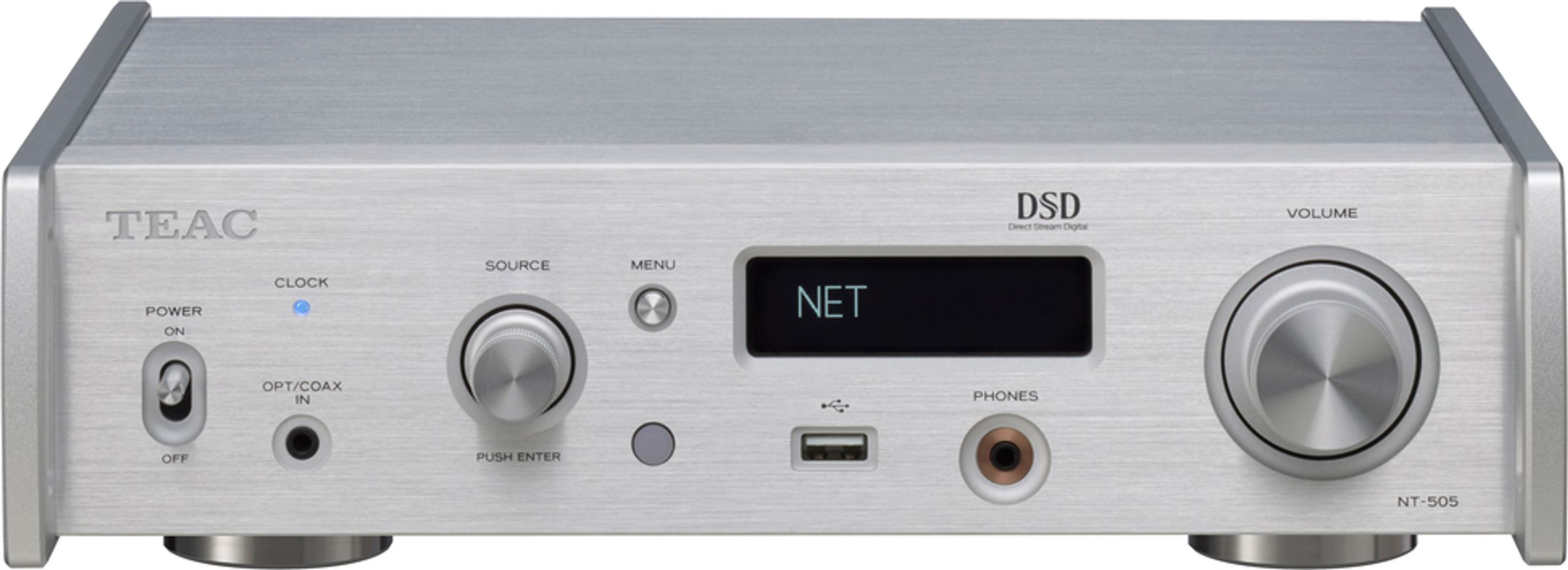
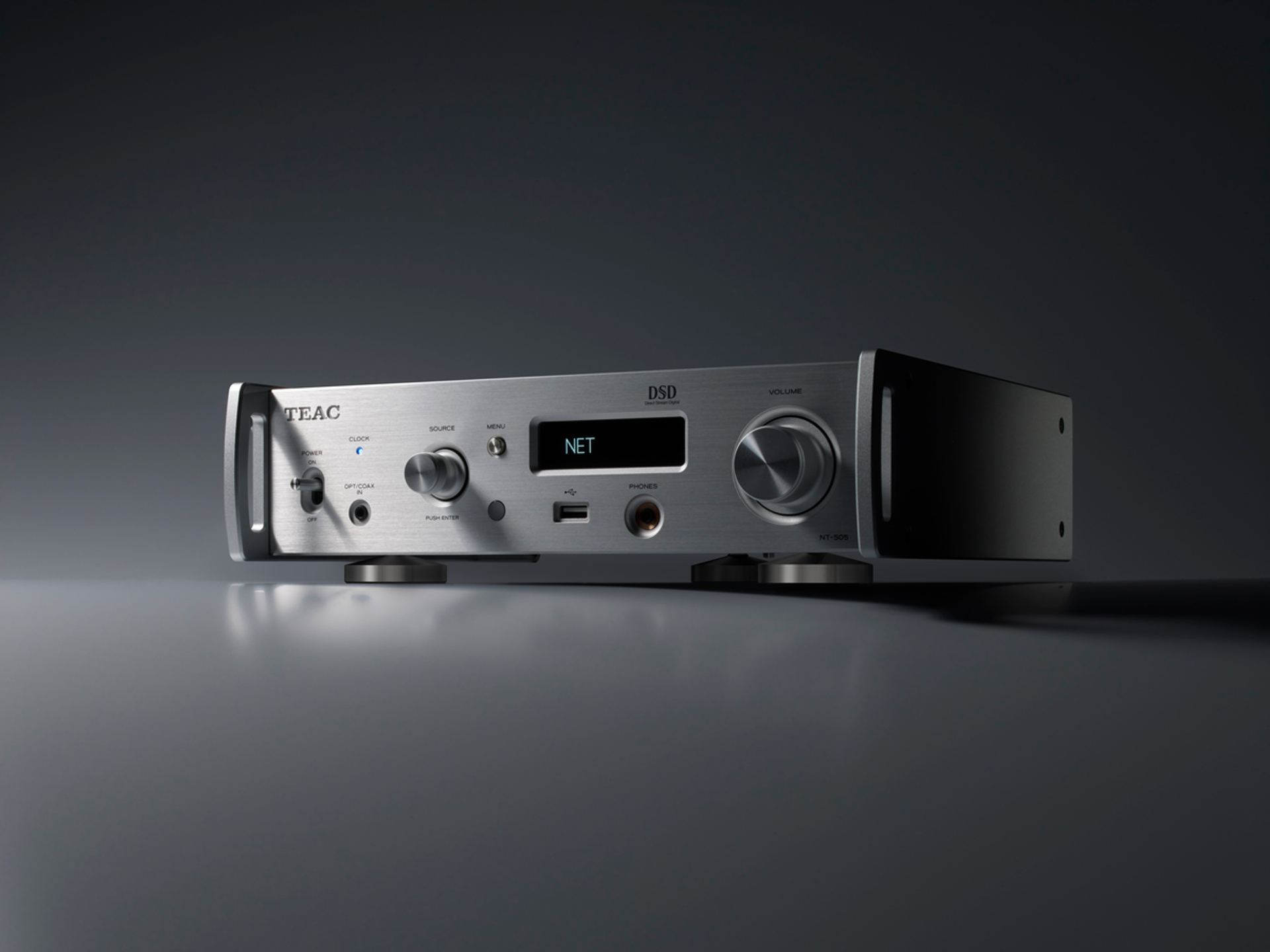
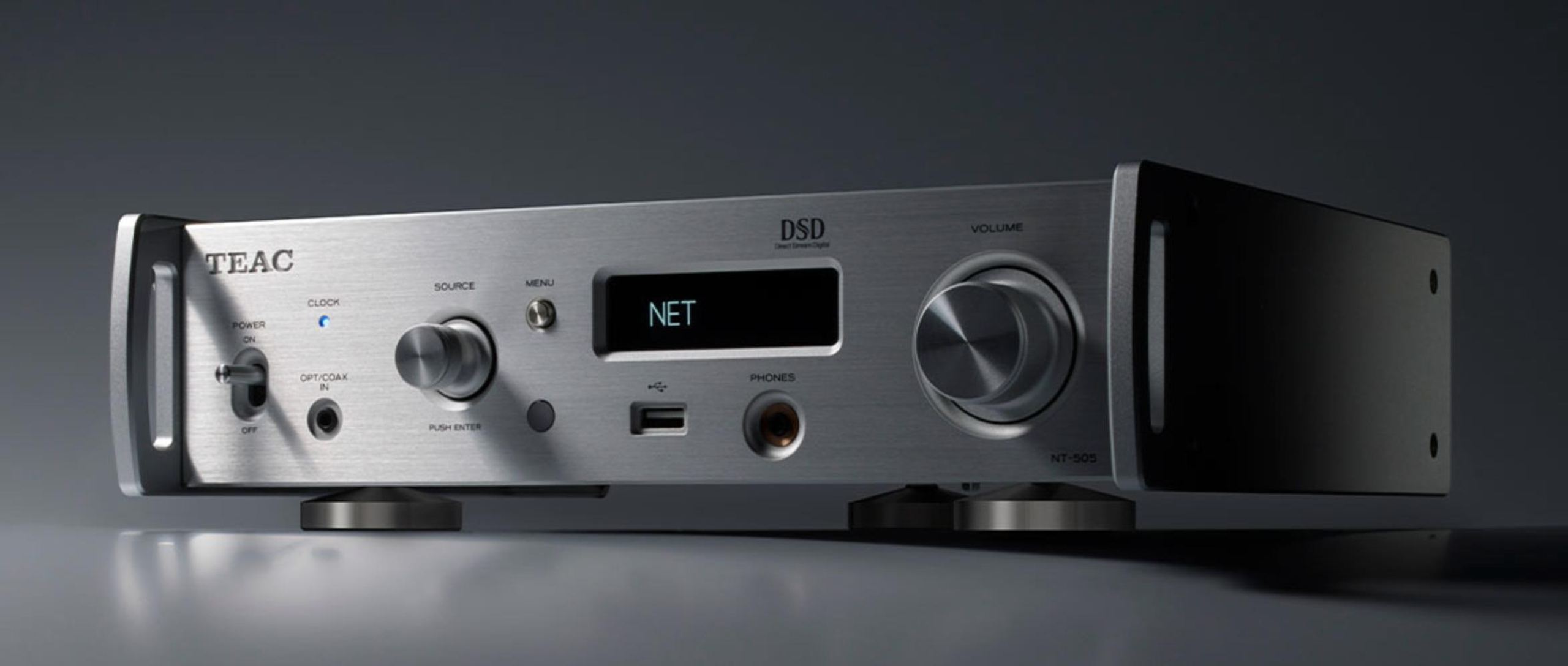
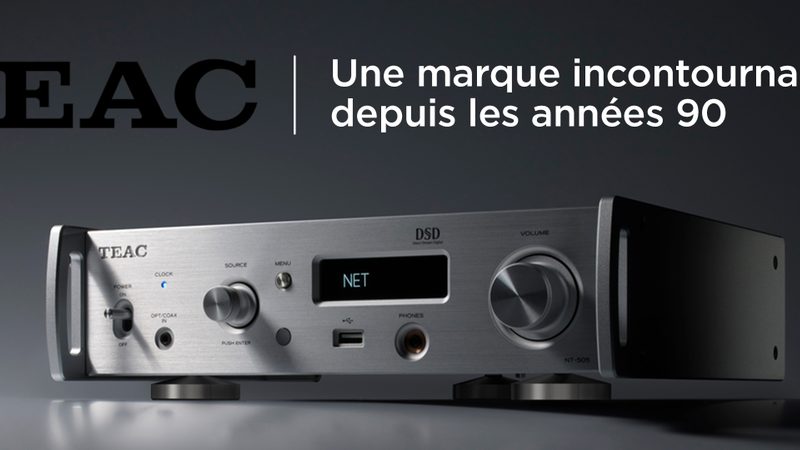
The TEAC NT-505-X is a compact-format (A4 equivalent) network audio player featuring a dual-mono DAC. It combines a wide range of network functions with a design born of the Japanese brand’s experience. Its format allows installation on a desk or in a compact hi-fi system.
Fully dual-mono design with the latest-generation ESS Technology converters
The NT-505-X employs a rigorous dual-mono configuration, from the power supply right through to the analog output stages. At the heart of this design, two ESS Technology ES9038Q2M SABRE32 Reference chips—one per channel—handle digital-to-analog conversion. These reference-grade converters, well regarded in the audiophile market, leverage the 32-bit HyperStream II architecture and Time Domain Jitter Eliminator, both exclusive ESS Technology developments. This configuration achieves an outstanding dynamic range and enhanced linearity in conversion, with each converter operating in mono mode to optimize the signal-to-noise ratio.
The unit natively handles resolutions up to 768 kHz at 32-bit for PCM and 22.5 MHz for DSD (DSD512). Seven PCM digital filters are available, allowing you to tailor the rendering to the file format or listening preferences. Filter switching is performed directly from the remote control, letting you explore the sonic nuances of each configuration.
Physical and electrical channel separation extends into the power supply, where two oversized toroidal transformers independently power the left and right channels. This architecture ensures that no channel is affected by the other’s power consumption variations during digital processing, preserving signal purity and soundstage stability.
TEAC proprietary technologies for optimal signal transmission
The analog output circuit incorporates TEAC-HCLD2 (High Current Line Driver) technology, an evolution of the original TEAC-HCLD circuit. This topology uses buffer ICs with very high current delivery capability, configured in a positive-negative structure for each channel. This design enables differential operation for balanced outputs and parallel operation for unbalanced outputs, transmitting audio signals without degrading their dynamism.
Volume control relies on the TEAC-QVCS (Quad Volume Control System), a variable-gain amplifier-type analog attenuator comprising four discrete circuits for the left, right, positive, and negative signals (L+, L−, R+, R−). By placing this control directly in the signal path on the board, noise issues related to divergent cabling are avoided.
RDOT-NEO (Refined Digital Output Technology NEO) is a smoothing algorithm that renders digital audio signals with naturalness. This function upconverts PCM signals up to 384 kHz/32-bit and DSD to 24.5 MHz. RDOT applies an analog interpolation method using a smoothing logic, developed to enable the reproduction of frequencies above 20 kHz lost by 44.1 kHz/48 kHz digital signals.
Precision clocking and external synchronization
The NT-505-X integrates two audio-grade quartz oscillators dedicated respectively to multiples of 44.1 kHz and 48 kHz. This setup—an alternative to a computer’s unstable and noisy clock during USB audio playback—ensures precise synchronization in asynchronous transfer mode. The unit automatically applies the appropriate clock to incoming digital signals, reproducing sound identical to the original by eliminating jitter effects on the audio signal.
A 10 MHz BNC external clock input enables synchronization with a higher-precision master clock generator such as the TEAC CG-10MA. This feature offers demanding users the possibility of further optimizing playback quality.
USB Bulk Pet technology: four transfer modes to manage system load
USB transmission benefits from the proprietary Bulk Pet technology, developed in collaboration with Interface Corporation. Unlike conventional isochronous transfer, where large variations can occur in processing loads on the transmitting computer and receiving USB DAC, Bulk Pet sends a fixed amount of data at a constant pace. This approach levels the processing load on both sides and ensures stable data transmission.
Four predefined transmission modes are available, allowing users to select the mode that best matches their sonic preferences and system configuration. Each mode shifts the processing load balance between the host computer and the DAC, subtly influencing the final audio quality.
Network capabilities and high-resolution streaming
The NT-505-X fits naturally into a modern audio ecosystem. Compatible with OpenHome and Roon Ready (via firmware update), it provides flexible playlist management and multiroom synchronization. Gapless playback ensures seamless listening for live albums or classical works.
The unit supports subscription streaming services Spotify Connect, TIDAL, and Qobuz, providing access to millions of tracks in lossless CD quality (44.1 kHz/16-bit) and beyond. Built-in MQA decoding lets you fully enjoy high-resolution recordings on TIDAL, reproducing analog waveforms with remarkable precision thanks to an efficient compression algorithm that makes high-resolution audio files compact.
Bluetooth connectivity includes, in addition to standard SBC and AAC codecs, support for LDAC (24-bit/96 kHz high-resolution transmission) and Qualcomm aptX HD (24-bit/48 kHz transmission), enabling high-quality wireless playback from smartphones and tablets.
Anti-vibration mechanical construction and optimized chassis
The all-metal chassis effectively resists external electromagnetic interference. 8 mm-thick aluminum panels cover both sides, ensuring a solid, stable structure that prevents twisting and flexing. This rigorous construction maintains a clean, low-noise internal environment even under conditions that are challenging for audio equipment.
Three-point support feet follow an anti-stress concept developed by TEAC. The machined steel conical tips are attached in such a way that they hang from the underside of the chassis and oscillate freely when the unit is lifted. This design enables more natural sonic reverberations while maintaining precise placement.
The top panel adopts a semi-floating structure, contributing to a sound with a remarkable sense of openness and freedom.
Dedicated software applications for seamless integration
TEAC HR Audio Player for Windows and Mac ensures the best available playback quality with any combination of audio format and computer configuration via a single USB cable. The user simply selects the NT-505-X from the output device dropdown menu.
The TEAC HR Streamer app for iOS and Android supports high-resolution audio formats up to 5.6 MHz DSD and 192 kHz PCM. This free app enables wireless streaming playback control from a device, a NAS, computers, and the Internet, with rich graphical information including album artwork.
Bluetooth 4.0 (codecs: SBC, AAC, aptX, aptX HD, LDAC)
Audio outputs:
1 × balanced XLR
1 × unbalanced RCA
1 × 3.5 mm headphone (4-pole, 500 mW + 500 mW into 32 Ω)
Audio Performance
THD: 0.002%
Signal-to-noise ratio: 110 dB
Frequency response: 10 Hz – 80 kHz
Construction and Design
Power supply: dual toroidal transformers (one per channel)
Chassis: full metal, 8 mm aluminum side panels
Feet: three-point anti-vibration design
Top panel: semi-floating
Dimensions and Weight
Height: 8.45 cm
Width: 29 cm
Depth: 24.87 cm
Weight: 5.3 kg
Accessories and Software
Remote control included
Free software:
TEAC HR Audio Player (Windows / Mac)
TEAC HR Streamer (iOS / Android)
Frequently Asked Questions
What is the main difference between the NT-505-X and the original NT-505 model?
+
The NT-505-X uses ESS Technology ES9038Q2M converters instead of the Asahi Kasei Microdevices AK4497 chips in the original model. This change, necessitated by the AKM factory fire in October 2020, led TEAC to rethink certain internal circuits while maintaining the same dimensions and overall features. The ESS converters offer a slightly different sonic signature, generally described as more analytical and detailed.
How does Bulk Pet technology work and what are its advantages?
+
Bulk Pet employs Bulk transfer instead of standard isochronous transfer for USB audio. This technology allows control over the volume and frequency of data transmission, distributing processing load more evenly. The four available modes offer different balances between the host processor load and the DAC load, allowing users to optimize sound quality according to their system and preferences.
Can the NT-505-X function as a preamplifier?
+
Yes. Thanks to the built-in TEAC-QVCS volume control, the NT-505-X can be connected directly to a power amplifier. The analog outputs (balanced XLR and unbalanced RCA) can be configured in fixed or variable mode to suit your system’s needs.
How is the firmware updated for Roon Ready compatibility?
+
Roon Ready compatibility requires a firmware update available after the initial purchase. Updates are generally carried out via the USB port or over a network connection, according to the specific instructions provided by TEAC on their website.
Does the unit require a break-in period?
+
Like any audio equipment using precision analog components, the NT-505-X may benefit from a period of thermal and electrical stabilization. The toroidal transformers and analog circuits typically reach their optimal performance after a few dozen hours of use.
Can multiple digital inputs be used simultaneously?
+
No, the NT-505-X processes a single source at a time. The active input is selected via the front-panel rotary knob or the remote control. Switching from one source to another is instantaneous and does not require restarting the unit.
User reviews
Marc
I was looking for a network player that doesn't color the sound, is very detailed, offers a beautiful stereo image, and above all, is very musical. I didn't let myself get lured in by Eversolo's marketing and their whole network of influencers, and I'm glad I didn't. This Teac is magnificent! Its ESS Sabre DACs are fabulous in terms of detail and specialization, while allowing a magnificent musicality to express itself. A musicality that is well orchestrated by the two very high-quality preamps of the Teac. The components and manufacturing of this player are exemplary. Moreover, we have here a true dual mono design (dual power supply, dual DACs, dual preamps). It needs to be broken in before listening, and that's what I did. One small complaint though: the firmware update can only be done with a Windows PC... Luckily a friend has one. The streaming app is not too bad once you get used to it, but when Qobuz finally decides to implement Qobuz Connect one day, it will be great. I hesitated with the Teac UD-701, but it's twice the price for certainly not twice as good. I also hesitated with a used NT505 with an AKM chip, but I don't regret at all having chosen the ESS Sabre chips. Here, I have plenty of details. It's worth noting that you can find some used UD or NT505 units, but also some 503s. Devices that are sometimes more than 10 years old and in impeccable condition. For me, this was a sign of quality. So, if you're looking for a network player, go for it.
Comment from February 02, 2024 — Experience from January 22, 2024
Automatically translated — Show original (French)
Je cherchais un lecteur réseau qui ne colore pas le son, qui soit très détaillé et offrant une belle image stéréo, et surtout très musical. Je ne me suis pas laissé appâter par le marketing d'Eversolo et tout son réseau d'influenceurs, et j'ai bien fait. Ce Teac est magnifique ! Ses DAC ESS Sabre sont fabuleux de détails, de spécialisation, tout en laissant s'exprimer une magnifique musicalité. Une musicalité bien orchestrée par les deux préamplis très qualitatifs du Teac. Les composants et la fabrication de ce lecteur sont exemplaires. De plus, nous avons là du vrai double mono (double alimentation, double DAC, double préampli). À roder avant d'écouter, et c'est ce que j'ai fait. Petit reproche quand même : la mise à jour du firmware ne peut se faire qu'avec un PC Windows... Heureusement qu'un copain en a un. L'application de streaming n'est pas trop mal une fois apprivoisée, mais quand Qobuz se décidera un jour à mettre en place Qobuz Connect, ce sera top. J'ai hésité avec le Teac UD-701, mais deux fois plus cher pour certainement pas 2 fois mieux. J'ai également hésité avec un NT505 d'occasion avec une puce AKM, mais je ne regrette pas du tout d'avoir fait le choix des puces ESS Sabre. Là, j'ai plein de détails. À noter, d'occasion on trouve quelques UD ou NT505 mais aussi des 503. Des appareils qui ont parfois plus de 10 ans et qui sont dans un état irréprochable. Pour moi, cela a été un gage de qualité. Donc, si vous recherchez un lecteur réseau, allez-y.
To better understand our visitors, measure marketing effectiveness and personalise ads, we and our partners use cookies and mobile advertising identifiers on your device. This data makes it possible to display personalised and non-personalised ads and measure their performance. Some cookies, which are technically necessary, are exempt from consent. You can accept those that require your consent, refuse them by clicking "Refuse", or customise your choices via the settings screen.
To find out how Google uses the data collected once you have given your consent, see Google’s Business Data Responsibility site.
You can change or withdraw your consent at any time via the "Consent and cookies" link. Your choices will apply on our site for 12 months.