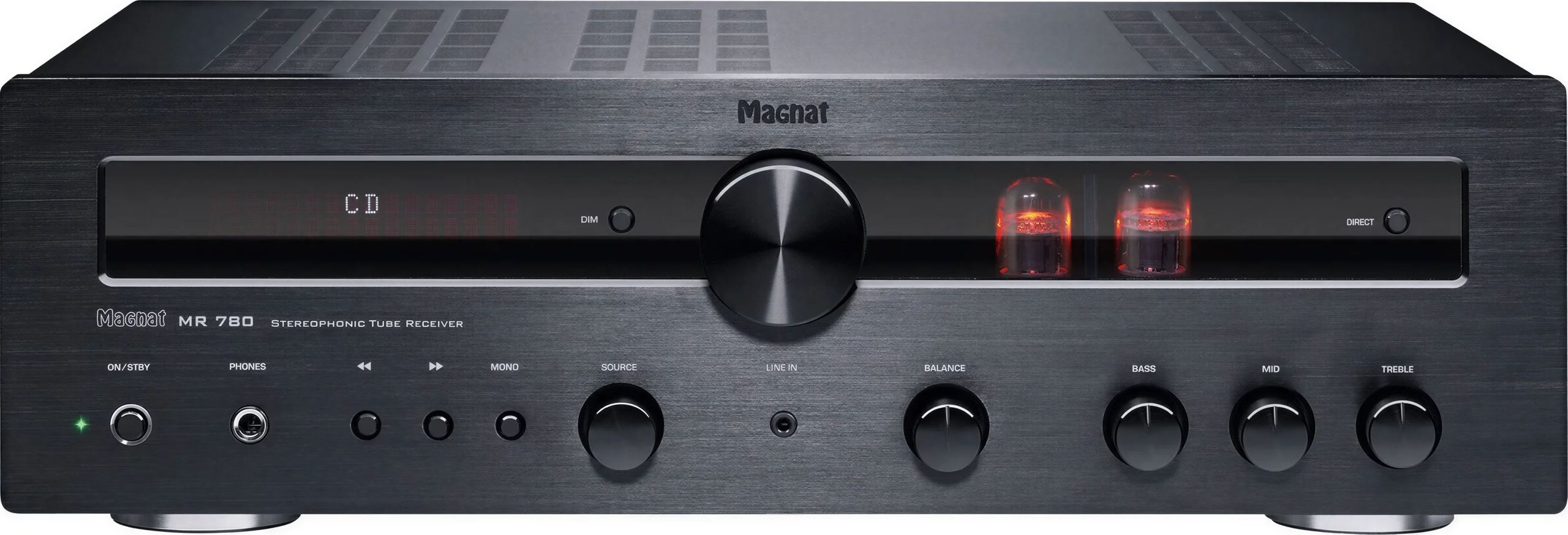
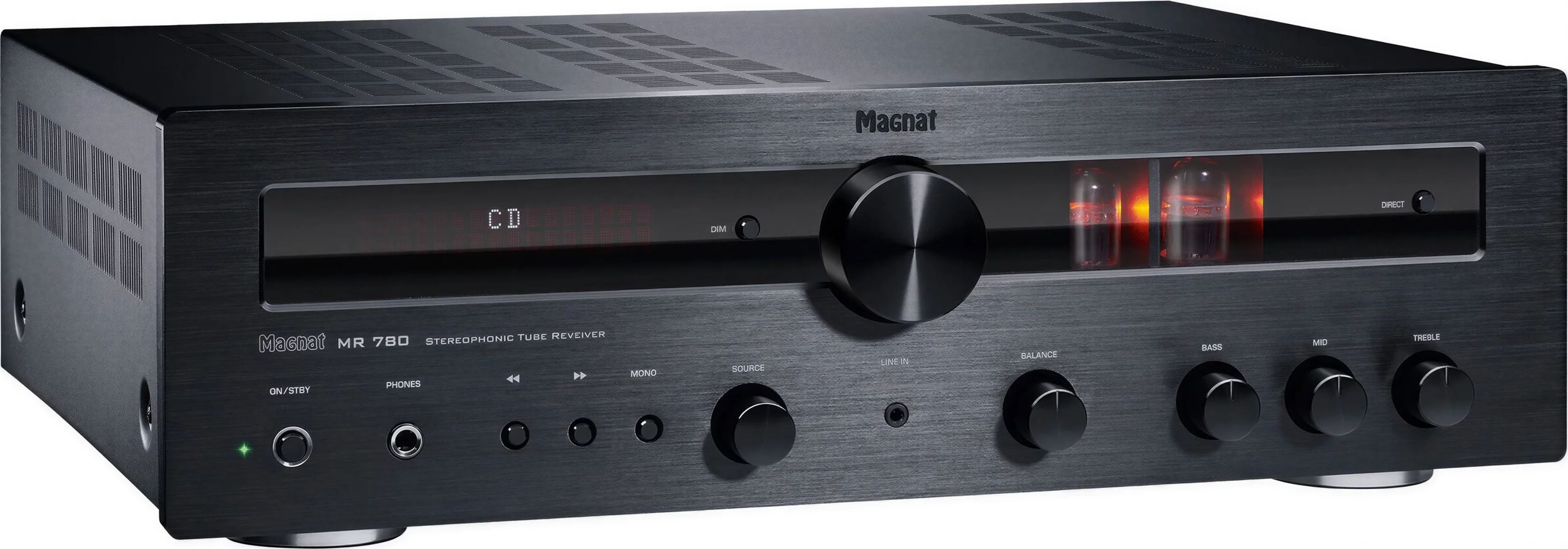
Two tubes work in the preamplifier, while transistors drive the speakers: this stereo amplifier brings both technologies together in an all-metal enclosure weighing 8.9 kg. It receives DAB+ digital radio and FM, accepts a turntable, a TV, a computer or a smartphone, and can be controlled entirely by remote control. Add a pair of speakers and it is all you need to build a complete system.
ECC81 tubes in the preamplification stage
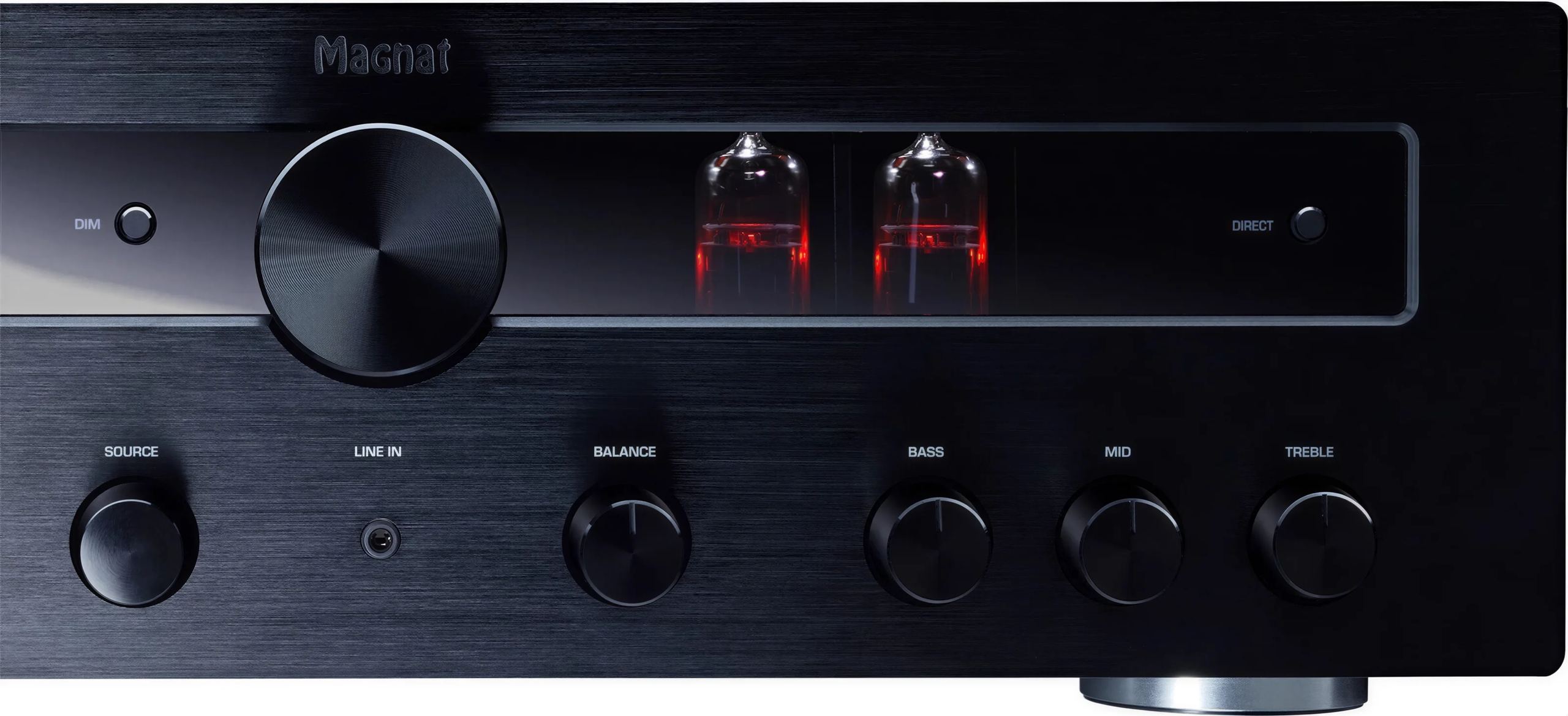
The MR 780 uses the hybrid principle that Magnat employs in several of its audio components. The source signal first passes through two ECC81 tubes (American designation 12AT7), dual triodes tasked with amplifying low-level signal voltage. This is where the tubes give the sound their character: their distortion consists mainly of even-order harmonics, which account for the smoothness associated with tube electronics. Magnat selects and burns in its tubes before assembly, ensuring that the two channels are matched and operation is stable from the very first listen.
Power then comes from a transistor stage built with discrete components, without integrated circuits. It delivers 2 × 75 W into 8 ohms and 2 × 100 W into 4 ohms, measured from 20 Hz to 20 kHz with less than 1% distortion. Peak power reaches 2 × 180 W into 4 ohms at 1 kHz. Most speakers on the market are rated at 8 ohms, so 75 W is the figure to keep in mind: it is enough for most bookshelf models and many floorstanding speakers in an average-sized living room. An all-tube amplifier delivering this much power would require large output transformers and power tubes that need regular replacement. Here, the tubes are used only to process the signal and remain under little stress.
On the line inputs, the frequency response extends from 6 Hz to 90 kHz at -3 dB and stays within ±0.3 dB between 20 Hz and 20 kHz. The signal-to-noise ratio is 104 dB(A).
A carefully designed power supply in an 8.9 kg chassis
The toroidal transformer has a low stray magnetic field. It therefore radiates little interference towards nearby sensitive circuits, particularly the phono preamplifier and the tuner. Each section of the circuit receives its own regulated voltage, and high-capacity filter capacitors provide the energy reserve for power peaks. A separate standby power supply takes over when the unit is switched off using the remote control: consumption then drops below 0.5 W, compared with a maximum of 300 W during operation.
The enclosure is entirely metal, with a brushed solid aluminium front panel and knobs. Feet with rubber inserts limit the transmission of vibrations from the supporting surface. The two-line display shows the source, volume and station name, and its brightness can be adjusted to three levels to avoid glare in a dark room. The unit measures 433 × 132 × 317 mm, but is 360 mm deep including the knobs and terminals: allow around 40 cm of shelf depth once the cables are connected.
Five digital inputs and seven analogue inputs
A turntable connects directly to the phono input, without an external preamplifier. This low-noise operational amplifier circuit accepts moving magnet (MM) cartridges: sensitivity of 5 mV, impedance of 47 kΩ and signal-to-noise ratio of 82 dB(A). It includes a subsonic filter set to 16 Hz with a slope of 18 dB per octave. This filter removes inaudible frequencies produced by a warped record or tonearm movements, which would otherwise cause unnecessary movement of the speaker cones. Five RCA line inputs (470 mV, 100 kΩ) accommodate a CD player, a tape deck or a network player. A front-panel 3.5 mm jack is handy for temporarily connecting a portable music player or laptop.
On the digital side, the MR 780 has two optical inputs and two coaxial inputs, all supporting up to 24-bit and 192 kHz. A TV connects to one of the optical sockets, with its audio output set to stereo PCM. The USB-B audio 2.0 input connects a computer, which then sends its music without using its own sound card, again at up to 24-bit and 192 kHz. All these digital sources are converted by a Wolfson converter.
Bluetooth 4.0 supports Qualcomm’s aptX codec, which offers greater detail than the basic SBC codec, provided the phone also supports it. The unit has neither Wi-Fi nor a network port: to listen to a streaming service at CD quality or higher, you need to add a network player connected to a coaxial or optical input.
Outputs include a 6.35 mm headphone socket and a fixed-level recording output, which sends the selected source signal to a recorder independently of the volume setting.
DAB+ digital radio and FM without an extra box
The tuner receives DAB and DAB+ (band III, from 174.928 to 239.2 MHz) as well as FM from 87.5 to 108 MHz, with a sensitivity of -108 dBm. Automatic DAB+ station search and FM scanning eliminate the need to enter frequencies manually. On FM, RDS and Radio Text display the station name and the information it broadcasts. There are 40 presets available for DAB+ and just as many for FM, all accessible from the system remote control, which controls all the unit’s functions.