Audeze LCD-2 Padauk
Overview
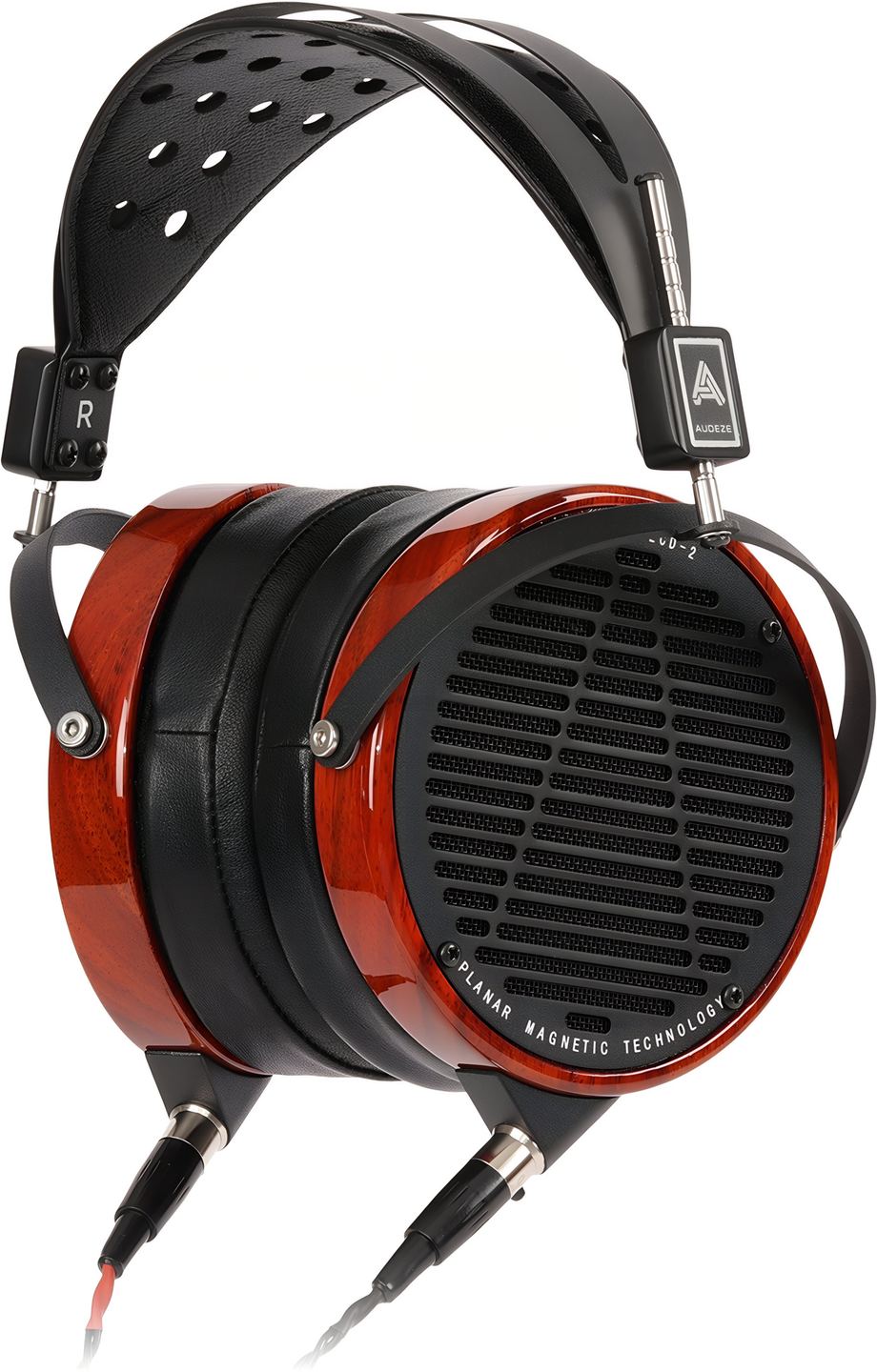
A planar headphone launched in 2009 and still in the catalog in 2026 is rare. Audeze has revised the LCD-2 several times without ever changing what gives it its character: deep-reaching bass, rich mids, and non-fatiguing highs. The current version is recognizable by its orange-red wood rings and ventilated suspension headband, two visible changes that accompany mechanics faithful to the original.
Handcrafted wood rings
Padouk comes from central and tropical western Africa. It is a hardwood used in luthiery for acoustic guitars and percussion instruments, whose orange-red hue gradually darkens when exposed to light. Audeze finishes each ring by hand in its Southern California workshop and protects it with varnish. The difference from the LCD-2 Classic, whose rings are made of glass fiber-reinforced nylon, can be seen and felt: wood weighs more.
The 106 mm planar driver
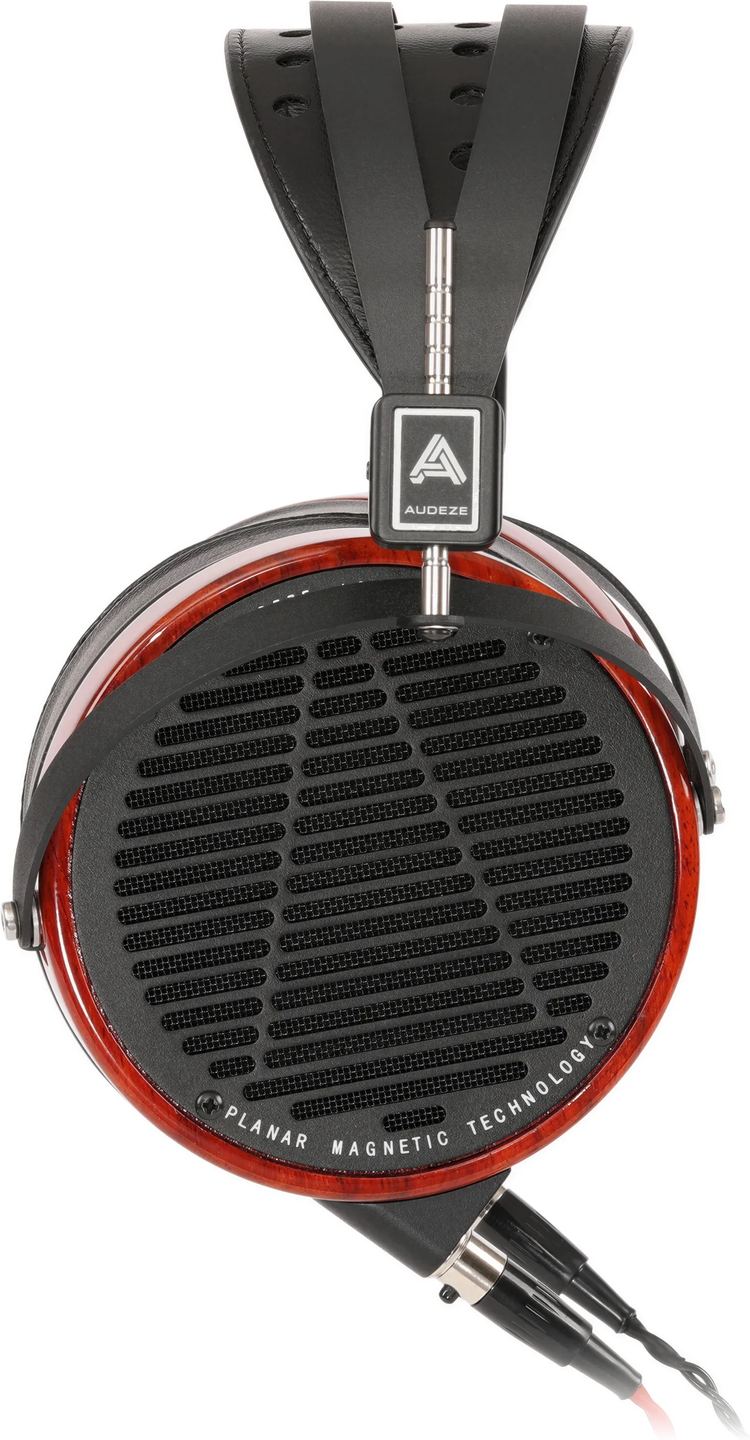
The planar principle can be summed up in a few words. A very thin diaphragm, crossed by a conductive circuit, is tensioned between two arrays of N50 neodymium magnets. The driving force is applied across its entire surface instead of being transmitted by a central voice coil as in a dynamic driver, which limits diaphragm deformation during rapid transients. At 106 mm in diameter, its radiating surface far exceeds that of a dynamic headphone driver. Audeze claims total harmonic distortion below 0.1% at 100 dB, already a high level, and a frequency response from 10 Hz to 50 kHz.
Fazor waveguides and phase
A planar driver suffers from an issue that dynamic drivers do not encounter: the wave emitted by the diaphragm must pass through the magnet bars before reaching the ear, and this passage creates reflections that blur phase in the upper part of the spectrum. Fazor elements, placed on either side of the diaphragm, channel air around the magnets to reduce this effect. Audeze claims lower distortion and a more clearly defined stereo image. This is the technical point that separates this LCD-2 from the LCD-2 Classic, which deliberately remains without Fazor and is tuned differently.
The amplification the LCD-2 requires
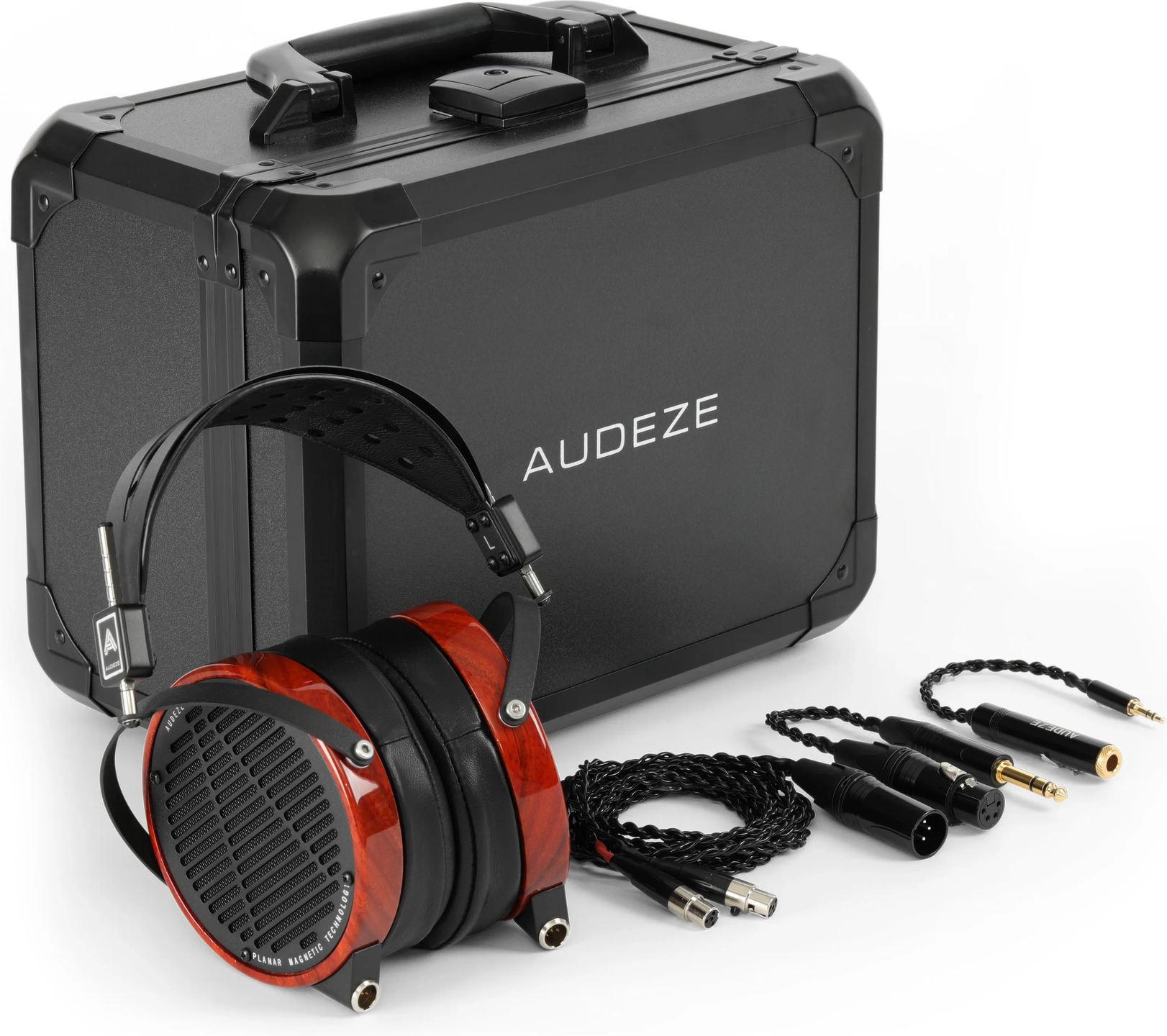
With 70 ohms and a sensitivity of 101 dB for 1 mW measured at the eardrum reference point, the LCD-2 is not a difficult headphone to drive. Audeze requires more than 100 mW at minimum and recommends more than 250 mW, with power handling reaching 5 W RMS. A laptop headphone output will produce sound, but without the headroom needed for the peaks of an orchestral recording or a drum track. A desktop headphone amplifier or a converter with a serious output stage changes bass control. The supplied cable ends in a 4-pin XLR connector, with an adapter cable to a 6.35 mm jack and a 6.35-to-3.5 mm adapter, all stored in a carrying case.
595 grams and a suspension headband
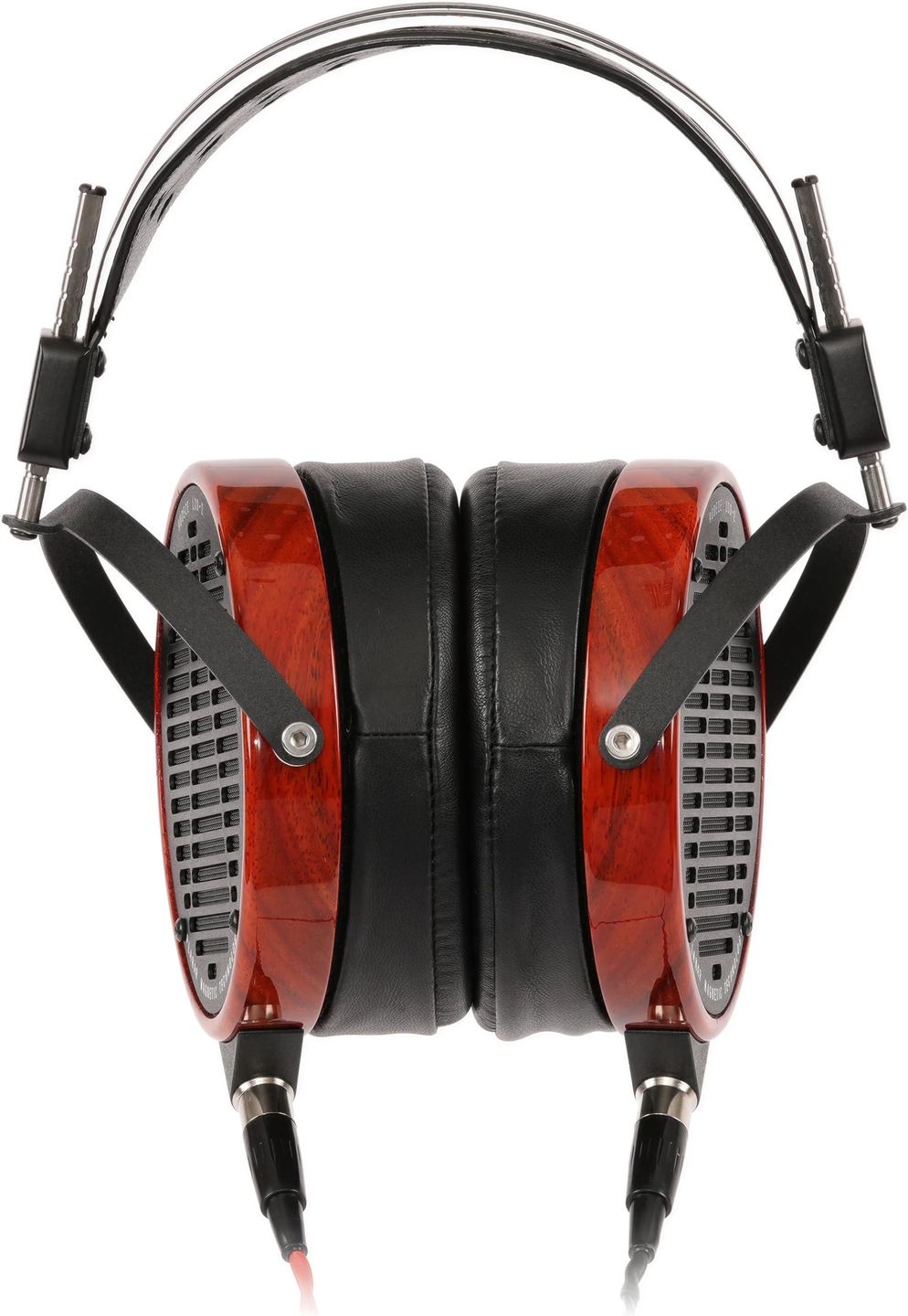
Weight remains the main drawback. At 595 grams, the LCD-2 is among the heaviest hi-fi headphones on the market, and the 51 grams separating it from the LCD-2 Classic come largely from the wood. The ventilated suspension headband distributes the load over a wide area of the head instead of concentrating it on one point, while the leather earpads cushion lateral pressure. In practice, the feeling of compression disappears, but the sense of weight on the neck does not: after two hours of continuous listening, a break becomes welcome.
An open back and its consequences
The open rear removes the sealed chamber behind the diaphragm and its accompanying pressure effect, for the benefit of a more airy soundstage. The trade-off is mechanical: the headphones let room noise in and let music out, audible to an office neighbor. In a quiet living room, in front of a turntable or at a workstation, this has no consequence. On a train or in an open-plan office, a closed-back model will do a better job.
Where it sits in the LCD series
The LCD-2 occupies the middle of Audeze’s audiophile range, above the LCD-2 Classic and below the LCD-3 and LCD-5. The MM-100 and MM-520 models, developed with sound engineer Manny Marroquin, target studio monitoring with a more neutral tuning. The LCD-2’s warm, forgiving tuning is more forgiving of average recordings, which explains its longevity among listeners who play older or poorly mastered catalogs.
Technical specifications
Key features
- Fazor waveguide technology for reduced distortion and precise imaging
- Tuned for a warm tonality with deep, punchy bass
- Hand-finished padauk wood rings
- Vented suspension headband and pads optimized for comfort
Design
- Open-back, circumaural style
- 106 mm planar magnetic transducer
- Ultra-thin diaphragm
- Leather earpads
Magnetic technology
- Proprietary magnet array
- N50 neodymium magnets
- Fazor phase management
Audio performance
- Frequency response: 10 Hz – 50 kHz
- Impedance: 70 Ω
- Sensitivity: 101 dB / 1 mW
- Total harmonic distortion: < 0.1% at 100 dB
- Maximum sound pressure level: > 130 dB
Power and weight
- Weight: 595 g
- Maximum power: 5 W RMS
- Minimum power: > 100 mW
- Recommended power: > 250 mW
Box contents
- LCD-2 headphones
- Standard LCD carrying case
- 4-pin XLR cable
- 4-pin XLR to 6.35 mm jack adapter cable
- 6.35 mm to 3.5 mm jack adapter
- Warranty card, certificate of authenticity
Frequently Asked Questions
Does padouk wood change in appearance over time?
Yes. Freshly worked padouk displays a vivid orange-red that darkens to a reddish brown under ultraviolet light. The varnish applied by Audeze slows the process without stopping it. Storing the headphones away from direct sunlight preserves the original shade longer; conversely, some owners appreciate the darkening, which brings the appearance closer to the older finishes in the LCD series.
Are the ear pads replaceable?
Yes, Audeze sells them separately. They are a wear item: the leather compresses and the foam loses density, which changes the seal around the ear and therefore the bass response. A flattened ear pad reduces the low end before it reduces comfort, a shift that often goes unnoticed.
Can I use a different cable than the one provided?
The headphone-side connector is a 4-pin mini-XLR per earcup, a standard used on most LCD models. Third-party cables using this connector fit without adaptation, including 4.4 mm balanced terminations required by many portable players and DACs.
Is the LCD-2 suitable for mixing?
It can serve as a secondary reference, but its warm voicing makes it less direct than monitoring headphones. Audeze reserves this use for its professional line. The brand also offers the Reveal+ processing module, available in VST, AU and AAX formats, which applies model-specific correction profiles and simulates listening through control room speakers; it is offered with a fourteen-day trial period.
Should headphones be broken in before judging their sound?
The planar diaphragm changes very little, unlike the suspension of a dynamic loudspeaker. It is mainly the ear pads that soften during the first few hours of use and slightly alter the fit. Critical listening after a few dozen hours remains reasonable, without expecting any transformation.
- Eco-contribution included in the sale price.
- Manufacturer reference: 100-L2-1023-00
- GTIN / EAN: 819343015530