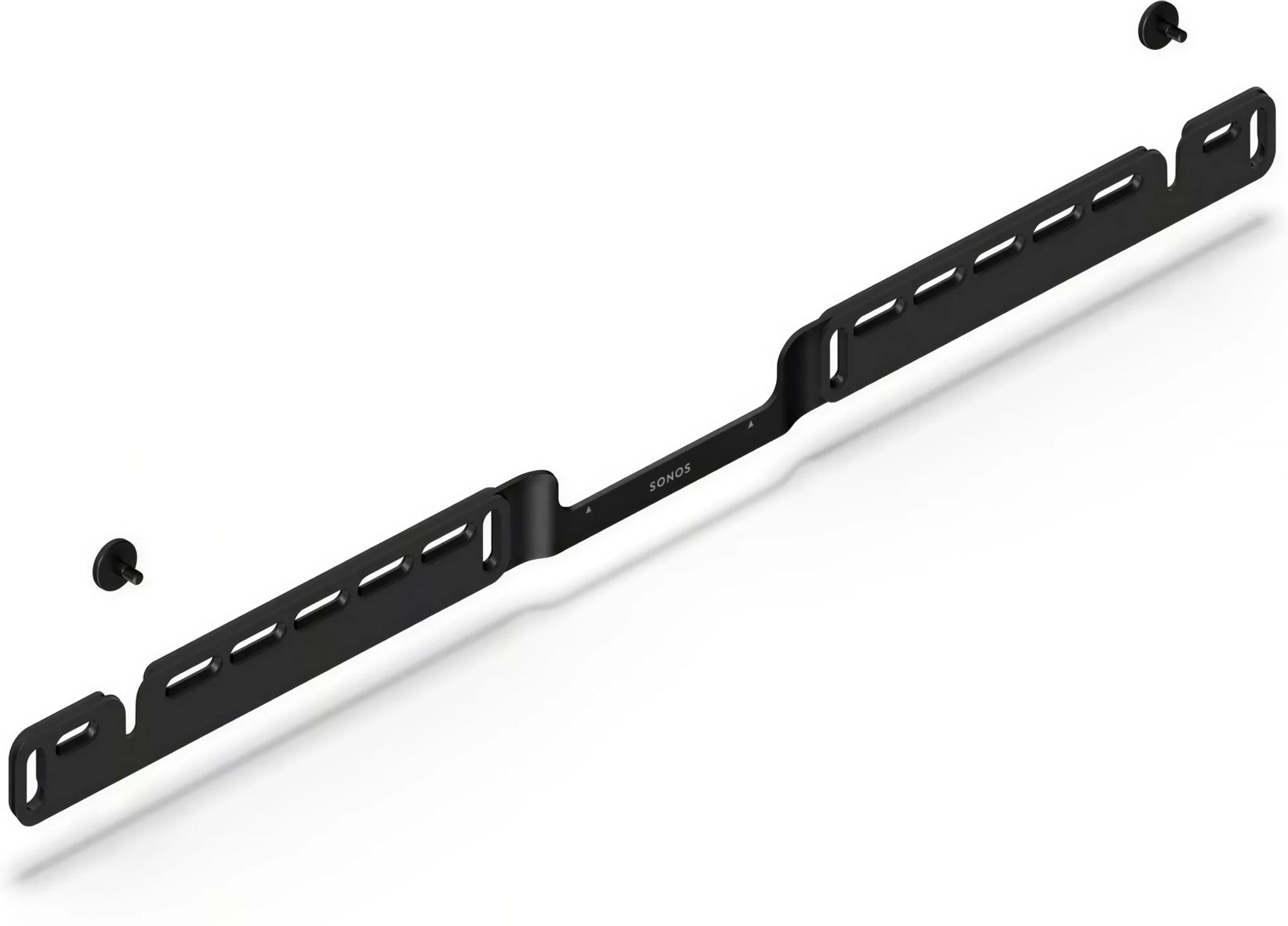
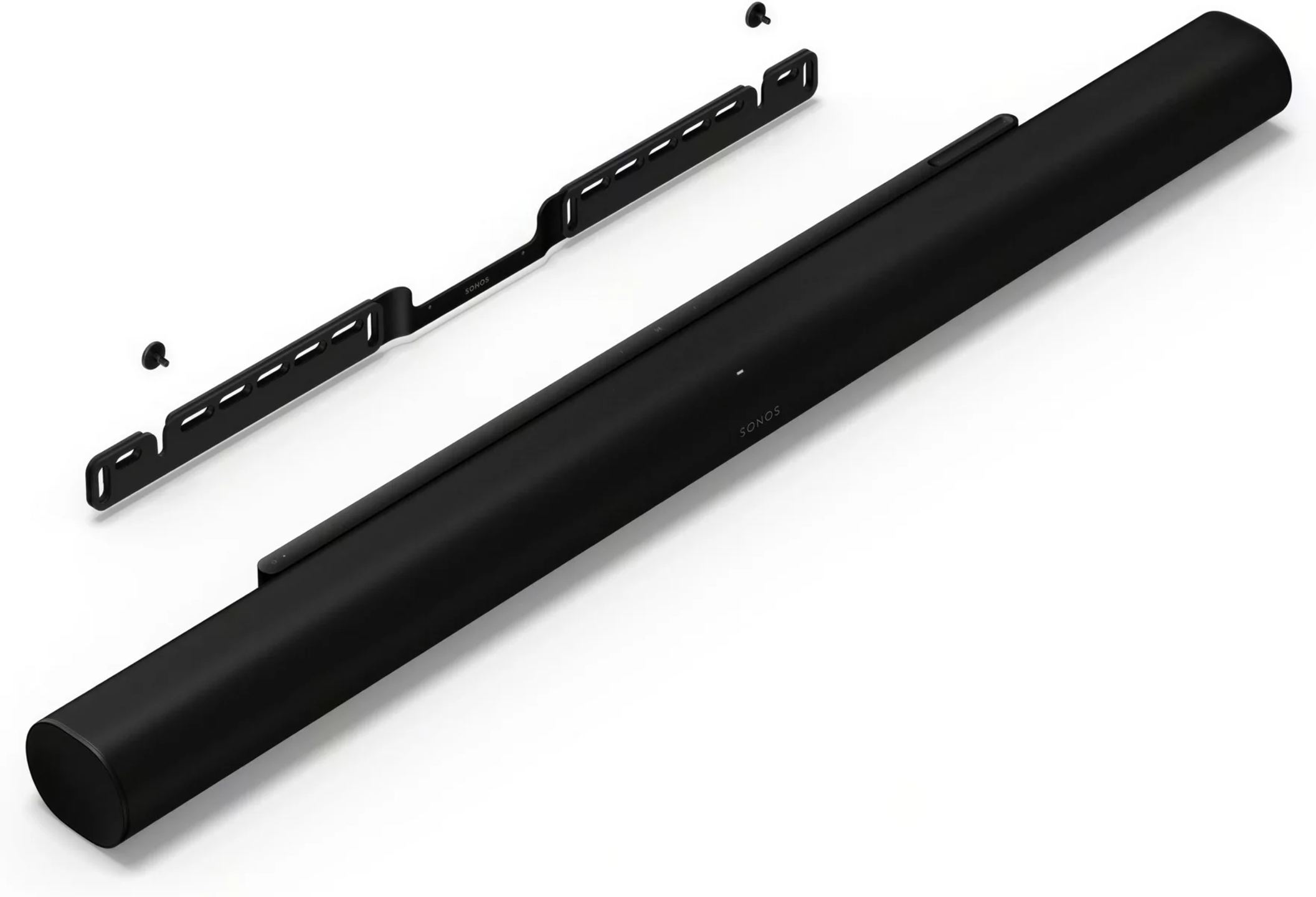
On a piece of furniture, a soundbar nearly 1.18 m long needs a surface wide and deep enough to accommodate it. Mounted on the wall below the screen, it no longer needs furniture, and the sound travels in line with the picture. This Sonos mount holds the Arc Ultra as close to the wall as possible and disappears behind it once the soundbar is in place. The soundbar automatically detects its wall-mounted position and adjusts its bass.
A mount that disappears behind the soundbar
The mount consists of a thin plate screwed to the wall, onto which the Arc Ultra hooks from the back. The two supplied knobs screw by hand into the threaded inserts on the back of the soundbar. The soundbar is then slid down until the knobs slot into the notches in the plate. The soundbar sits flush against the wall, with no bracket or arm protruding underneath: viewed from the front or at an angle, only the soundbar remains visible. The plate weighs 0.55 kg and supports a 5.9 kg soundbar. The power and HDMI cables connect to the back of the Arc Ultra before mounting, then run down behind it towards the mains socket and the TV.
Bass adjusted as soon as the soundbar is wall-mounted
A speaker placed flush against a wall does not sound the same as one on a piece of furniture. The wall reflects some of the low frequencies back into the room, and this bass adds to the bass coming directly from the soundbar. The bass increases in volume, sometimes to the point of becoming overpowering or making the partition resonate. The Arc Ultra detects that it is wall-mounted and automatically changes its equalisation to control this resonance, without requiring any adjustments in the app. The correction affects the bass, the part of the frequency spectrum most sensitive to proximity to a wall. The soundbar’s Sound Motion module, a flat woofer with four motors and dual diaphragms, is therefore adjusted from the very first listen. Bass, treble and loudness settings remain available in the Sonos app to fine-tune the result to your taste.
Below or above the screen: clearances to maintain
Sonos recommends installation below the TV. Mounting above the screen remains possible when the TV’s height or the room layout requires it.
In either case, leave at least 10 cm between the soundbar and the TV. Two of the Arc Ultra’s tweeters face upwards and create the Dolby Atmos height channels by reflecting sound off the ceiling: the soundbar needs space above it. When installed below the screen, this 10 cm gap corresponds to 14 cm between the top edge of the plate and the bottom of the TV. A supplied positioning guide lets you transfer this measurement to the wall. It looks like a simple packaging spacer, so it is best not to throw it away before installation.
The touch controls must remain facing upwards. Each end of the soundbar must be at least 30 cm from a wall or obstacle. Avoid room corners or enclosed recesses.
Installation within reach of a DIY enthusiast
The box contains the plate, the positioning guide, the two knobs, six screws and six wall plugs. First, hold the plate against the wall to mark the screw positions, then drill according to the wall material. In a wooden stud, a pilot hole made with a 3 mm drill bit is sufficient, and the wall plugs stay in the box: they are not used in wood or plastic. Plasterboard without a stud, or a plaster, concrete or brick wall, requires an 8 mm drill bit and the supplied wall plugs.
The plate is then secured with a Phillips screwdriver or a power screwdriver, using a spirit level to check that it is horizontal. The arrows engraved in the centre of the plate must point upwards. All that remains is to screw the knobs into the back of the soundbar, connect the cables and hang the assembly.