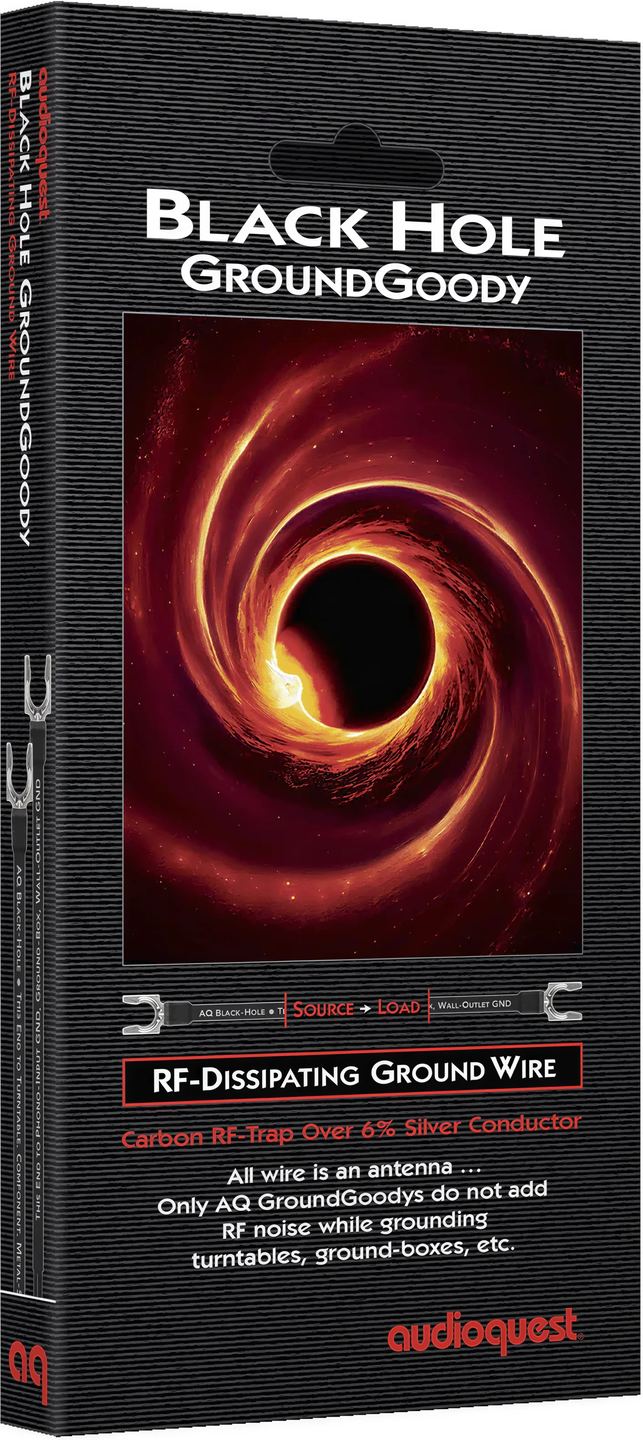
A low hum heard between tracks on a record often comes from the ground connection: the turntable is not connected to the phono preamp, or the connection is poor. A ground cable fixes this. The problem is that a simple wire also picks up radio interference, like an antenna. The entry-level model in AudioQuest’s GroundGoody series, the Black Hole connects the grounds and drains away this interference rather than feeding it into the electronics.
A ground wire that does not pick up radio waves
A turntable’s signal travels through the RCA cables. The metal chassis and tonearm need a separate connection to the preamp’s ground terminal. Without it, the 50 Hz mains hum finds its way into the speakers. This wire carries no music. It establishes the reference potential against which the preamp measures the cartridge’s signal: a few millivolts for a moving magnet (MM) cartridge and often less than one millivolt for a moving coil (MC) cartridge.
A bare conductor more than a meter long picks up Wi-Fi, phones, and noise from switching power supplies. It brings this high-frequency noise to the very place where the preamp needs it least: the reference point for a tiny signal. AudioQuest designed the Black Hole to drain this noise away along the cable rather than carry it to the device.
Silver-plated copper and a carbon trap
The conductors are made from Long-Grain Copper (LGC), AudioQuest’s long-grain copper. This copper has fewer grain boundaries than ordinary copper, and here it receives 6% silver plating. The conductors are solid-core: with no strands rubbing against one another, they avoid interactions between strands, which AudioQuest considers a source of distortion in stranded cables. Around the conductor, the Carbon RF-Trap is a layer of PVC made conductive with carbon. It absorbs radio-frequency energy before the conductor picks it up. The conductors are also oriented during manufacturing to direct the flow of induced noise.
It is important to keep things in perspective. All this work addresses radio interference. If the 50 Hz hum comes from a missing ground connection, any securely fastened wire will eliminate it. The Black Hole addresses a second issue: avoiding replacing that hum with more diffuse background noise introduced by the wire itself.
Cold-welded, silver-plated spades
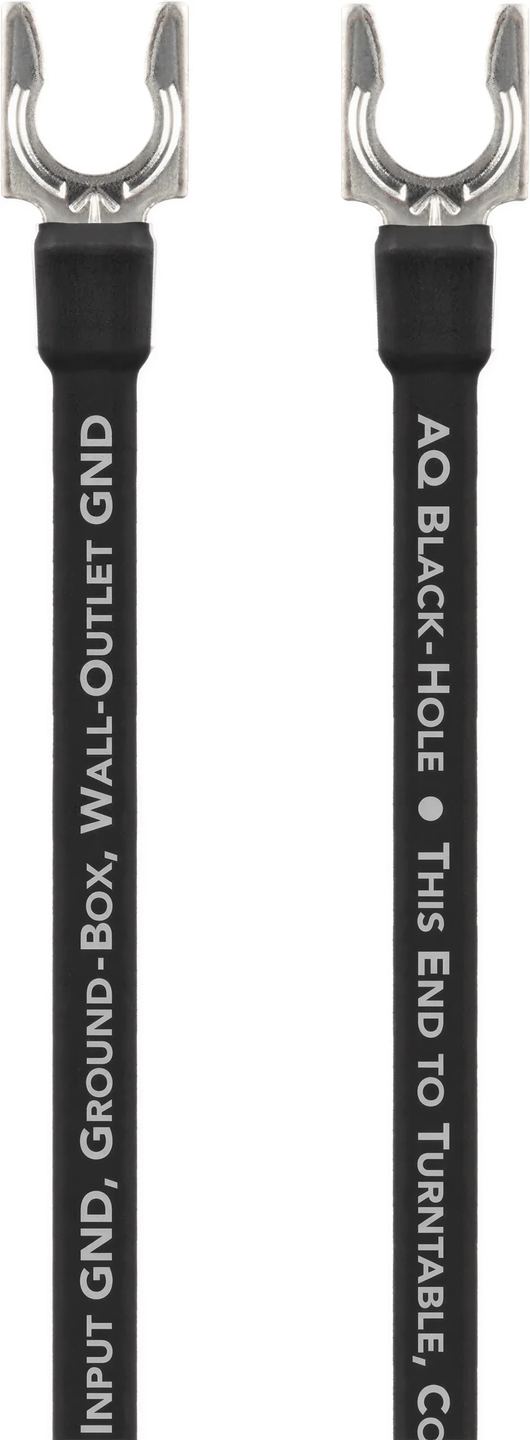
Each end has a size #10 spade, directly silver-plated. Its opening accommodates a threaded post just under 5 mm in diameter, matching the ground thumbscrew on most turntables, phono preamps, and integrated amplifiers with a phono input. The conductor is cold-welded to the terminal, meaning it is joined under pressure, without adding solder. There is therefore no solder alloy between the copper and the spade.
If the device has a larger-than-average ground terminal or simply a threaded hole without a thumbscrew, check that the spade fits. A spade does not plug into a banana socket: it is clamped under a nut or thumbscrew.
Which devices to use it with
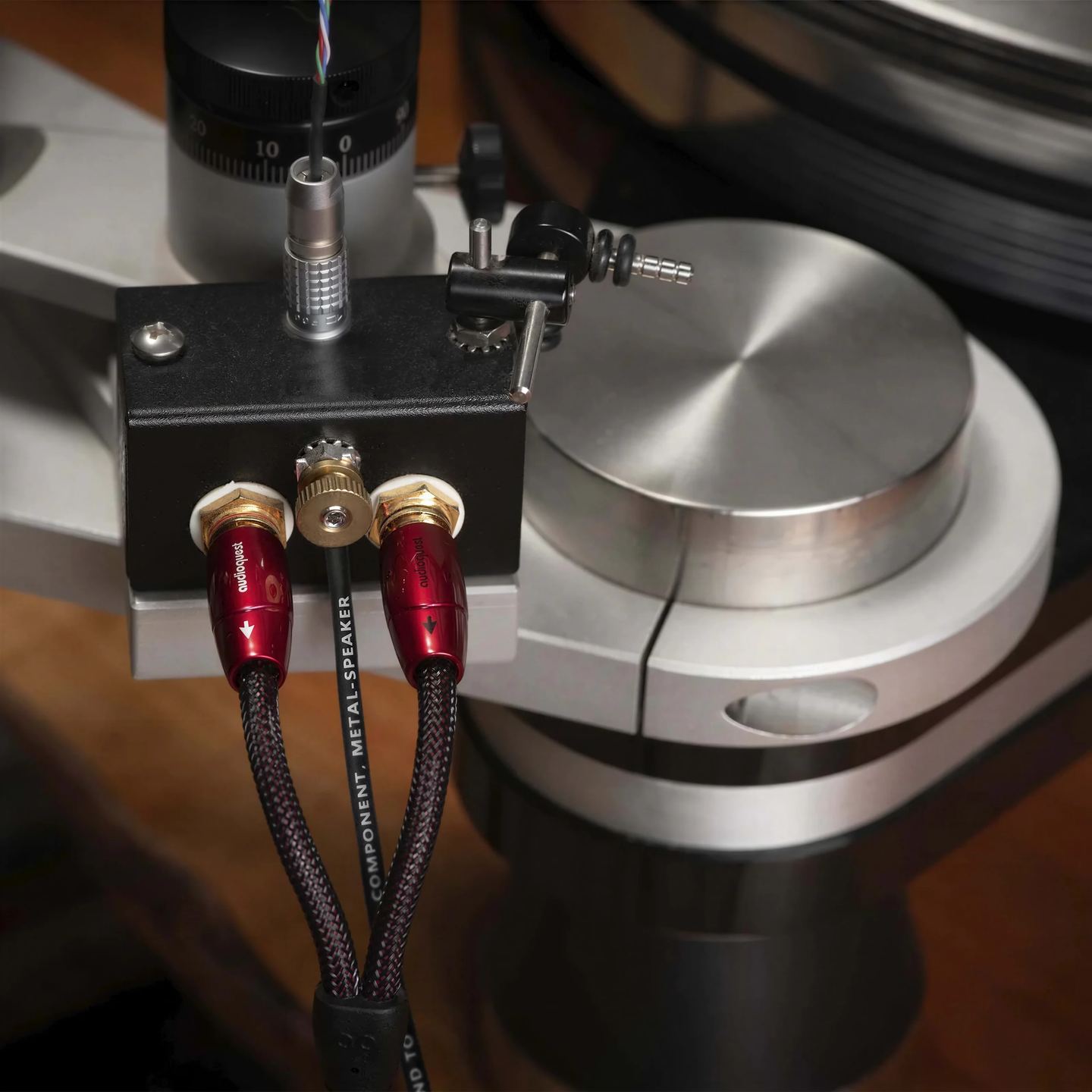
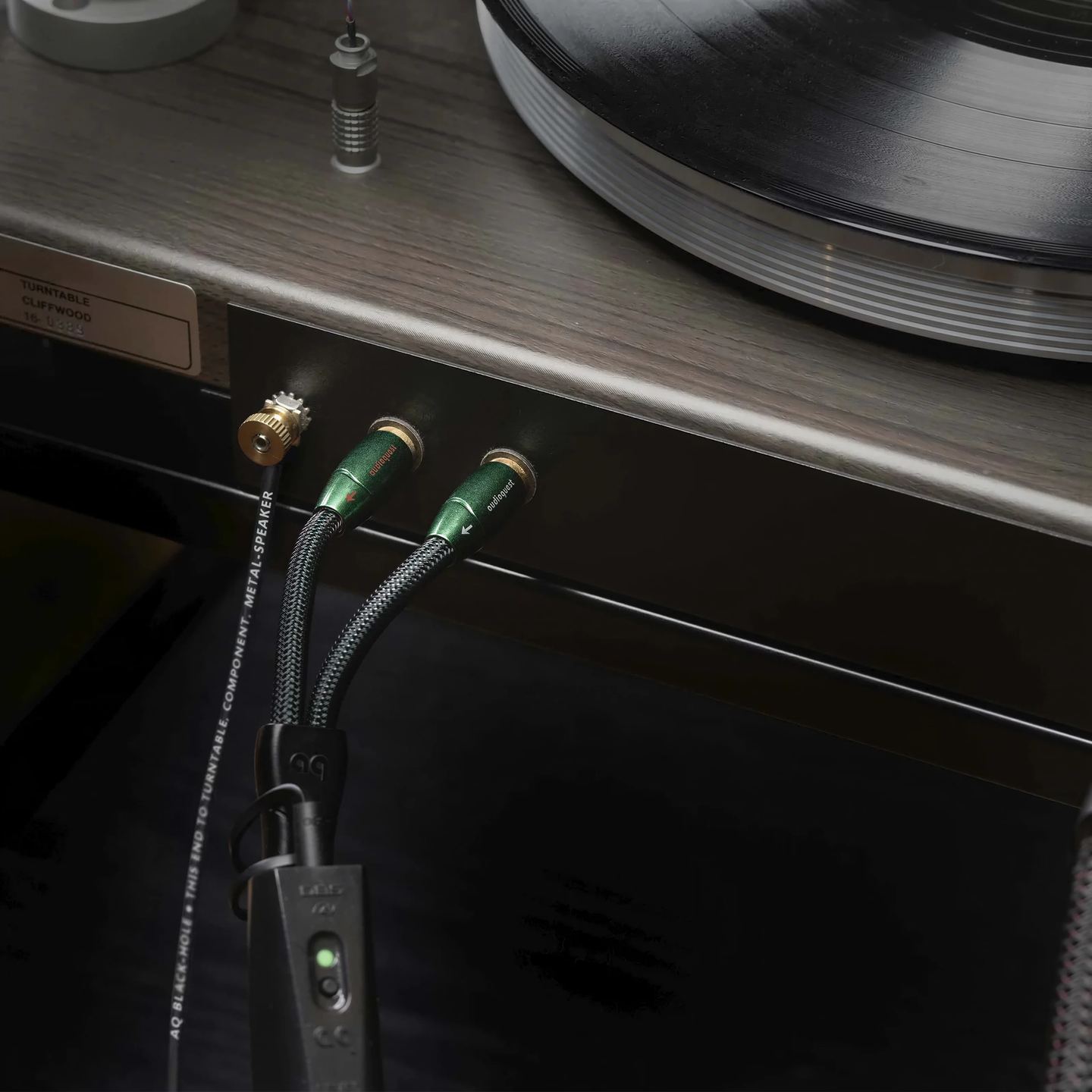
The most common case is a turntable with RCA sockets and a separate ground terminal. AudioQuest recommends pairing the Black Hole with almost any analog interconnect to create a complete phono cable. This lets you choose the RCA connection independently of the ground wire. The Black Hole also connects the ground of a separate phono preamp to that of the amplifier when both devices have a dedicated terminal. The brand also uses it with grounding boxes or other ground points in the system.
Some turntables do not need it. This is the case when the output cable is fixed and already includes its own ground wire, when a built-in preamp is set to line output, or with USB models. Nor does the cable fix hum originating elsewhere: a ground loop through the TV antenna, a cartridge incorrectly wired in the headshell, or a transformer too close to the tonearm.
Made to order in California
AudioQuest assembles the Black Hole GroundGoody to order at its Irvine workshops. Delivery therefore takes a little longer than for a cable taken from stock, and other terminations can be requested. In the GroundGoody series, the Black Hole is the entry-level model. The ThunderBird and Dragon sit above it, with more advanced noise-dissipation systems.