

Klipsch La Scala AL6 Black Ash (pack of 2)


Complementary product
Overview
The Klipsch La Scala AL6 represents the evolution of an audiophile legend born in 1963. This imposing floorstanding speaker carries on the legacy of Paul W. Klipsch while incorporating major technological innovations for 2025. Designed for discerning music lovers, it combines the legendary efficiency of Klipsch horn systems with technical advances such as a new 3-inch compression midrange driver, an innovative bass-reflex system, and the option for external active crossover. Handcrafted in Arkansas, each La Scala AL6 embodies American acoustic excellence with its exceptional 103 dB sensitivity and its ability to reproduce the subtlest musical nuances with remarkable precision.

Six Decades of Heritage Reimagined
La Scala was born in 1963 from Paul W. Klipsch’s desire to create a more compact speaker than the Klipschorn while retaining its exceptional acoustic qualities. Sixty years later, the La Scala AL6 continues this philosophy by combining the fundamental principles developed by its creator with contemporary technologies. This sixth generation (AL6) preserves the Klipsch DNA while bringing significant improvements at every level.
The design remains true to the original spirit with its imposing MDF veneered cabinet, but every component has been re-engineered to maximize performance. Standing nearly 100 cm tall and weighing 93 kg, the La Scala AL6 asserts itself as a true musical instrument, its physical presence reflecting the sonic scale it delivers. Its artisanal construction in Hope, Arkansas, guarantees flawless build quality and attention to detail that is evident in every aspect of the speaker.

Acoustic Excellence Through Horn-Loaded System
The heart of the La Scala AL6 lies in its three-way horn-loaded system, an acoustic architecture that has made Klipsch famous for decades. Each driver is coupled to a meticulously designed horn, optimized for its specific frequency range. This approach generates exceptional acoustic efficiency, allowing for high sound levels with modest amplifier power.
The tweeter uses the K-771 compression driver paired with a new patented extended phase plug, mounted on a K-792 horn. This configuration avoids phase cancellations and equalizes wavelengths for more even high-frequency dispersion. The result is crystal-clear treble reproduction, free from harshness even at high volumes.
For the midrange, Klipsch has integrated the new 3-inch (7.6 cm) K-1133-HP compression driver, one inch larger than the previous AL5 model. This increase in compression surface boosts sound pressure at the horn throat, bringing greater presence and richness to voices and instruments. The accompanying Tractrix K-406M horn features a throat shortened by 5 cm for unmatched precision and presence.

The Horn-Loaded Bass-Reflex Revolution
The major innovation of the La Scala AL6 lies in its bass reproduction system. For the first time in this model’s history, Klipsch moves away from a fully horn-loaded system to adopt a patented hybrid solution combining horn loading and bass-reflex. This technical evolution maximizes efficiency, extends low-frequency response, and significantly reduces distortion.
The 12-inch (30.5 cm) K-281 woofer integrates perfectly into this new acoustic system, producing richer and more powerful bass regardless of the listening room’s acoustics. This hybrid architecture allows the La Scala AL6 to achieve unprecedented bass extension for this model, while retaining the speed and precision characteristic of Klipsch horn systems.
This innovative approach solves one of the historical challenges of horn speakers by offering extended low-frequency response without compromising efficiency or dynamics. Fans of orchestral music, organ, or contemporary genres will especially appreciate this ability to reproduce the full musical spectrum with naturalness and authority.

Mumps and Tractrix Technology for Optimal Soundstage
The La Scala AL6 benefits from exclusive technologies developed by Klipsch to optimize sound dispersion and stereo imaging coherence. Mumps technology (Multiple Undulation Multiple Propagation Streamline) integrates small contours on the edge of the horn to maintain a consistent frequency response right to the edges of the coverage area.
This innovation, combined with the Tractrix horn geometry, delivers wider and more uniform sound coverage in the listening room. The transition between the different drivers becomes imperceptible, creating a coherent and precise stereo image. Instruments are positioned accurately in space, and the soundstage extends well beyond the physical limits of the speakers.
Tractrix technology, Klipsch’s acoustic signature, optimizes sound directivity control and minimizes unwanted reflections. This mastery of sound propagation allows the La Scala AL6 to adapt to different room configurations while maintaining its exceptional acoustic qualities.

Heritage Active Crossover: The Ultimate Option
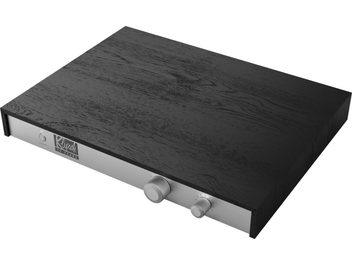
For audiophiles seeking ultimate performance, Klipsch offers the optional Heritage active crossover, specially designed for the La Scala AL6. This external digital signal processing (DSP) system is inspired by the technology developed for the Jubilee floorstanding speakers, the brand’s flagship.
The Heritage active DSP perfectly aligns time and phase between the different drivers while independently amplifying each frequency band. It also balances equalization for a uniform, uncolored response. This multi-amplification approach allows up to three power amplifiers per speaker, each dedicated to a specific channel.
This solution elegantly addresses one of the inherent challenges of horn systems: the differences in arrival time between high, mid, and low frequencies. The tweeter’s sound reaches the listener first, followed by the midrange, then the bass. The Heritage DSP compensates for these timing differences for perfect coherence.
While the La Scala AL6 works perfectly with a conventional amplifier thanks to its pre-configured 5-way metal binding post, the active crossover option opens new possibilities for high-end systems.

Documentation
Technical Specifications
Acoustic Performance
- Frequency response: 40 Hz - 19 kHz (+/- 4 dB), quarter-space anechoic measurement
- Sensitivity: 103 dB, pink noise, 2.83 V, 1 m, 40 Hz - 19 kHz
- Power handling: 100 W / 400 W (continuous / peak)
- Maximum sound pressure level: 120 dB, pink noise, 1 m, 20 V, 40 Hz - 19 kHz
- Nominal impedance: 8 ohms, minimum 3.2 ohms at 70 Hz
- Crossover frequency: 425 Hz, 2900 Hz
Drivers
- Tweeter: K-771 compression driver with extended phase horn on K-792 horn
- Midrange driver: 7.6 cm K-1133-HP compression driver on K-406M Tractrix horn with Mumps technology
- Woofer: 30.5 cm K-281 woofer in a horn-loaded bass-reflex system
Physical Characteristics
- Cabinet material: MDF with veneer
- Connectors: 5-way metal binding post
- Dimensions:
- Height: 99.4 cm
- Width: 62.25 cm
- Depth: 64.7 cm
- Weight: 93 kg
Finishes
- Grille fabric: metallic silver
Frequently asked questions
What is the main difference between the La Scala AL6 and the previous AL5 model?
The most significant difference lies in the bass reproduction system. The AL6 adopts, for the first time, a hybrid horn/bass-reflex system, whereas the AL5 used only a horn-loaded design. The AL6 also features a new 3-inch compression midrange driver (compared to 2 inches on the AL5), a Tractrix K-406M midrange horn with a shortened throat, and Mumps technology for better sound dispersion. The Heritage active crossover option is also a major new feature.
What type of amplifier is recommended for these speakers?
Thanks to their exceptional 103 dB sensitivity, the La Scala AL6 works perfectly with modestly powered amplifiers. A quality amplifier delivering between 30 and 100 watts per channel into 8 ohms will be ideal. They are particularly well-suited to tube amplifiers, which can fully express their musicality without being limited by power. If you opt for the Heritage active crossover, you will need three amplifiers per speaker, one for each channel.
How does the optional Heritage active crossover system work?
The Heritage active crossover is an external digital processor that replaces the speakers’ internal passive crossover. It splits the audio signal into three distinct frequency bands before amplification, allowing a dedicated amplifier for each driver (bass, midrange, treble). This system compensates for differences in arrival time between the various frequencies, aligns phase, and optimizes equalization for a perfectly linear response. Connections are made via the speakers’ 5-way binding post, which can be reconfigured for multi-amplification.
What is the difference between the La Scala AL6 and the Klipschorn AK7?
The Klipschorn AK7 is Klipsch’s flagship model, larger than the La Scala AL6. It uses a corner horn system for bass frequencies that requires placement in the room’s corners, while the La Scala AL6 adopts a hybrid horn/bass-reflex system offering more placement flexibility. The Klipschorn is also taller (135 cm vs. 99.4 cm) and heavier. However, both models share the same midrange and treble drivers, as well as the Heritage active crossover option.
- Eco-contribution included in the sale price.
- Manufacturer reference: 1073140
- GTIN / EAN: 743878092417


