

Furutech FI-11-N1 (R)
Complementary product
Overview
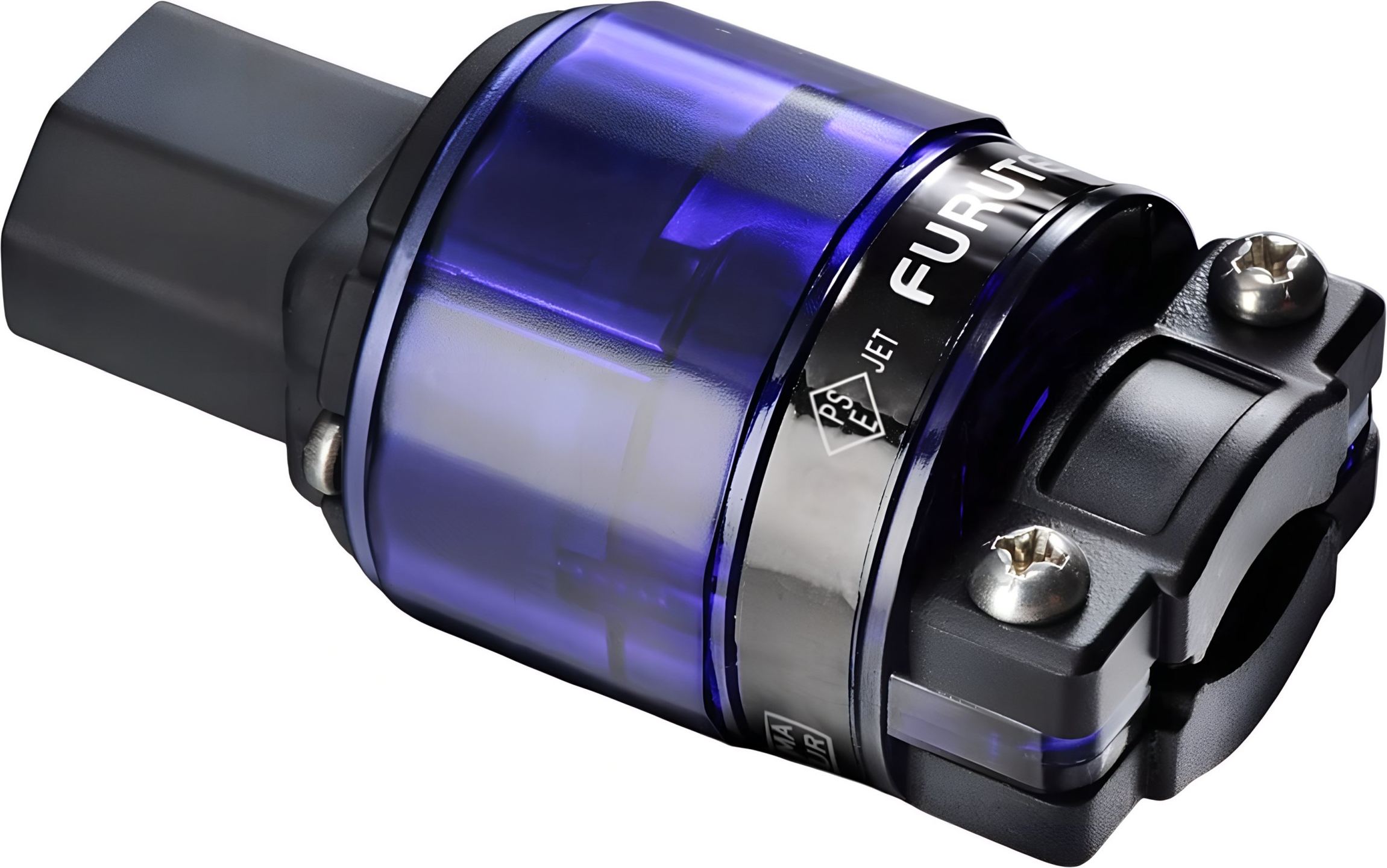
The Furutech FI-11-N1(R) power connector is designed for mains cables intended for audio systems. It uses rhodium-plated α phosphor bronze conductors and incorporates a magnetic field damping system. This 10 A female IEC plug is engineered to maintain the quality of the electrical signal supplied to high-fidelity audio equipment.
Construction and material selection
The core of the FI-11-N1 (R) is based on α phosphor bronze pins, a non-magnetic alloy prized for its high conductivity and mechanical stability. Furutech applies a rhodium plating, a platinum-group metal renowned for its exceptional hardness and resistance to oxidation. Unlike gold or silver, rhodium forms a remarkably dense surface that limits the formation of oxide layers that disrupt electrical transfer.
The dimensions reflect attention to detail: the body measures 44 mm in length and 39 mm in diameter, while the total length reaches 77 mm. These proportions allow for generously sized cables, from 6.6 to 16 mm nominal diameter (extendable to 20 mm with an optional extended screw). Clamping is achieved by a non-magnetic stainless-steel collar, secured by an M4 x 20 mm screw that holds the cable without excessive compression.
The front body in glass fiber-reinforced nylon provides rigidity and electrical insulation, while the transparent blue polycarbonate shell reveals the internal assembly. This aesthetic choice also facilitates visual inspection during assembly: the user can instantly check correct conductor positioning and the absence of stray strands.
Floating Field Damper System: magnetic stabilization
The floating field damping system is a technical hallmark of the FI-11-N1 (R). Alternating currents flowing through the conductors generate varying magnetic fields, which can induce parasitic micro-currents in surrounding metal structures. Although small, these disturbances accumulate in an audio chain with multiple connections.
Furutech integrates damping elements positioned around the conductive pins, creating a barrier that mitigates these inductive fields. The term “floating” indicates that these components are not directly in the main electrical path: they act by proximity effect, absorbing stray magnetic flux without altering direct conduction. This approach aims to reduce electrical background noise that can veil sonic nuances, particularly in the treble where audio signals present higher impedances.
Electrical characteristics and safety
The connector supports 10 amperes at 250 volts AC, or 15 amperes at 125 volts. These values more than cover the needs of most home audio equipment: integrated amplifiers, network players, DACs, and other digital sources generally operate below these thresholds. High-consumption devices such as certain Class A power amplifiers or multichannel systems may require higher-rated connectors.
The “2-pole + ground” configuration corresponds to European and Japanese standards. The systematic presence of a ground pin improves electrical safety and offers a return path for static charges, helping to reduce floating potentials between device chassis. This common grounding also helps minimize ground loops, a frequent source of hum in complex installations.
Installation and compatibility
Assembling a power cable with the FI-11-N1 (R) requires basic electrical wiring skills and appropriate tools. The manufacturer recommends stripping the conductors to a precise length, inserting them fully into the screw terminals, then tightening firmly without over-torquing. The clamp must grip the cable’s outer jacket, ensuring mechanical retention and strain relief.
Audiophile power cables often feature generous cross-sections (3 × 2.5 mm² or 3 × 4 mm²) and thick insulation. The compatibility range up to 16 mm diameter covers these configurations, including shielded models with an external metal braid. For cables beyond 16 mm, Furutech offers an extended clamping screw that raises the limit to 20 mm.
The female IEC format fits the mains inlets of audio devices compliant with IEC 60320. This interface, virtually universal in high-fidelity audio, facilitates comparative cable testing: simply unplug and replug to assess the impact of a change. The robust construction of the FI-11-N1 (R) withstands repeated insertion-extraction cycles without notable contact degradation.
Sonic influence of rhodium plating
Choosing rhodium as the plating material steers reproduction toward neutrality and transient definition. User feedback converges on a sound presentation that is clear, articulate, and highlights detail in the treble. Rhodium conveys fast wavefronts without perceptible attenuation, imparting a sense of speed to instrumental attacks.
This characterization differs from gold plating, often described as warmer with more present mids, or silver, known for its sparkle but sometimes perceived as aggressive. Rhodium occupies an intermediate territory: it neither softens nor boosts the frequency extremes, aiming for linear transmission. Systems seeking tonal balance and analytical resolution will find the FI-11-N1 (R) a coherent match.
However, this transparency can reveal upstream flaws. A power cable using medium-purity copper conductors or exhibiting imperfect connections will have its limitations exposed rather than masked. The Furutech connector acts like a revealer: it does not correct; it faithfully transmits what it receives.
Technical Specifications
Electrical Specifications
- Type: 2 poles + earth
- Rated voltage: 250 V AC
- Rated current: 10 A at 250 V AC, 15 A at 125 V AC
Materials and Construction
- Conductor: Non-magnetic α (Alpha) phosphor bronze
- Plating: Rhodium
- Anti-magnetic system: Floating Field Damper System (floating field damping system) preventing induced magnetic fields
- Front body: Nylon / fiberglass
- Shell: Transparent blue polycarbonate
- Clamp: Non-magnetic stainless steel with M4 x 20 mm screws
Dimensions and Compatibility
- Body length: 44.0 mm
- Diameter: 39.0 mm
- Total length: 77.0 mm
- Compatible cable diameter: 6.6 to 16.0 mm (up to 20.0 mm with extended screw)
Acoustic Features
- High resolution and accuracy with a transparent sound across the full spectrum
- High signal-to-noise ratio
- Strong contrasts and precise bass
- Transparent, neutral, and detailed sound reproduction, particularly in the high frequencies
- Ideal for audiophile systems seeking neutrality and expressiveness
Key Features
- Ultra-precise, neutral transmission based on Pure Transmission principles
- Durable, oxidation-resistant rhodium finish
- Anti-resonance, non-magnetic structure
- Compatible with audiophile cables from 6.6 to 16.0 mm
- Anti-magnetic field stabilization system
Frequently asked questions
Can I assemble power cables myself with the FI-11-N1 (R)?
Yes, provided you master the basics of electrical wiring and comply with safety standards. Strip the conductors to the exact length, insert them fully into the terminals, tighten the connection screws firmly, and secure the clamp on the outer jacket. Check for the absence of stray strands before closing the shell. If in doubt about your skills, entrust assembly to a qualified professional.
What’s the difference between rhodium plating and gold or silver finishes?
Rhodium prioritizes tonal neutrality and transient definition, with pronounced clarity in the treble. Gold tends toward more warmth in the mids and a slightly smoother presentation. Silver offers brightness and detail but can seem aggressive on some systems. The choice depends on the balance you seek and the characteristics of your existing audio chain.
Does the FI-11-N1 (R) accept all audiophile power cables?
It accommodates diameters from 6.6 to 16 mm, covering the majority of cables on the market, including shielded models with thick insulation. Beyond 16 mm, an extended clamping screw (available separately) expands compatibility to 20 mm. Check your cable’s outer diameter before purchase to ensure a stress-free installation.
Does the anti-magnetic system provide audible benefits?
In high-resolution systems within electrically clean environments, reducing stray fields can lower the noise floor and enhance the sense of silence between notes. The effect remains subtle and highly context-dependent: proximity to other cables, mains quality, and component sensitivity. Differences tend to emerge more during extended listening at moderate volume on low-dynamic passages.
Can I use the FI-11-N1 (R) to power a high-power amplifier?
The rating of 10 amperes at 250 volts (theoretical 2500 watts) suits integrated and moderately powerful amplifiers. For monoblocks or Class A amps that continuously draw several hundred watts, opt for a higher-rated connector (15 or 20 amperes) to provide comfortable thermal headroom and reduce Joule losses at the contacts.
- Eco-contribution included in the sale price.