Gold Note DS-1000 EVO LINE black


Specifications and features


Overview
The Gold Note DS-1000 EVO LINE is the most comprehensive version in the DS-1000 range. This network player integrates a double-mono digital-to-analog converter, a class A preamplification stage, and a headphone amplifier. It also offers analog inputs in addition to its digital connections. Developed in Gold Note’s workshops in Tuscany, the unit combines technical features aimed at high-fidelity reproduction with the brand’s distinctive sonic signature.
Conversion architecture and signal processing
At the heart of the DS-1000 EVO LINE are two AKM AK4493 digital-to-analog converters in a dual-mono configuration. This approach physically separates the left and right channels from the conversion stage onward, thus minimizing crosstalk. Each converter has its own power supply and processing circuit, ensuring strict stereo separation. The measured specifications show a signal-to-noise ratio of 125 dB and total harmonic distortion kept below 0.001%.
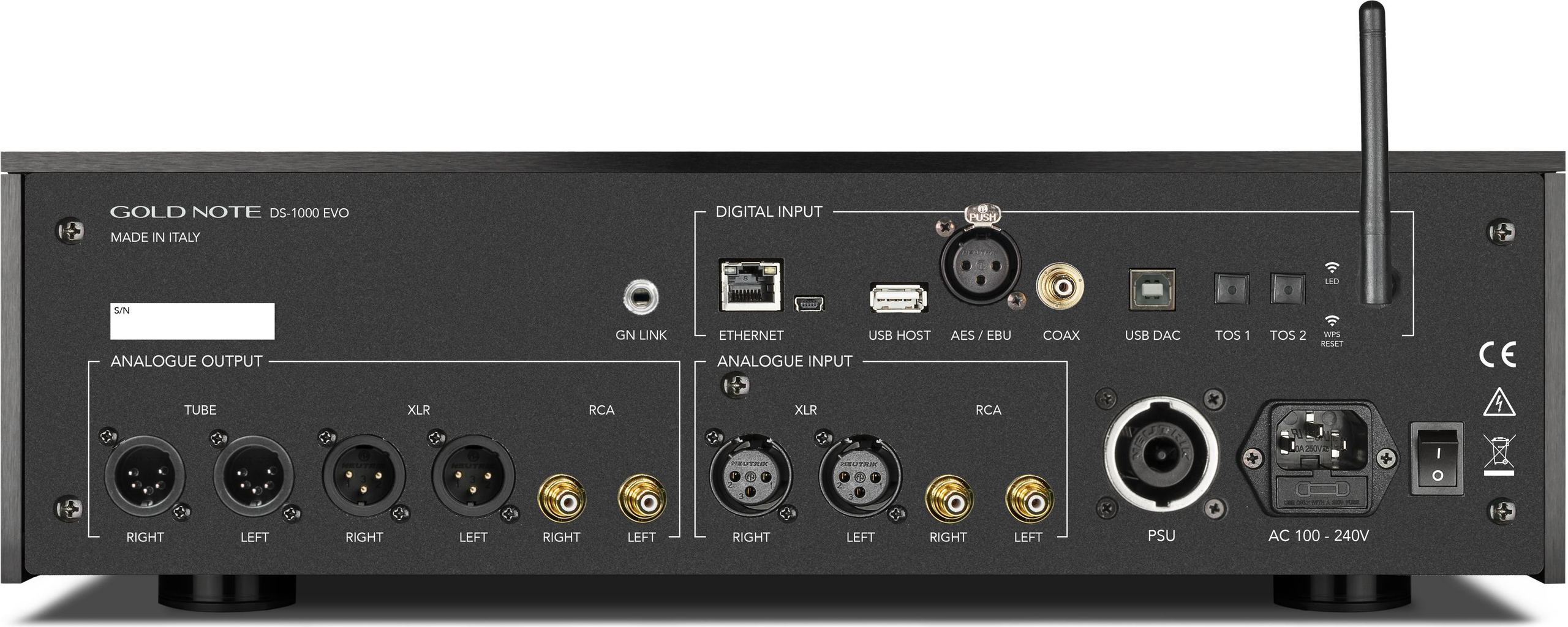
The unit supports PCM files up to 32-bit / 384 kHz and native DSD files up to DSD256 over the network, DSD512 via USB-B. Supported formats include AIFF, ALAC, WAV (compressed or not), FLAC, MP3, OGG, Monkey’s Audio, and Apple Lossless. Digital connectivity includes a coaxial RCA input, an AES/EBU on XLR, two TOS-Link optical inputs, an asynchronous USB-B, and a front USB-A accepting drives up to 32 GB formatted in FAT32 or NTFS.
Class A output stage and preamplification
What sets the DS-1000 EVO LINE apart from the standard version is the integration of a class A preamplification stage built with carefully selected discrete components. This stage allows volume control directly in the analog domain, after digital-to-analog conversion. The user can enable or disable this function depending on whether they want to use the unit as a simple fixed-level converter or as a full-fledged preamplifier.
The LINE version also features two analog inputs: one balanced on XLR and one unbalanced on RCA. These connections allow integration of analog sources such as a phono preamplifier or any other device producing an analog signal. The unit thus becomes a true audio hub capable of handling digital and analog sources simultaneously. Outputs, available on RCA and XLR both for the converter and for the preamplifier, provide a level of 2 Vrms with output impedances of 50 Ω and 100 Ω respectively.
Streaming and network compatibility
The DS-1000 EVO LINE connects to the local network via Ethernet or dual-band Wi‑Fi 802.11a/b/g/n/ac (10/433 Mbit/s). It includes high-definition Bluetooth 5.0 and supports a long list of services: Roon Ready, Tidal, Tidal Connect, Qobuz, Deezer, Spotify Connect, AirPlay, and vTuner for internet radio. Roon Ready certification ensures seamless integration with the Roon ecosystem, known for its high-quality interface and methodical music library management.
Tidal Connect and Spotify Connect functions allow direct streaming from the respective apps without going through the unit’s interface. To access files stored on a NAS server or computer, the device supports UPnP and DLNA protocols. Note, however: to play DSD files via UPnP, the server must specifically support DSD streaming.
Gold Note offers the GN Control app, available free on iOS and Android, to control all functions of the DS-1000 EVO LINE. This app displays metadata for the tracks being played, as well as format and resolution, and allows you to manage volume, input selection, and access to the various streaming services. According to user feedback, the interface is responsive and reliable. Firmware updates can be carried out directly via the internet (OTA).
User interface and controls
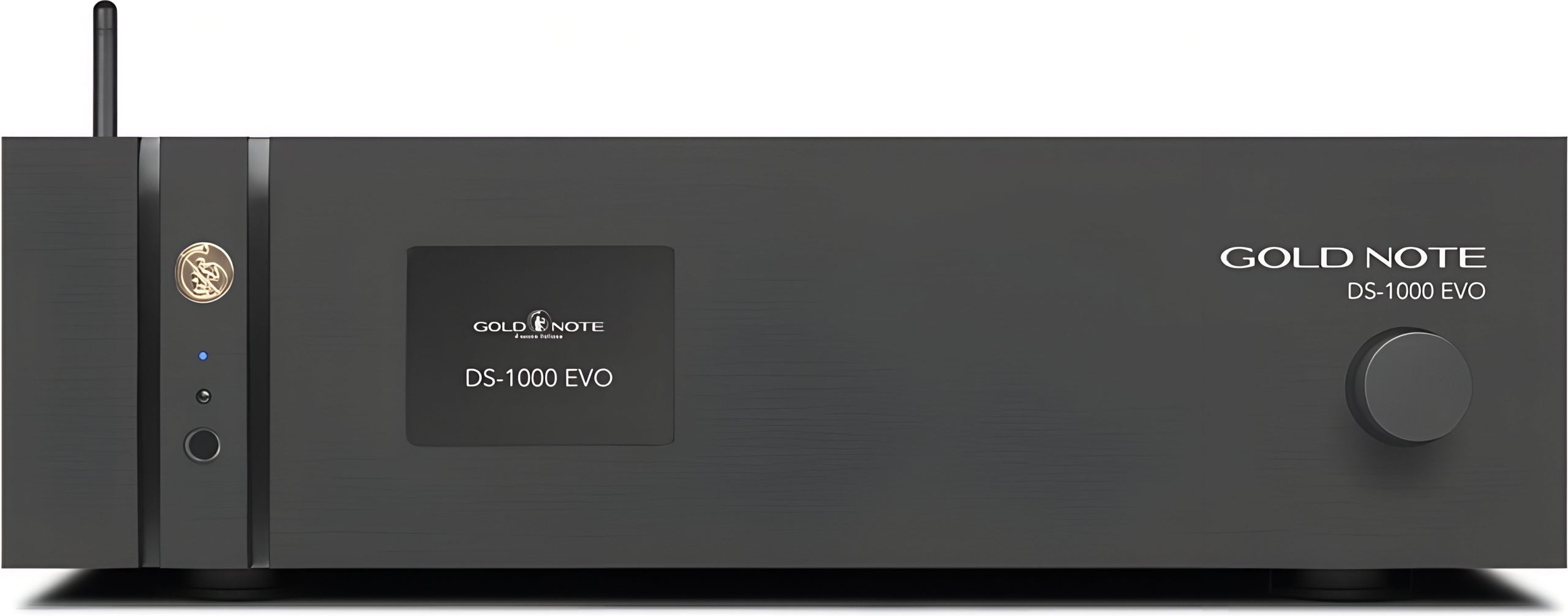
The front panel of the DS-1000 EVO LINE features a clean design. A 3.5” color TFT display occupies the central position, surrounded by a multifunction knob called SKC (Single Knob Control). This push-rotary knob allows you to navigate the menus and adjust settings without having to use the supplied infrared remote control. To the left of the screen is a 6.3 mm headphone jack on the front panel.
The screen permanently displays the essential information: active source, audio format (PCM or DSD), sampling frequency, selected input and output, operating mode, and volume level. The user can quickly access settings via the SKC knob without having to operate multiple buttons. This interface proves particularly convenient for frequent adjustments such as source changes or volume control.
Headphone amplification and listening modes
The DS-1000 EVO LINE includes a headphone amplifier that is not a simple derivation of the line outputs but a circuit specifically developed by Gold Note. Two sensitivity levels (High/Low) allow the output to be adapted to different types of headphones. This function aims to optimize gain according to the impedance and sensitivity of the headphones in use, thus avoiding excessive or insufficient amplification.
The 6.3 mm jack on the front panel benefits from this dedicated circuit and allows for high-quality headphone listening. When the built-in preamplifier is enabled, the volume control also affects the headphone output, ensuring consistent operation. This approach differs from solutions where the headphone output is simply connected to the line outputs through a basic resistive potentiometer.
Upgradability and expansion options
The DS-1000 EVO LINE, like the other models in the 1000 series, can be upgraded with external components. Gold Note offers two external power supplies: the PSU-1250 (300 W) and the PSU-1000 (200 W), both designed with an inductive architecture and inductive filters on the positive and negative stages. These separate power blocks connect via two 5-pin XLR sockets on the rear of the unit and are intended to improve mains filtering.
Another expansion option: the TUBE-1006 (6 tubes) and TUBE-1012 (12 tubes) tube output stages, operating in class A. These external modules are placed between the DS-1000 EVO LINE and the power amplifier, adding an extra analog processing stage with tube components. Gold Note offers complete configurations called DS-1000 TRIO, pairing either the DS-1000 EVO LINE with the PSU-1250 and TUBE-1012 (Premium version), or the DS-1000 EVO with the PSU-1000 and TUBE-1006 (Lite version).
Documentation
Technical specifications
Digital-to-analog conversion
- Chip: 2 × AKM AK4493 in dual-mono architecture
- Frequency response: 20 Hz – 20 kHz (± 0.1 dB)
- Total harmonic distortion: 0.001% maximum
- Signal-to-noise ratio: 125 dB
- Dynamic range: 120 dB
Supported audio formats
- PCM: up to 32-bit / 384 kHz
- Native DSD: up to DSD256 (DSF, DFF) via USB-A, up to DSD512 via USB-B
- File formats: AIFF, ALAC, WAV (compressed / uncompressed), FLAC, MP3, OGG, Monkey’s Audio, Apple Lossless
Streaming and network
- Network: Ethernet (LAN), dual-band Wi-Fi 802.11a / b / g / n / ac (10 / 433 Mbit/s)
- Bluetooth: HD 5.0 (44 / 16)
- Compatible services: Roon Ready, Tidal, Tidal Connect, Qobuz, Deezer, Spotify Connect, AirPlay, vTuner
- Media servers: UPnP, DLNA, Roon
- The UPnP server must support DSD streaming to play DSD files
Connectivity
- Digital inputs
- 1 × coaxial RCA (PCM up to 24-bit / 192 kHz)
- 1 × AES / EBU (24-bit / 192 kHz)
- 2 × optical TOSLink (24-bit / 192 kHz)
- 1 × asynchronous USB-B (DSD512 and PCM 32-bit / 384 kHz)
- 1 × USB-A (DSD256 and PCM 32-bit / 384 kHz, FAT32 / NTFS, 32 GB maximum)
- Analog inputs (DS-1000 EVO LINE only)
- 1 × unbalanced RCA
- 1 × balanced XLR
- Audio outputs
- Converter outputs: 1 × RCA (2 Vrms), 1 × XLR (2 Vrms)
- Preamplifier outputs: 1 × RCA, 1 × XLR
- 1 × 6.3 mm headphone output (front panel)
- Output impedance
- RCA: 50 Ω
- XLR: 100 Ω
Preamplification
- Type: Class A preamplifier with discrete components
- Volume control: Available only on the DS-1000 EVO LINE model
Power supply
- Voltage: 100 – 240 V, 50 / 60 Hz
- Power consumption: 30 W
- Fuse: 2 A T
Dimensions and weight
- Dimensions: (W x H x D) 430 × 135 × 375 mm
- Net weight: 10 kg
- Packaged weight: 15 kg
Package contents
- Multifunction remote control
- Power cable
- Documentation
Frequently Asked Questions
What is the difference between the DS-1000 EVO and the DS-1000 EVO LINE?
The DS-1000 EVO LINE adds a class A preamplification stage with analog volume control and two analog inputs (RCA and XLR). The standard DS-1000 EVO model operates solely as a fixed-level digital-to-analog converter, without these analog inputs or the preamplifier. Both versions share the same conversion section, the same headphone amplifier, and the same streaming capabilities.
Can the preamplifier be disabled on the LINE version?
Yes, the DS-1000 EVO LINE allows you to switch between preamplifier mode with volume control and pure DAC mode at fixed level. This function is activated via the menu accessible from the front display, the remote control, or the GN Control app. In pure DAC mode, the signal comes directly from the conversion stage without passing through the preamplification circuit.
Are the external PSU-1250 and PSU-1000 power supplies necessary?
The DS-1000 EVO LINE operates fully with its internal power supply. The external PSU-1250 and PSU-1000 power blocks are upgrade options for those who wish to push performance further. These inductive power supplies with advanced filtering are designed to reduce mains-borne interference. Their contribution depends on the quality of the electrical network and the rest of the audio system. It is recommended to audition them before purchase.
Which headphones can be used with the 6.3 mm output?
The headphone output offers two sensitivity levels (High/Low) to adapt to different types of headphones. The Low mode is suitable for high-sensitivity or low-impedance headphones, while the High mode is intended for less sensitive or high-impedance models. This dual sensitivity prevents issues of excessively low volume or early saturation. The exact output impedance specifications are not provided separately for the headphone amplifier.
Does the DS-1000 EVO LINE play MQA files?
Yes, the unit fully decodes MQA files and displays this information on the front panel when such a file is being played. MQA support works via compatible streaming services such as Tidal, but also with locally stored MQA files. The converter performs the full unfolding of the MQA format up to its native resolution.
- Eco-contribution included in the sale price.
- Manufacturer reference: PF-MILLE-DSL-001-B