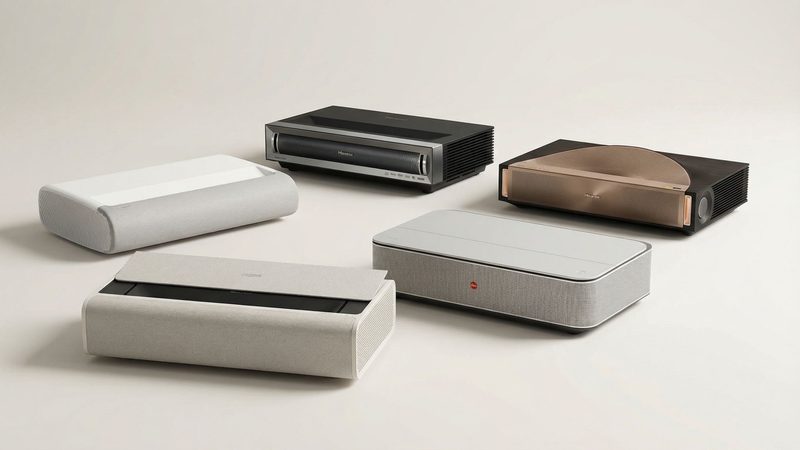
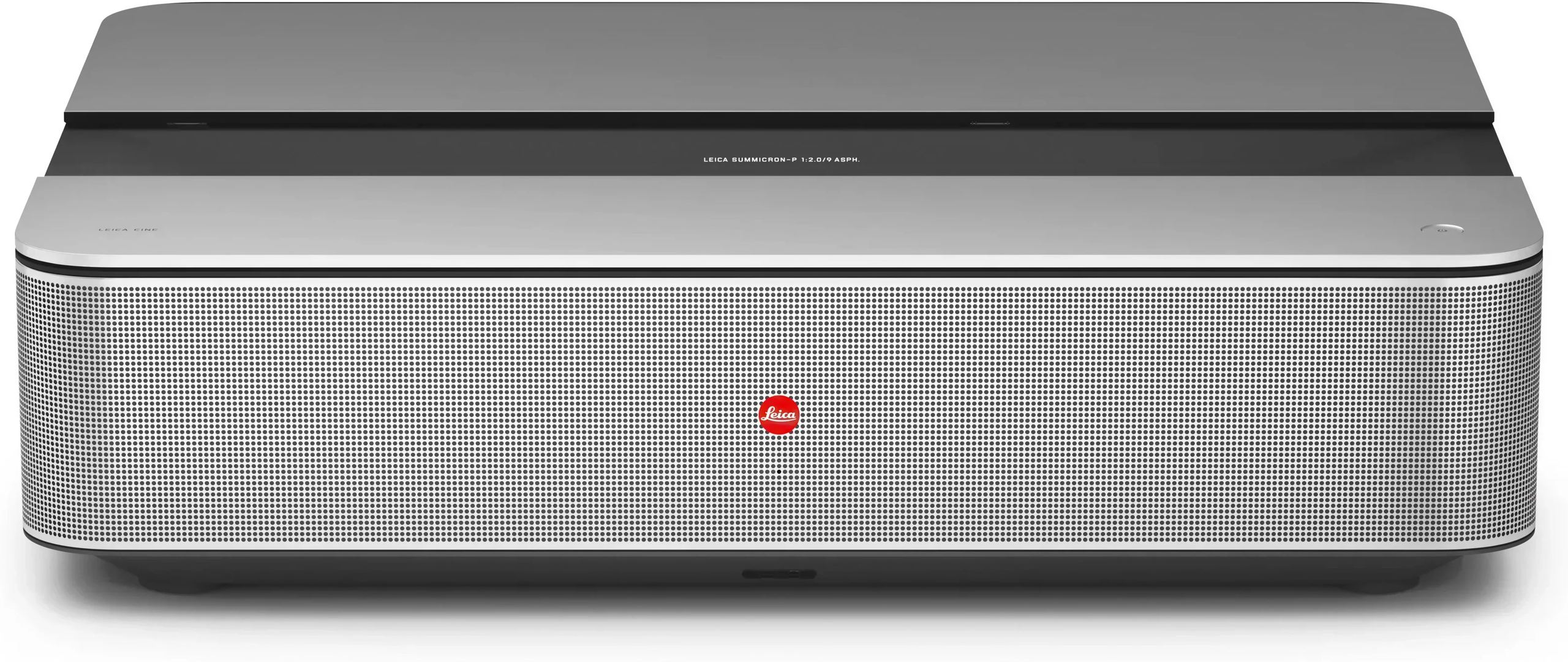
Leica Cine 1 I 100"
Buy as a bundle and save
- Leica Cine 1 I 100"
- Future Screen EP5-R100H
Complementary product
Specifications and features


Overview
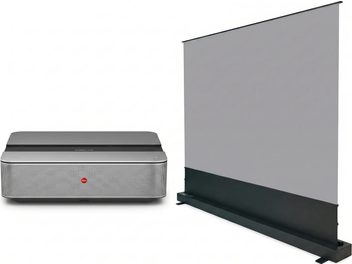
The Leica Cine 1 I 100 is the German manufacturer’s first ultra-short-throw projector, developed in collaboration with Hisense. It combines a Summicron lens that meets Leica standards with triple RGB laser technology, enabling it to project a 100-inch 4K image from 25 cm away from the wall. It is equipped with DTT tuners, a Dolby Atmos audio system, and a Smart TV interface.

A Bauhaus-inspired aluminum chassis
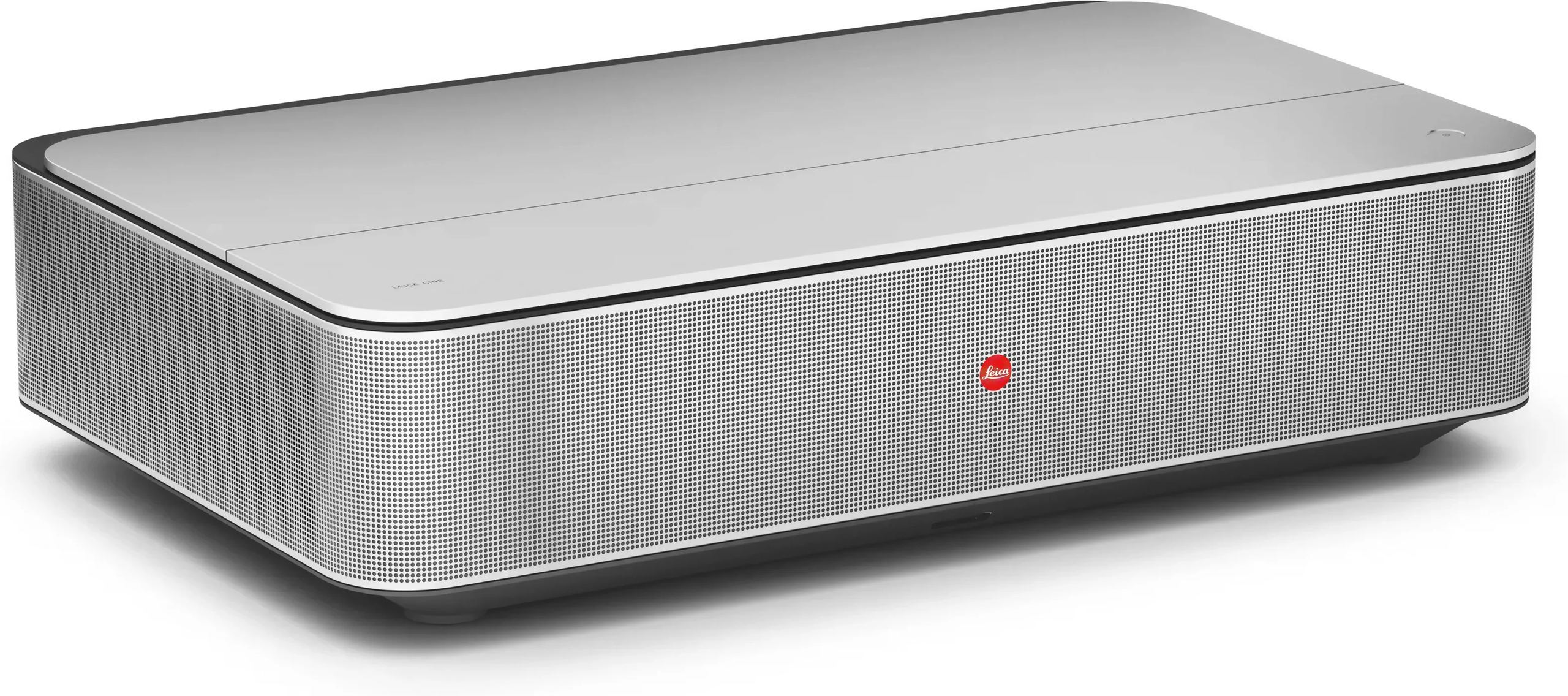
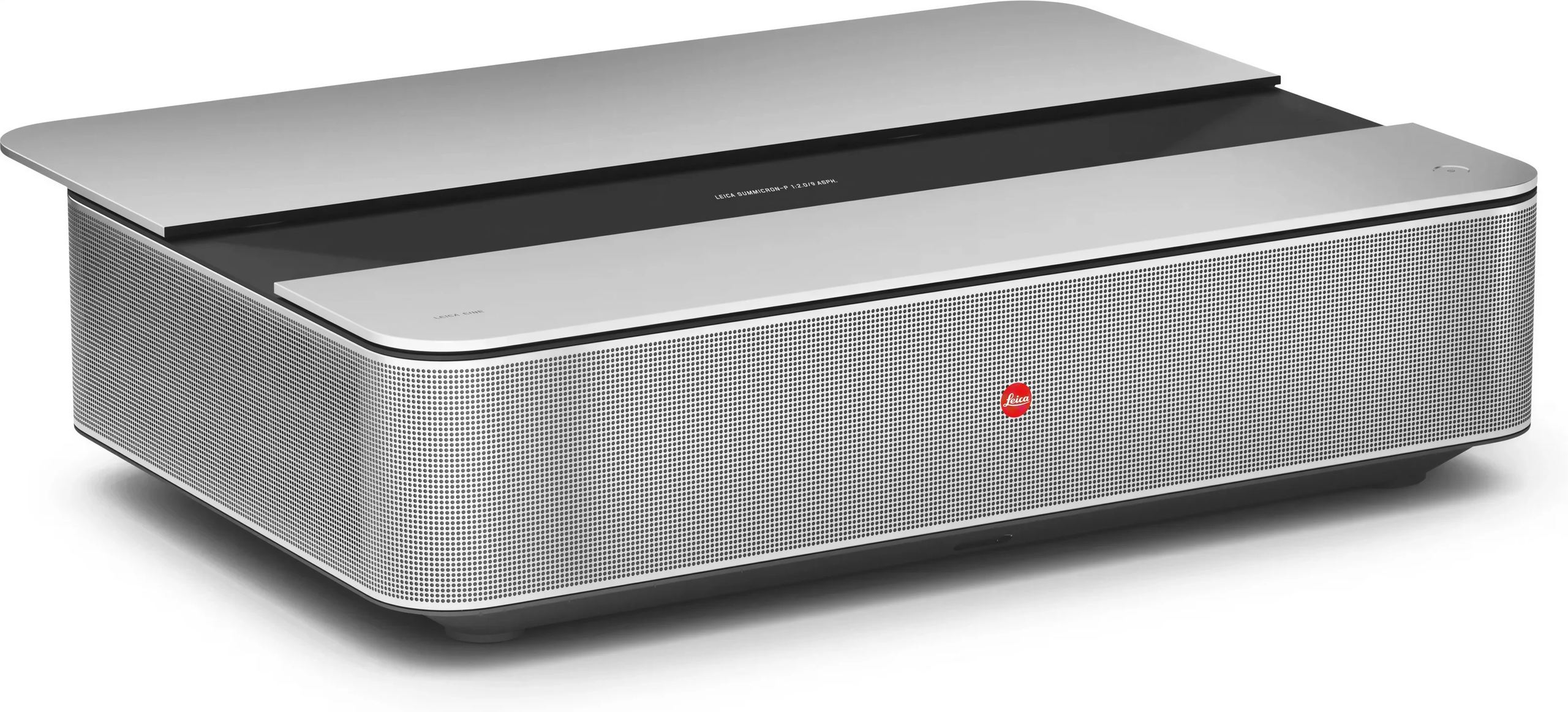
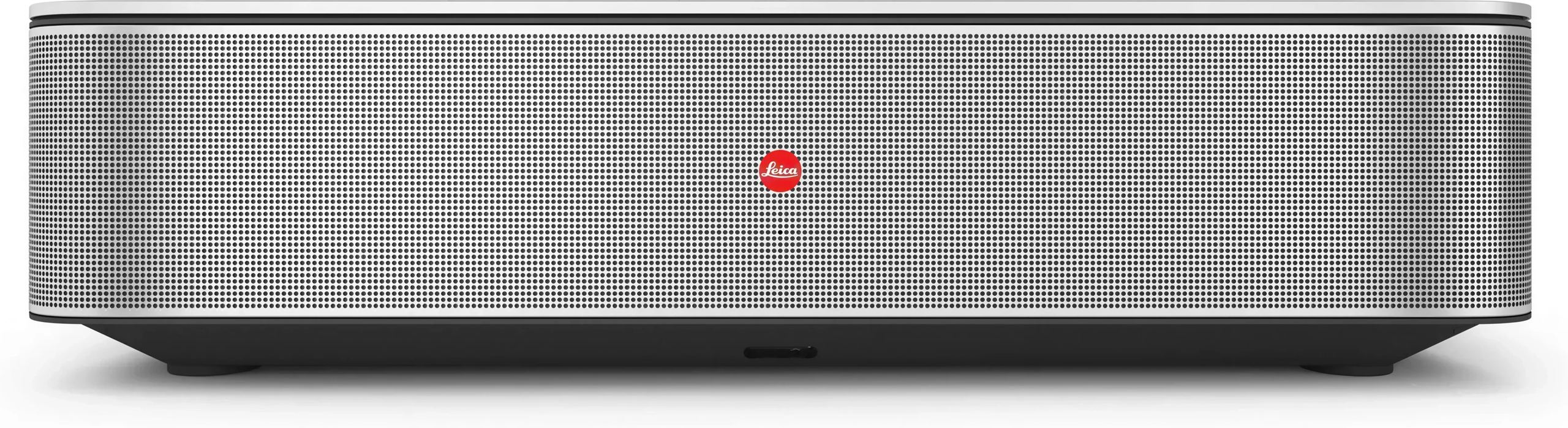
The Leica Cine 1 I 100 features a clean, geometric design that draws on the Bauhaus aesthetic vocabulary. The housing is entirely clad in silver brushed aluminum, a material choice that gives it a robustness and level of finish rarely seen on this type of device. Its dimensions of 600 × 378 × 149 mm and weight of 15.1 kg attest to a substantial build.
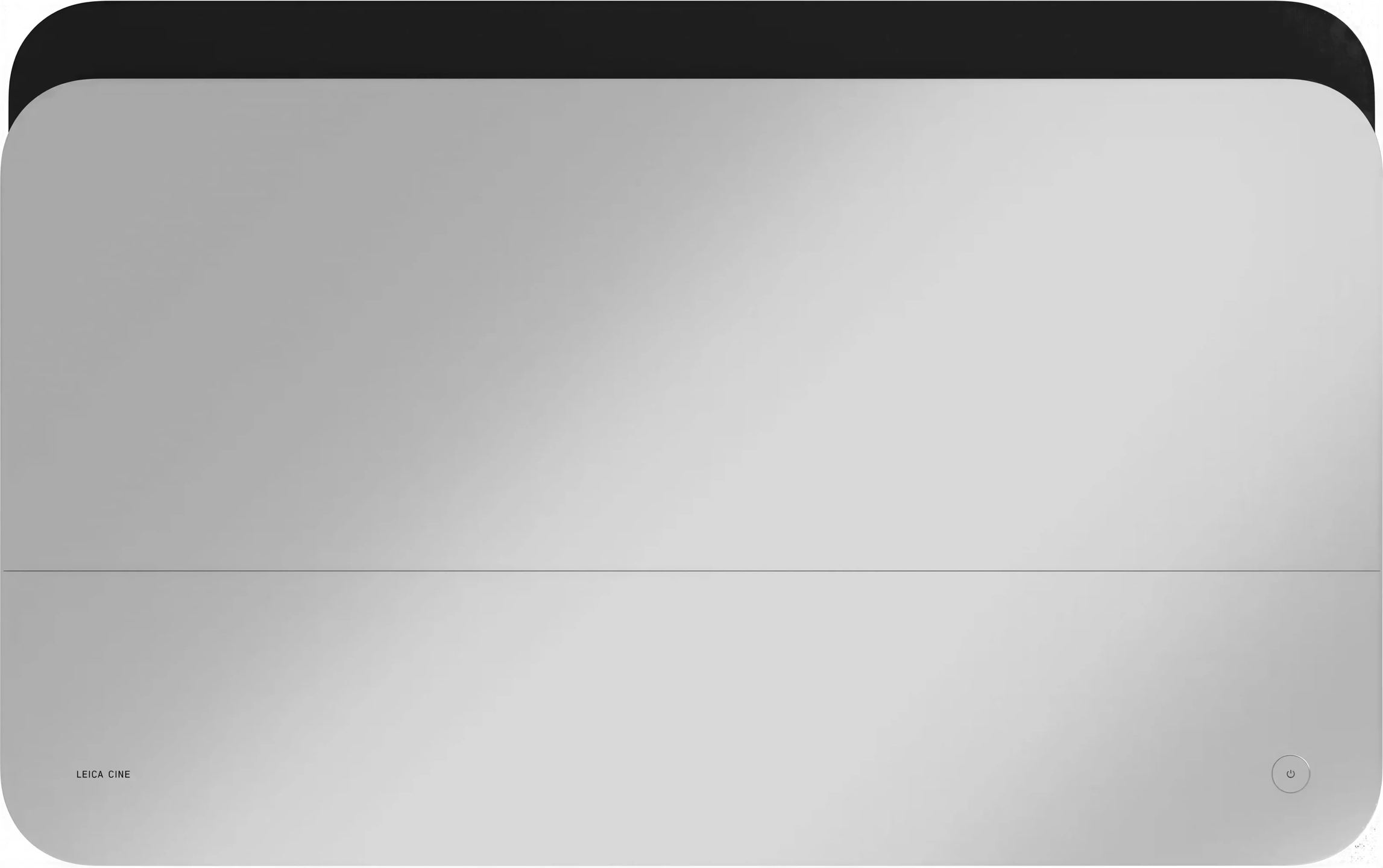
The top surface is uncluttered, punctuated only by the power button, a few LED indicators, and the brand’s iconic red dot. The side panels are regularly perforated, providing both thermal ventilation and sound dispersion from the built-in speakers. The result is an object that fully assumes its presence in a living space without trying to hide.
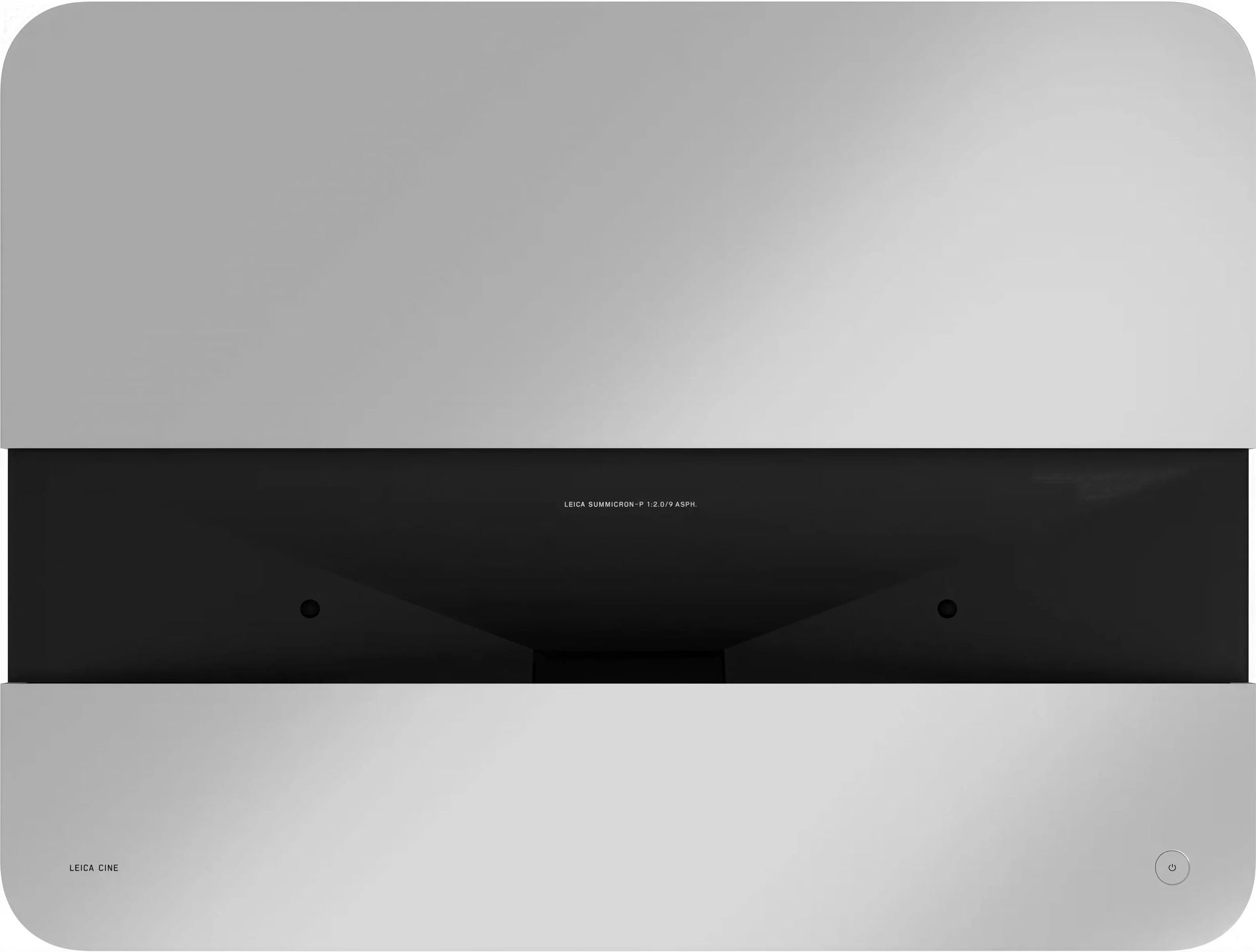
One feature sets the Cine 1 apart from many competitors: the motorized dust cover that protects the optics. When the device is switched off, a metal flap automatically closes over the lens, preventing dust from accumulating on the glass elements. This mechanism, still too rare on ultra-short-throw projectors, preserves image quality over the long term. Presence sensors located on the top can also interrupt the laser beam if someone comes too close to the light source.

The Summicron lens: four aspherical elements serving image quality
The optical core of the Cine 1 I 100 is based on a Summicron lens developed specifically for this projector. This lens incorporates four aspherical elements manufactured to Leica’s strict tolerances. Unlike many projectors that offer a zoom to adjust image size, the Cine 1’s Summicron is factory-set for a fixed 100-inch diagonal.
This technical choice is far from trivial. Leica believes that a fixed focal length lens optimized for a specific image size guarantees superior sharpness and uniformity across the entire projected surface. The 80- and 120-inch models in the range each have their own dedicated lens, tuned for their respective formats. Moving the projector to change the image size would impair projection quality.
With a throw ratio of 0.25, the Cine 1 can operate at around 25 centimeters from the projection surface to produce a 100-inch image. This ultra-short throw allows it to be placed on a low piece of furniture, without a person walking in front of the unit interrupting the projection. The benefits of the optical design are evident in the uniform focus from the center to the edges of the image and the reduction of chromatic aberrations—those colored fringes sometimes visible on high-contrast transitions.

Triple RGB laser and LIO processing
The Cine 1 I 100’s light source uses three separate lasers for the primary colors red, green, and blue. This configuration, more sophisticated than systems that rely on a blue laser with a phosphor wheel, enables an extended color gamut. Leica claims coverage of more than 100% of the BT.2020 color space, the reference standard for HDR content.
The light output reaches around 3,000 lumens, which allows viewing in moderately lit conditions. For optimal performance, a darkened environment is still preferable, and using an ambient light rejecting (ALR) screen significantly improves perceived contrast in the presence of stray light sources. The laser source’s lifespan exceeds 25,000 hours, equivalent to several decades of use at a few hours per day.
The proprietary LIO (Leica Image Optimization) processing applies correction algorithms designed to reproduce natural colors and smooth gradients. This processing focuses on skin tone handling, transitions between bright and dark areas, and the rendering of detail in highlights and shadows. Compatibility with Dolby Vision, HDR10, and HLG formats makes it possible to leverage the dynamic metadata of recent content to adjust the image scene by scene.

DLP XPR technology: simulated 4K resolution
The Cine 1’s display engine is built around a 0.47-inch DMD (Digital Micromirror Device) chip supplied by Texas Instruments. This array has a native resolution of 1920 × 1080 pixels. The 4K resolution (3840 × 2160 pixels) is achieved through XPR (Expanded Pixel Resolution) technology, which successively projects multiple slightly shifted images at a high frequency.
This pixel-shifting technique, common to many DLP projectors in this category, produces an image perceived by the human eye as 4K. The result offers a higher level of detail and finesse than native Full HD projection, although some purists distinguish this approach from true pixel-by-pixel 4K resolution. In practice, the Cine 1 delivers a very sharp picture with rich detail that meets the expectations of home cinema use.
The claimed dynamic contrast ratio reaches around 2,000,000:1, while native contrast is around 1,000:1. In real-world terms, this translates into relatively deep blacks for a projector and an ability to reproduce dark scenes with a good level of detail. It should be noted that a slight colored fringing effect (green or red) may appear at the borders of very high-contrast areas, an inherent characteristic of triple laser technology that the Summicron lens mitigates but does not completely eliminate.

An integrated Dolby Atmos audio system
The Cine 1 I 100 features a 4.0-channel audio system delivering a total power of 50 watts (2 × 25 W). Six speakers are distributed inside the chassis, projecting sound through the perforated side grilles. Dolby Atmos processing creates an immersive soundstage around the listener, simulating height and depth effects.
For occasional viewing or use in a living space, this audio system can be sufficient. Dialogue remains intelligible, sound effects have a certain breadth, and bass is present, though it does not reach the depth of a dedicated subwoofer. For a more advanced home cinema setup, connecting a soundbar or separate audio system via the HDMI eARC output or the optical S/PDIF output is still recommended.

VIDAA and Smart TV functions
The VIDAA operating system, developed by Hisense and used on more than 30 million connected devices, powers the Cine 1’s interface. This platform provides access to the main streaming apps: Netflix, Disney+, Amazon Prime Video, Apple TV, MyCanal, Molotov, among others. The interface is organized into horizontal rails grouping apps and recommended content.
The system’s responsiveness allows for smooth navigation between menus and applications. The built-in media player supports a wide range of video, audio, and image file formats stored on a USB stick or external hard drive. VIAA Voice control, accessible via the microphone built into the remote control, lets you launch searches or control certain functions without pressing buttons.
The Cine 1 also includes DTT tuners (DVB-T2/C/S2/S) with an electronic program guide, enabling it to operate as a fully fledged television. Program recording to USB storage is supported. AirPlay compatibility allows content to be streamed from Apple devices, while screen mirroring extends this capability to other smartphones and tablets.

Game mode and latency
The Cine 1 I 100 offers a dedicated game mode that reduces display latency. In 4K at 60 Hz, the measured input lag is under 60 milliseconds, an acceptable value for most types of video games. The HDMI 2.1 ports allow connection of the latest-generation consoles and gaming PCs.
It should be made clear that current DLP chips cannot display 4K at 120 Hz, even though the HDMI 2.1 inputs can technically receive such a signal. 4K/120 content is displayed at 60 Hz. For competitive gamers seeking minimal latency, specialized projectors or traditional displays remain better suited.
Documentation
French
Technical specifications
Projection and display
- Native screen size: 254 cm (100 inches)
- Native resolution: 4K (3840 × 2160 pixels)
- Display technology: 0.47-inch DLP XPR (Texas Instruments)
- Throw ratio: 0.25 (ultra short throw)
- Resolution enhancement: yes
Image quality
- Light output: ~ 3000 lumens
- Dynamic contrast: ~ 2,000,000:1
- Contrast ratio: ~ 1000:1
- Rec. 2020 color gamut coverage: > 100%
Light source and image processing
- Light source type: triple RGB laser
- Light source lifetime: > 25,000 hours
- LIO image processing: Leica Image Optimization (yes)
HDR and video formats
- Supported HDR modes
- Dolby Vision
- HDR10
- HLG (Hybrid Log-Gamma)
Integrated TV and smart features
- Operating system: VIAA U6
- Tuner: DVB-T2 / C / S2 / S with EPG
- Unicable support: Unicable 1 / Unicable Jess
- DiSEqC: DiSEqC 1.2
- Web browser: built-in
- HbbTV: yes
- Voice control: VIAA Voice
- Parental control: yes
- Noise reduction: yes
Integrated audio system
- Output power: 2 × 25 W
- Supported audio formats: Dolby Atmos, Dolby Digital Plus
- Configuration: 4.0 channels
- Headphone / audio output: 1 × 3.5 mm jack
Connectivity and interfaces
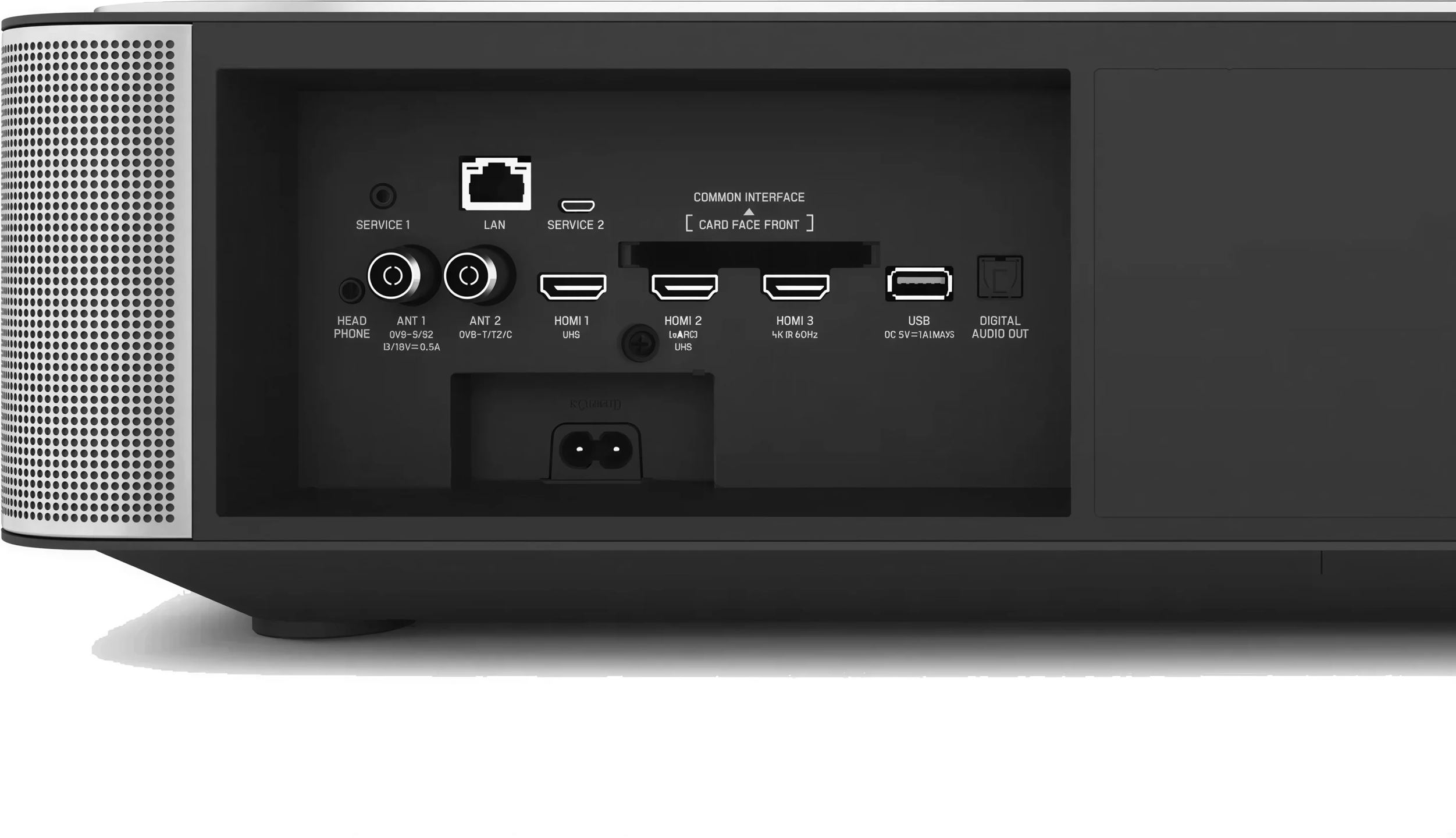
- HDMI: 2 × HDMI 2.1 + 1 × HDMI 2.0 (with eARC support)
- USB: 2 × ports (1 × USB 2.0 + 1 × USB 3.0) with USB recording
- LAN: 1 × Ethernet RJ45
- RF antenna inputs: 2 × inputs
- Optical S / PDIF: 1 × Toslink
- CI+: 1 × slot (Common Interface)
- Wi-Fi 6: 802.11 AX (2.4 / 5.0 GHz)
- Bluetooth: 5.0
- AirPlay: yes
- Screen mirroring: yes
Gaming performance
- Game mode: yes
- 4K 60 Hz latency: < 60 ms
Supported file formats
- Containers: AVI, MP4, MKV, TS, FLV, OGG
- Video: AVI, WMV, MP4, MOV, 3GP, MKV, MPG, MPEG, VOB, FLV, WebM, OGM
- Audio: WMA, MP4, FLAC, MP2, MP3, AAC, WAV
- Image: JPEG, BMP, PNG, GIF, WEBP
Dimensions and weight
- Dimensions (console only): 600 × 378 × 149 mm (W × D × H)
- Weight (console only): ~ 15.1 kg
Power supply and power consumption
- Mains voltage: 120 V – 240 V
- Power consumption
- Standard mode: max. 300 W
- Standby mode: 0.5 W
- Network mode: 2.0 W
- Auto standby: 15 minutes without signal
Environmental conditions
- Operating temperature: +5 °C to +40 °C
- Storage temperature: -20 °C to +65 °C
- Noise level: < 32 dB(A)
- OTA updates: yes (Over-The-Air)
Remote control
- Type: Bluetooth with aluminum housing
- Function: with microphone (voice control)
Frequently asked questions
Can the Leica Cine 1 I 100 project onto a white wall or does it require a specific screen?
Technically, it can project directly onto a white wall, but a projection screen significantly improves image quality. Leica recommends using ALR (Ambient Light Rejection) screens designed for ultra-short-throw projectors. These special screens reject ambient light coming from the sides and ceiling while efficiently reflecting the projected light toward the viewer. The result is a much higher perceived contrast, especially in rooms that cannot be completely darkened.
What is the difference between the 80-, 100-, and 120-inch versions of the Cine 1?
All three models share the same chassis and electronics. The difference lies in the Summicron optics, individually calibrated for each image size. The 80-inch version delivers 2,100 lumens and sits about 14 cm from the wall. The 100-inch version goes up to 3,000 lumens at a distance of 25 cm. The 120-inch version maintains 3,000 lumens with a throw distance of 36 cm. Changing the projection distance to alter the image size would degrade optical quality.
Is the Cine 1 I 100 suitable for daytime use?
With its 3,000 lumens, the Cine 1 supports viewing in a room with moderate lighting. However, in full daylight with direct light, blacks will lose depth and colors will look washed out. For everyday daytime use, pairing it with an ALR screen and partially reducing ambient light (blinds, curtains) will greatly improve visual comfort.
Does the remote control work via Bluetooth or infrared?
The Cine 1’s aluminum remote control uses Bluetooth and radio frequency, eliminating the need for a direct line of sight to the projector. This is particularly useful when the device is built into a piece of furniture or placed behind an item of decor. A built-in microphone enables voice control to operate certain functions.
Can DTT programs be recorded on the Cine 1?
The Cine 1 features terrestrial, cable, and satellite DTT tuners with an electronic program guide. USB recording is supported: simply connect a properly formatted USB stick or external hard drive to schedule recordings from the EPG or start a recording on the fly. This functionality brings the Cine 1 closer to a traditional television in everyday use.
What is the lifespan of the laser light source?
Leica advertises a lifespan of more than 25,000 hours for the triple RGB laser source. At 4 hours of viewing per day, that represents over 17 years of use before brightness starts to decline. Unlike traditional lamps that needed replacement every few thousand hours, the laser source requires no user maintenance.
Does the Cine 1 I 100 support 3D?
The Leica Cine 1 I 100 does not offer 3D projection. This technology, less in demand today than in the early 2010s, was not included in this model. Users who wish to watch 3D content will need to look to other products on the market.
- Eco-contribution included in the sale price.
- Manufacturer reference: 30169
- GTIN / EAN: 4022243301696