Tivoli Model One BT walnut/beige



Specifications and features

Overview
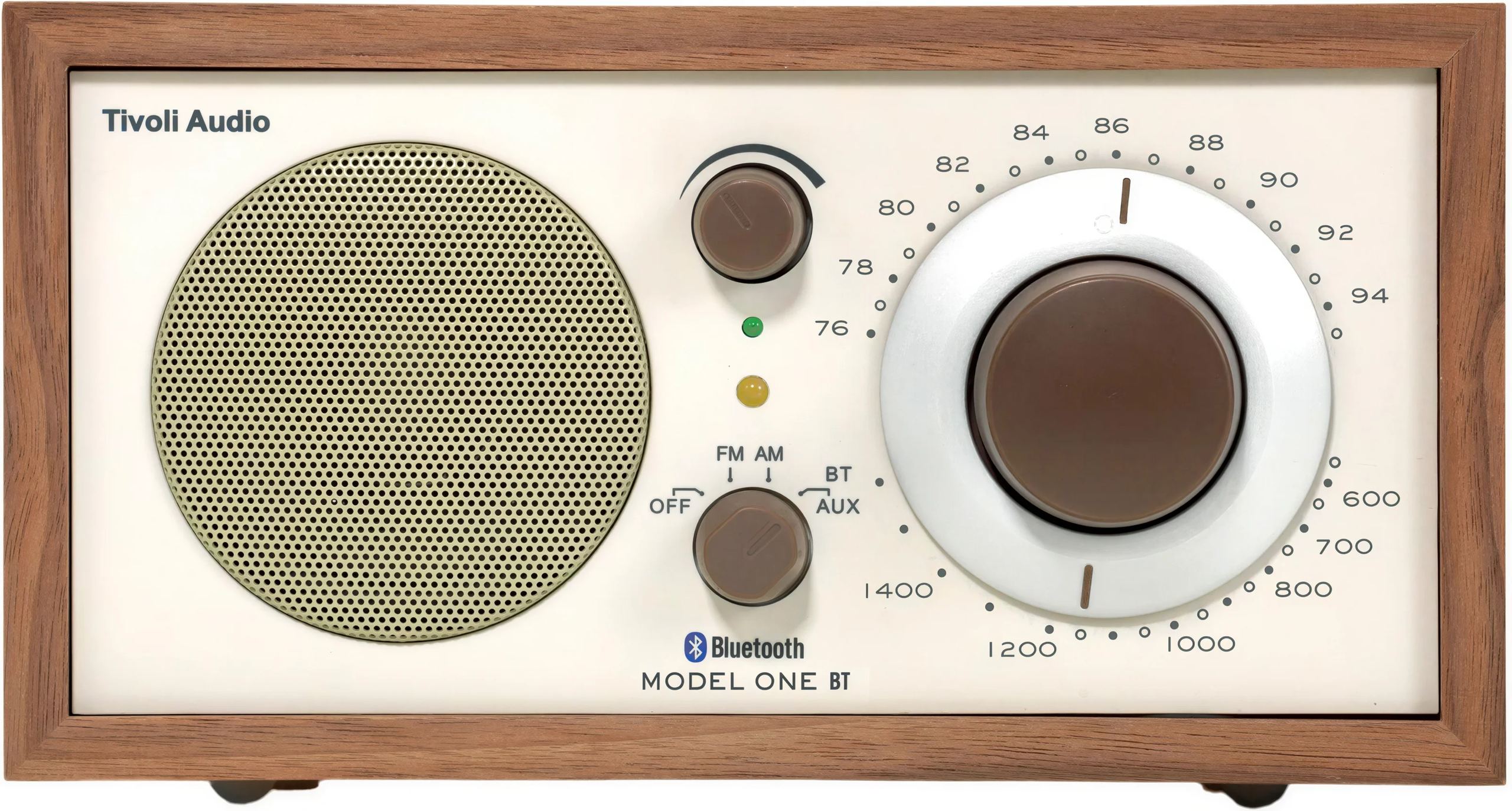
In the early 2000s, acoustic engineer Henry Kloss designed in his workshop a table radio that followed in the footsteps of his work from previous decades. This original Model One quickly became a classic of the genre. The BT version preserves its full sonic and aesthetic DNA while adding a Bluetooth connection, allowing wireless playback of music stored on a phone or tablet.
A wooden cabinet in the service of acoustics
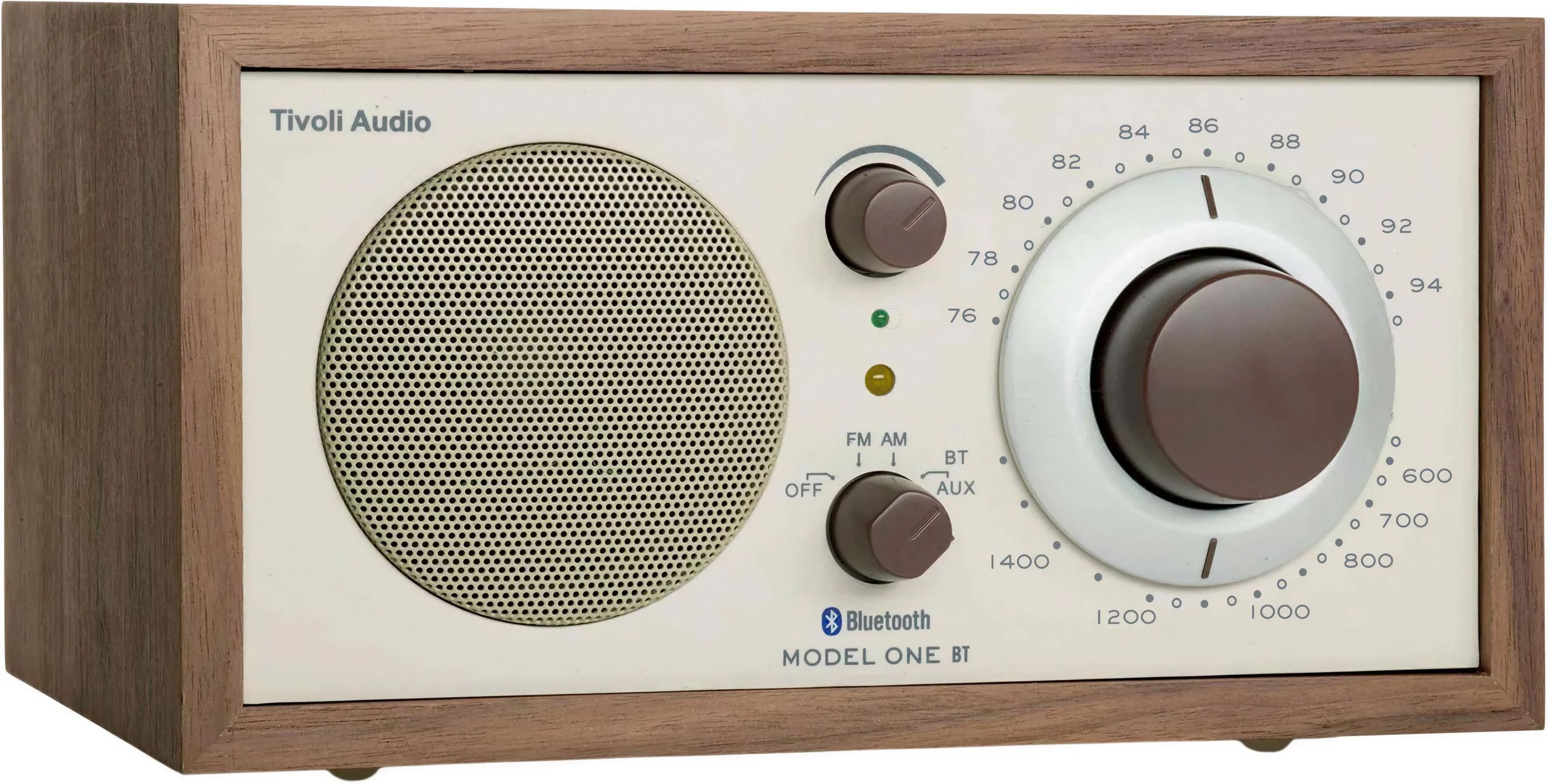
The rectangular cabinet with beveled corners is made of MDF with real wood veneer, a material chosen as much for its acoustic properties as for its appearance. This inert construction prevents unwanted vibrations and provides a stable internal volume for the speaker. The veneer grain is matched at the corners for a visually coherent result, and several finish combinations are available to suit different interiors.
The format remains compact: just over 21 cm wide and around 11 cm high, with a weight close to 1.9 kg. This relative density hints at the quality of the materials used. The unit can be placed horizontally or vertically depending on the layout of the room, bearing in mind that a bass-reflex port located under the chassis contributes to the low-end foundation. It is therefore best to leave a bit of space under the unit rather than place it on a padded surface.
Three knobs, one philosophy
The front panel shows only the essentials: a speaker protected by a metal grille and three rotary knobs. The upper left knob combines power and source selection (AM, FM, auxiliary input, or Bluetooth). The second controls the volume. The third, noticeably larger, is used for radio tuning.
This last one deserves a closer look. Its mechanism operates with a 5:1 reduction ratio, which means one full turn of the knob moves the needle by only one-fifth of the frequency band. This deliberate slowness allows for precise, station-by-station adjustment, recreating the ritual of radio listening as it was practiced before the advent of digital presets. The feel is smooth, with no play or excessive resistance. The visual indicators on each knob remain discreet yet legible.

A high-sensitivity analog tuner
The FM reception circuit is based on a discrete-component architecture incorporating GaAs MES-FET transistors, a technology derived from mobile telephony that improves selectivity and sensitivity. In practice, the radio picks up weak or distant stations that other devices struggle to lock onto, and maintains a clean signal even when several transmitters occupy neighboring frequencies. The AM band is also present, which can be useful in regions where some local or news stations still broadcast on these waves.
The telescopic antenna, discreet at the rear, is usually sufficient for urban areas. For more challenging situations, a socket allows connection of an external FM antenna.
A deliberately mono sound reproduction
The 76 mm (3-inch) full-range driver uses a heavy magnet and long-throw suspension. This technical choice allows for significant cone excursion, resulting in a more generous bass response than the cabinet size would suggest. A frequency compensation circuit automatically adjusts the response curve in half-octave steps, balancing the rendering of voices, instruments, and bass depending on the content being played.
The choice of mono, often perceived as a limitation, is in fact a deliberate technical decision: rather than multiplying small-diameter drivers to simulate a stereo effect that is often artificial at such a small scale, Tivoli Audio favors a single, well-made speaker. The result sounds confident and coherent, voices remain intelligible at low volume, and the music retains body when you turn it up. The rated power of 25 watts is more than enough for a medium-sized room.

Bluetooth to broaden usage
The addition of Bluetooth (version 2.1+EDR with A2DP profile) enables wireless music playback from a compatible smartphone, tablet, or computer. Pairing is done via a button on the back: a long press activates discovery mode, and the unit then appears in the list of available devices on the source device. The connection is stable within a radius of around ten meters without major obstacles.
This function turns the radio into an extra speaker for listening to podcasts, streaming services, or simply the audio from a video. Sound quality via Bluetooth is slightly superior to that of FM radio, as the digital signal is free from the interference inherent to over-the-air broadcasting. Note, however, that Bluetooth works only as a receiver: it is not possible to send the radio’s sound to a wireless headset, for example.
Connectivity and power supply
The rear panel groups several sockets recessed into a reinforced area. In addition to the FM antenna input and the Bluetooth pairing button, there is a 3.5 mm mini-jack auxiliary input for connecting a CD player, portable player, or any other wired audio source. A headphone output, also in mini-jack format, automatically mutes the speaker when headphones are plugged in, allowing private listening without disturbing others.
Power is supplied via an external AC adapter with a cable measuring around 1.70 m, offering some flexibility in positioning the unit. No battery is built in: the Model One BT is designed for a fixed installation rather than mobile use.

Technical specifications
Construction and design
- Furniture-grade wooden cabinet, optimized for natural acoustic reproduction
- Iconic Tivoli Audio design, inspired by classic analog radios
- Balanced front panel layout with front-facing controls
- Multiple finishes available depending on the collections
Audio performance
- Full-range speaker optimized for clear, well-balanced sound reproduction
- Tivoli Audio sound signature: rich, precise, and warm sound
- Excellent radio reception quality
- Suitable for near-field listening: bedroom, office, kitchen, living room
Controls and interface
- Analog rotary knobs for intuitive use
- Volume control
- Radio search and tuning
- Simple, immediate operation with no complex interface
Connectivity and playback
- Built-in Bluetooth for wireless streaming from smartphone, tablet, or computer
- Integrated radio function
- Mains power: no battery, no recharging required
Dimensions and weight
- Dimensions: 11.43 × 21.27 × 13.34 cm
- Weight: 1.88 kg
Box contents
- Model One BT Bluetooth radio
- Power cable
- User documentation
Frequently Asked Questions
Can the radio run on a battery or batteries?
No, the Model One BT requires a permanent mains power supply. Tivoli Audio offers other models with a built-in battery for mobile use, particularly in the PAL range.
Is it possible to connect an additional speaker to get stereo sound?
The Model One BT does not have an output dedicated to a second passive speaker. However, the headphone output can feed an active speaker if you want to expand the setup. Tivoli Audio also sells a compatible subwoofer, the Model Sub.
What is the effective Bluetooth range?
Under normal conditions, with no major obstacle between the source device and the radio, the connection remains stable up to about ten meters. Thick walls or electromagnetic interference may reduce this distance.
Does the radio receive DAB or terrestrial digital radio?
No, the Model One BT is an analog FM and AM tuner. For DAB+ reception, Tivoli Audio offers the Model One Digital or Model One+, which include this feature in addition to Bluetooth.
- Eco-contribution included in the sale price.
- Manufacturer reference: TA-M1.BTCLA
- GTIN / EAN: 850003501826