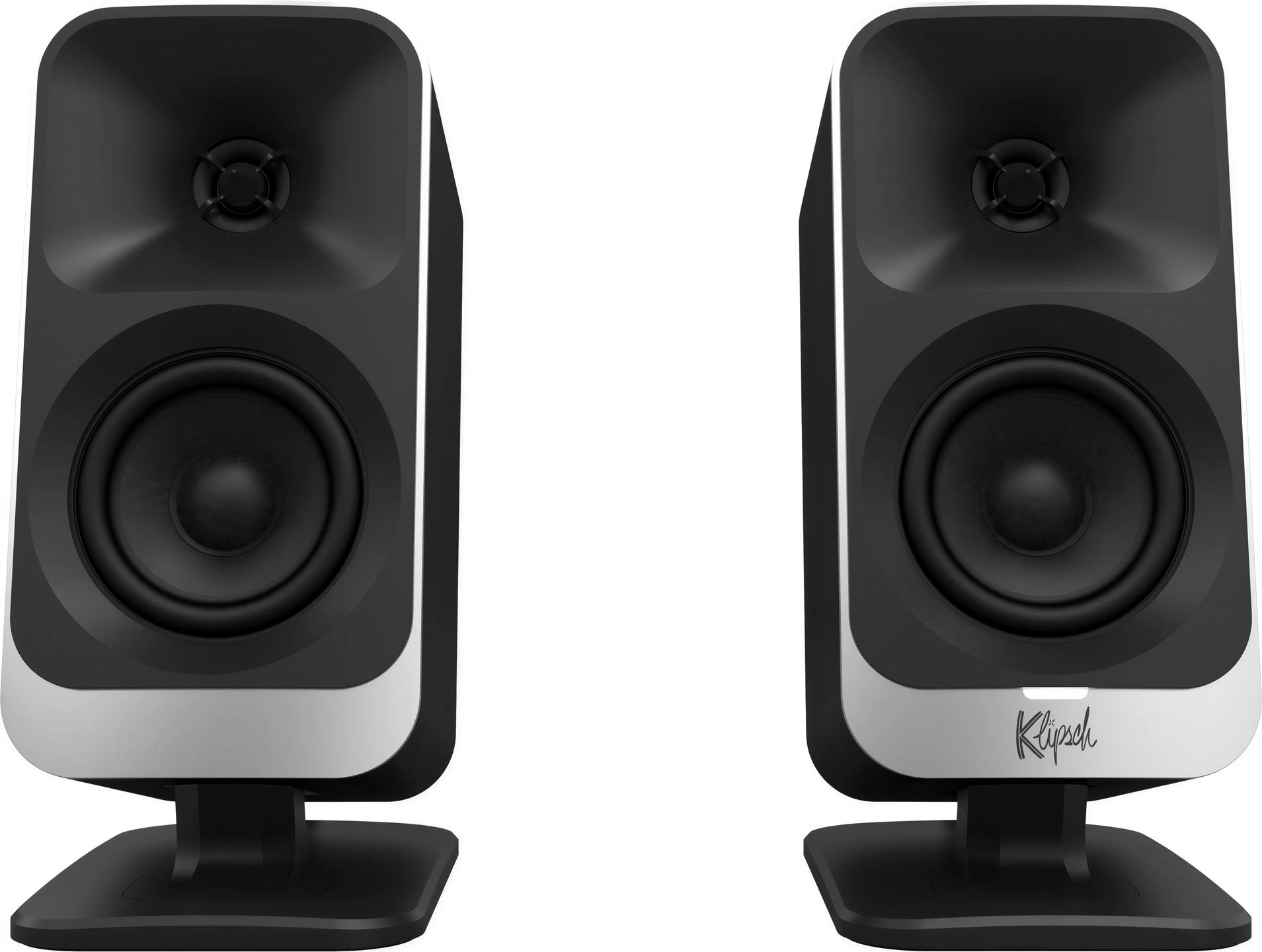
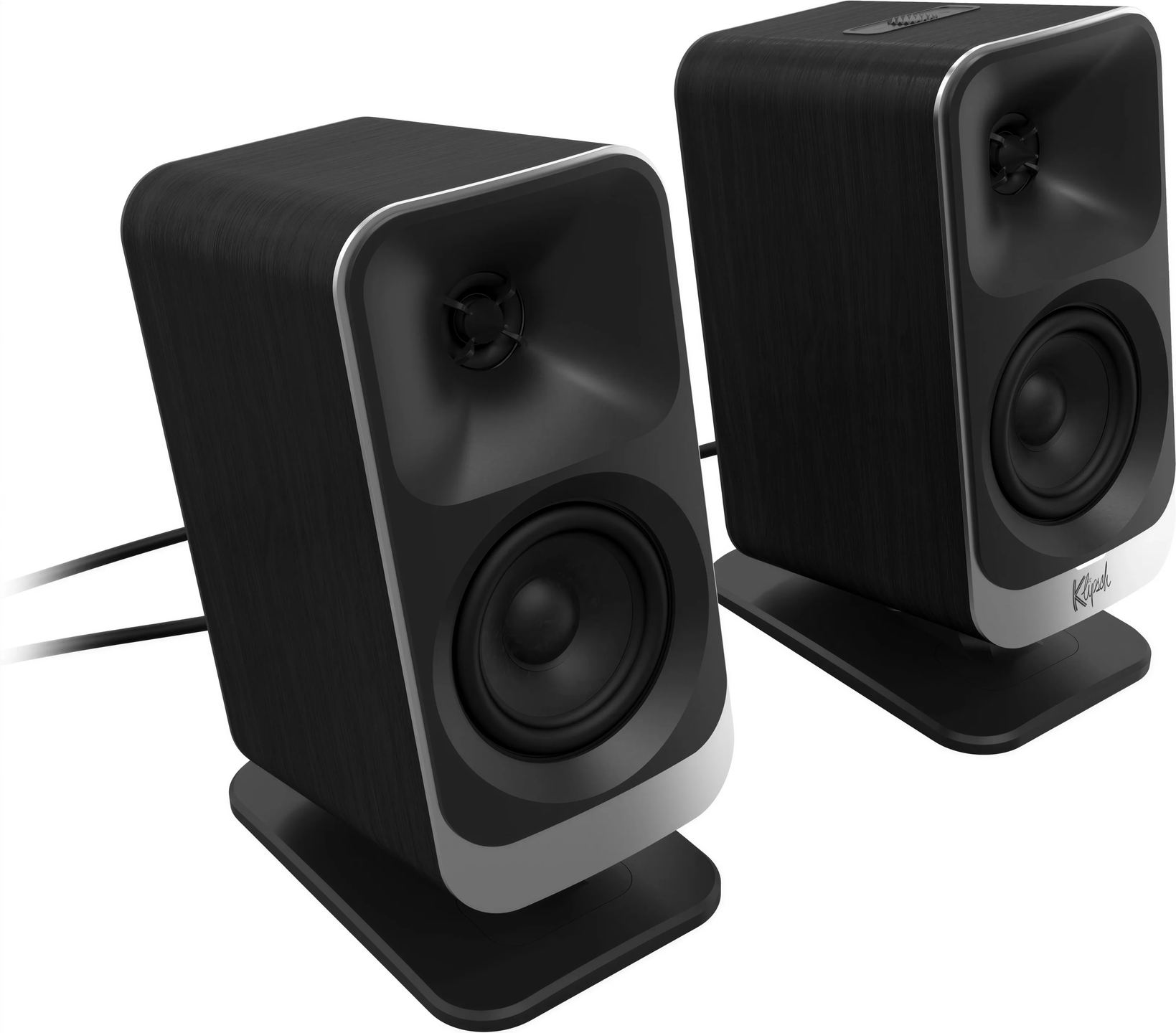
Twenty-five years after the launch of the original ProMedia, Klipsch is revisiting its 2.1 desktop system. The Lumina revives the formula that made its predecessor successful (two horn-loaded satellites and an active subwoofer) but adapts it to modern usage: native USB-C connectivity, Bluetooth 5.3, and software control via a dedicated app. All in a format that embraces an aesthetic dimension with its integrated LED lighting.
Horn technology applied to desktop audio
The ProMedia Lumina satellites each integrate a 1-inch tweeter mounted on a MicroTractrix horn. This technology patented by Klipsch functions as an acoustic waveguide: it focuses sound energy toward the listener and reduces unwanted reflections. On this model, the horn adopts a wider profile compared to previous generations, which improves horizontal dispersion and broadens the optimal listening zone.
Each satellite complements its tweeter with a 3-inch Mylar cone midrange driver, housed in a sealed ABS enclosure. The assembly displays a sensitivity of 91 dB and an impedance of 8 ohms, values that allow the integrated amplifier to drive them at high efficiency with minimal distortion. The stated frequency response extends from 40 Hz to 20 kHz (measured at -6 dB), with a maximum output level of 98 dB SPL.
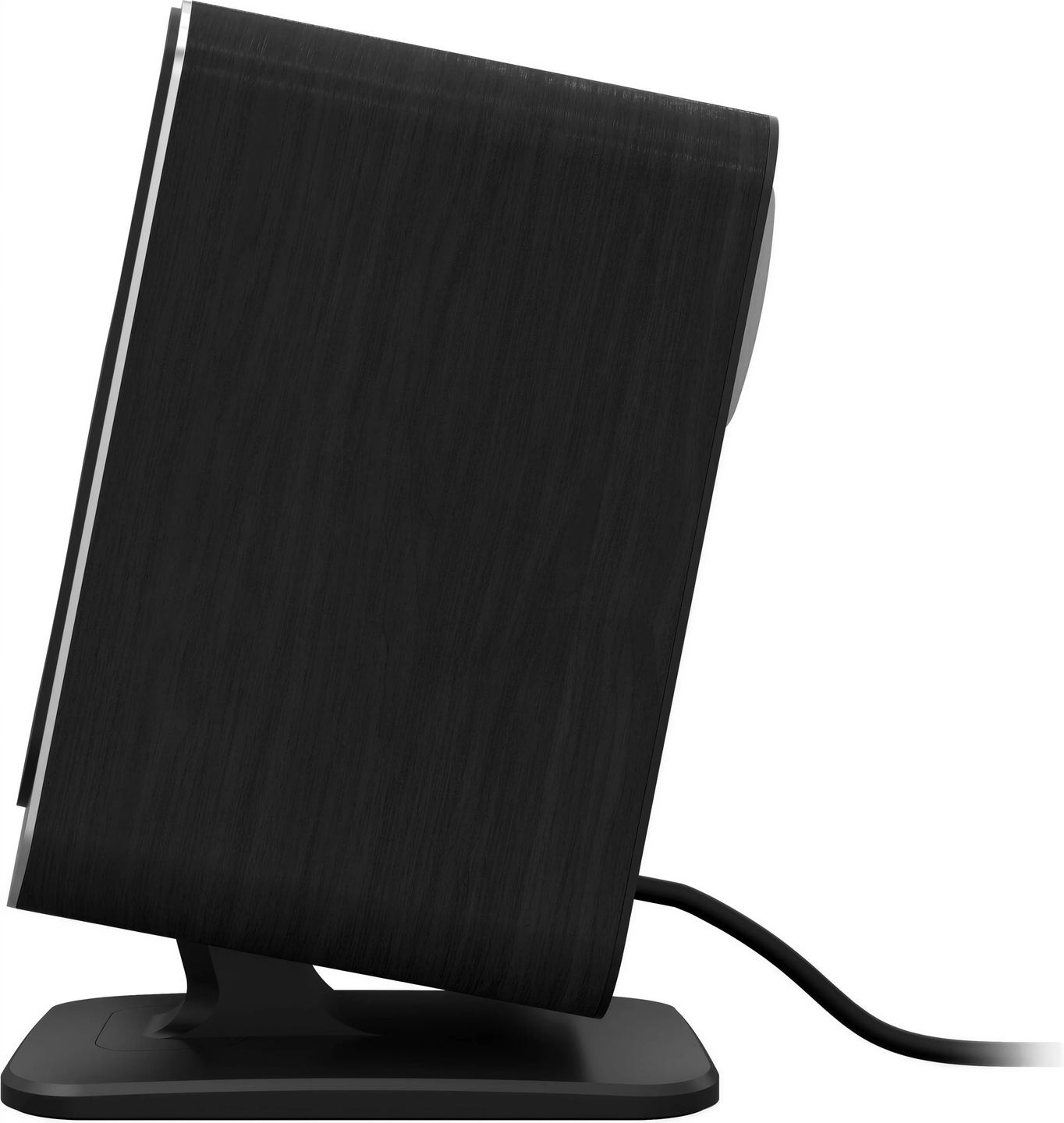
The satellites are mounted on tiltable stands, adjustable between 0 and 18 degrees. This angle allows the tweeters to be aimed at the listener’s ears when the speakers are placed on a desk, a position where they are typically lower than ear level.
A subwoofer designed for compact spaces
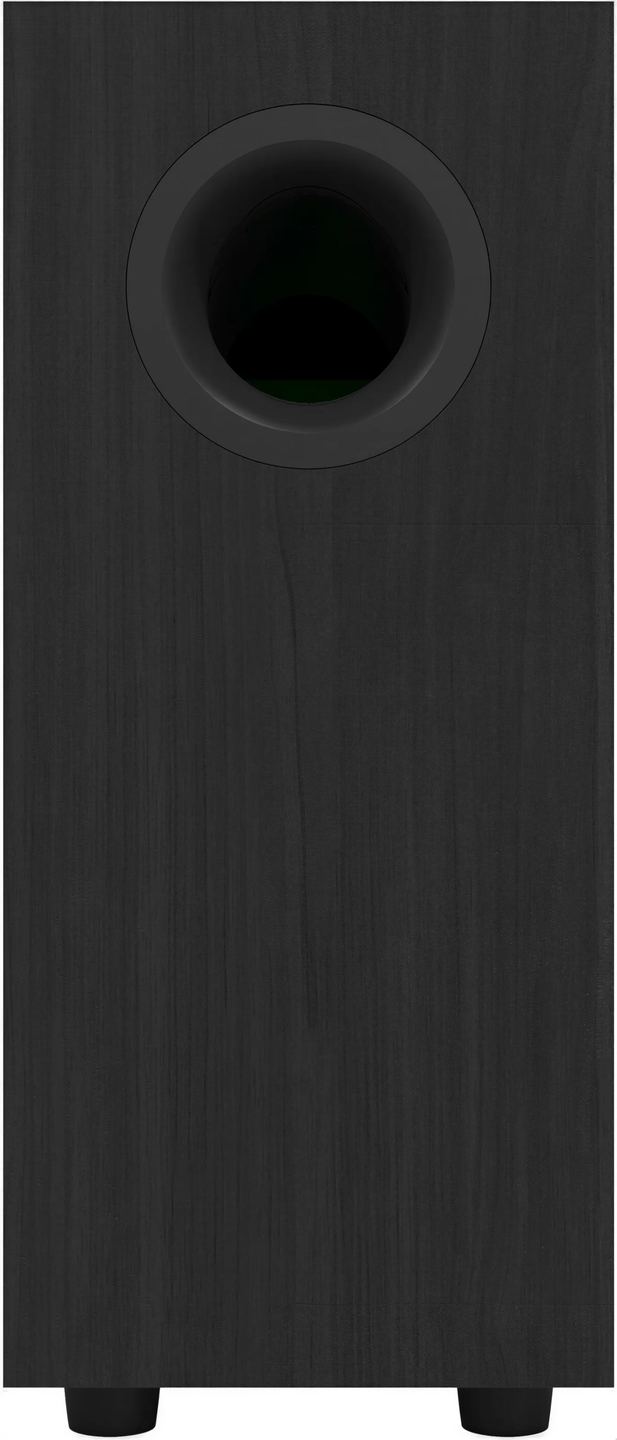
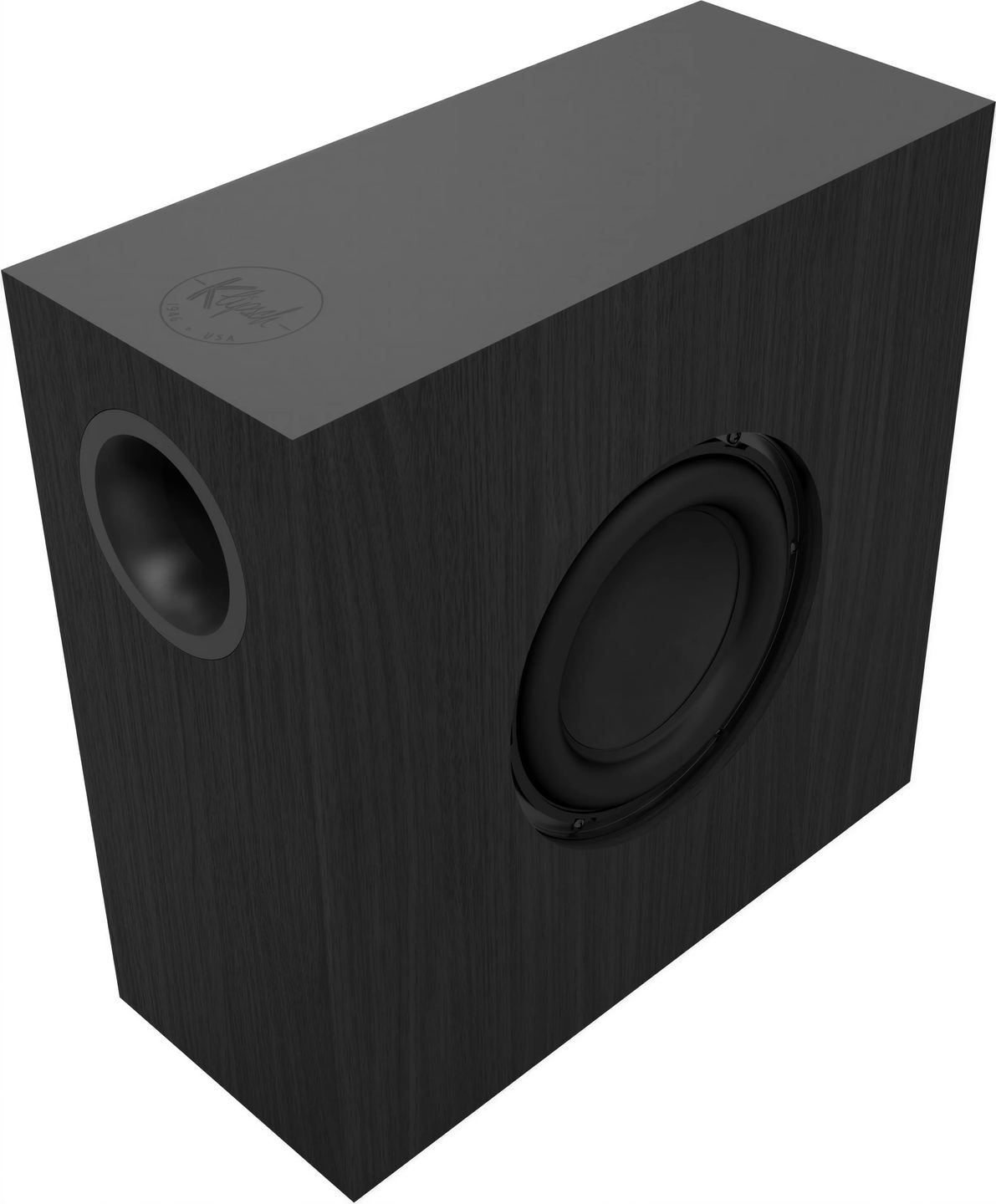
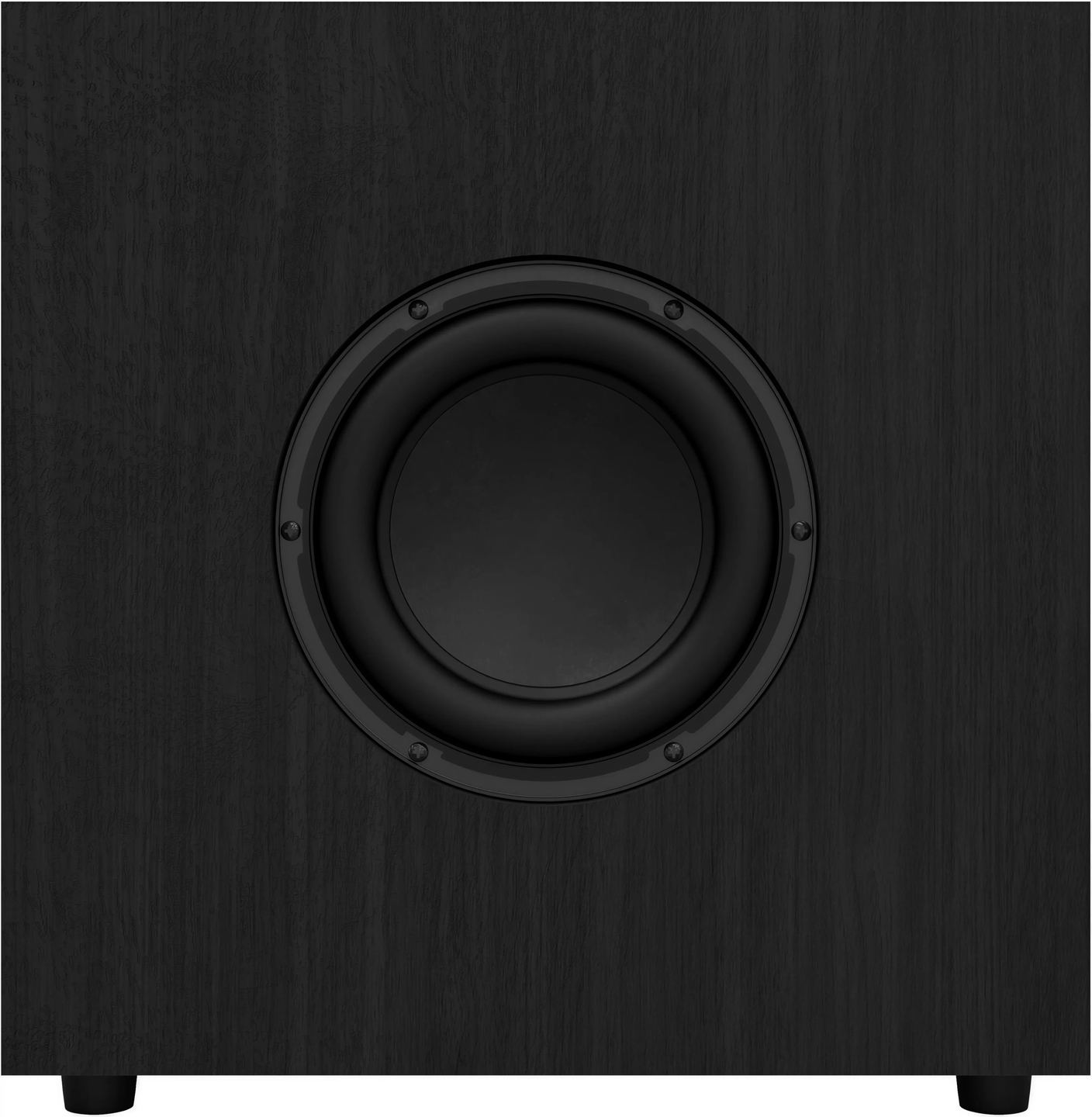
The subwoofer breaks away from the usual cubic formats. Its MDF cabinet adopts a vertical, narrow silhouette (14 × 6 × 13.9 inches) that can slip under a desk or against furniture without taking up much floor space. The 6.5-inch driver is mounted in a side-firing position and works with a front-facing tubular port. This compact bass-reflex configuration reaches down to 40 Hz according to specifications, with a crossover frequency set at 150 Hz.
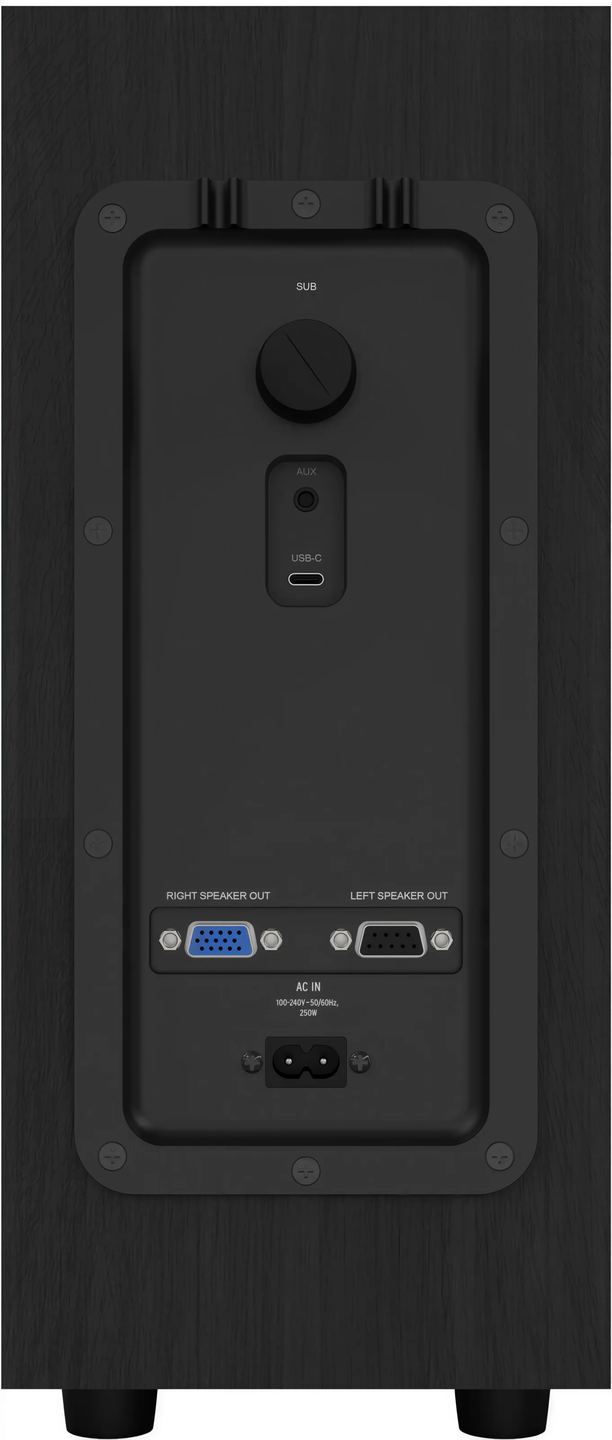
A gain knob on the rear of the subwoofer allows bass level adjustment based on room acoustics and personal preferences. The subwoofer also integrates a dedicated cable management recess, a practical detail that limits visual clutter on the desk.
Amplification is entirely managed by the subwoofer, which powers the satellites via dedicated cables. This choice eliminates the need for an external amp and simplifies installation.
Three connection modes and a headphone output
The ProMedia Lumina offers three inputs: USB-C, 3.5mm auxiliary jack, and Bluetooth 5.3. The USB-C connection ensures digital audio transport from a computer and allows the system to synchronize with the PC’s power state (automatic power on and off). Bluetooth offers wireless compatibility with smartphones, tablets, or any other compatible device. The auxiliary input remains available for analog sources.
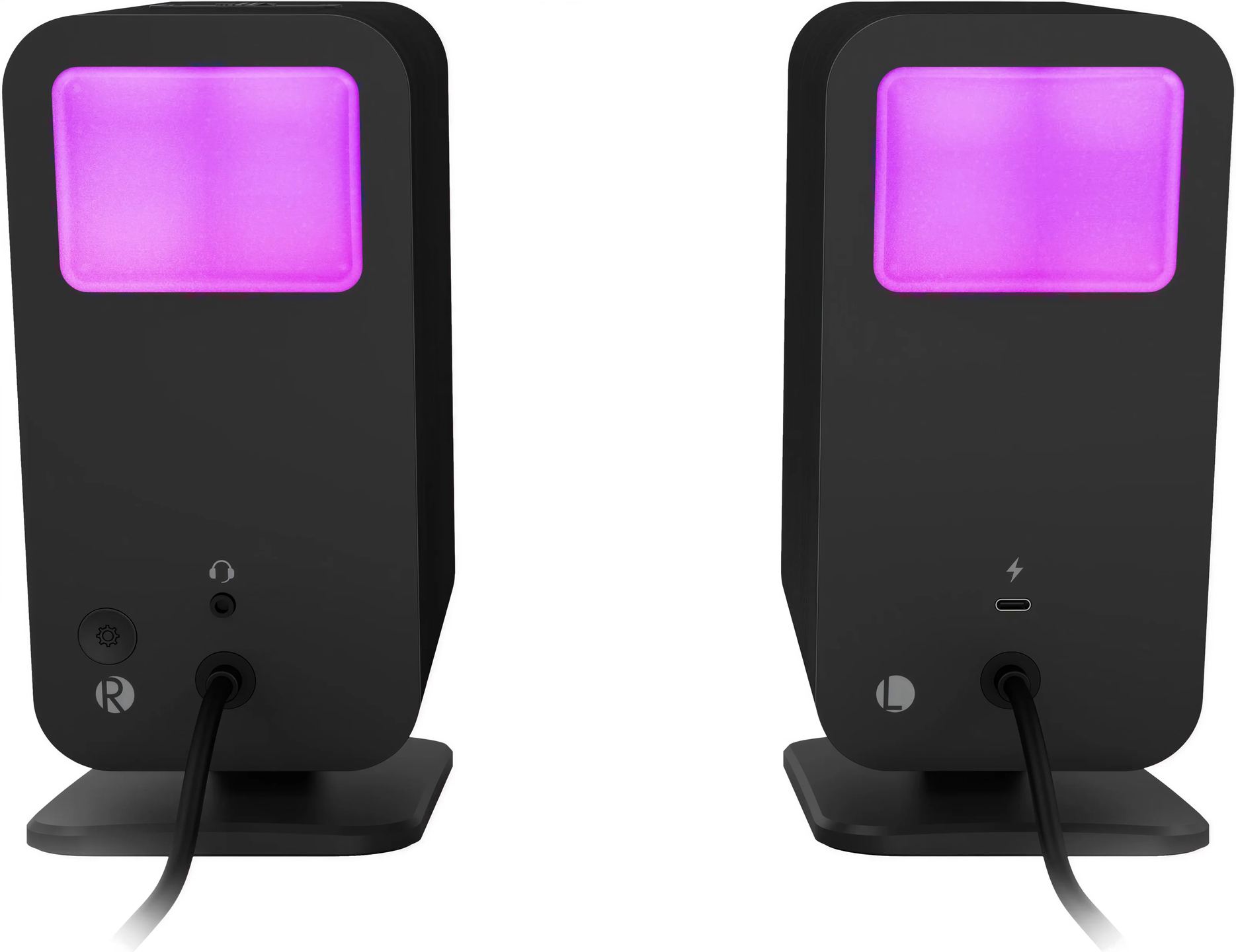
A 3.5mm headphone jack output is present on the subwoofer for plugging in headphones without having to disconnect the system. The USB-C port can also charge external peripherals at 5V/2A (Reverse Charging function), a welcome bonus for powering a smartphone or accessories.
The system accepts an input voltage of 100 to 240 V, making it usable without an adapter in most countries.
Audio customization via the Klipsch Control app
The Klipsch Control app (available on Windows) and Klipsch Connect Plus (Android/iOS) provide access to advanced settings impossible to perform from the hardware alone. The 6-band equalizer allows adjustment of the response curve according to content type or personal taste. Several presets are offered: Flat, Rock, Hip Hop, Bass Boost, Vocal Boost, or a custom profile.
Two predefined sound modes, Music and Movie, automatically adapt the audio signature. Virtual Surround mode artificially widens the soundstage to create a more pronounced sense of space, an effect that can help localize directional sounds in games. Night mode reduces bass levels and lowers overall volume for late-night sessions where neighbors need to be considered.
Mac users don’t have access to the desktop app and must use the mobile app for advanced settings.
LED lighting as a customization element
Each satellite integrates six LEDs on the rear, diffused through the cabinet to create an ambient light halo. Five preprogrammed lighting modes are accessible: Rainbow, Breathe, Aurora, Static, and a music-reactive mode (Music React) that pulses the LEDs to the rhythm of the bass.
Windows users have additional functions. Screen React mode analyzes the colors of the four corners of the screen and projects them onto the satellite LEDs, creating visual continuity between the monitor and speakers. Under Windows 11, Dynamic Lighting mode synchronizes the LEDs with other compatible RGB peripherals.
Lighting is controlled via the app. On the speakers themselves, only brightness level can be adjusted directly.
What the press says
The Klipsch ProMedia Lumina 2.1 is a decent desktop speaker system with solid mids and highs, a compact and stylish finish and decent app support. [...] Connectivity is just okay, and the lack of much low-end, even with a dedicated subwoofer, can leave audio feeling a little detached. [...] I was immediately impressed with the sense of separation and the precision of the soundstage from the satellite speakers, especially on busier tracks such as Dance of the Illegal Aliens from Brand X and Earth, Wind & Fire’s September.
MicroTractrix horn for exceptional vocal and instrumental clarity
Customizable lighting for desktop or studio
Recommended Applications
Video gaming, content creation, music listening and movies
Workstations and desks with limited space
Easy installation thanks to modern connectivity
Key Features
Detailed and powerful sound in a compact format
Low-profile subwoofer delivering deep bass
Tiltable satellites for better dispersion
MicroTractrix horn technology for exceptional clarity
Customizable lighting
Simple installation with USB-C, AUX and Bluetooth 5.3 connectivity
Frequently asked questions
Does the ProMedia Lumina work with a Mac?
+
Yes, via USB-C, auxiliary jack, or Bluetooth. The Klipsch Control app is not available on macOS, but the Klipsch Connect Plus mobile app (iOS) provides access to the equalizer, sound modes, and lighting control.
Can the system be used with a gaming console?
+
Bluetooth 5.3 and the 3.5mm jack input allow the system to connect to a PlayStation, Xbox, or Nintendo Switch. The USB-C connection is only compatible with computers.
What is the difference between the ProMedia Lumina and the ProMedia Heritage?
+
The Heritage adopts a retro design inspired by the Heresy, with an 8-inch subwoofer and limited connectivity (Bluetooth and jack only). The Lumina offers a more compact format, a 6.5-inch slim subwoofer, USB-C connectivity, a complete control app, and LED lighting. The Heritage targets vintage aesthetics, the Lumina modern integration.
Can the LED lighting be disabled?
+
Yes, the app allows the LEDs to be turned off completely or their intensity adjusted. A static lighting mode at minimum brightness can also serve as a compromise.
Does the system turn on automatically with the computer?
+
When connected via USB-C, the ProMedia Lumina detects the PC’s power state and turns on or off automatically accordingly. This function does not activate via Bluetooth or auxiliary jack.
Does Virtual Surround mode replace a home theater system?
+
No. It is a DSP treatment that widens the perceived soundstage, useful for improving spatialization in games or movies. The effect remains limited by the stereo configuration with two satellites and does not reproduce a true multichannel surround system.
User reviews
Roland
Superb sound, properly positioned, the small KLIPSCH speakers work wonders... and the subwoofer completes the setup. a very good retailer, attentive to its customers.
Comment from 25 September 2026 — Experience from 20 March 2026
Automatically translated — Show original (French)
Superbe sonorité, bien disposées, les petites KLIPSCH font merveille... et le caisson de basses complète l'ensemble. très bonne enseigne de vente, proche de la clientèle.
Clément
For the price, nothing to complain about! Perfect with a desktop computer via USB. It’s just that everything has to be done with the app; there are few buttons.
Comment from 9 June 2026 — Experience from 10 April 2026
Automatically translated — Show original (French)
Pour le prix, rien à redire ! Parfait avec un ordinateur de bureau en USB. Juste, il faut tout faire avec l’app, peu de boutons.
To better understand our visitors, measure marketing effectiveness and personalise ads, we and our partners use cookies and mobile advertising identifiers on your device. This data makes it possible to display personalised and non-personalised ads and measure their performance. Some cookies, which are technically necessary, are exempt from consent. You can accept those that require your consent, refuse them by clicking “Reject”, or customise your choices via “More options”.
To find out how Google uses the data collected once you have given your consent, see Google’s Business Data Responsibility site (opens in a new window).
You can change or withdraw your consent at any time via the “Cookies” link. Your choices will apply on our site for 12 months.