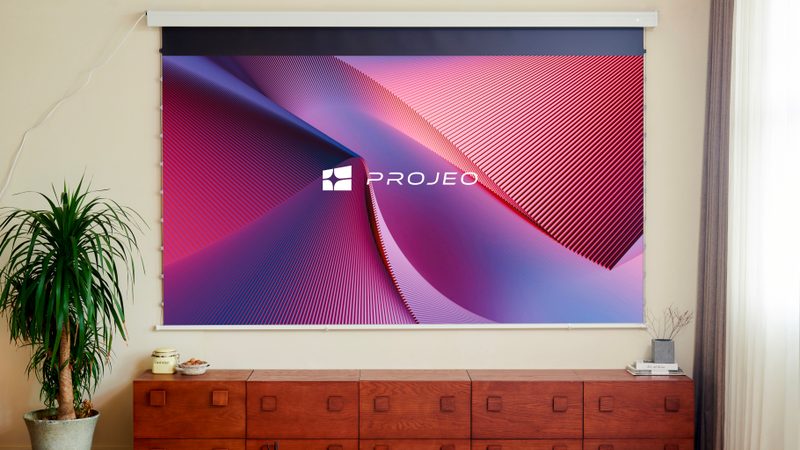
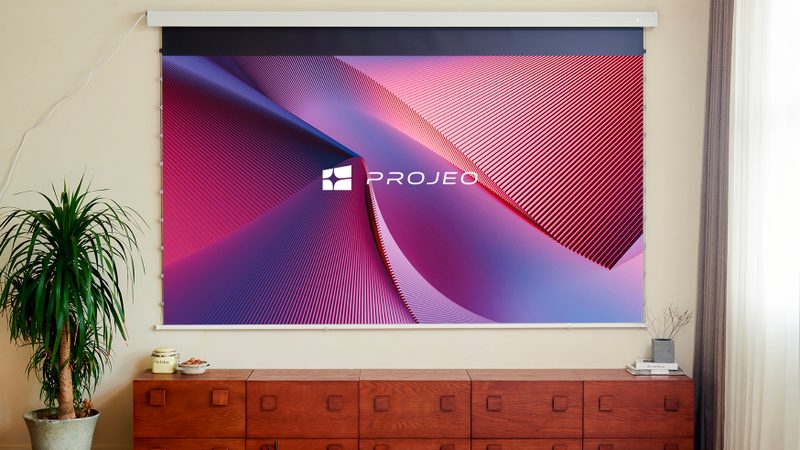
Projeo Motion ALR LT 120
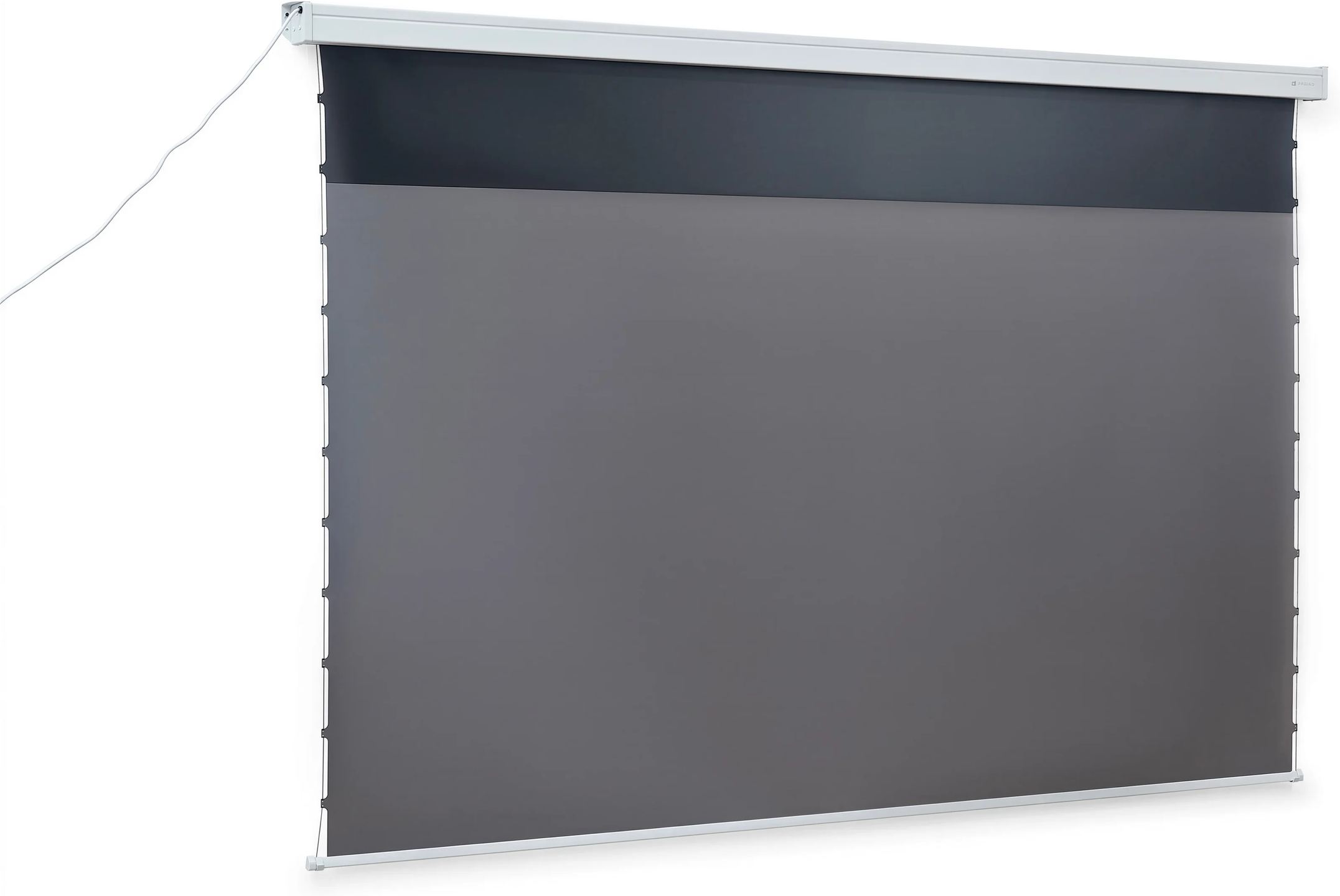


Projeo Motion ALR LT 120: the motorized ALR screen for bright rooms
Projecting in a living room flooded with light has long meant making an unsatisfying choice: close the shutters or accept an image washed out of its contrast. Ambient light rejecting screens shift that balance. This 117-inch model is aimed at living spaces that remain lit during viewing, with a screen material calibrated for long-throw projectors and a motorized housing that disappears once the screen is rolled up.

A screen material that filters ambient light
An ALR screen material (from Ambient Light Rejection) does more than simply reflect the projector’s light. Its surface is structured to primarily reflect light arriving along the projector’s axis and absorb light coming from elsewhere, whether from a ceiling light or a side window. The difference is especially visible in blacks and dark areas, which retain density instead of turning gray when the room remains lit.
The surface used here is a PET film called ALR LT, with the LT suffix referring to long-throw projectors. This detail has practical consequences. The optical structure of an ALR screen material is calibrated for a given angle of incidence, the one at which the projector’s light reaches the screen. A long-throw projector, placed at the back of the room or mounted on the ceiling, illuminates the screen almost head-on. Pair the same screen material with an ultra-short-throw projector, whose beam rises from a cabinet placed just below the screen, and the screen will reject that projector’s light just as it rejects light from a ceiling fixture.
The stated gain is 1.8. A gain above 1 indicates that the screen material reflects more light toward viewers than a neutral white reference, which helps preserve brightness against competing lighting. A high gain generally comes with a narrower viewing cone. Projeo specifies a directivity of 120°, the angle within which the image retains its qualities; seats positioned far off-center, outside this cone, will perceive a less bright image.
One limitation should be stated early: this screen material is calibrated for conventional long-throw projectors and is not compatible with RGB tri-laser models: the combination degrades color accuracy. For a tri-laser source, a screen material of a different design is required.
A motorized housing and a screen kept flat
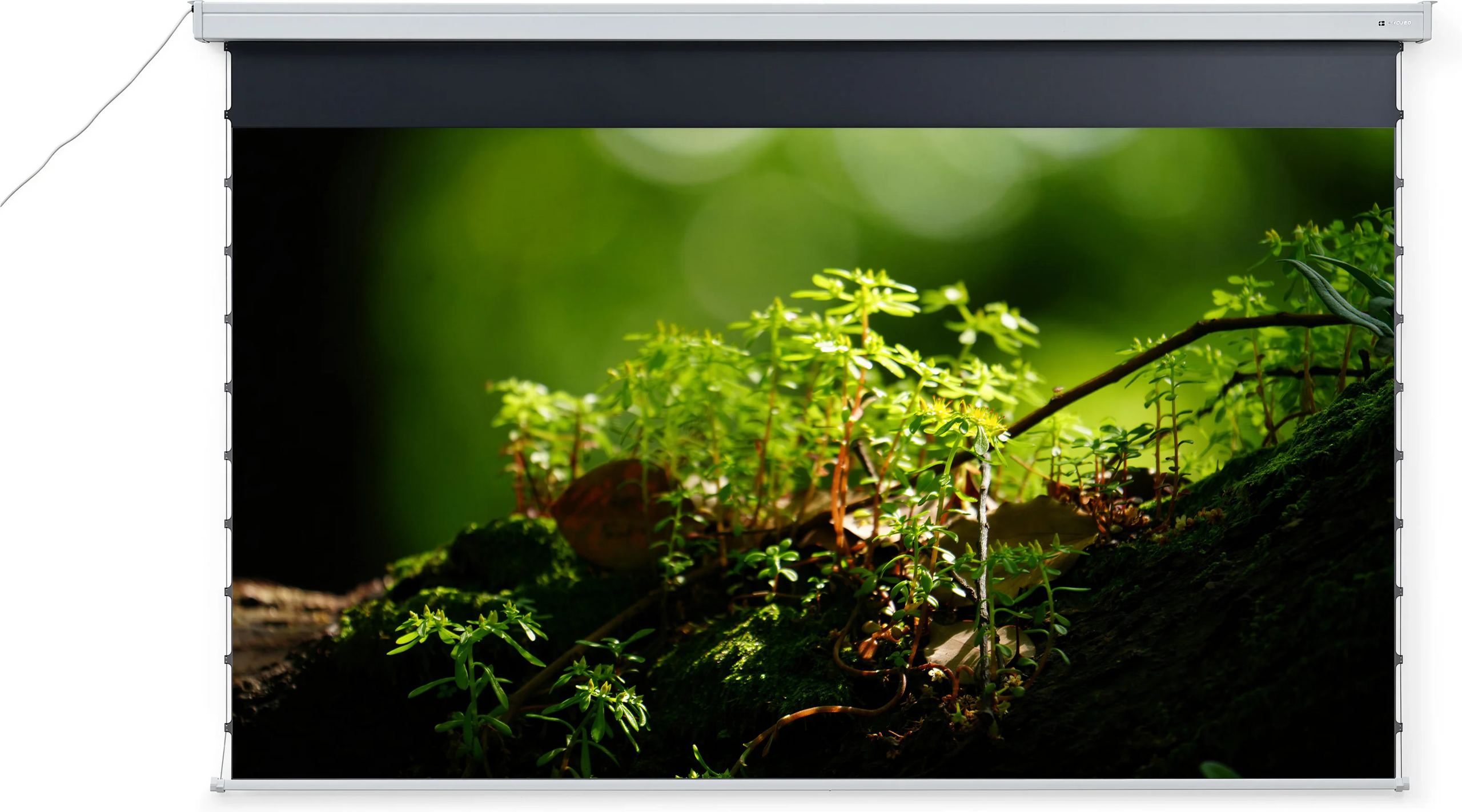
The white lacquered metal housing measures 275 cm long on the 120 version. It contains a tubular motor, the same type of motorization found in roller shutters: compact, housed inside the winding tube, and quiet in use. The screen deploys and retracts smoothly.
The most useful technical feature of this screen is its lateral tensioning system. Small tabs distributed along both edges of the screen pull it outward during descent. Without this system, a roll-up screen tends to ripple and twist slightly near the edges. An ALR surface does not tolerate these irregularities well: its optical structure only works properly on a truly flat plane. The weighted bar at the bottom of the screen, 269 cm long, completes the tensioning through its weight.
Installing the screen and controlling it every day
Three mounting positions are provided: wall mounting, ceiling mounting, or suspension. This flexibility helps adapt to the room, depending on whether the wall behind the screen is available, and makes it easier to adjust image height. A 300 mm black drop runs across the top of the screen, above the active image area; it serves as a positioning margin. The side and bottom borders remain slim, at 20 mm.
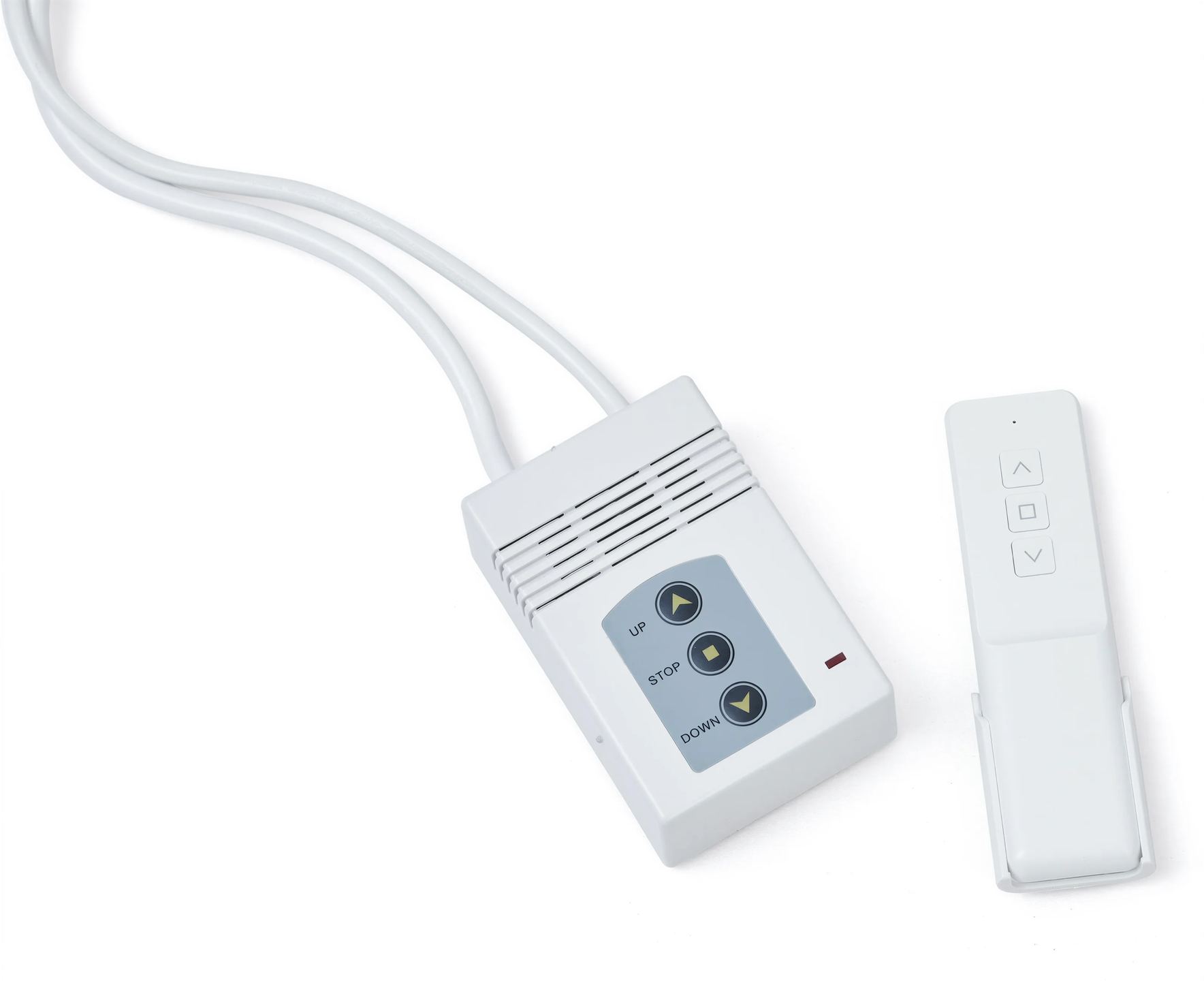
On the control side, an infrared receiver is integrated into the housing, and a remote infrared sensor is supplied. This remote sensor addresses a common issue with recessed screens or screens housed in a false ceiling: when the housing is concealed, its receiver can no longer pick up the remote control signal. Moved to a visible location, the sensor restores the connection. A three-position wall switch (up, stop, down) remains available as a backup wired control. Power is supplied via a 220 V European mains plug, with a 5.1 m cord.
Documentation
Technical Specifications
Screen
- Projection surface: ALR (Ambient Light Rejection) for Long Throw projector
- Gain: 1.8
- Viewing angle: 120°
- Projector type: long throw
Structure
- Housing: white lacquered metal
- Motor: tubular motor
Control system
- Integrated IR remote control system
- External IR sensor included
- Manual switch: Up, Stop, Down
- Power cord
- European type
- Voltage: 220 V
- Cable length: 5.1 m
Available dimensions and formats
- Ratio: 16 / 9
- Screen type: ALR Long Throw
- Borders: B1 300 mm, B2 20 mm
Motion ALR LT 120
- Viewable image size: 259.6 × 146 cm
- Diagonal: 117” (297.18 cm)
- Housing size (L1): 275.1 × 8.2 × 8.2 cm
- Weight bar size (L2): 269.4 × 3.09 × 2.39 cm
- Packaging dimensions: 295 × 16 × 15 cm
Frequently asked questions
What type of projector should be paired with this screen material?
A long-throw projector, installed at the back of the room or mounted on the ceiling, at a suitable distance from the screen. The ALR LT screen material is calibrated for this projection angle. Two categories should be avoided: ultra-short-throw models, whose very steep beam would be rejected by the screen material, and RGB tri-laser models, which create a color fidelity issue. Since the screen material is intended for lit rooms, a projector with a good brightness reserve remains preferable to take full advantage of ambient light rejection.
What viewing distance should be planned for a 117-inch image?
The image area measures 2.6 m wide. For 4K content, a viewing distance between one and one and a half times that width offers a good balance, or about 2.6 to 4 m between viewers and the screen. Closer than that, 4K definition remains usable but the field of view becomes very wide. Farther away, the large-image effect diminishes. The projector’s own throw distance depends on its throw ratio range, which should be checked on its own technical data sheet.
Can deployment be automated via a home automation system or the projector?
The available controls are the infrared remote control, with its integrated receiver and remote sensor, and the three-position wall switch. The technical data sheet mentions neither a 12 V trigger input nor a radio-frequency receiver. Synchronized deployment with projector power-on is therefore not provided as standard. Home automation integration remains possible by using a controlled infrared transmitter, a common method for devices operated by infrared. It is best to confirm this point according to your installation before purchase.
- Eco-contribution included in the sale price.
- Manufacturer reference: PROMOT120LT
- GTIN / EAN: 3700795165065