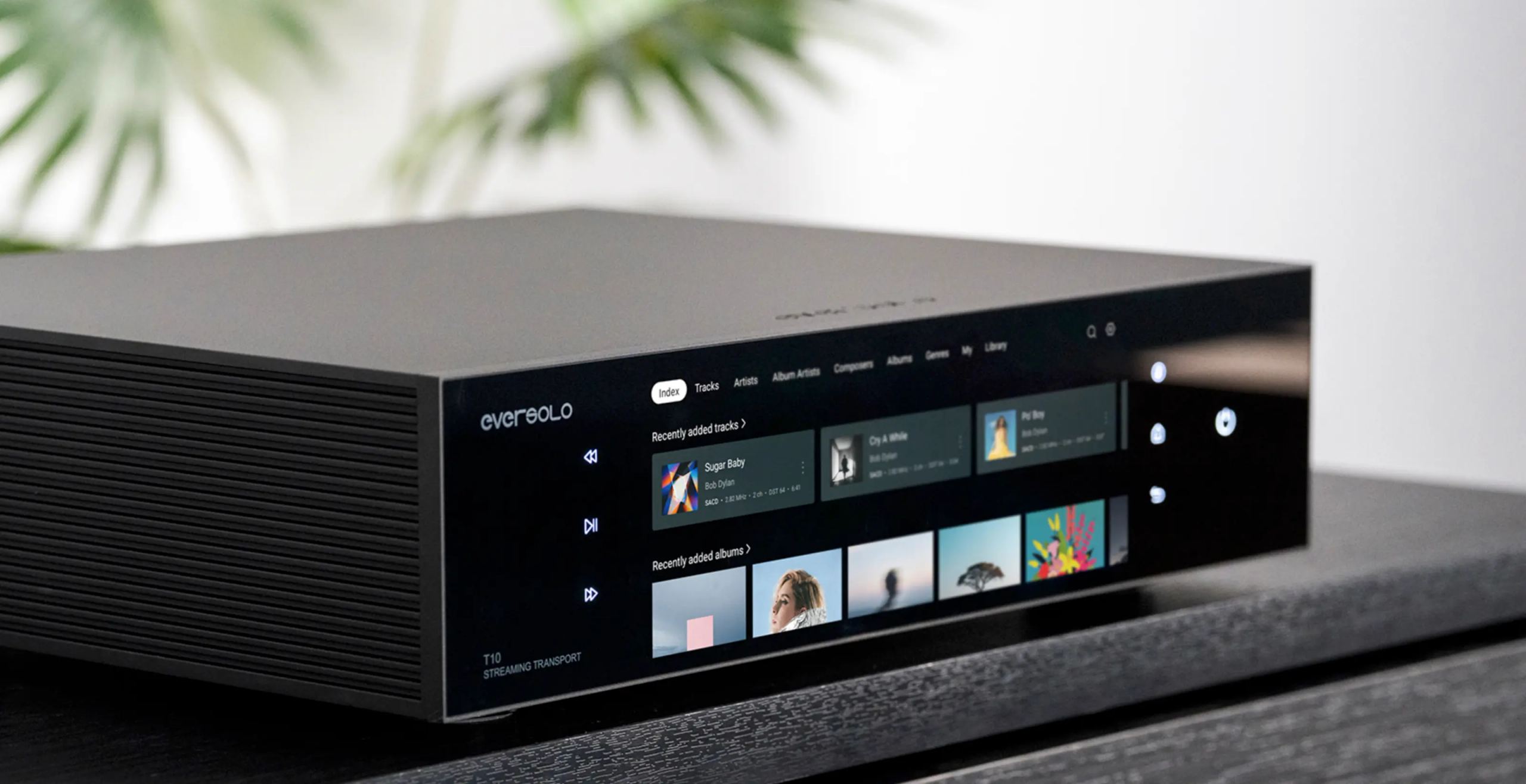
Entrusting signal conversion to a converter of your choice and reserving an entire machine solely for playing digital streams: that is the principle of a streaming transport. The T10 extends this idea at EverSolo, after the T8, by refining the clock, power supply, and isolation. There is no converter on board, then, but rather a digital source whose mission is to send the cleanest possible signal to the electronics placed behind it.
A transport without integrated conversion
The T10 contains no digital-to-analog converter. Its job stops at reading and formatting the digital stream, which it retrieves from the network, internal storage, or streaming platforms, then sends to an external converter. This choice leaves everyone free to keep the DAC they prefer; the T10 handles the source side, that is, organizing music, managing online services, and transmitting the signal.
Compared with an all-in-one network player, which combines streamer and converter in the same enclosure, this separation has a concrete advantage: moving the final conversion out of the rest of the chain and entrusting it to dedicated electronics, less exposed to noise from the computer and the network.
The OCXO clock and 10 MHz input
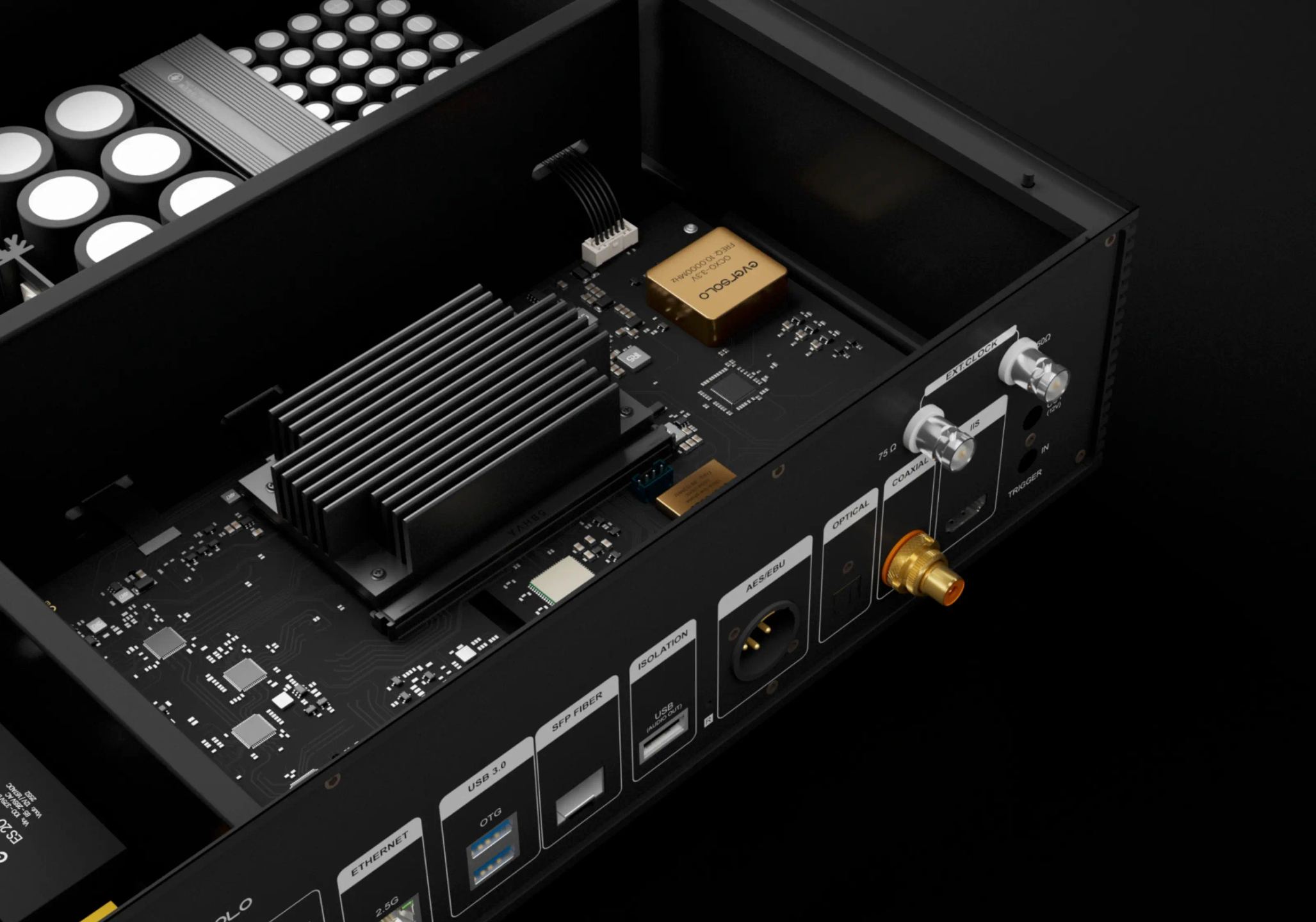
Clock regularity determines the quality of digital transmission. The T10 features an OCXO (Oven Controlled Crystal Oscillator) with very low phase noise, kept at a stable temperature to limit frequency drift. A phase-locked loop (PLL) circuit refines this clock signal and reduces jitter, those tiny timing variations that degrade the reading of audio data.
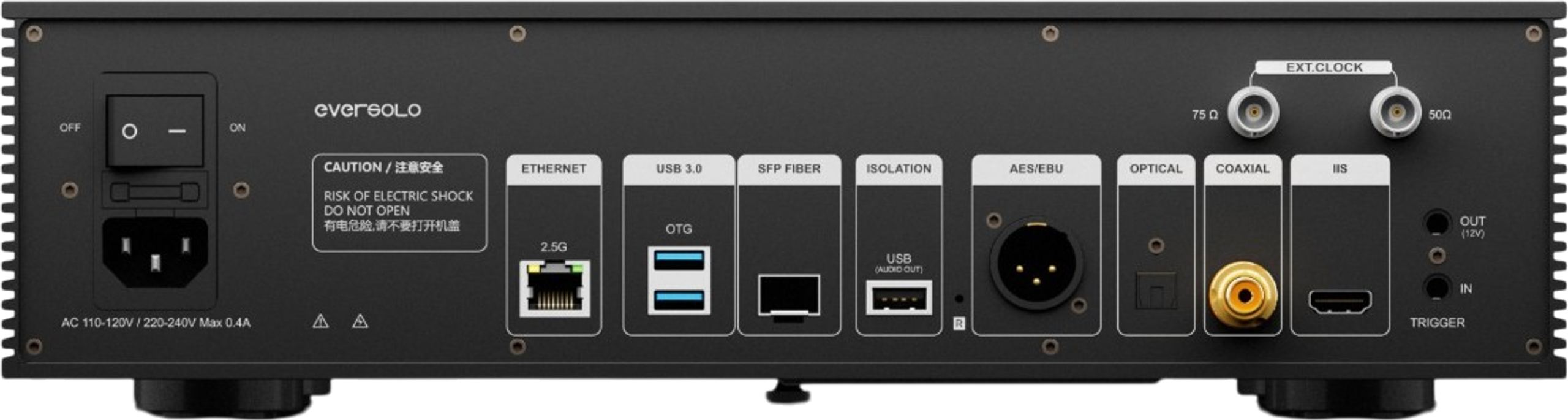
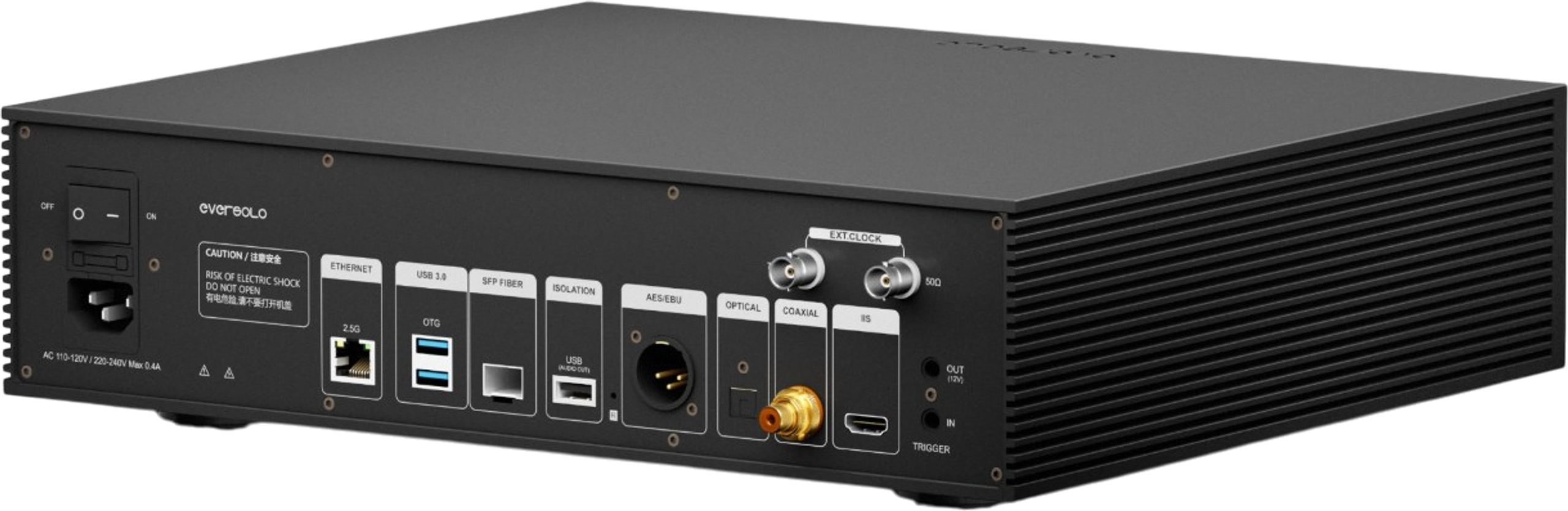
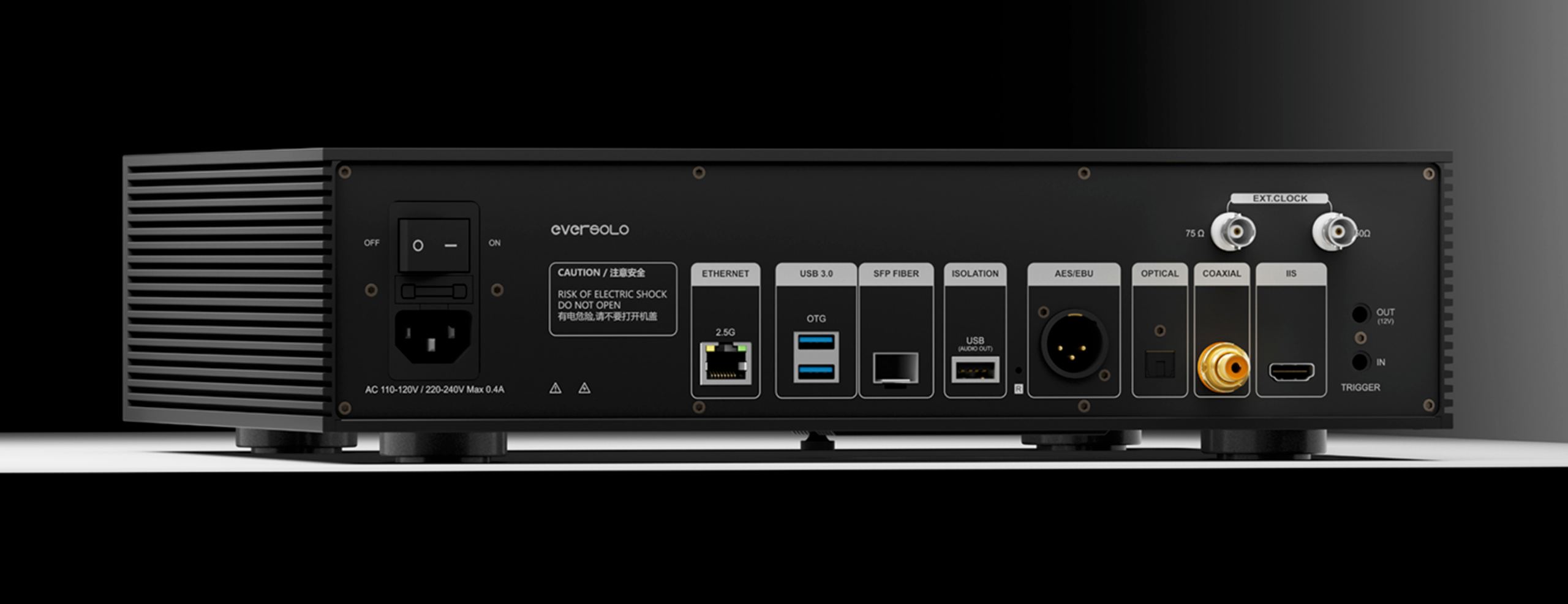
For systems already equipped with a master clock, the T10 adds a 10 MHz input compatible with 50 and 75 ohm impedances. This connector prepares for the arrival of the C10, the external clock announced by EverSolo, without imposing anything: the internal oscillator works on its own, and the input remains an option for those who want to go further in synchronization.
Linear power supply and isolated signal
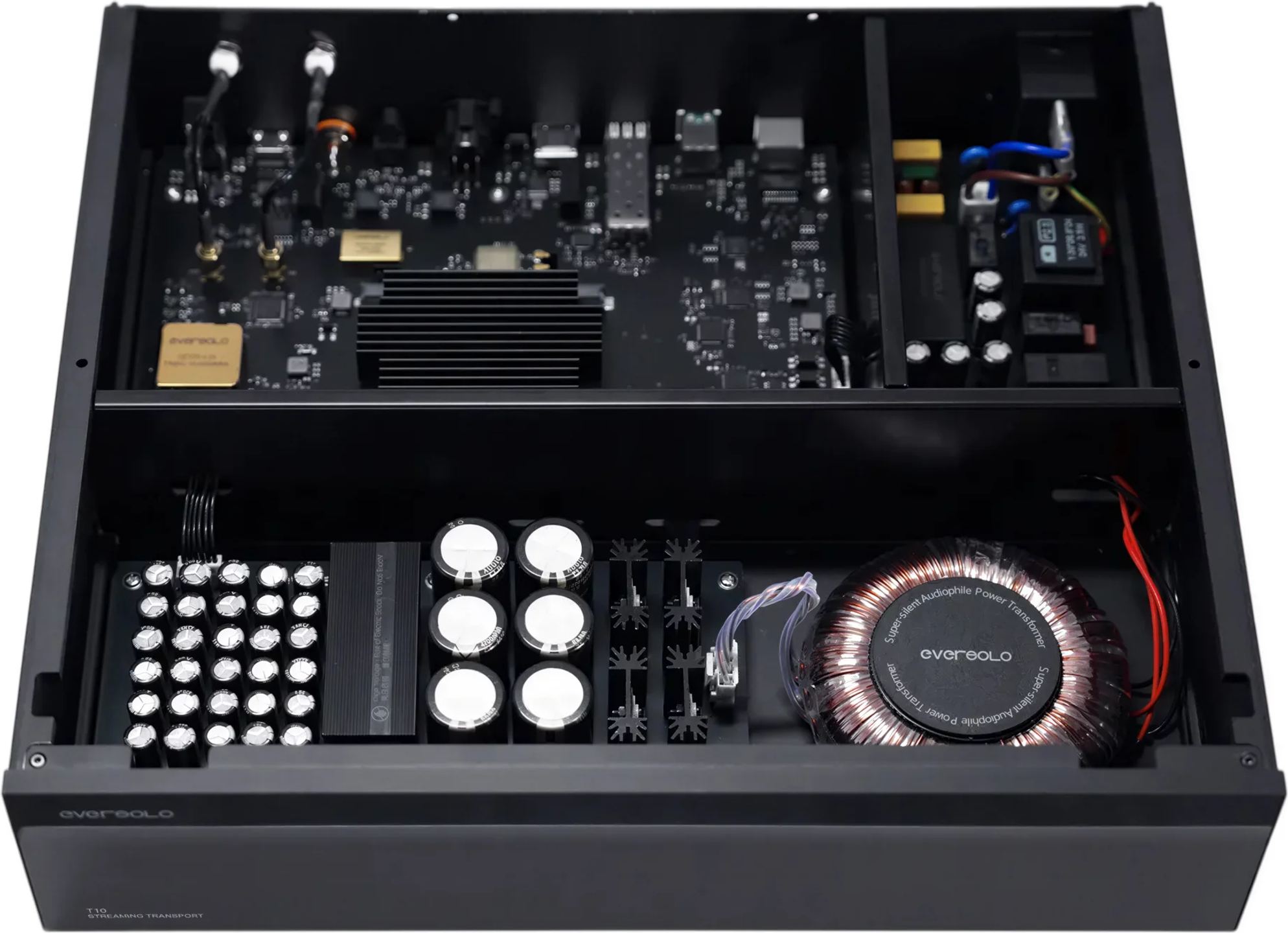
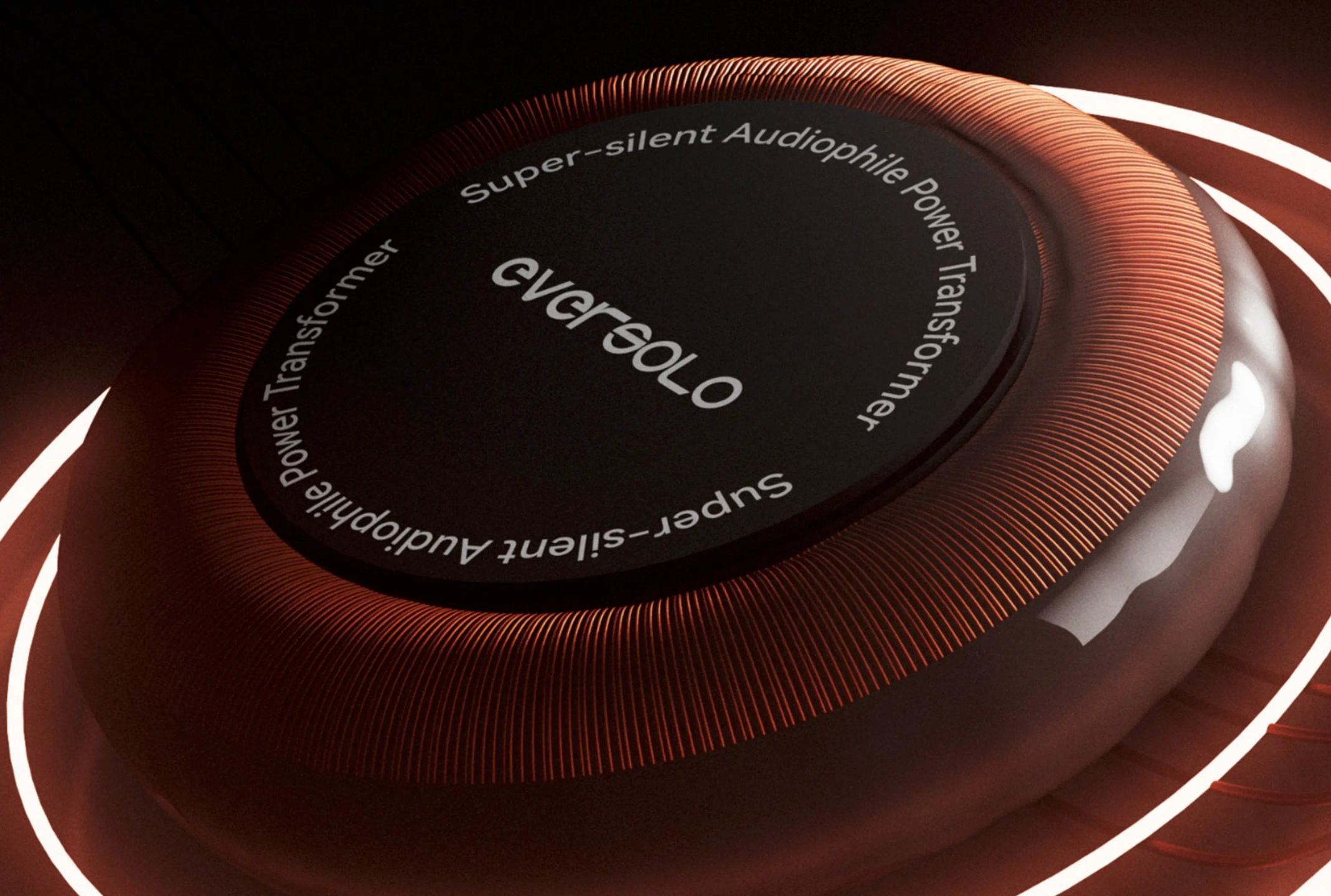
The power supply is based on an O-type toroidal transformer developed for the device, with separate paths for the system circuits and the audio circuits. The objective is to keep interference from the computing section away from the audio section. Added to this is electrical isolation across all interfaces, with multiple layers on the critical digital signal paths, internal physical partitioning, and electromagnetic shielding for the screen.
These measures are not intended to color the sound in one way or another. They aim for a calmer electrical environment, where details and dynamic nuances stand out against a reduced noise floor.
Digital outputs and network connections
On the output side, the T10 offers an IIS connection with eight selectable modes, enough to adapt to different converters and their pinouts. Added to this are a USB Audio output and a coaxial output, each with high-precision isolation, as well as an AES/EBU connection and an optical output. This variety covers most DACs on the market, old and new.
For networking, two wired inputs coexist: a 2.5 Gigabit Ethernet port, which ensures comfortable bandwidth for high-resolution streams and large libraries, and an SFP fiber interface, which cuts the copper link and keeps electrical interference from network equipment at a distance. Dual-band Wi-Fi 6 completes the package for rooms without cabling.
A redesigned 8.6-inch screen
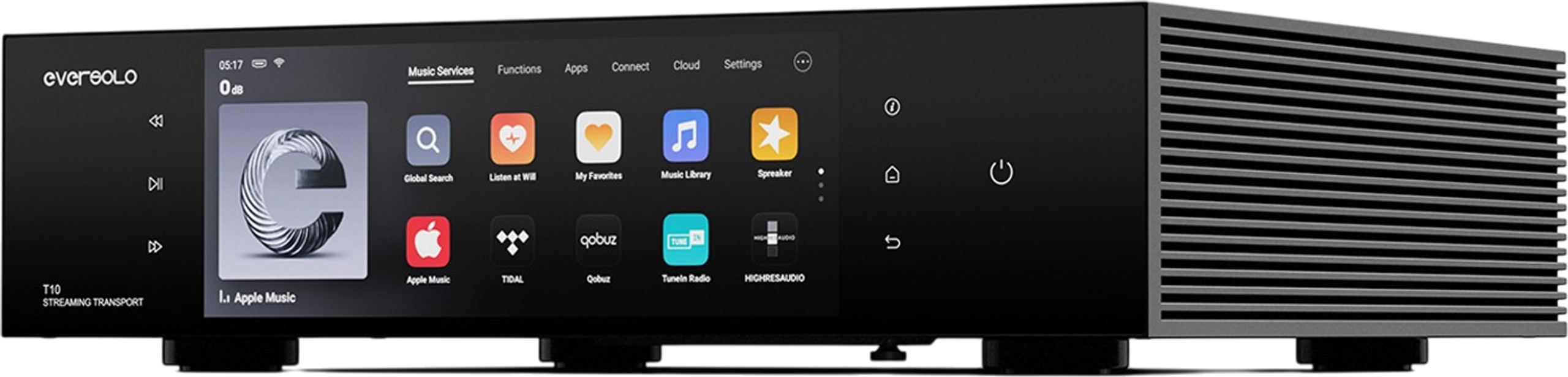
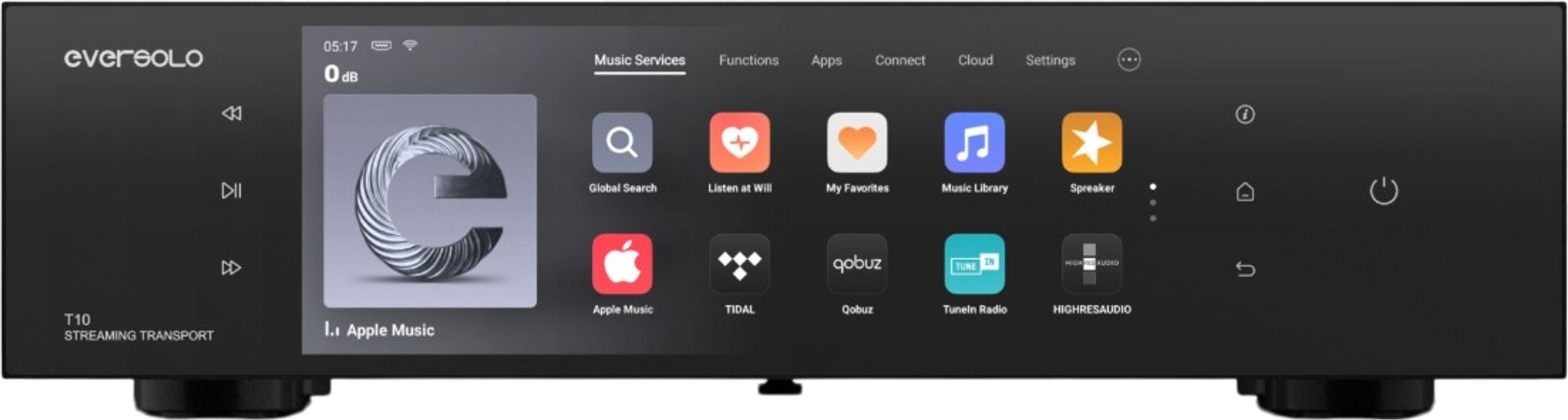
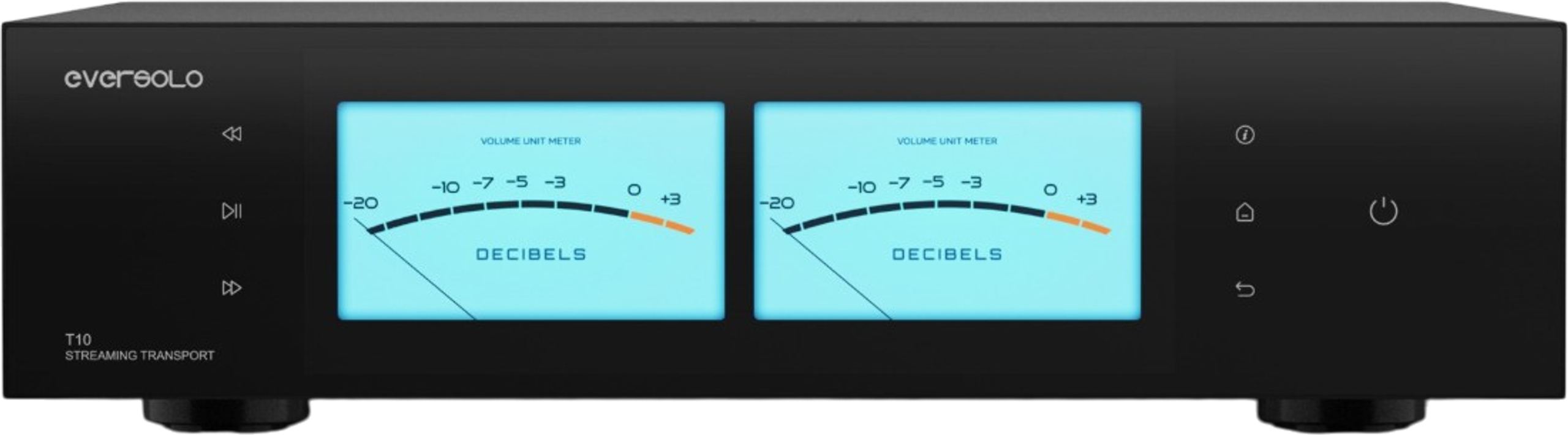
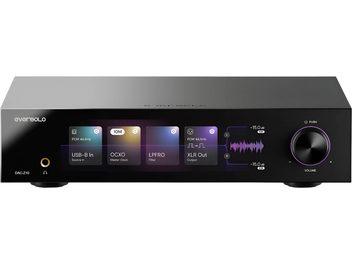
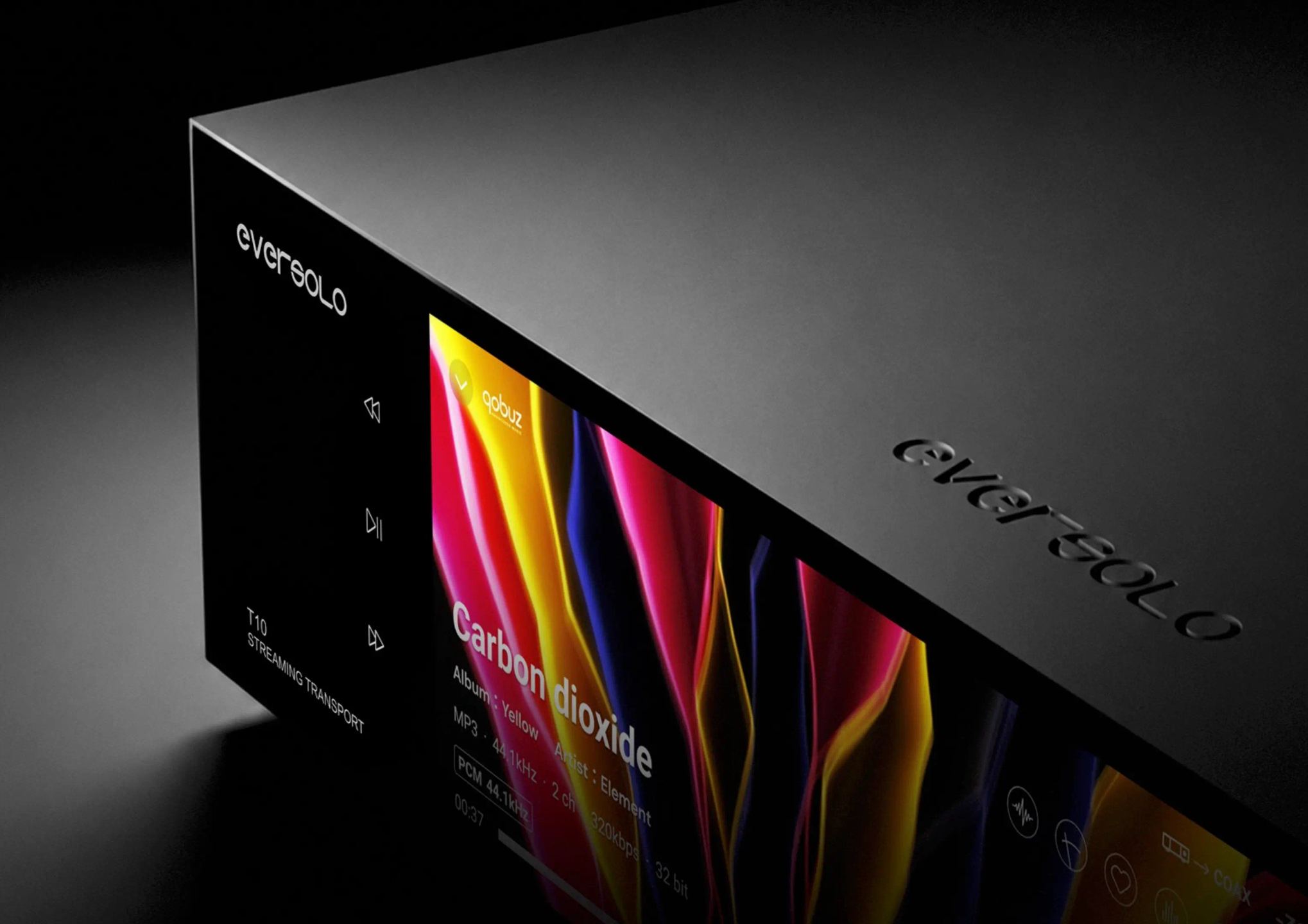
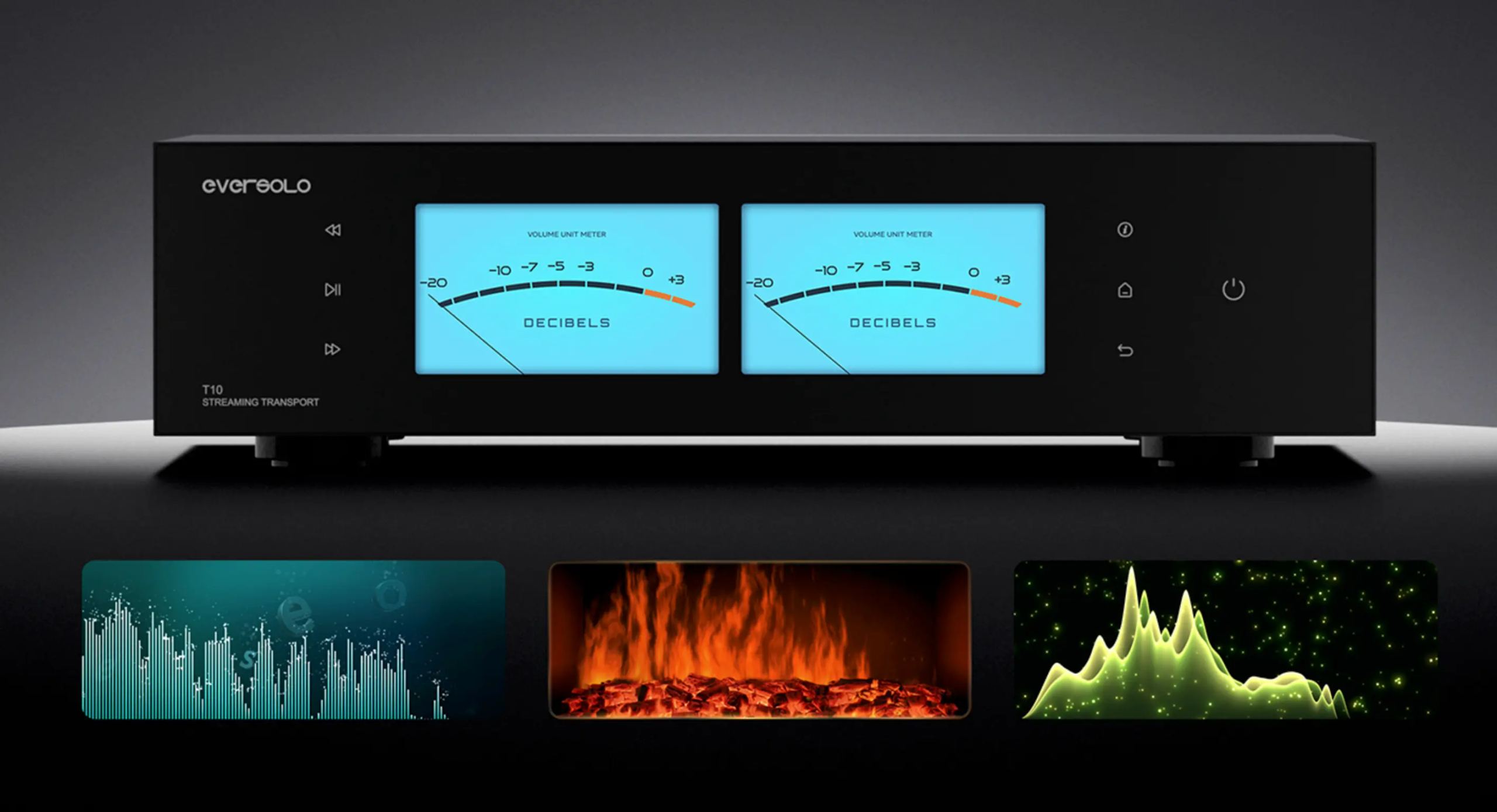
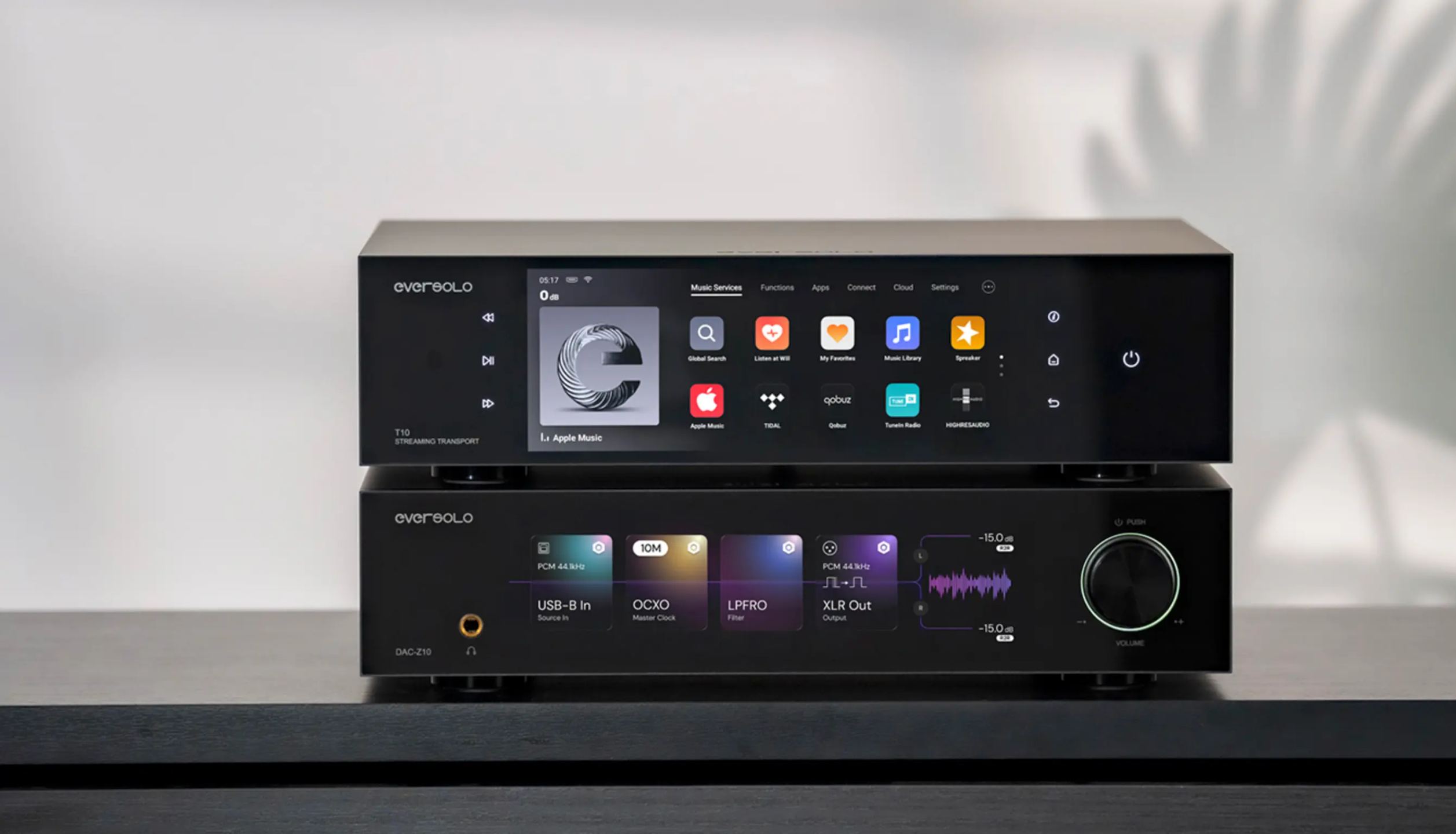
The touchscreen grows to 8.6 inches and adopts a completely redesigned interface: new information layout, revised interaction logic, card-based navigation. The panel has two uses. It controls playback, and during listening it displays VU meters in several styles, spectrum visualizations, or ambient animations such as a campfire and forest scenes. Enough to give the device a real presence in the room, where many sources make do with a small display.
Playback software and library
The software side relies on a 64-bit eight-core processor, 8 GB of RAM, and 64 GB of internal storage, enough to handle large collections without latency and switch from one task to another without waiting.
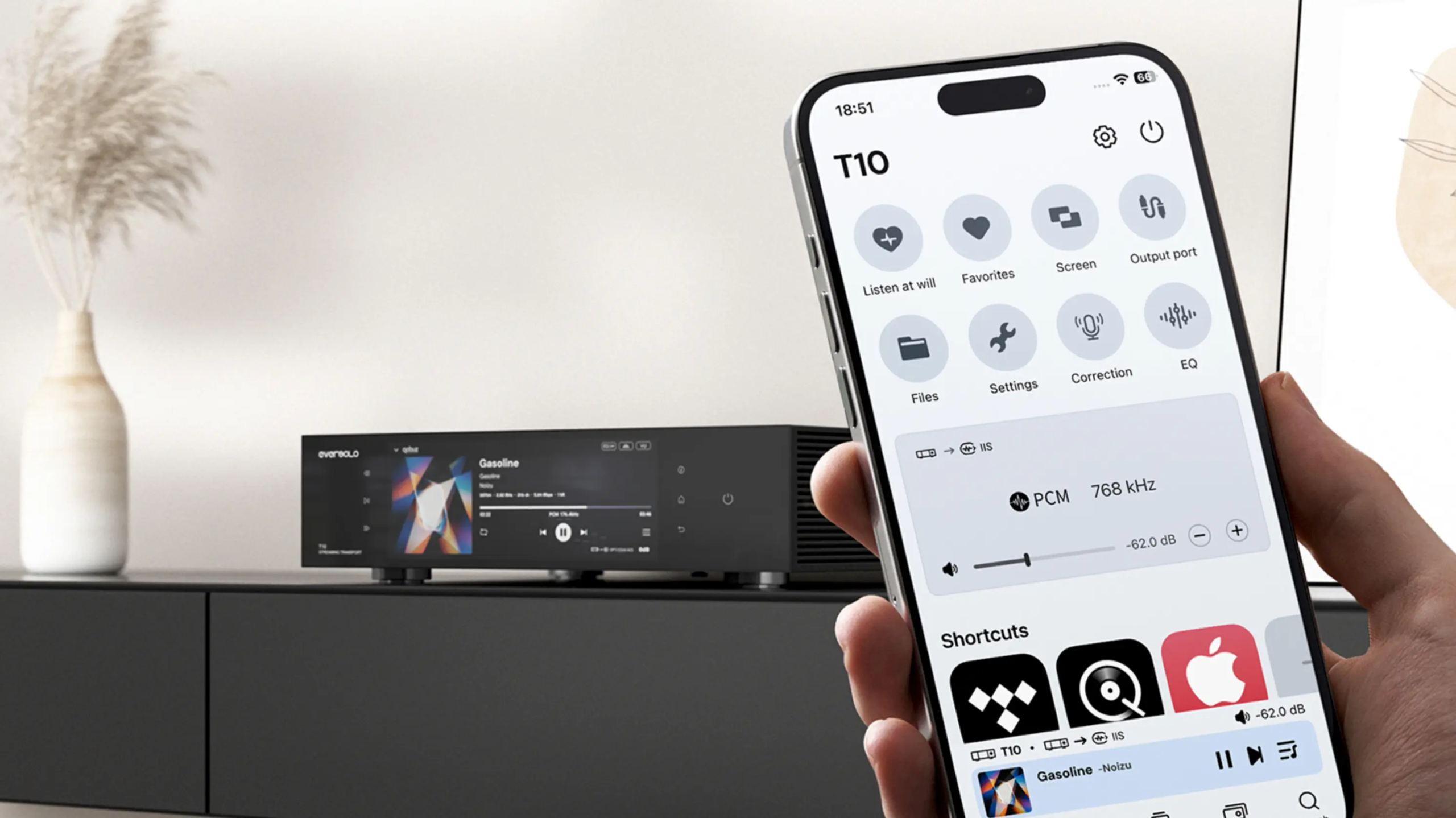
The system natively integrates the main platforms: Apple Music, TIDAL, Qobuz, Deezer, Amazon Music. It also supports the TIDAL Connect, Spotify Connect (Lossless), Qobuz Connect, and DLNA protocols. The new library engine analyzes around 200,000 tracks in two hours, with global search, cross-platform playlists, and full shuffle playback. A CD ripping function retrieves cover art, track information, and metadata with intelligent error correction, a global fade-in and fade-out smooths transitions, and upsampling up to 16× is available for high-resolution recordings. Control is handled from the screen, the EverSolo Control app on smartphone and tablet, or the supplied V16 remote control.
Acoustic correction with evotune Pro
The T10 uses the evotune Pro acoustic correction system, here equipped with a new FIR (finite impulse response) algorithm, a 20-band parametric equalizer, and more advanced bass management. The principle: measure the room, build a model of it, then generate a suitable compensation profile. A living room, an office, and a dedicated room do not present the same acoustic problems; the goal is to correct those that weigh most heavily on the result, without imposing any particular color on the sound.
Its place in the 10 range
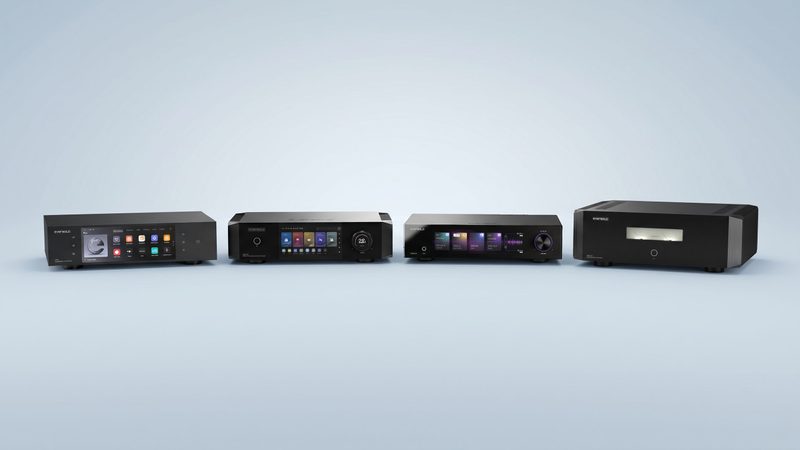
The T10 is the flagship of EverSolo’s new 10 range, which also includes the DAC-Z10 converter and the upcoming C10 master clock. The enclosure measures 365 by 310 by 88 mm and weighs 6.3 kg; it shares the dimensions of the Z10, for neat stacking once the two devices are combined. It is the direct successor to the T8, whose pure transport logic it retains while revising the internal architecture, from the clock to the network.
Technical specifications
Synchronization and clock
OCXO (Oven Controlled Crystal Oscillator) clock with ultra-low phase noise
High-precision PLL (Phase-Locked Loop) circuit
Thermal regulation to limit frequency drift
Jitter reduction during digital transmission
External 10 MHz master clock input
Compatible with 50 Ω and 75 Ω impedances
Power supply
Specifically developed O-Type toroidal transformer
Stable and particularly quiet power supply
Separate power paths for system circuits and audio circuits
Limitation of internal interference
Isolation and shielding
Fully electrically isolated design across all interfaces
Multilayer isolation on critical digital signal paths
Dedicated internal physical partitioning
Electromagnetic shielding of the screen
Reduced interference coupling between subsystems
Hardware platform
64-bit processor, 8 high-performance cores
RAM: 8 GB
Internal storage: 64 GB
Screen and interface
8.6-inch artistic touchscreen
Completely redesigned graphical interface
Information layout and interaction logic redesigned
Compatibility with smartphones, tablets, and various audio devices
Music library management
New intelligent library system
Analysis of approximately 200000 tracks in two hours
Creation of cross-platform playlists
Global search
Full shuffle playback
Management of local and network libraries
Control and app
Eversolo Control app for smartphones and tablets
Playback management
System settings
Room calibration
V16 remote control included
EverSolo ecosystem
Compatible with the DAC-Z10
Ready for the upcoming EverSolo C10 external master clock
Dimensions and weight
Dimensions (W × D × H): 365 mm × 310 mm × 88 mm
Device weight: 6.3 kg
Packaged weight: 9 kg
Frequently asked questions
Does the T10 work without a separate converter?
+
No. The T10 is a transport, not an integrated player: it does not include any digital-to-analog converter and must be connected to an external DAC to produce an analog signal for an amplifier. That is what distinguishes it from an all-in-one streamer.
Can internal storage be added and can external drives be connected?
+
Yes. The T10 has two M.2 NVMe slots (2280 form factor) supporting up to 16 TB total, with drives not included. It also offers two USB 3.0 ports to connect external storage and host a local library in addition to online services.
What distinguishes the T10 from the T8?
+
The T10 goes from a four-core to an eight-core processor, doubles the RAM (8 GB versus 4), enlarges the screen from 6 to 8.6 inches, and boosts the network from 1 to 2.5 Gigabit, with SFP fiber as an added bonus. Above all, it adds two elements missing from the T8: the OCXO oscillator and the 10 MHz external clock input.
Do you need an external clock to enjoy the T10?
+
No. The internal OCXO oscillator operates autonomously. The 10 MHz input is intended for setups that already have a master clock, or those that will accommodate EverSolo’s future C10; it remains optional.
Which network connection should be preferred?
+
2.5 Gigabit Ethernet is suitable for most uses and handles high-resolution streams with ease. SFP fiber goes further by eliminating the copper link, which reduces electrical interference transmitted over the network. Wi-Fi 6 remains useful when cabling is not possible.
What maximum resolutions does it support depending on the output?
+
The IIS and USB Audio outputs support up to native DSD512 and PCM 768 kHz/32-bit. The optical, coaxial, and AES/EBU outputs are limited to 192 kHz/24-bit and DoP64, a point to keep in mind for anyone aiming for very high resolutions.
User reviews
Jean-Michel
I have an A6 and a Play for my 2 head-fi setups I have a T8 and now a T10 on my two systems, which shows how much I like Eversolo, its serious approach and its design. Paradoxically, the T 10 is connected to the smaller (more understated) of my systems since I only pair it with a pair of Piega 701 premium wireless gen2 and its Connect plus module. So T 10 connected via RCA coax to the module. And the difference and improvement in quality vs T8 is very convincing. I’d pinned all my hopes on its power supply and its beefed-up clock, and bingo! The T8 stays on the “big” system, where the clocks in a DDC and the DAC prove their worth. But I already have a feeling that a T20 next year…
Comment from 26 October 2026 — Experience from 15 October 2026
Automatically translated — Show original (French)
J’ai un A6 et un Play pour mes 2 head-fi
J’ai un T8 et maintenant un T10 sur mes deux systèmes, c’est dire que j’aime Eversolo , son sérieux et son design. Paradoxalement le T 10 est connecté au plus petit (sobre) de mes systèmes puisque je n’y adjoint que une paire de Piega 701 premium wireless gen2 et son module Connect plus . Donc T 10 connecté en coax RCA au module . Et la difference et le gain de qualité vs T8 est très probant . J’avais tout misé sur son alimentation et son horloge bodybuildée et bingo !
Le T8 est conservé sur le « gros » système où les horloges d’un DDC et du DAC trouvent leur justification.
Mais je sens déjà qu’un T20 l’an prochain…
Murat
It's a great device
Comment from 23 October 2026 — Experience from 3 September 2026
Automatically translated — Show original (German)
Es ist ein suoer Gerät
Vincent
A network transport that takes sound reproduction to a high level: top-notch finish, excellent app, numerous features, internal library and, above all, very natural sound with a very low noise floor, detail and smoothness (a complete absence of harshness). The break-in period is fairly long and holds a few surprises, but once it's over, it's pure bliss.
Comment from 21 October 2026 — Experience from 8 October 2026
Automatically translated — Show original (French)
Transport réseau qui élève la restitution à un haut niveau : finition au top, appli excellente, nombreuses fonctionnalités, bibliothèque interne et surtout restitution très naturelle avec un niveau de bruit très faible, détails et douceur (absence totale d'acidité). Le rodage est assez long et réserve quelques surprises, mais une fois passé, c'est que du bonheur.
To better understand our visitors, measure marketing effectiveness and personalise ads, we and our partners use cookies and mobile advertising identifiers on your device. This data makes it possible to display personalised and non-personalised ads and measure their performance. Some cookies, which are technically necessary, are exempt from consent. You can accept those that require your consent, refuse them by clicking “Reject”, or customise your choices via “More options”.
To find out how Google uses the data collected once you have given your consent, see Google’s Business Data Responsibility site (opens in a new window).
You can change or withdraw your consent at any time via the “Cookies” link. Your choices will apply on our site for 12 months.