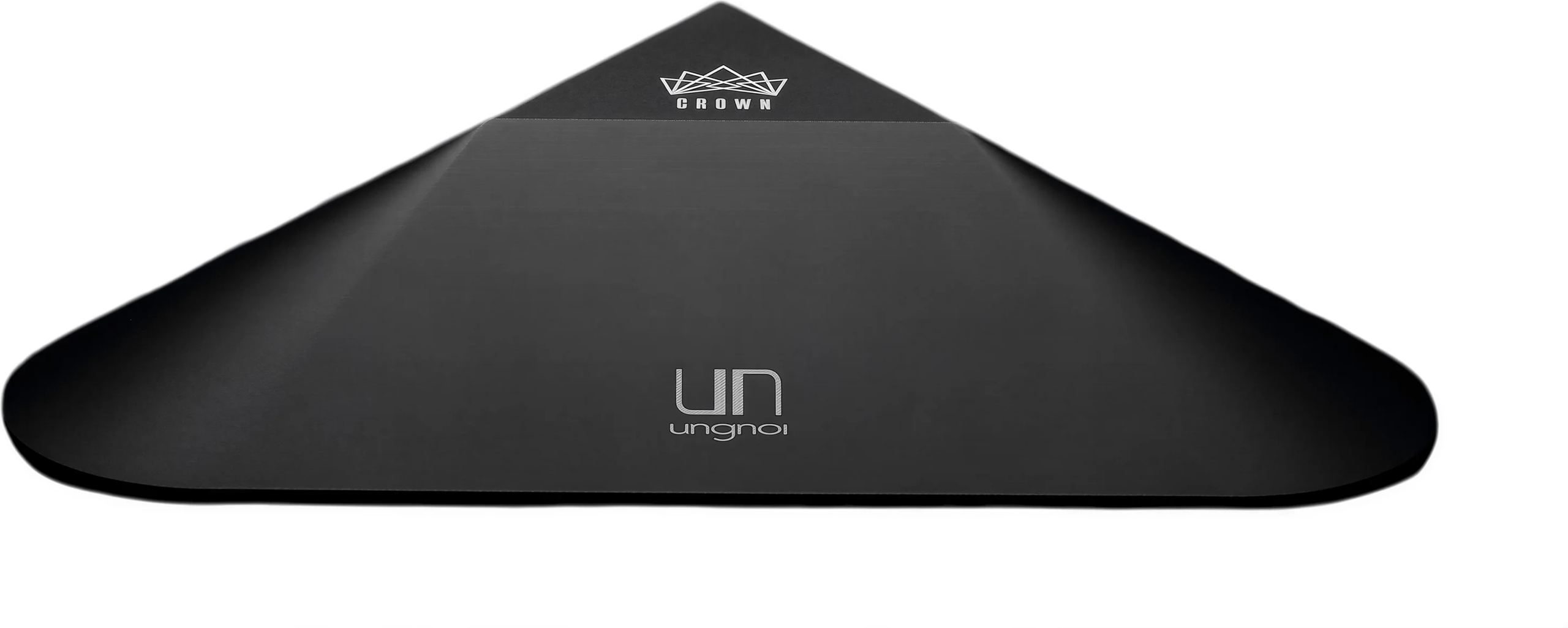
Ungnoi Crown black


Overview
Under a HiFi component, spikes or feet are used to isolate it from the furniture. But some vibrations do not come from the floor: they originate in the chassis itself and travel through the air. The Crown tackles this category of disturbances, the kind that conventional supports often leave aside. Ungnoi addresses it with an assembly of materials with contrasting densities.
Another family of vibrations to address
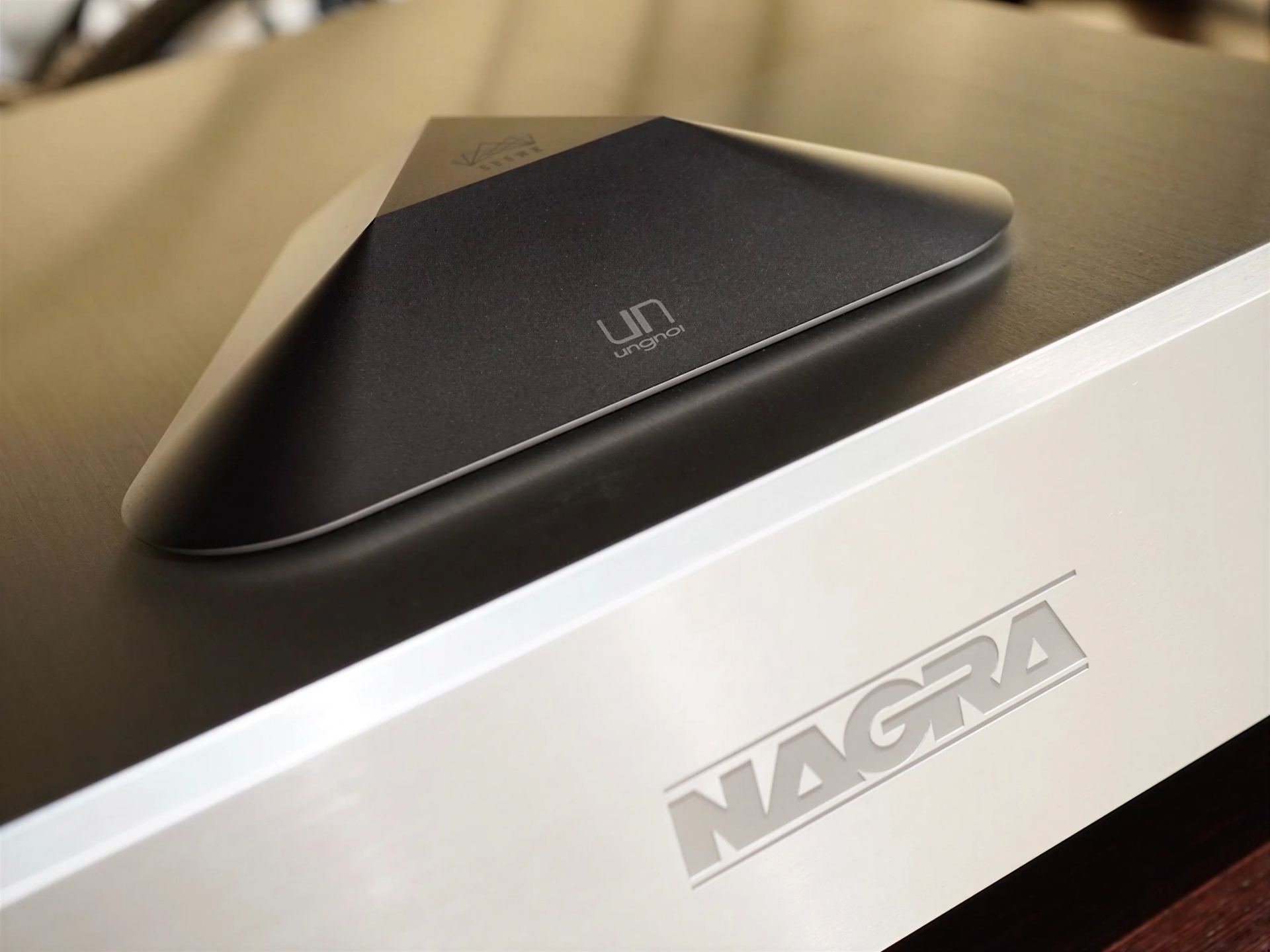
Ungnoi’s Taichi series deals with vibrations from below: feet that decouple the component from its support. The Crown addresses a different problem. Vibrations in the chassis and those that propagate through the air do not necessarily pass through the feet, and most accessories that rely mainly on mass overlook them. It is placed near the points where these disturbances concentrate, where a support placed under the component has no effect.
Several materials for several frequencies
A given material dampens some frequencies well and others poorly. That is the principle behind the Crown: rather than a single material, a mix of carbon fiber, natural rubber cork, aluminum, metal, and ceramic beads. Each component has its own density and texture, and therefore its own way of reacting to vibrations depending on their frequency. The design team arrived at this combination after comparing several assemblies, weighing density, texture, and weight each time.
The carbon fiber and cork base
At the base of the Crown, the carbon fiber and natural rubber cork serve two functions. First, antistatic protection: the whole assembly repels static charges and keeps the HiFi equipment away from the metal parts of the Crown, which eliminates any direct contact. Second, electromagnetic interference filtering. Ungnoi says it selected a carbon fiber capable of blocking this interference (EMI), in order to preserve the audio signal.
Metal spheres with calibrated proportions
The Crown incorporates metal spheres whose proportions were defined through numerous tests. These dimensions are not incidental: they determine the frequencies the spheres absorb. To ensure that each unit behaves the same way, Ungnoi applies quality control that verifies compliance with these proportions on every Crown produced.
Bass, treble, and instrument clarity
According to Ungnoi, resonance stabilization and vibration conversion result in several audible changes. Bass extension is better utilized, treble loses aggressiveness and harshness, and the gap between soft passages and powerful passages becomes easier to discern. In dense works, a classical symphony for example, instrument placement gains clarity. This type of effect remains linked to the system and to each listener’s hearing: an anti-vibration accessory acts on ground already shaped by the electronics, the speakers, and the room.
Where to place the Crown in your setup
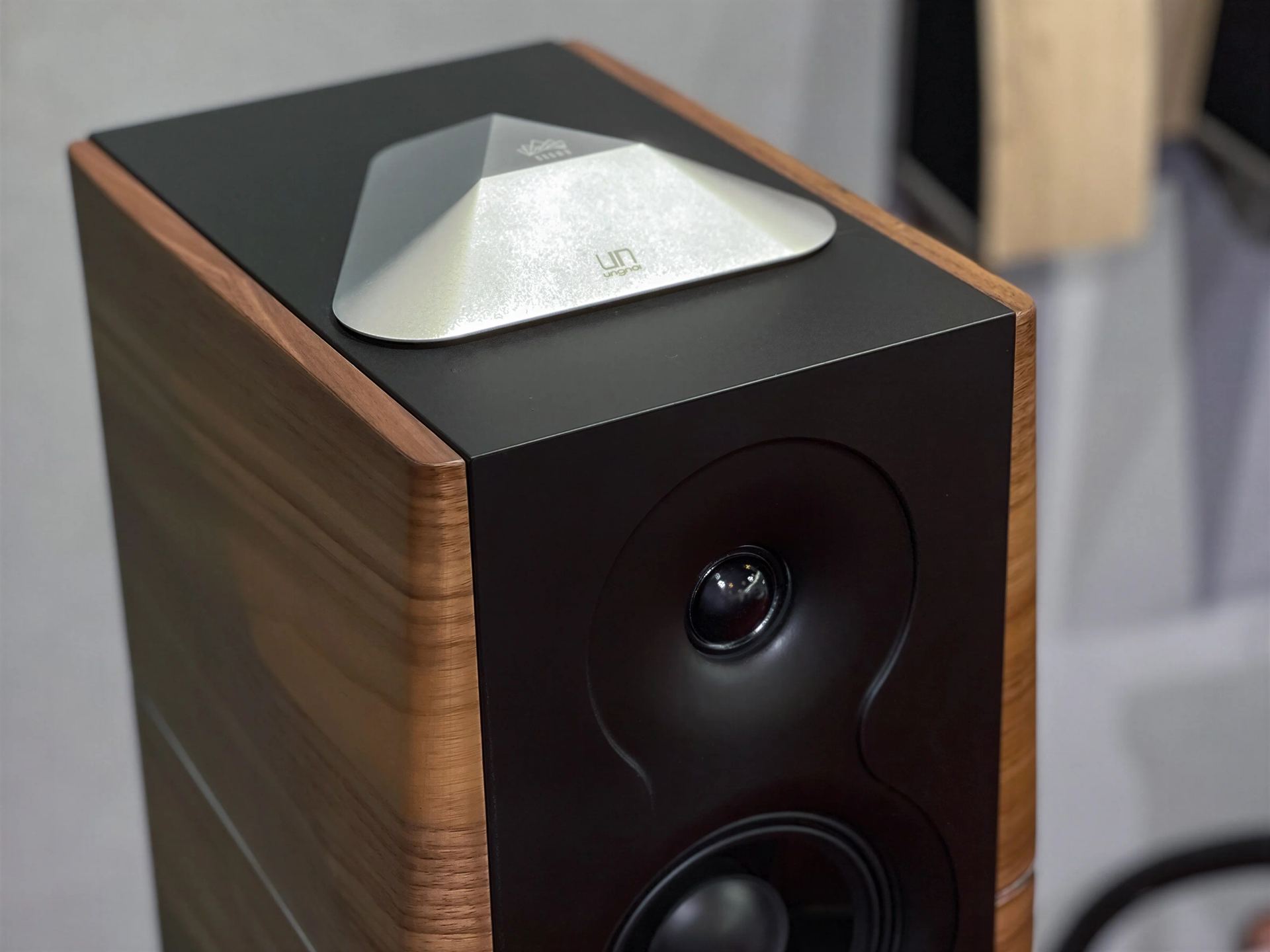
Placement comes down to experimentation. Ungnoi advises placing the Crown near the areas most subject to vibrations and interference, which often means testing several positions before finding the most effective one. At 16.4 cm wide, 15.0 cm deep, and 3.1 cm high, weighing 780 grams, it remains compact and fits easily near a component or on a piece of furniture. It complements a foundation such as Taichi feet rather than replacing it, since it deals with a type of vibration those feet do not cover.
Technical Specifications
Overview
- Solution designed to address chassis vibrations and airborne vibrations affecting equipment
- Approach taking into account vibrations across different frequency ranges
- Derived from the lineage of quality foundations of ungnoi’s Taichi series
Design and materials
- Mixed composition: carbon fiber, natural rubber cork, aluminum, metal, and ceramic balls
- Base in carbon fiber and natural rubber cork
- Excellent antistatic capability
- Protection of HiFi equipment from the metal parts of the Crown
- Rejection of static charges
- Highly selected carbon fiber blocking electromagnetic interference (EMI) for optimal sound performance
- Metal spheres with unique proportions, developed by the design team after numerous tests, in order to address vibrations at different frequencies
- Quality control ensuring compliance with the exact proportions on each Crown
Acoustic and anti-vibration performance
- Response to vibrations across several frequency ranges thanks to materials with varied textures and densities
- Resonance stabilization and vibration conversion
- Full enhancement of bass extension
- Less aggressive and less harsh highs
- Better contrast between soft sounds and powerful sounds
- Precise instrument placement, including in complex works such as classical symphonies
- Enhanced emotional rendering of the music
Installation
- To be placed near areas subject to strong vibrations and interference
Physical specifications
- Dimensions (W × D × H): 16.4 × 15.0 × 3.1 cm
- Net weight: 0.78 kg
Frequently Asked Questions
Which devices is the Crown most useful on?
Chassis vibrations are felt most strongly on components equipped with transformers or moving mechanical parts, such as amplifiers, certain power supplies, or CD players. The Crown finds here a context in which its action is easier to perceive, without being limited to these devices alone.
Should the Crown be oriented in a specific way?
When placed in contact with a device, the carbon fiber and cork base should be positioned on the equipment side. It is this side that provides antistatic insulation and places a protective barrier between the device and the metal parts of the Crown.
Can multiple Crown units be installed in the same system?
Nothing prevents it. Since positioning is adjusted by trial and error, using multiple units makes it possible to separately treat several sources of vibration, for example an amplifier and a turntable placed on the same piece of furniture.
Does the Crown require a break-in period?
No. It is a passive absorber: its effect is present as soon as it is put in place. The only adjustment is to move the Crown until you find the position that delivers the clearest result.
Does the effect of the Crown vary depending on the listening volume?
Airborne vibrations increase with sound pressure. At high levels, the share of disturbances the Crown seeks to absorb becomes greater, which can make its effect more noticeable. At low volume, the difference remains more subtle.
- Eco-contribution included in the sale price.